- Bizible (now Marketo Measure) is deeply embedded in the Adobe product suite, which makes it expensive and slow to implement for teams not already running Marketo Engage.
- Several alternatives offer multi-touch attribution with tighter Salesforce native builds, warehouse-native architectures, or significantly lower price points.
- The right alternative depends on your CRM, deal cycle length, and whether you need account-level or person-level attribution as the primary lens.
- Most teams switching off Bizible cite implementation complexity and attribution data living outside their CRM as the top reasons to leave.
- This list covers seven verified alternatives with public pricing where available, real trade-offs, and a framework for matching each tool to your stack.
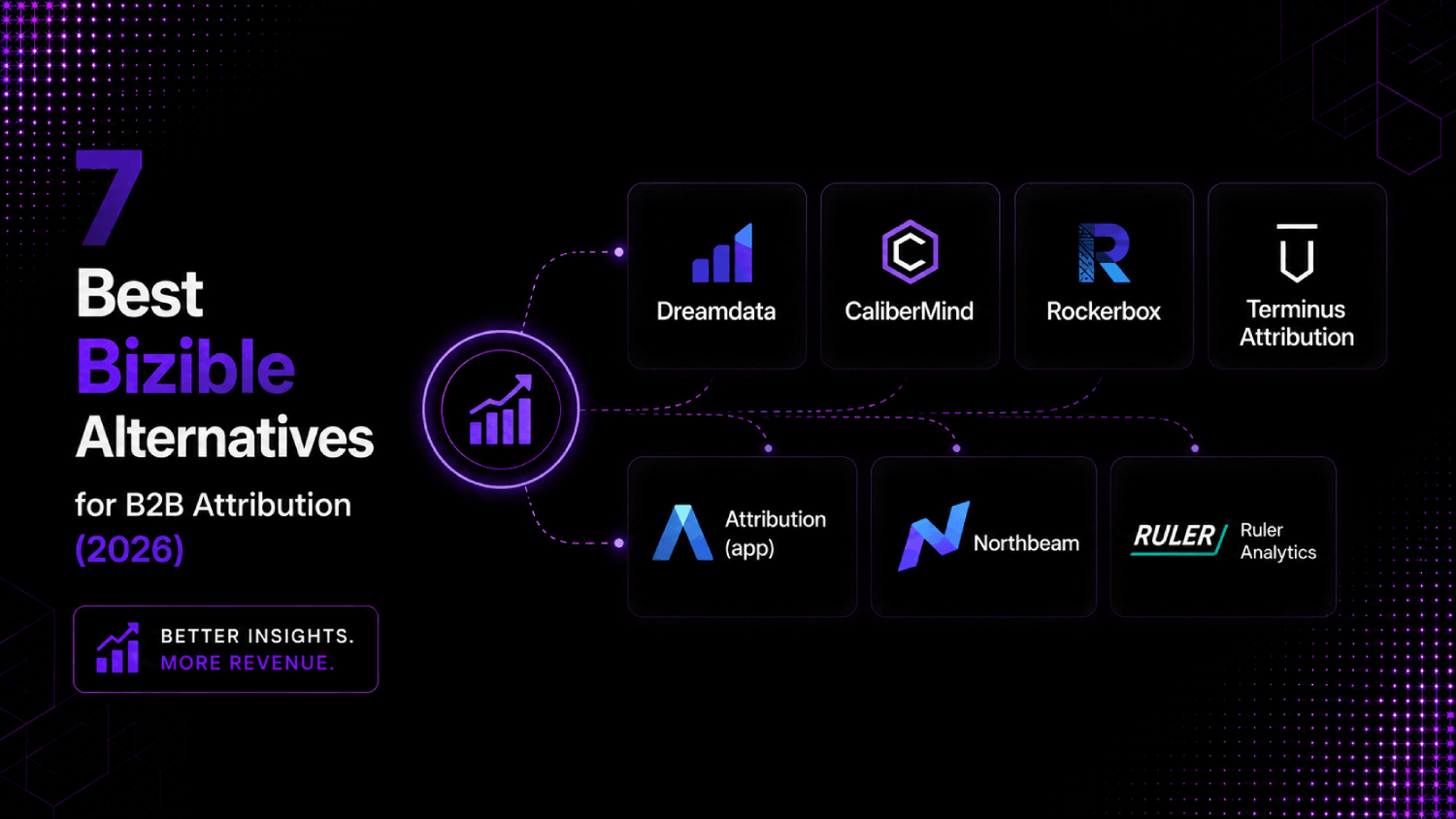
The strongest Bizible alternatives for B2B teams are Terminus Attribution (for ABM-heavy stacks), Dreamdata (for warehouse-native teams), Rockerbox (for mid-market multi-channel), CaliberMind (for Salesforce-centric RevOps), Attribution (for lighter-touch setups), Northbeam (for paid media-heavy programs), and Ruler Analytics (for agencies and smaller B2B teams). Each solves a different version of the attribution problem that Bizible leaves unaddressed.
Why Are B2B Teams Actually Leaving Bizible?
Bizible rebranded to Marketo Measure after Adobe’s acquisition of Marketo, and that move explains most of the switching behavior. The product is now designed to function inside the Adobe Experience Cloud, meaning teams without a Marketo Engage subscription hit friction at nearly every integration point. Salesforce users in particular report that attribution data surfaces inside Adobe dashboards rather than inside CRM objects, which creates a reporting gap that RevOps teams then have to paper over with manual exports.
Pricing is the second driver. Marketo Measure does not publish pricing publicly, and public buyer discussions suggest it sits at the higher end of the attribution market, typically bundled into broader Adobe agreements rather than sold standalone. Teams that want attribution without committing to the broader Adobe stack find the economics hard to justify.
The third issue is implementation weight. Bizible’s JavaScript-based tracking and its dependency on Marketo’s data model mean a typical implementation takes weeks, not days, and requires either a Marketo-certified admin or professional services engagement. For companies on HubSpot, Salesforce without Marketo, or a warehouse-first stack, that investment rarely pays off the way the vendor pitch implies.
The AboutMartech Attribution Fit Test: Four Checks Before You Switch
Before evaluating any specific Bizible alternative, run this four-check framework against your current setup. These are the questions that determine which category of tool you actually need, and skipping them is how teams end up replacing one wrong tool with another.
Check 1: CRM centricity. Does your sales team live inside Salesforce or HubSpot? Attribution data that doesn’t surface natively in your CRM creates a two-dashboard problem that kills adoption. Tools like CaliberMind and Dreamdata have native Salesforce objects; some others rely on BI connectors.
Check 2: Account vs. person. B2B attribution at the account level (aggregating all touchpoints from a buying committee) is architecturally different from person-level multi-touch. If your deals involve five or more stakeholders, person-level models undercount influence. Know which lens matters before you demo anything.
Check 3: Channel coverage. Some tools are ad-click strong but weak on offline channels like field events, SDR calls, and partner referrals. If 30% of your pipeline comes from outbound, check whether the tool captures CRM-logged activities, not just digital touchpoints.
Check 4: Data residency. Warehouse-native tools like Dreamdata write attribution models directly to your data warehouse, which gives analysts full query access but requires more infrastructure. SaaS-layer tools are faster to deploy but keep your data inside their system. Neither is universally better; the right answer depends on your data team’s capacity.
7 Best Bizible Alternatives for B2B Attribution
| Tool | Best For | CRM Fit | Pricing | Account-Level |
|---|---|---|---|---|
| Dreamdata | Warehouse-native, data-team-led stacks | Salesforce, HubSpot | Starts ~$999/mo (public) | Yes |
| CaliberMind | Salesforce-heavy RevOps teams | Salesforce native | Quote-based | Yes |
| Rockerbox | Mid-market multi-channel paid programs | Salesforce, HubSpot | Quote-based | Partial |
| Terminus Attribution | ABM programs with account engagement data | Salesforce | Quote-based | Yes |
| Attribution (app) | Lighter-touch mid-market teams | Salesforce, HubSpot, others | Starts ~$299/mo (public) | Partial |
| Northbeam | Paid media-heavy demand gen teams | Limited native CRM objects | Quote-based | No |
| Ruler Analytics | Agencies, SMB B2B, lead-gen businesses | Salesforce, HubSpot, Pipedrive | Starts ~$199/mo (public) | Partial |
1. Dreamdata
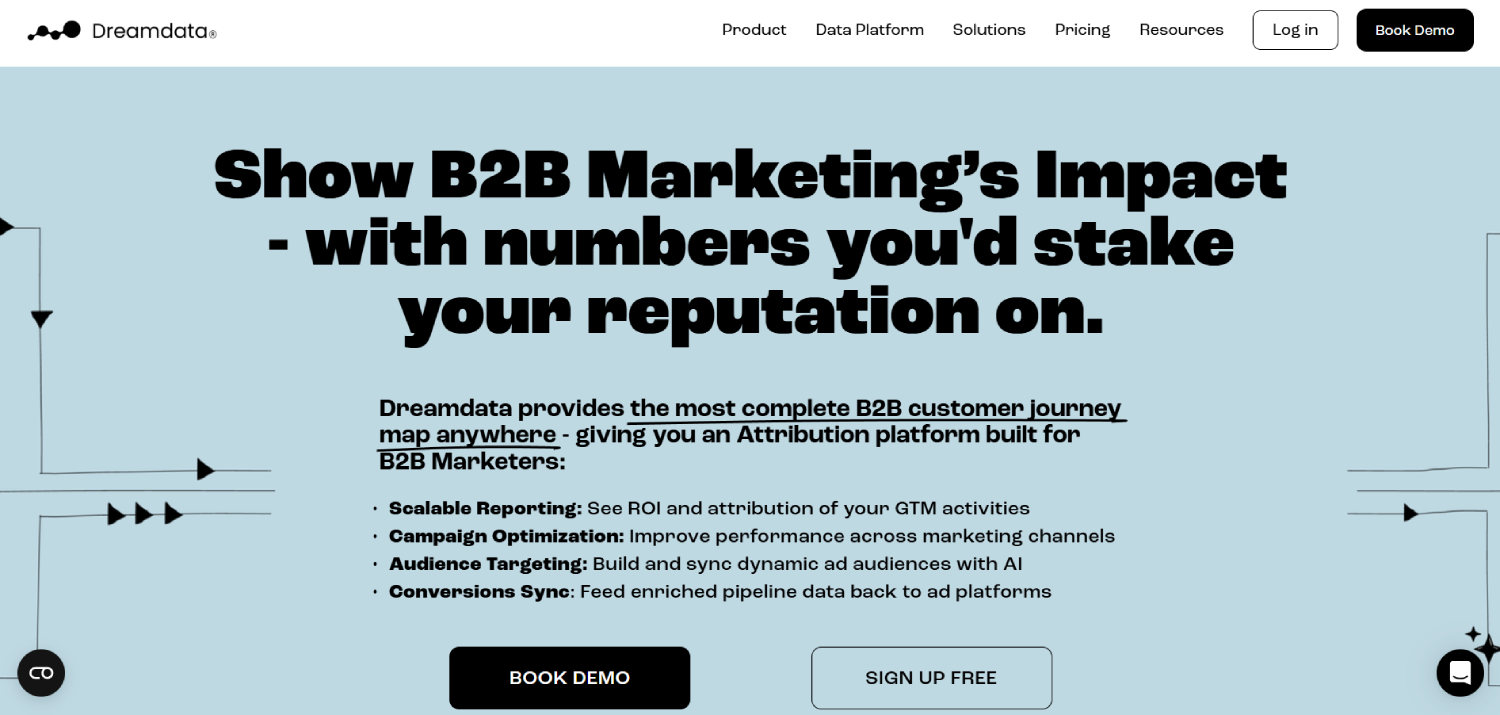
Dreamdata is the strongest Bizible alternative for teams with a functioning data warehouse and a RevOps or analytics function with SQL fluency. The platform ingests touchpoint data from ad platforms, CRM, marketing automation, and product analytics, then models attribution inside your warehouse rather than a closed SaaS layer. That architecture means attribution models are queryable, auditable, and not locked to Dreamdata’s UI.
The B2B account timeline view is genuinely differentiated. It visualizes every touchpoint across a buying committee at the account level, which makes it possible to see whether your webinar or your competitor comparison page actually influenced the deal. Bizible does this in a limited way; Dreamdata does it as the core product experience.
Public pricing starts around $999 per month according to Dreamdata’s pricing page, with higher tiers for larger data volumes and additional seats. That’s meaningfully lower than what most teams pay for Marketo Measure as a standalone product. The trade-off is a steeper initial setup if your warehouse isn’t already receiving CRM and ad data via a reliable pipeline. Teams without a data engineer on staff will feel that gap.
2. CaliberMind
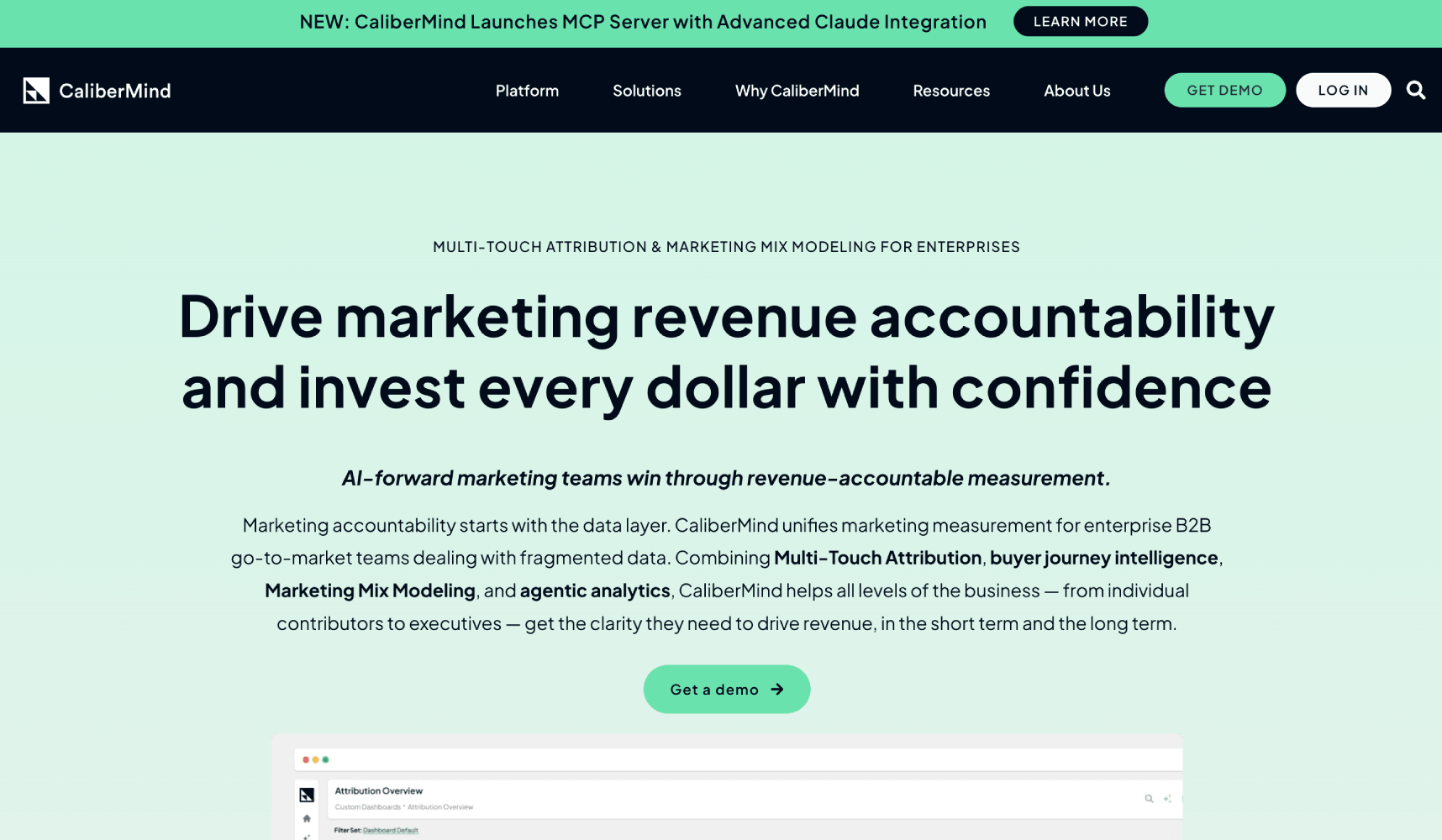
CaliberMind is built for teams that run their entire revenue operation inside Salesforce and want attribution data to live there too, not in a separate BI tool. The platform writes attribution credits directly to Salesforce Campaign objects and Opportunity records, which means sales reps and RevOps can see attributed pipeline without leaving the CRM. That’s the primary reason teams choose CaliberMind over Bizible: data residency inside Salesforce rather than inside Adobe’s reporting layer.
The platform also handles the B2B identity resolution problem more deliberately than most competitors. When a single deal involves ten contacts from the same account touching different campaigns, CaliberMind’s account-level graph stitches those contacts together before assigning credit. Person-level tools miss this entirely and systematically undercount account-based programs. CaliberMind’s pricing is quote-based and not publicly disclosed.
3. Rockerbox
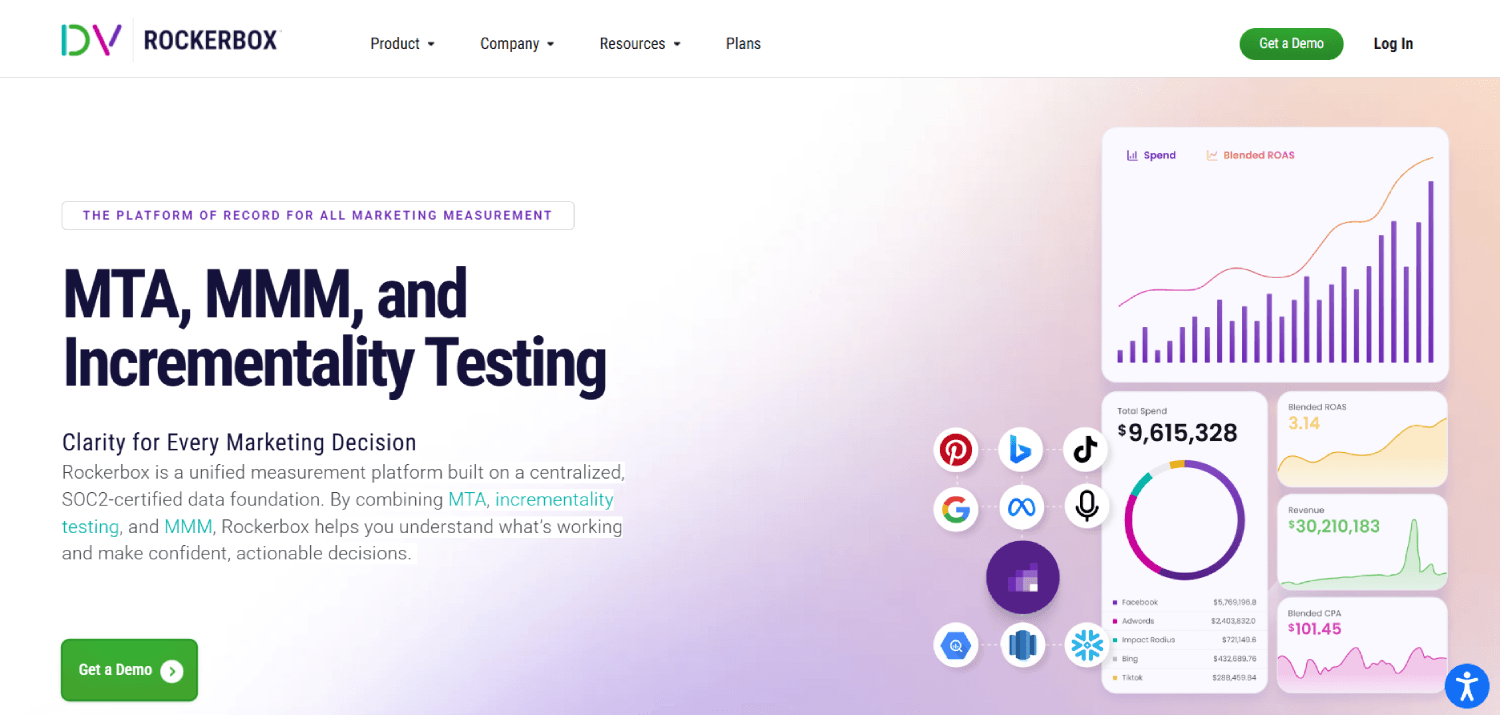
Rockerbox sits in an interesting position: it’s strong on paid media attribution with deduplicated, cross-channel views across Google, Meta, LinkedIn, and programmatic channels, but it also ingests CRM data to tie spend back to pipeline. For B2B demand-gen teams running significant paid programs alongside content and events, that combination works better than pure ad-platform reporting or pure CRM attribution alone.
Where Rockerbox is weaker than Dreamdata or CaliberMind is account-level attribution and offline channel handling. The platform is primarily person-and-session oriented , it tracks individual contacts and their digital touchpoints rather than aggregating activity across a full buying committee at the account level. In practice, that means it handles deals with one or two known contacts reasonably well but loses accuracy as the buying committee grows and stakeholders enter the funnel through different channels under different identities. Companies with six-month enterprise sales cycles involving procurement, legal, and multiple business unit stakeholders will find that gap more painful than teams running shorter, simpler cycles. Pricing is quote-based. Teams evaluating Rockerbox alongside Bizible are usually doing so because of Bizible’s limited paid media deduplification, not because they need deeper CRM integration.
4. Terminus Attribution
Terminus is an ABM platform that includes account-level attribution as part of its broader suite. If you are already using Terminus for account-based advertising and engagement data, adding its attribution module makes sense because the engagement signals from your target account list feed directly into the attribution model. That’s a data advantage no standalone attribution tool can replicate without ingesting third-party intent data separately.
The limitation is that Terminus attribution is not competitive as a standalone purchase. If you aren’t using Terminus for ABM execution, you’re buying the weaker part of the product while paying for the platform as a whole. Teams evaluating it as a pure Bizible alternative should scope whether the ABM use case justifies the broader platform cost. Pricing is quote-based and tied to your account advertising spend and seat count.
5. Attribution (attributionapp.com)
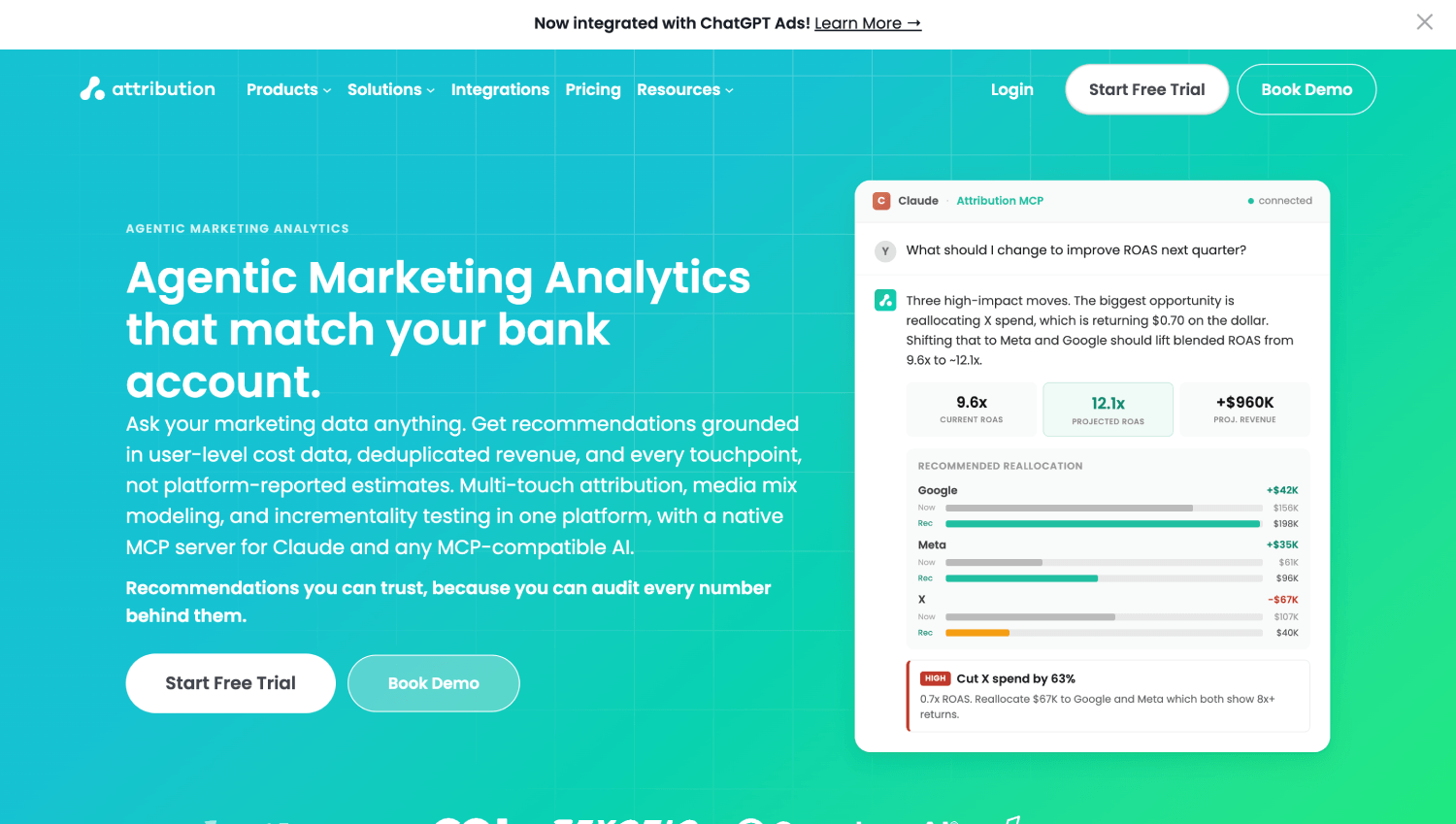
Attribution is the lightest-touch option on this list. The platform pulls in data from ad platforms, CRM, email, and billing tools, then lets you compare attribution models (first-touch, last-touch, linear, time-decay, custom) side by side without requiring a data warehouse or engineering work. Public pricing starts around $299 per month based on their pricing page, making it accessible for mid-market teams that find Bizible’s pricing and complexity disproportionate to their needs.
The trade-off is depth. Attribution handles the standard multi-touch models well but doesn’t offer the same account-level graph, identity resolution, or warehouse write-back capabilities that Dreamdata or CaliberMind provide. For a 50-person B2B SaaS company with a 60-day sales cycle and a two-rep sales team, that depth probably isn’t necessary. For an enterprise with complex buying committees and a six-month deal cycle, it likely is.
6. Northbeam
Northbeam built its reputation in DTC and e-commerce attribution, but it has expanded toward B2B demand-gen teams managing large paid media budgets. Its strength is media mix modeling combined with multi-touch attribution, giving media buyers a fast read on marginal return by channel and campaign without waiting for a 12-week MMM study. For teams spending heavily on LinkedIn, Google, and programmatic and frustrated by platform-reported attribution discrepancies, Northbeam’s deduplicated view is genuinely useful.
Northbeam is not a CRM-native tool, and it doesn’t do account-level attribution in any meaningful sense. Teams with long enterprise sales cycles and complex buying committees will find it incomplete as a primary attribution system. It works better as a paid media intelligence layer alongside a CRM-integrated tool than as a standalone Bizible replacement. Pricing is quote-based.
For a deeper look at how marketing mix modeling fits into a post-cookie measurement strategy, the best marketing mix modeling tools for post-cookie measurement covers the category in detail, including where tools like Northbeam sit relative to pure MMM vendors.
7. Ruler Analytics
Ruler Analytics connects marketing touchpoints to closed revenue by tracking visitors, stitching their path across sessions and devices, and then matching them to CRM deals when they convert. It integrates with Salesforce, HubSpot, and Pipedrive and pushes revenue data back to Google Analytics and ad platforms. That closed-loop reporting is the core value proposition.
Public pricing starts around $199 per month based on Ruler Analytics’s pricing page, making it one of the most accessible options for smaller B2B teams and agencies running attribution on behalf of clients. The limitation is that it’s more person-level and session-level than account-level, which makes it a reasonable fit for SMB B2B with short cycles but a stretch for enterprise deals. Agencies managing multiple clients will find the multi-client workspace structure practical in a way that Bizible’s enterprise architecture isn’t.
Which Bizible Alternative Fits Which Stack?
Consider a B2B SaaS team with 200 employees, a 90-day average sales cycle, a six-rep inside sales team, and a marketing mix of paid LinkedIn, content syndication, webinars, and SDR outbound. They’re on Salesforce. Bizible works for this profile on paper, but the attribution data surfacing inside Adobe’s reporting rather than Salesforce’s native objects creates a RevOps workflow problem every quarter.
For that team, CaliberMind or Dreamdata are the two real options. CaliberMind wins if they want zero engineering lift and attribution native to Salesforce. Dreamdata wins if they have a data warehouse already in place and want analysts to own the attribution model logic directly. Both solve the core Bizible complaint at that company size.
A 30-person B2B SaaS team with a 30-day trial-to-close cycle and a marketing team of three running mostly paid search and email is a different problem. Attribution or Ruler Analytics at $200-300 per month delivers 80% of the insight at 20% of the complexity. Dreamdata and CaliberMind are both overbuilt and overpriced for that profile.
For teams running ABM as the primary go-to-market motion with a defined target account list, Terminus Attribution is the only option on this list that uses intent and engagement data from the ABM execution layer in the attribution model itself. That data advantage matters more than any architectural difference between the other tools.
Our broader guide on B2B attribution tools for long sales cycles covers category mechanics in more depth, including how to evaluate tools when deal cycles stretch past 120 days and buying committees exceed five contacts.
What Does Bizible Cost Compared to These Alternatives?
Marketo Measure does not publish pricing publicly. The product is typically sold as part of an Adobe Marketo Engage agreement, and list prices surface only in vendor negotiations. Buyer discussions in public forums and review sites suggest costs in the tens of thousands of dollars annually at minimum, rising significantly with data volume and feature tier. Teams on Adobe’s higher-tier plans sometimes receive it as an included feature, which changes the calculus entirely.
If your team is not already on Marketo Engage and is evaluating Marketo Measure as a standalone attribution tool, the economics are difficult to justify against alternatives with public pricing starting at $199 to $999 per month. The feature gap between Marketo Measure and tools like Dreamdata or CaliberMind at comparable price points is not large enough to absorb an order-of-magnitude price difference for most mid-market teams.
Understanding attribution model mechanics before committing to any platform saves implementation regret. The guide on multi-touch vs. last-touch attribution models explains the practical differences and when each model type actually reflects how buyers behave, which should inform which tool’s model flexibility matters to your team.
How Do These Tools Handle Offline and Outbound Attribution?
This is where most attribution tools, including Bizible, leave B2B teams with gaps. Digital touchpoints tracked via JavaScript and ad platform APIs are relatively straightforward. The hard problem is attributing pipeline influence to an SDR call logged in Salesforce, a field event badge scan, a partner referral, or a direct mail piece.
CaliberMind and Dreamdata both ingest Salesforce Activity data, which means CRM-logged calls, emails, and meetings can be included in the attribution model alongside digital touches. That’s a meaningful capability difference from purely JavaScript-dependent tools. Ruler Analytics handles this through its CRM integrations but with less granularity at the activity level.
No tool on this list handles offline events without some manual work. Badge scan data from field events typically requires a CSV import or a Zapier connection, and the attribution credit for a physical event interaction is inherently estimated rather than deterministic. Teams that drive significant pipeline from conferences and field events should ask each vendor specifically how event data enters the attribution model before signing a contract.
If your attribution data feeds a broader demand-gen reporting stack, the guide on marketing dashboard tools for eliminating manual reporting covers how attribution outputs from tools like these connect to visualization layers that RevOps teams actually use day to day.
Frequently Asked Questions
What is the main difference between Bizible and Marketo Measure?
They are the same product. Adobe acquired Marketo in 2018 and subsequently rebranded Bizible as Marketo Measure. The core multi-touch attribution functionality carried over, but the product is now positioned as part of the Adobe Experience Cloud rather than a standalone tool. Teams evaluating “Bizible alternatives” and “Marketo Measure alternatives” are searching for the same category of replacement. Any reference to Bizible in vendor comparisons written before approximately 2021 describes what is now called Marketo Measure.
Can these alternatives replace Bizible for Salesforce-only teams without Marketo?
Yes, and this is actually the primary use case for most alternatives on this list. CaliberMind, Dreamdata, and Attribution all integrate directly with Salesforce without requiring Marketo Engage. CaliberMind in particular writes attribution data natively to Salesforce objects, which many Salesforce-only teams find more useful than Bizible’s Adobe-centric reporting layer. Teams on Salesforce without Marketo are among the best candidates for switching, because Bizible’s Marketo dependency creates friction that doesn’t exist in most of its alternatives.
Do any of these tools support account-based attribution for B2B buying committees?
Dreamdata and CaliberMind both support account-level attribution explicitly, aggregating touchpoints across multiple contacts at the same account before assigning model credit. This is the correct architecture for enterprise B2B deals where five to fifteen stakeholders interact with your content and campaigns over months. Terminus Attribution also supports account-level models but requires the broader Terminus ABM platform. Person-level tools like Ruler Analytics and Attribution offer partial account grouping but are fundamentally designed around individual contact-level tracking rather than full buying-committee aggregation.
What is the most affordable Bizible alternative for a small B2B team?
Ruler Analytics publicly lists pricing starting around $199 per month, making it the most accessible entry point on this list. Attribution (attributionapp.com) starts around $299 per month publicly. Both provide multi-touch attribution across digital channels with CRM integrations. For teams with fewer than 50 employees, a sales cycle under 60 days, and a marketing team of one to three people, either tool delivers attribution coverage without the implementation complexity or cost that Bizible and its closest competitors require.
How long does implementation take for these alternatives compared to Bizible?
Bizible implementations are commonly reported to take four to eight weeks, particularly when JavaScript tag deployment, Salesforce package installation, and campaign tagging all need coordination. Ruler Analytics and Attribution typically deploy in one to two weeks because they rely on simpler tracking architectures and fewer CRM dependencies. Dreamdata and CaliberMind take longer, in the two to six week range, because of the data pipeline work required to connect ad platforms, CRM, and the warehouse. None of the seven alternatives require a Marketo-certified admin, which removes a common Bizible implementation bottleneck.
Is there a warehouse-native Bizible alternative?
Dreamdata is the clearest warehouse-native option in this category. It writes attribution models to your data warehouse rather than maintaining a proprietary data store, which gives analysts full SQL access to the underlying attribution logic. Teams already running a modern data stack with Snowflake, BigQuery, or Redshift will find Dreamdata’s architecture the most compatible with how the rest of their data infrastructure works. For context on how warehouse-native tools fit broader CDP architectures, the guide on warehouse-native CDPs for the modern data stack covers adjacent tooling decisions that often affect attribution platform selection.
The Single Most Important Factor When Switching From Bizible
Attribution tool switching decisions fail most often not because the new tool lacks features, but because attribution data ends up living in a different system than where revenue decisions get made. Bizible’s core problem for many teams is exactly this: attribution lives in Adobe, deals live in Salesforce, and RevOps spends cycles reconciling them. Choosing a replacement that creates the same two-system problem in a different configuration wastes the migration entirely.
Before you finalize any shortlist, map where your revenue team actually makes decisions. If that’s Salesforce, the tool you choose needs to write data to Salesforce natively, not just connect to it. If that’s a BI layer like Looker or Tableau, a warehouse-native tool like Dreamdata gives analysts the query flexibility that pre-built dashboards in SaaS attribution tools can’t match. If your team runs primarily off HubSpot reports, several of these tools support HubSpot as a primary CRM destination.
The right Bizible alternative is the one that puts attribution data one click away from where pipeline reviews, budget decisions, and channel optimizations actually happen. Every other consideration is secondary to that.