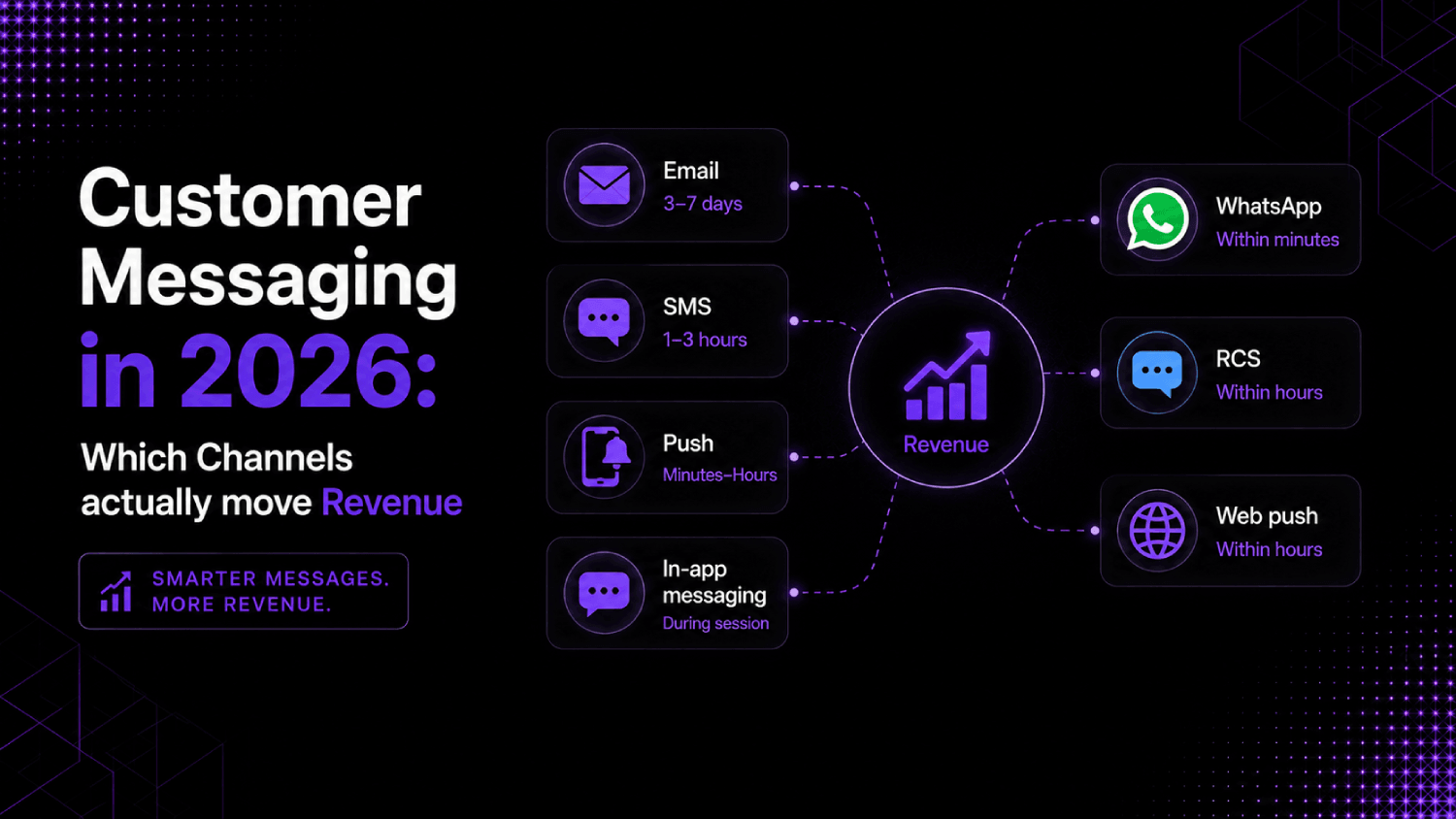
- Email is the highest-volume channel but not the highest-urgency one. SMS and push notifications outperform email when a message must act within hours, not days.
- No single channel wins across all buying stages. Acquisition, onboarding, retention, and re-engagement each have a channel that naturally fits the moment.
- Most teams leave revenue on the table not because they are missing a channel, but because they are running each channel independently rather than as a coordinated sequence.
- The best customer messaging platforms are not the ones with the most channels. They are the ones whose data model lets you suppress, sequence, and personalize across all of them from a single audience definition.
- RCS is the channel most marketing teams have not deployed yet and probably should be evaluating now, before competitors do.
A customer messaging platform is software that lets marketing teams send, automate, and measure messages across one or more channels, including email, SMS, push notifications, in-app messages, and emerging formats like RCS and WhatsApp. The best platforms unify audience data, trigger messages based on behavior, and give operators a single view of what every customer has received and how they responded. Teams picking one platform over another are really picking a data model and a channel philosophy, not just a sending engine.
Most marketing teams arrive at their messaging stack the same way: they signed up for Mailchimp or Klaviyo years ago, and now that stack is load-bearing infrastructure nobody wants to touch. The result is an email-first operation that treats SMS as an afterthought and ignores push notifications entirely. That is not a strategy. It is path dependency masquerading as one.
What follows is a channel-by-channel analysis of where each format actually moves revenue, which platforms dominate each category, and a framework for deciding which combination fits your stack and your customer base. This guide links out to deeper channel-specific comparisons for every category covered.
What Is a Customer Messaging Platform, and How Does It Differ From a Marketing Automation Tool?
The terms get used interchangeably, but they are not the same thing. Marketing automation platforms like HubSpot or Marketo are primarily lead management systems with messaging bolted on. They organize contacts into lifecycle stages, score them, and route them to sales. Customer messaging platforms like Braze, Iterable, or Klaviyo are built around the message itself and the behavior that triggered it. The data model is event-driven, not lifecycle-stage-driven.
That distinction matters in practice. A marketing automation tool typically fires an email when a contact enters a stage. A customer messaging platform fires a message when a user does or does not do something specific, and it can decide which channel to use based on what that user has responded to before. One is about pipeline. The other is about conversation.
For teams with mobile apps, the distinction is even starker. Marketing automation platforms almost never handle push notifications or in-app messages natively. Dedicated customer messaging platforms were built for exactly that use case.
Which Messaging Channel Drives the Most Revenue, and for Whom?
There is no universal answer, but there are strong patterns by business model. Here is an honest breakdown.
| Channel | Best business model fit | Primary use case | Typical revenue moment |
|---|---|---|---|
| DTC, B2B SaaS, ecommerce | Nurture, newsletters, product announcements | 3-7 days post-action | |
| SMS | DTC, retail, restaurants, events | Flash sales, cart recovery, appointment reminders | Within 1-3 hours |
| Push (mobile) | Apps, media, consumer SaaS | Re-engagement, time-sensitive alerts | Within minutes to hours |
| In-app messaging | SaaS, consumer apps | Onboarding, feature adoption, upsell | During active session |
| International DTC, B2C high-touch | Order updates, support, re-engagement | Within minutes | |
| RCS | Retail, DTC, enterprise B2C | Rich product carousels, loyalty, promotions | Within hours |
| Web push | Media, ecommerce, content publishers | Abandoned browse, content alerts | Within hours |
Email wins on volume and cost per message. SMS wins on urgency and open rates. Push wins when you need to reach a user who has not opened your app in a week. The right answer for any given team is determined by where in the customer lifecycle a message needs to land and how fast the customer needs to act on it.
How Does Email Marketing Still Hold the Anchor Position in Every Stack?
Email has been declared dead at least twice per decade since 2005, and it keeps growing. It is still the only channel every customer expects, every compliance regime addresses, and every marketing platform supports. It is the anchor, not because it is the most exciting channel, but because it is the most universal.
The platforms that dominate here split cleanly by use case. Klaviyo is the default choice for Shopify-first ecommerce teams, with tight native integration and a revenue attribution model that ties email sends directly to orders. Braze and Iterable serve enterprise and mobile-first brands that need email to coexist with push and in-app channels in a single canvas. ActiveCampaign sits in the middle, serving SMBs that need automation beyond what Mailchimp offers but are not ready for Braze’s complexity or pricing.
Email’s structural limitation is timing. A promotional email sent on a Tuesday afternoon competes with dozens of others in the same inbox. The average office worker receives well over 100 emails per day, according to widely cited industry estimates, and that number skews higher for the marketing professionals you are trying to reach. That is why email alone is not a retention strategy. It is a broadcast layer that needs faster-twitch channels sitting next to it.
When Does SMS Actually Outperform Email?
SMS earns its budget allocation in exactly two scenarios: time-sensitive revenue moments and high-urgency transactional messages. Flash sales, limited-time offers, back-in-stock alerts, appointment reminders, abandoned cart follow-ups sent within 30 minutes of abandonment , these are SMS territory. Email can do all of these, but SMS does them faster and with less inbox competition.
The compliance overhead is real and should not be glossed over. The TCPA compliance requirements and 10DLC registration rules that govern SMS marketing in the US add friction to list building and carry meaningful legal risk for teams that ignore them. Any team deploying SMS at scale needs a consent architecture, not just a checkbox on a signup form.
Platform choice matters more in SMS than in email because the carriers, not the software, ultimately control deliverability. Attentive and Postscript are the two most frequently compared platforms for Shopify-native SMS , their differences in list growth tools, segmentation depth, and pricing structure are covered in detail in the Attentive vs Postscript platform comparison. For teams outside the Shopify ecosystem, Klaviyo‘s SMS product is worth evaluating because it shares the same segmentation layer as their email tooling, reducing the operational overhead of managing two separate channel databases.
SMS also carries the highest unsubscribe risk of any channel. One misfire , a message sent at 2am, a promotional send that doesn’t match expectations , and you lose that subscriber permanently. The floor for quality control on SMS is higher than on email.
What Role Do Push Notifications Play in a Messaging Stack?
Push notifications split into two distinct formats: mobile app push and web push. They share a delivery mechanism but serve different audiences and require different infrastructure.
Mobile app push notifications
Mobile push is the highest-return channel for any business with an app, because it reaches users on a device they check dozens of times per day without requiring them to be in the app. The challenge is opt-in rate. Users must explicitly grant permission on iOS, and approximately half of users decline. That means your addressable push audience is, at best, half your installed base.
Among the platforms built for mobile push, Braze is the category leader for enterprise mobile brands. OneSignal has a strong free tier that works for early-stage apps. Airship (formerly Urban Airship) remains the choice for media and publishing companies that need high-volume, low-latency delivery. The full comparison of push notification platforms covers pricing, delivery infrastructure, and which platforms handle both web and mobile push from a single dashboard.
Web push notifications
Web push reaches browser users who have opted in to receive notifications from your site. It doesn’t require an app. Conversion rates on web push tend to be modest compared to mobile push, but the opt-in friction is lower and the audience is broader. For ecommerce and content publishers, web push can fill the gap between email sends and serve users who haven’t downloaded the app.
What Is In-App Messaging, and Does It Belong in a Messaging Platform?
In-app messaging is any message delivered inside an application during an active user session. Modals, tooltips, banners, checklists, slideouts. Unlike push notifications, in-app messages require no opt-in and carry no carrier risk. They reach users at the moment of highest intent: when they are already using the product.
For SaaS teams, in-app messaging is where onboarding happens. A well-timed in-app prompt that surfaces a feature after a user has completed a related action is more effective than an email drip sequence about the same feature, because it meets the user in context. The leading customer onboarding tools , platforms like Appcues, Userflow, and Pendo , sit at the intersection of in-app messaging and product analytics.
The organizational question for in-app messaging is ownership. Product teams typically control the in-app experience. Marketing controls the CRM. If those two systems don’t share data, you end up sending an email about a feature the user has already adopted, or showing an onboarding prompt to a power user. Solving that requires a shared event schema and an audience suppression layer that sits across both tools.
Where Do WhatsApp and RCS Fit in a Serious Messaging Stack?
WhatsApp and RCS are the two channels most US-focused marketing teams are underdeploying, for different reasons.
WhatsApp for marketing
WhatsApp Business API opens the channel for programmatic marketing messages, but Meta’s approved message template system limits creative flexibility. You cannot send arbitrary promotional messages , templates must be pre-approved, and conversion-focused messaging requires the user to initiate the conversation or to have opted in to receive template messages. For US DTC brands with significant international audiences, particularly in Latin America, India, and Europe, WhatsApp is often the highest-engagement channel available. The best WhatsApp marketing platforms for US DTC brands break down which BSPs handle template management, opt-in collection, and revenue attribution properly.
RCS business messaging
RCS (Rich Communication Services) is the successor to SMS that runs natively in Android Messages and, since iOS 18, in Apple’s Messages app. Unlike SMS, RCS supports read receipts, typing indicators, high-resolution images, carousels, quick-reply buttons, and verified sender branding. It looks and behaves more like an app than a text message, and it lands in the native messaging inbox rather than requiring a separate app download.
For US marketers, RCS became genuinely viable in 2024 when Apple added support. The carrier coverage is now sufficient for most consumer audiences. The revenue case for RCS is straightforward: richer creative in a high-trust channel at SMS-level deliverability. The leading RCS business messaging platforms available in the US include vendors like Sinch, MessageBird, and Google’s own RCS Business Messaging infrastructure. Early movers in RCS have a window to capture engagement before inbox saturation makes it as noisy as email.
The Channel-Sequence Matrix: How to Build a Coordinated Messaging Program
Running channels independently is where most teams lose. A customer who abandons a cart receives an email at hour one, then another email at hour 24, then nothing , because the team hasn’t connected their SMS tool to their email platform’s suppression logic. The customer converts via SMS from a competitor who got there first.
The AboutMartech Channel-Sequence Matrix is a decision framework for assigning each message to the right channel based on two variables: urgency (how fast does the customer need to act?) and intimacy (how personal or sensitive is the message?). Here is how it maps out:
| Urgency | Low intimacy | High intimacy |
|---|---|---|
| Low (act within days) | Email newsletter, blog digest, product announcement | Email (personalized), in-app message |
| Medium (act within hours) | Web push, mobile push, RCS promotion | SMS cart recovery, WhatsApp order update |
| High (act immediately) | Mobile push alert, in-app modal | SMS (password reset, fraud alert, booking confirm) |
The matrix doesn’t replace a sequencing tool. It tells you which channel to reach for first. From there, a platform like Braze or Iterable handles the fallback logic: if a user has not opened the push notification within two hours, escalate to SMS. If they have not opted into SMS, send email. That fallback chain is what separates a coordinated omnichannel messaging program from a set of parallel campaigns that happen to share a brand name.
How Do Customer Messaging Platforms Handle Data, and Why Does That Determine Everything?
The performance ceiling of any customer messaging platform is set by the quality of its underlying data, not its channel support. A platform with great SMS delivery but stale audience data will consistently send the wrong message to the wrong person. That is a data problem, not a messaging problem.
Most modern messaging platforms pull audience data one of three ways:
- Native CDP layer: The platform maintains its own user profile store. Klaviyo and Braze both do this. It is simple to set up but creates a data silo if you are not careful about bidirectional sync with your CRM or data warehouse.
- Reverse ETL integration: The platform pulls audience segments and traits directly from your data warehouse (Snowflake, BigQuery, Databricks). Tools like Hightouch and Census sit in the middle and sync warehouse models to your messaging tool. This approach gives you warehouse-quality data in your messaging layer without rebuilding your entire stack. The trade-offs between these two tools are covered in the Hightouch vs Census reverse ETL comparison.
- CDP passthrough: A purpose-built customer data platform for B2B teams like Segment or RudderStack handles identity resolution and event streaming, then forwards unified profiles to the messaging platform. This is the most complete architecture but requires the most ongoing maintenance.
Consider a team sending re-engagement campaigns across email and SMS. If the email platform and the SMS platform don’t share suppression lists, you will send a “we miss you” email to a customer who subscribed to SMS yesterday and purchased this morning. That is a data synchronization failure, and it damages sender reputation and customer trust simultaneously.
What Is Omnichannel Messaging, and When Does the Complexity Pay Off?
Omnichannel messaging means coordinating messages across channels so they reinforce each other rather than competing. The same customer receives an email Monday, a push notification Wednesday, and an SMS Friday, and each message knows what the others said and how the customer responded. That is different from multichannel messaging, which just means being present on multiple channels without coordinating them.
The complexity pays off at scale and for high-frequency brands. A media company sending daily content, a DTC brand with a high repurchase cycle, a B2C SaaS product with a DAU-sensitive engagement model , these are the teams where omnichannel coordination directly affects revenue. For a B2B SaaS company selling a $25,000 annual contract to a 6-person buying committee, the omnichannel messaging stack matters far less than the quality of the content and the sales team’s outreach cadence.
The platforms built for true omnichannel orchestration are Braze, Iterable, and Salesforce Marketing Cloud. Each has a different strength. Braze is fastest to deploy for mobile-first brands. Iterable is more flexible for teams that want to build complex multi-step automation sequences without heavy developer involvement. Salesforce Marketing Cloud is deepest for enterprise teams already on the Salesforce CRM who need native data sharing across Sales Cloud and Service Cloud. Pricing for all three is quote-based, so published comparisons of list price are unreliable.
How Should a Small Team Think About Messaging Platform Selection?
Small teams get hurt by overpaying for channels they will never use and by buying platforms whose complexity requires a dedicated admin to run. A 10-person marketing team at a DTC brand does not need Braze. They need Klaviyo, or possibly Omnisend, and a separate SMS tool if their transaction volume justifies it.
The practical selection test runs like this. Start with your primary revenue channel: email for most teams. Pick the email platform that fits that use case first. Then ask whether your second-most-important channel (usually SMS or push) is native to that platform or requires a separate tool. If it requires a separate tool, evaluate whether the audience data can be shared cleanly between them. If it cannot, that operational overhead will cost more than a platform switch in the long run.
For Shopify-native brands evaluating SMS specifically, the best SMS marketing apps for Shopify stores narrows the field considerably. For brands outside the Shopify ecosystem with tighter budgets, the most budget-friendly SMS marketing tools for small businesses covers platforms with entry-level pricing that does not require enterprise volume commitments.
How Do You Measure Revenue Attribution Across Multiple Messaging Channels?
Attribution across messaging channels is harder than most teams admit. Email platforms report their own revenue attribution. SMS platforms report their own. Push notification platforms report their own. If a customer received an email on Monday, a push notification on Wednesday, and an SMS on Friday before purchasing Saturday, all three platforms will likely claim credit for the conversion.
The solution is not to solve attribution within each messaging platform. It is to bring conversions back into a single attribution layer that sits outside any individual sending tool. This is where a dedicated marketing attribution tool earns its place in the stack. Platforms like Northbeam, Triple Whale, and Rockerbox ingest conversion events from multiple channels and apply a single attribution model across all of them, breaking the self-reported bias that inflates every platform’s native dashboard. For teams running longer sales cycles, the best B2B attribution tools for long sales cycles covers how this same cross-channel problem plays out in account-based contexts.
For teams at the early stages of building this measurement layer, the first step is establishing a consistent order ID or customer ID that passes from every messaging platform to the conversion event. Without a shared key, cross-channel attribution is guesswork no matter how sophisticated the attribution model is.
Frequently Asked Questions
What is a customer messaging platform?
A customer messaging platform is software that sends, automates, and tracks marketing and transactional messages across channels like email, SMS, push notifications, in-app messages, and WhatsApp. Unlike CRM tools that organize contacts, messaging platforms are built around behavioral triggers , a customer does or doesn’t do something, and the platform decides what message to send, on which channel, and when. Leading platforms include Braze, Iterable, Klaviyo, and ActiveCampaign, each with different strengths depending on business model and technical maturity.
Which messaging channel drives the most revenue?
Email reaches the largest audience at the lowest cost per message, making it the dominant channel by total revenue volume across most business models. SMS tends to drive the highest revenue per send for time-sensitive campaigns like flash sales, cart recovery, and appointment reminders, because open rates are higher and response times are faster. The most effective programs use both: email for nurture and longer-form communication, SMS for urgency, and push notifications to re-engage app users who haven’t responded to either. No single channel wins across all scenarios.
What is the difference between SMS and push notifications?
SMS lands in the native messaging app of any mobile phone and requires no app download. Push notifications require users to have your app installed and to grant notification permissions. SMS has near-universal reach but carries per-message costs and strict compliance requirements under TCPA. Push notifications are effectively free per send but have lower opt-in rates, particularly on iOS. SMS is better for high-urgency transactional and promotional messages. Push is better for re-engagement and real-time alerts within an existing app relationship.
What is omnichannel messaging software?
Omnichannel messaging software coordinates messages across multiple channels so each one knows what the others have sent and how the customer responded. If a user ignores a push notification, the platform can automatically send an SMS an hour later. If the user converts via SMS, the platform suppresses the follow-up email. This is distinct from simply being present on multiple channels. Platforms built for this include Braze, Iterable, and Salesforce Marketing Cloud. Simpler tools like Klaviyo offer some cross-channel coordination but are optimized primarily for email-first brands.
How much do customer messaging platforms cost?
Pricing varies widely. Klaviyo’s email and SMS pricing is public and scales with contact count and message volume, making it transparent and predictable for SMBs. Braze, Iterable, and Salesforce Marketing Cloud do not publish pricing and require a sales conversation, with contracts typically starting in the five-figure annual range for enterprise tiers. SMS and push-only platforms like OneSignal have free tiers with paid add-ons. Most teams should budget separately for the messaging platform itself and for any data infrastructure (CDPs, reverse ETL tools) needed to keep audience data synchronized across channels.
Can a small business run SMS and email from the same platform?
Yes, and several platforms are built exactly for this. Klaviyo offers both email and SMS from a single dashboard with shared segmentation. Omnisend does the same with a focus on ecommerce. ActiveCampaign supports SMS through a third-party integration that shares contact data with the email layer. The advantage of running both from one platform is a unified suppression list and shared behavioral data , so a purchase made after an SMS send automatically suppresses the follow-up email. Teams that run email and SMS on separate platforms often end up double-messaging customers who convert through one channel before the other fires.
What is RCS and should marketers care about it now?
RCS, or Rich Communication Services, is a messaging protocol that replaces SMS with a richer format supporting images, carousels, quick-reply buttons, read receipts, and verified brand identity. It delivers natively in Android Messages and, since iOS 18, in Apple Messages. For marketers, it offers SMS-level deliverability with creative closer to email or an app interface. Since Apple added support in 2024, US consumer reach has expanded enough that RCS is worth testing now, particularly for brands running high-volume SMS campaigns that could benefit from richer product presentation.
How do I know if my messaging stack needs a CDP?
A CDP becomes necessary when audience data is fragmented across more than two or three systems and the gaps between them are causing message quality problems: sending emails to churned customers, missing suppression on unsubscribes, or sending promotional messages to users in an active support ticket. If your email, SMS, and push platforms each have their own contact database with no reliable sync mechanism between them, a CDP or a reverse ETL layer is the right fix. For teams early in this evaluation, the comparison of ETL vs reverse ETL vs CDP in the modern data stack is a useful starting point.
The Real Argument for Adding a Second Channel
The common objection to expanding beyond email is implementation cost. Setting up a new channel requires new compliance work, a new platform contract, new audience sync logic, and someone to own the reporting. Those costs are real. But the opportunity cost of staying email-only is just as real and harder to see on a spreadsheet.
Email-only programs systematically miss the highest-intent moments. A customer who abandons a cart at 9pm on a Tuesday is not going to check email until tomorrow morning. The window to convert them is tonight. SMS reaches them in that window. Push notifications reach them before they open Instagram. RCS reaches them with a product image and a buy button before they forget why they were on your site. Email handles the follow-through. The other channels handle the moment.
The teams that build a coordinated messaging program across even two channels , email plus SMS, or email plus push , consistently outperform single-channel programs at the same message volume, not because they are sending more, but because they are meeting customers where attention actually is. That is not a technology argument. It is a timing argument. And timing is what separates revenue from almost-revenue.