
- Attentive and Postscript are not interchangeable: they differ materially on pricing structure, Shopify integration depth, and the type of operator each is built for.
- Postscript prices on a per-message basis and keeps its entire product focused on Shopify, making it the lower-friction choice for stores that live inside that Shopify-only stack.
- Attentive charges on a subscriber basis, targets omnichannel retailers and enterprise brands, and offers broader channel coverage including email alongside SMS.
- For most Shopify stores under roughly $5M in annual revenue, Postscript will cost less and require less configuration to produce results.
- Attentive earns its premium for stores that need advanced segmentation, A/B testing at scale, or a single platform to run both SMS and email.
In the attentive vs postscript decision for Shopify merchants, Postscript is the better default for small to mid-size stores because its per-message pricing and Shopify-native architecture reduce setup complexity and early-stage cost. Attentive is the better pick for stores scaling past mid-market that need a combined SMS and email platform, sophisticated audience segmentation, or dedicated customer success support built into the contract.
Why Most SMS Platform Comparisons Get This Wrong
The default assumption among Shopify merchants is that SMS platforms are commodity infrastructure. Send a text, pay per message, watch revenue flow. That framing leads buyers to optimize purely on per-message rate, which is the wrong variable for most stores.
What actually separates Attentive from Postscript is not the cost per SMS segment. It is the pricing architecture, the depth of Shopify data access, the subscriber growth tooling, and the operational complexity each platform demands from your team. Pick the wrong one and you either overpay for features you cannot use, or you outgrow the platform inside 18 months.
How Does Each Platform Price, and What Does That Mean for Your Bill?
Pricing is where the two products diverge most sharply, and the difference is structural rather than just numerical.
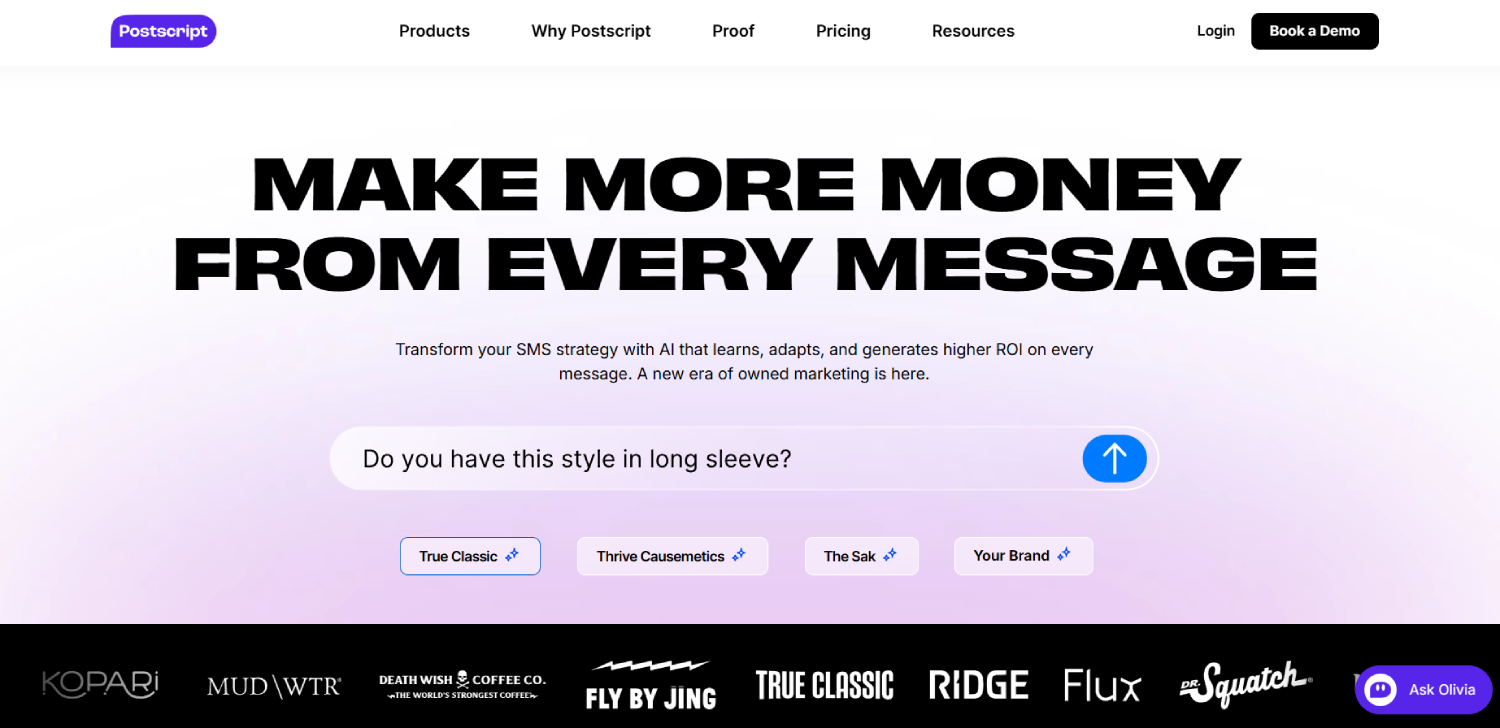
Postscript uses a usage-based model. According to Postscript’s published pricing page, plans start at $100 per month on the Growth tier, which includes a message credit allotment. You pay for the messages you send, not the size of your subscriber list. Credits roll over, and you can top up when campaigns spike. This model rewards stores with high subscriber counts but low send frequency, because dormant subscribers do not cost you anything beyond the plan floor.
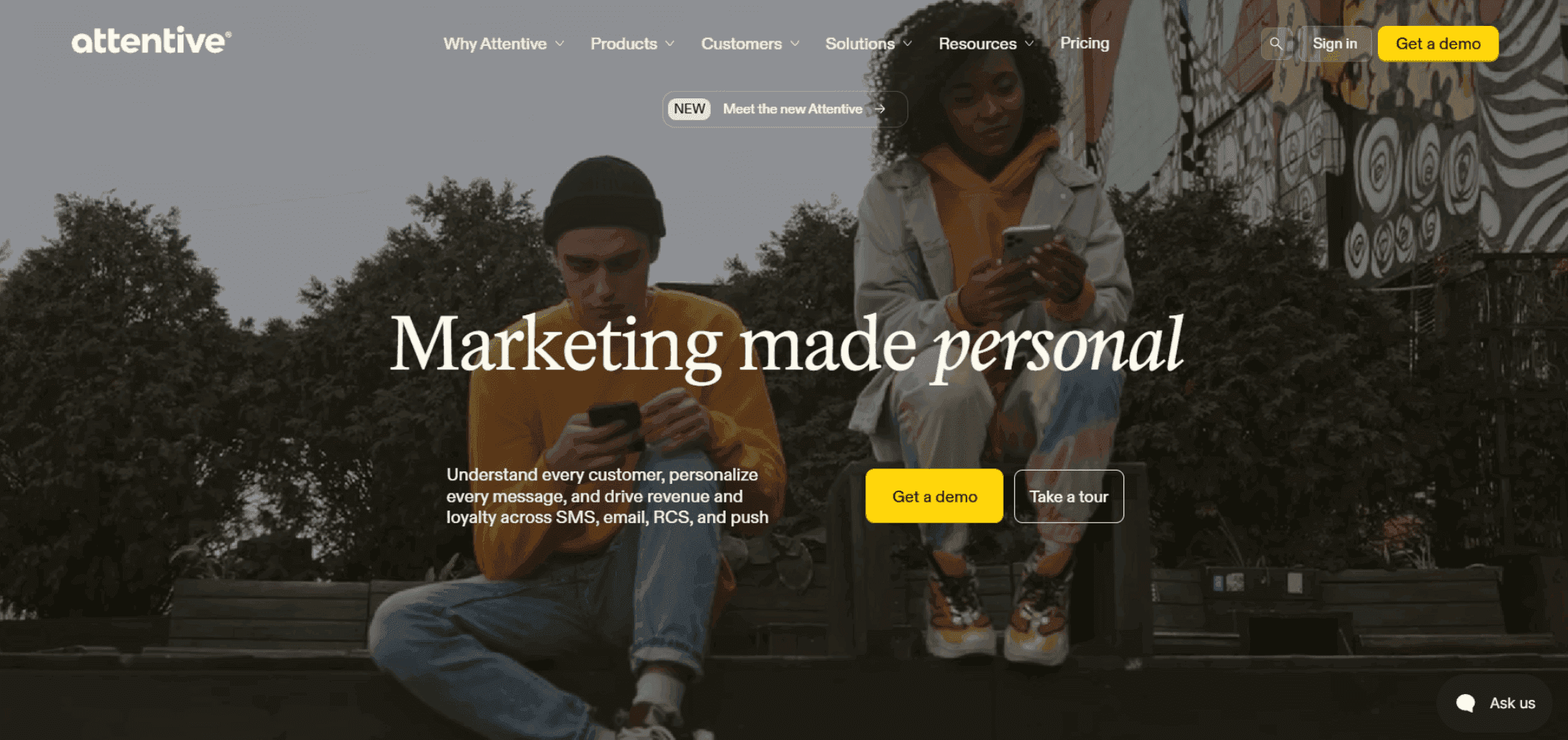
Attentive does not publish list prices. Attentive’s pricing is quote-based, and the vendor does not disclose tiers publicly. Buyers consistently report that contracts are structured around active subscriber count, with message costs layered on top. That means a fast-growing list drives your bill up even in months when you send less. For stores in list-building mode, this can produce invoice surprises that usage-based pricing avoids entirely.
| Factor | Attentive | Postscript |
|---|---|---|
| Pricing model | Subscriber-based (quote-only) | Message credit / usage-based |
| Published pricing | No , requires sales call | Yes , starts at $100/month (Growth) |
| Email included | Yes (Attentive Email add-on) | No (SMS and MMS only) |
| Contract length | Typically annual | Monthly available on lower tiers |
| Trial access | Demo-gated | 30-day trial on select plans |
| Onboarding fee | Often included in contract | Varies by plan tier |
The practical implication: a Shopify store with 40,000 subscribers sending two campaigns per month will almost certainly pay less on Postscript’s usage model than on an Attentive subscriber-count contract. Run the math against your own list size and send cadence before any sales call.
Which Platform Has Deeper Shopify Integration?
Both platforms integrate with Shopify, but Postscript was built specifically for Shopify from day one. That origin shapes everything from its data model to its default automation triggers.
Postscript connects directly to Shopify’s storefront data without middleware. Abandoned cart, browse abandonment, post-purchase upsells, back-in-stock alerts, and shipping notifications all fire from native Shopify event triggers. The product catalog sync is real-time, meaning a price change or inventory update in Shopify reflects in an outgoing SMS without a manual refresh. For a lean team running a single-channel store, this means fewer things to configure and fewer things to break.
Attentive’s Shopify integration is solid but more generalist. It was designed to work across Shopify, Salesforce Commerce Cloud, BigCommerce, Magento, and custom stacks simultaneously. That breadth is genuinely useful for multi-storefront operators, but it means the Shopify-specific experience is not as tight. Attentive pulls order and customer data through API, and its automation library covers the same use cases, but configuration requires more deliberate setup, particularly around custom product attributes and collection-level segmentation.
One area where Attentive has a real advantage: two-way conversational SMS. Its AI-powered concierge feature, Attentive AI, handles inbound replies with intent classification and can escalate to a human agent queue. Postscript’s two-way messaging exists but is more manual. For brands running high-touch customer experience programs, that gap matters.
The AboutMartech Shopify SMS Fit Test
Rather than comparing feature checklists, a more useful evaluation runs through four variables that actually determine platform fit. Call this the Shopify SMS Fit Test.
- List growth rate vs. send frequency ratio. If your list grows faster than your send cadence, subscriber-based pricing punishes you. High-frequency senders with stable lists break even or favor subscriber pricing.
- Channel consolidation need. If you want SMS and email from one vendor with shared audience segments, Attentive is the only one of the two that offers it. Postscript is SMS-only.
- Shopify exclusivity. If Shopify is your only commerce platform and you have no plans to add a second, Postscript’s native depth pays dividends. If you run a hybrid stack or are evaluating a platform migration, Attentive’s connector architecture gives you more flexibility.
- Team size and operational capacity. Postscript’s setup is simpler and its support documentation is Shopify-native. Attentive’s more sophisticated toolset assumes someone on your team has the bandwidth to configure and test segmentation logic before launch.
Score your store against these four variables honestly. The platform that scores three or four in your favor is almost certainly the right pick, regardless of what either sales team tells you.
How Do Attentive and Postscript Compare on Subscriber Growth Tools?
SMS deliverability starts with a clean, compliant list. Both platforms provide opt-in tools, but their approach differs in ways that compound over time.
Attentive’s two-tap mobile opt-in flow is its most cited differentiator and for good reason. The mechanism presents a pre-populated opt-in text on mobile, removing keyboard friction at the moment of conversion. According to Attentive, this flow drives higher opt-in rates than standard web forms. They have built a significant portion of their brand positioning around this single feature, and the underlying mechanics are legitimately well-engineered.
Postscript offers comparable pop-up and keyword opt-in flows, including a mobile landing page builder that ties directly to Shopify’s checkout. Its opt-in tools are competitive but less differentiated. Where Postscript closes the gap is in its A/B testing for opt-in copy and incentives, which is available on its Growth and Professional tiers without needing to involve their support team.
Both platforms maintain TCPA compliance tooling and handle consent tracking at the subscriber level. Neither platform forces manual double opt-in, though both support it as a configuration option. For brands in regulated categories, confirm your compliance requirements before assuming either platform’s defaults are sufficient.
What Does a Real Store’s Cost Look Like on Each Platform?
Consider a Shopify apparel brand with 25,000 active SMS subscribers sending three campaigns per month plus four automation flows (abandoned cart, post-purchase, win-back, birthday). Call this a mid-size store with a competent but small marketing team.
On Postscript’s Growth plan, which starts at $100 per month according to their published pricing page, that store pays for message volume consumed. Three monthly campaigns to 25,000 subscribers, each SMS averaging 1.2 message segments due to length, plus automation volume of roughly 8,000 messages per month, totals approximately 98,000 message segments monthly. Working from Postscript’s published credit rates and applying them to that volume, the estimated monthly spend falls in the range of $200 to $400 all-in, depending on MMS usage. These are illustrative figures derived from the published pricing structure, not confirmed quotes.
On Attentive, the same store would negotiate a contract. Buyers report typical Attentive contracts for accounts of this size starting in the range of $400 to $700 per month annually, though the vendor does not confirm this publicly and actual quotes depend on contract length, feature tier, and negotiation. These figures reflect buyer-reported ranges, not publicly stated pricing. The email add-on costs extra.
This scenario is illustrative. Real quotes will vary. But the directional conclusion holds: Postscript’s usage-based model is more predictable at this store size, and Attentive’s subscriber-count model starts to look competitive only when you are sending very high volumes to a very large list where the per-message economics favor a bundled contract.
Which Platform Wins on Deliverability and Carrier Relationships?
Deliverability in SMS is not the same discipline as email deliverability. Carrier filtering, 10DLC registration, toll-free verification, and short code provisioning all shape whether your message reaches the device. Both Attentive and Postscript handle 10DLC (10-digit long code) registration on behalf of merchants, which became mandatory in the US market for application-to-person SMS traffic.
Attentive’s scale gives it a practical advantage here. A larger platform sending higher aggregate volume has more carrier relationship history and a faster path to resolving filtering disputes when they occur. This is not a knock on Postscript. Postscript’s 10DLC support is fully functional and its compliance documentation is thorough. It is simply that carrier-level deliverability reputation tends to benefit from platform-wide send volume, and Attentive’s customer base is larger.
Short code provisioning is where Attentive pulls further ahead for high-volume senders. Dedicated short codes give brands the highest throughput and best deliverability, but they require significant volume to justify the cost. Attentive can provision and manage dedicated short codes more easily at scale. For stores under a certain send threshold, this is irrelevant. Most Shopify brands at the mid-market level will run on 10DLC or toll-free numbers, where the gap between the two platforms is narrow.
If you are thinking more broadly about SMS as a channel and want context on how RCS messaging compares to traditional SMS for brand communications, the best RCS business messaging platforms available in the US is worth reviewing before you lock into any long-term SMS contract.
How Do Attentive and Postscript Handle Analytics and Attribution?
Both platforms attribute revenue to SMS using last-click within a configurable window, typically 24 to 72 hours. This is the industry standard and carries the same caveats that last-click attribution always does: it overstates SMS’s contribution when SMS is one of several active channels.
Attentive’s analytics dashboard is more sophisticated. It surfaces cohort-level performance, tests statistical significance on A/B experiments, and offers a revenue attribution model that accounts for assisted conversions. For teams that want to run rigorous channel-level reporting, Attentive’s reporting tools are genuinely better. Postscript’s analytics are functional and clear but less configurable.
Neither platform replaces a proper multi-touch attribution setup. If you are running paid social, email, and SMS simultaneously and want to understand true channel contribution, you will need a dedicated attribution tool regardless of which SMS platform you pick. The best marketing attribution tools for proving what drives revenue covers that problem independently of your SMS choice.
Postscript does offer a tighter integration with Klaviyo than Attentive does, which matters for stores already running Klaviyo for email. Shared audience segments between Klaviyo and Postscript keep your email and SMS lists in sync without manual exports. Attentive’s native email product eliminates the need for Klaviyo entirely if you want to consolidate, but if you are committed to Klaviyo, Postscript’s interoperability is a real operational benefit.
Verdict: Which Platform Should You Actually Choose?
For Shopify stores under roughly $5M in annual revenue or under 50,000 SMS subscribers, Postscript is the better starting point. Its usage-based pricing is more predictable, its Shopify integration requires less configuration, and its monthly plan options give you the ability to exit without a 12-month commitment if the channel does not perform. The Klaviyo compatibility is a genuine bonus for the majority of Shopify merchants already running that email stack.
Attentive makes sense when at least two of the following apply: you want SMS and email from a single vendor with shared segmentation, you are operating at a scale where a subscriber-count contract becomes competitive on a per-message basis, your team has the bandwidth to configure advanced automation and test it properly, or you need two-way conversational SMS at volume. Attentive also makes sense if you run storefronts on multiple commerce platforms and need a platform that handles them all from one interface.
The stores most likely to make the wrong call are those in the $2M to $10M revenue range who assume Attentive’s more visible brand means better results. At that stage, Postscript’s Shopify-native depth usually produces comparable or better results at meaningfully lower cost. Scale past that point, consolidate channels, or need enterprise-grade reporting, and the calculation shifts.
Frequently Asked Questions
Is Postscript only for Shopify stores?
Postscript is designed exclusively for Shopify and Shopify Plus merchants. It does not support other commerce platforms. This focus is both its main strength and its hard limit: the native Shopify integration is tighter than any competitor, but if you operate on BigCommerce, Magento, or a custom stack, Postscript is not an option. Attentive, by contrast, supports multiple commerce platforms through API connectors.
Does Attentive offer a self-serve trial?
Attentive does not offer a self-serve trial. Access requires a demo call with their sales team, after which they configure a pilot environment. Postscript offers a 30-day trial on select plans that can be initiated without a sales conversation. For teams that want to evaluate SMS performance before committing budget, Postscript’s trial path is significantly lower friction.
Can I run both Attentive and Postscript simultaneously?
Technically yes, but it creates subscriber consent and list management complexity that most teams cannot justify. Running two SMS platforms to the same customer base risks double-sending, consent tracking conflicts, and attribution confusion. The practical answer is to pick one platform and migrate fully. If you are switching from one to the other, both platforms have migration support teams, though transfer of historical subscriber consent records requires careful verification of your original opt-in documentation.
Which platform integrates better with Klaviyo?
Postscript has a deeper native Klaviyo integration. Shared list segments, flow triggers, and suppression lists sync bidirectionally, meaning a subscriber who opts out of SMS in Postscript is automatically suppressed in Klaviyo’s SMS segment as well. Attentive integrates with Klaviyo through a standard API connection, but Attentive’s preferred pairing is its own email product. If Klaviyo is your email platform and you plan to keep it, Postscript is the more operationally coherent choice.
How does 10DLC registration work with each platform?
10DLC registration is the carrier-required process for US businesses sending application-to-person SMS on 10-digit long code numbers. Both Attentive and Postscript handle 10DLC registration on behalf of their customers as part of onboarding. You provide your business information, use case description, and opt-in confirmation, and the platform submits registration to The Campaign Registry. Approval timelines vary by carrier but typically run one to three weeks. Neither platform can bypass this requirement, and sending before registration approval increases the risk of carrier filtering.
What happens to my subscribers if I switch platforms?
SMS subscriber consent is tied to the business entity, not the platform. Your opt-in records belong to you. Migrating from Postscript to Attentive, or the reverse, requires exporting your subscriber list with documented consent timestamps and opt-in sources, then importing to the new platform. Both platforms have migration documentation. The operational risk is not the technical transfer but ensuring that your historical opt-in records are clean and auditable, particularly if your original opt-in flows were managed outside the platform you are leaving.
Does Attentive’s email product replace Klaviyo for Shopify stores?
Attentive Email is a viable replacement for Klaviyo for stores that want to consolidate SMS and email into one platform. It includes segmentation, flows, campaigns, and Shopify data sync. Whether it is a complete functional replacement depends on your current Klaviyo usage. Stores running advanced predictive analytics, deep custom property logic, or complex multi-step flows in Klaviyo will find Attentive Email less mature in some of those areas. For stores doing standard lifecycle email without heavy customization, the consolidation is worth considering.
Which platform is better for high-volume SMS senders?
At genuinely high volume, specifically stores sending millions of SMS segments per month, Attentive’s infrastructure and dedicated short code provisioning give it an edge in throughput and deliverability consistency. Postscript handles significant volume but is optimized for the mid-market Shopify merchant rather than the enterprise sender. If your monthly send volume exceeds several million segments, Attentive’s carrier relationships and technical infrastructure are worth the premium. Below that threshold, the difference in real-world deliverability between the two platforms is narrow enough not to be the deciding factor.
Two Things Worth Knowing Before You Sign Anything
First, the platform you pick shapes your data architecture in ways that go beyond SMS. If you ever move toward a more structured customer data layer, the cleanness of your SMS consent data, your subscriber identifiers, and your event history will matter. Both platforms export data, but Attentive’s data model is more normalized for integrating with a broader stack. If your roadmap includes a customer data platform built for multi-channel identity resolution, think about how your SMS subscriber records will flow into it from day one.
Second, do not anchor your evaluation on current list size. Model the cost at 2x your current subscribers and at your peak seasonal send volume. A platform that looks affordable at 15,000 subscribers on a subscriber-count model can become expensive quickly if your list doubles in 12 months. Postscript’s usage-based pricing is more predictable in that scenario. Attentive’s contract pricing can be more favorable if you are sending at consistently high frequency to a stable, large list and can negotiate accordingly.
The stores that get this decision right are the ones that model the economics over 24 months rather than the first invoice. Do that math before the demo call, not after.