
- The AI marketing stack is not a single platform. It is eight distinct tool categories, each solving a different job, and most marketing teams only have two or three of them today.
- Generative AI sits on top of every category now, but the underlying infrastructure (data layer, identity resolution, activation) still determines whether AI outputs are useful or generic.
- The most overlooked category in 2026 is AI visibility, which tracks whether your brand appears in ChatGPT, Perplexity, and Google’s AI Overviews, a channel that has no equivalent in the classic martech map.
- Buying AI-branded versions of tools you already own is usually a worse decision than filling genuine gaps in your data or activation layer first.
- This guide maps all eight categories, names the real tools in each, and tells you which ones a lean team should prioritize before scaling.
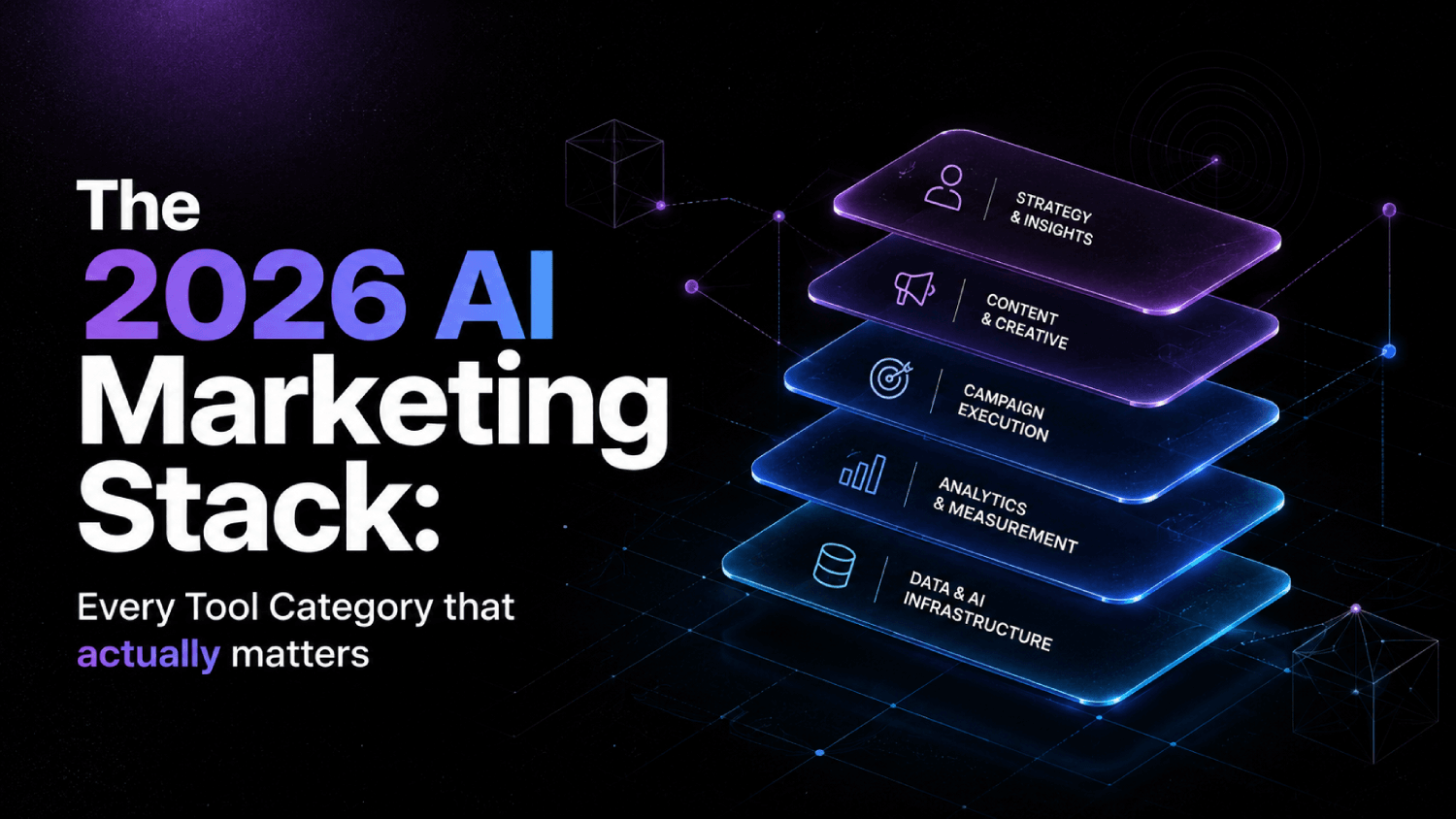
The AI marketing stack covers eight tool categories: content generation and optimization, AI SEO and generative engine optimization (GEO), AI visibility monitoring, customer data infrastructure (CDPs and warehouse-native CDPs), marketing analytics and attribution, campaign activation and personalization, revenue operations and lead intelligence, and customer success automation. Each category is distinct, serves a different function, and requires separate evaluation criteria before purchasing.
Why Most AI Marketing Tool Maps Are Useless
Most “AI marketing tool” lists are vendor directories with AI slapped on the label. They conflate a writing assistant with a customer data platform, list 47 tools without explaining what any of them actually do at the infrastructure level, and leave buyers no closer to a decision than before they clicked.
The problem is categorical confusion. Marketers searching for AI marketing software are often shopping for five completely different things at once: content production, audience intelligence, channel activation, search visibility, and measurement. These are not the same product. They do not share a budget line. They do not share a buyer.
What follows is the AboutMartech Signal Stack, a framework that organizes AI marketing tools into eight categories defined by their function in the data and activation flow, not by their marketing copy. Each category has a clear job, a clear buyer, and a clear set of trade-offs. Teams that map their gaps against this framework before purchasing avoid the most common mistake: buying AI features for a layer they already have while starving the layer they actually need.
What Is the AboutMartech Signal Stack Framework?
The Signal Stack treats your AI marketing infrastructure as a flow, not a collection of point solutions. Data enters at the top, gets enriched and resolved in the middle, activates in channels at the bottom, and gets measured in a feedback loop. AI capabilities live at every layer, but the value of AI at any given layer depends entirely on the quality of inputs from the layer below it.
The eight categories, in order of where they sit in the flow:
- Data infrastructure: CDPs, warehouse-native CDPs, and reverse ETL tools that unify and activate customer data
- Identity and enrichment: Lead enrichment, intent data, and routing tools that fill gaps in first-party data
- Content generation: AI writing, image, and creative tools that produce or assist in campaign assets
- SEO and GEO: Tools that optimize for both traditional search and AI-generated answers
- AI visibility monitoring: Tools that track brand presence in LLM-generated responses
- Campaign activation and personalization: Platforms that use AI to segment, sequence, and personalize outreach across email, SMS, push, and chat
- Analytics, attribution, and measurement: Tools that connect marketing activity to revenue outcomes
- Revenue operations and customer success: AI-assisted tools that manage pipeline health and post-sale retention
Category 1: Data Infrastructure , the Layer Most Teams Skip
Every AI marketing tool that promises personalization, segmentation, or predictive scoring runs on your customer data. If that data lives in five disconnected systems with no unified identity layer, the AI outputs will be wrong, and you will not know why.
The core products here are customer data platforms (CDPs) and warehouse-native CDPs. A traditional CDP like Segment, RudderStack, or Tealium collects event streams, resolves identity, and builds unified profiles. A warehouse-native CDP like Hightouch or Census assumes your data already lives in a cloud warehouse (Snowflake, BigQuery, Databricks) and focuses on activation, syncing audiences to downstream tools via reverse ETL.
The practical decision: if you have a mature data warehouse and a data engineering team, a warehouse-native CDP is almost always cheaper and more flexible than a traditional CDP. If you are pre-warehouse and need event collection plus profile unification in one place, a traditional CDP is the faster path. For a detailed comparison of how these models differ, the ETL vs reverse ETL vs CDP breakdown explains the architecture without jargon.
Reverse ETL as activation infrastructure
Reverse ETL tools like Hightouch and Census deserve their own mention because they are the bridge between your warehouse and every downstream AI tool. Without a reliable reverse ETL layer, syncing a model-scored audience from your data warehouse into your email platform or ad network requires custom engineering work every time. Teams evaluating Hightouch vs Census for reverse ETL should weigh connector breadth, pricing model (row-based vs sync-based), and whether the platform supports model-based audiences natively.
Category 2: Identity, Enrichment, and Lead Intelligence
AI personalization breaks without clean identity resolution. A visitor who converts on three different devices, under two different email addresses, across six months of touchpoints, is three different people to any platform that does not resolve deterministic and probabilistic signals into a single profile.
Lead enrichment tools like Clearbit (now part of HubSpot), ZoomInfo, Apollo, and Clay fill first-party data gaps with firmographic and technographic signals. Routing tools connected to these platforms use those signals to assign leads to the right rep or sequence without manual intervention. For RevOps teams managing high inbound volume, this is where AI delivers the most immediate ROI: not in content generation, but in the quality of data driving lead routing decisions. The lead enrichment and routing tools comparison covers the seven most-evaluated options for RevOps teams in detail.
Category 3: AI Content Generation , Where Everyone Starts (and Where Many Stall)
Content generation is where most marketing teams first encountered AI tools, and where the most fatigue now lives. The initial novelty of watching a language model draft a blog post has worn off. Teams that have stayed in this category have moved past prompting assistants toward integrated workflows where AI drafts, humans edit, and brand voice is enforced programmatically.
The leading standalone AI writing tools include Jasper, Copy.ai, Writesonic, and Anyword. Each wraps GPT-4 or Claude with content templates and workflow features. The honest comparison: Jasper’s brand voice controls are the most mature, but it is also among the most expensive in the category. Writesonic and several other Jasper alternatives that cost less offer comparable output quality at a fraction of the price for teams without a brand consistency requirement baked into their procurement criteria.
The broader AI content category now includes tools beyond text: Midjourney and DALL-E 3 for image generation, Synthesia for AI video, and Descript for audio and video editing. For a tested comparison of the tools B2B content teams are actually shipping with, the AI content tools review covers eleven platforms with specific use-case guidance.
Category 4: AI SEO and Generative Engine Optimization (GEO)
SEO tooling has fragmented sharply. The traditional tools (Semrush, Ahrefs, Moz) are adding AI features, while a new class of tools built specifically for generative engine optimization has emerged to address a different problem entirely: not ranking in Google’s blue links, but appearing in AI-generated answers from ChatGPT, Perplexity, Google AI Overviews, and Microsoft Copilot.
GEO and AEO (answer engine optimization) tools analyze whether your content is structured in ways that LLMs can extract, cite, and surface. The practical difference from classic SEO: keyword density and backlink count matter less than entity clarity, factual accuracy, structured data, and whether your content directly answers specific questions without requiring inference.
For teams that want to understand the strategic divergence before buying tools, the GEO vs SEO comparison maps what changes and what carries over from traditional search optimization. For tool evaluation, the best GEO and AEO tools for AI citations covers nine platforms in detail, including how each one approaches content gap analysis for AI answer engines.
AI-native SEO tools vs AI-augmented traditional tools
Tools like Surfer SEO, MarketMuse, and Clearscope use AI to score content comprehensiveness against top-ranking competitors. These are AI-augmented SEO tools. They are useful and proven. Dedicated GEO tools are a newer category, solving for LLM retrieval rather than Google ranking, and the two optimization targets do not always align. A team with limited bandwidth should prioritize the channel that currently drives more of its traffic before splitting investment across both.
Category 5: AI Visibility Monitoring , the Category That Did Not Exist Two Years Ago
If your prospects are asking ChatGPT or Perplexity to recommend tools in your category, and your brand does not appear in those answers, you have a distribution problem that no amount of Google ranking improvement will fix. AI visibility monitoring is the category that tracks whether, how often, and in what context AI answer engines mention your brand.
The tools in this category include Profound, Otterly, BrandMentions, and a growing set of platforms adding LLM-monitoring dashboards. These tools run automated queries across multiple AI models and track whether your brand appears, where it ranks in AI-generated lists, and what sources the models cite when they do mention you. For a direct comparison of the two most-evaluated tools in this space, the Profound vs Otterly analysis covers methodology, pricing, and which fits which team size. For a broader market view, the AI visibility tools roundup covers thirteen platforms with specifics on query volume, model coverage, and reporting.
This is the category most marketing leaders have not budgeted for yet. That is a mistake. A brand that measures AI visibility now has a 12-month head start on building citation equity before competitors realize the channel exists.
Category 6: Campaign Activation and AI Personalization
This is the largest and most crowded category in the AI marketing stack. It includes email marketing platforms, SMS tools, push notification tools, and the marketing automation platforms that orchestrate them. Nearly every platform in this space now ships AI features for subject line optimization, send-time personalization, predictive segmentation, and content recommendations.
| Sub-Category | Key Tools | Primary AI Use Case | Best For |
|---|---|---|---|
| Email automation | Klaviyo, Brevo, ActiveCampaign, HubSpot | Predictive send time, subject line testing, churn prediction | Mid-market B2B and DTC |
| SMS marketing | Attentive, Postscript, Klaviyo SMS | AI-generated copy variants, opt-out prediction | DTC and Shopify brands |
| Push notifications | OneSignal, Pushwoosh, Airship | Delivery optimization, segmentation | Mobile-first product teams |
| RCS messaging | Sinch, Twilio, MessageBird | Rich media automation, conversational AI responses | Enterprise mobile messaging |
| Marketing automation | Marketo, Pardot, HubSpot, Ortto | Lead scoring, workflow branching, content personalization | B2B demand gen |
The honest assessment of AI in activation platforms: most of the AI features in email and SMS tools are still statistical, not generative. Send-time optimization uses historical open data. Predictive churn scoring uses behavioral signals. These are mature machine-learning features, not ChatGPT-style generation. That is not a criticism, it is a clarification. Buyers should not pay an AI premium for a feature that has been in platforms like Klaviyo and Marketo for years under a different label.
Category 7: Analytics, Attribution, and Marketing Measurement
Marketing analytics has two distinct jobs that are often collapsed into one buying decision. Product analytics tools like Mixpanel, Amplitude, and PostHog track in-product behavior and user flows. Marketing attribution tools like Northbeam, Rockerbox, and Triple Whale connect ad spend and campaign activity to revenue outcomes. These are different problems that need different tools.
AI enters this category primarily through natural language querying (ask your data a question in plain English), automated anomaly detection, and predictive modeling. The practical limitation: these AI features are only as useful as the quality of the underlying data model. A team running last-touch attribution in a 90-day B2B sales cycle gets useless AI-generated insights, because the model they are using to answer questions is wrong to begin with. For teams running long enterprise sales cycles, the B2B attribution tools for long sales cycles covers the seven platforms that handle multi-touch, offline-to-online, and CRM-integrated measurement correctly.
Marketing mix modeling in a post-cookie environment
Marketing mix modeling (MMM) is experiencing a significant revival as third-party cookie deprecation removes the deterministic signals that multi-touch attribution relied on. AI-driven MMM tools like Meridian (Google’s open-source MMM framework), Northbeam, and Robyn use Bayesian modeling and AI to estimate channel contribution from aggregate spend and revenue data, without user-level tracking. This is not a replacement for attribution, it is a complement, but teams that have not added an MMM layer to their measurement stack are flying partially blind on brand and upper-funnel spend.
Category 8: Revenue Operations and Customer Success AI
RevOps and customer success platforms are where AI has the clearest, most measurable ROI in the entire stack, because the inputs (CRM data, product usage, support tickets, NPS scores) are structured and the outputs (expansion revenue, churn rate) are directly trackable.
Customer success platforms like Gainsight, ChurnZero, and Vitally now use AI to score account health, surface early churn signals, and automate QBR preparation. For B2B SaaS teams that cannot staff a full CS team for every account, AI-assisted health scoring and automated playbook triggers are not a nice-to-have, they are a coverage model. RevOps tooling like Clari, Gong, and Salesloft uses AI to forecast pipeline, analyze sales calls, and identify MQL-to-SQL leakage in the handoff process.
MQL-to-SQL leakage deserves specific attention. It is the single most common place AI investments fail in a B2B stack. A team can have excellent lead scoring, excellent content, and excellent attribution, and still lose 40 to 60 percent of pipeline value between marketing qualification and sales acceptance, because the handoff criteria, routing logic, or SLA is broken. AI cannot fix a process problem. It can only make a working process faster.
How to Prioritize Which Categories to Build First
The Signal Stack framework has an intentional order: data infrastructure before activation, identity before personalization, measurement before scaling spend. Buying in the wrong order is the most expensive mistake in martech.
Consider a hypothetical B2B SaaS team with 50 employees, $5 million in ARR, and a 60-day average sales cycle. They currently have an email platform, a CRM, and Google Analytics. What they actually need, in order:
- First: Fix the measurement layer. GA4 is inadequate for B2B attribution. Moving to a dedicated attribution tool before scaling spend means every dollar spent after that point generates usable signal.
- Second: Add identity and enrichment. At 50 employees, a sales-assisted motion needs clean firmographic data and routing logic before AI-assisted outreach adds any value.
- Third: Add a CDP or reverse ETL layer if the data stack is siloed. Without unified profiles, segmentation in the email platform will produce wrong audiences regardless of how good the AI features are.
- Fourth: Add AI content tools and GEO tooling to accelerate content production and optimize for AI search visibility.
- Fifth: Add AI visibility monitoring to track brand presence in AI-generated answers, before that channel matures and competition increases.
This order is not universal, but the principle holds: fix the signal before amplifying it. AI applied to bad data produces confident wrong answers at scale.
What Does an AI Marketing Stack Actually Cost?
Pricing across these categories varies enormously, and a significant portion of the market is quote-based at the enterprise level. The table below reflects publicly available pricing tiers as of current public pricing pages. Many enterprise tools in the CDP, attribution, and RevOps categories do not disclose pricing publicly.
| Category | Representative Tools | Entry Price Range | Pricing Model |
|---|---|---|---|
| Data infrastructure (CDP) | Segment, RudderStack | $120/mo and up (Segment free tier available) | MTU or event volume |
| Reverse ETL | Hightouch, Census | Free tier to $350/mo and up | Row syncs or seats |
| Lead enrichment | Apollo, Clay | Apollo from $49/mo; Clay from $149/mo | Credits or seats |
| AI content tools | Jasper, Writesonic | $39-$99/mo per seat (entry plans) | Per seat |
| GEO/AEO tools | Varies by platform | Quote-based for most | Subscription or usage |
| AI visibility monitoring | Profound, Otterly | Varies; quote for enterprise tiers | Query volume or subscription |
| Email/SMS activation | Klaviyo, Brevo | Free tier to $45/mo (contact volume based) | Contact-based |
| Attribution | Northbeam, Rockerbox | Quote-based for most | Spend percentage or flat |
| RevOps/CS platforms | Gainsight, ChurnZero, Clari | Quote-based for enterprise | Per seat or ARR percentage |
A realistic full stack for a 50-person B2B SaaS company, covering data infrastructure, enrichment, content, attribution, and basic activation, runs $2,000 to $5,000 per month before enterprise contracts enter the picture. Teams that treat AI marketing tools as a single budget line consistently overspend in the category they already have and underspend in the category they need.
Frequently Asked Questions
What are the main categories of AI marketing tools?
The eight main categories are: data infrastructure (CDPs and reverse ETL), identity and lead enrichment, AI content generation, SEO and generative engine optimization, AI visibility monitoring, campaign activation and personalization (email, SMS, push), marketing analytics and attribution, and revenue operations and customer success. Each category serves a distinct function in the data-to-revenue flow and requires separate evaluation criteria.
How do I build an AI marketing stack in 2026?
Start with measurement, then data unification, then identity and enrichment, then activation, then content and GEO. Buying activation tools before fixing your data layer produces AI-amplified noise. The sequence matters: each layer depends on the quality of the one below it. Map your current gaps against the eight Signal Stack categories, identify the layer that is most broken, and prioritize that purchase before adding more AI features on top of a shaky foundation.
Which AI tools do marketing teams actually need right now?
For most B2B SaaS teams under 200 employees, the highest-impact additions are a marketing attribution tool (if you are relying on GA4 for revenue reporting), a lead enrichment platform (if sales is working unqualified inbound), and an AI visibility monitoring tool (to measure brand presence in LLM search before competitors do). AI content tools are useful but lower-priority than fixing data and measurement gaps, because content quality does not compound if no one can find it.
What is generative engine optimization (GEO) and why does it matter?
Generative engine optimization is the practice of structuring content so AI answer engines like ChatGPT, Perplexity, and Google AI Overviews can extract, cite, and surface it in response to user queries. Unlike traditional SEO, which optimizes for keyword ranking in blue-link results, GEO focuses on entity clarity, factual density, structured markup, and direct question answering. It matters because a growing share of information queries are going to AI answer engines instead of traditional search results, and appearing in those answers requires different content structure than ranking in Google.
Is a CDP the same as a marketing automation platform?
No. A CDP collects, unifies, and resolves customer identity across sources to build a single customer profile. A marketing automation platform uses audience segments to send campaigns and manage workflows. They are complementary: the CDP builds the audience, the marketing automation platform activates it. Some platforms (Klaviyo, HubSpot) bundle lightweight CDP features into their automation tools, which is sufficient for teams with simple data models but insufficient for teams with complex multi-source data environments.
What is reverse ETL and how does it relate to AI marketing?
Reverse ETL is the process of moving data from a cloud data warehouse (Snowflake, BigQuery, Databricks) back into operational tools like CRMs, email platforms, and ad networks. In an AI marketing context, reverse ETL is how model-generated outputs (propensity scores, churn predictions, LTV tiers) get operationalized in the tools that actually send messages or assign leads. Without reverse ETL, AI scoring models built in the warehouse stay in the warehouse and never change what a salesperson sees or what email a customer receives.
How do AI visibility tools differ from traditional brand monitoring tools?
Traditional brand monitoring tools track mentions in social media, news, and web content. AI visibility tools specifically track whether your brand appears in responses generated by LLMs when users ask questions related to your category. The inputs are different (automated query sets run against ChatGPT, Perplexity, Google AI Overviews) and the outputs are different (citation frequency, sentiment in AI-generated context, which sources the model uses to justify mentioning you). They solve for a channel that traditional monitoring tools were never designed to measure.
Can a small marketing team (under 10 people) use an AI marketing stack effectively?
Yes, but scope matters. A small team should not try to operate all eight categories simultaneously. The highest-leverage starting point is typically AI content tools (for production velocity) plus a simple attribution tool (to know which channels are working) plus lead enrichment (if there is an outbound or sales-assist motion). Full data infrastructure investment makes sense at the point where manual data wrangling is consuming more than 20 percent of the team’s time or where personalization at scale has a measurable revenue impact the current tooling cannot deliver.
The One Mental Model That Ties the Stack Together
The AI marketing stack is not primarily an AI problem. It is a data quality problem with AI consequences. Every generative, predictive, or personalization feature in every platform in this guide produces outputs that are exactly as good as the data fed into it. A team that spends $50,000 on AI-powered personalization running on a fragmented, unresolved data layer has paid a premium for confident misinformation delivered at scale.
The Signal Stack framework exists to short-circuit the most common buying mistake: purchasing AI features at the top of the stack while ignoring the infrastructure at the bottom. Identity resolution, clean data pipelines, and reliable attribution are not unglamorous prerequisites to the real work. They are the real work. AI makes them faster and more powerful, but it cannot replace them.
The most interesting development in 2026 is the emergence of AI visibility as a distinct, measurable channel with its own tooling, its own optimization practices, and its own competitive dynamics. Teams that build citation equity in AI answer engines now, before the channel becomes saturated and expensive to compete in, are making the same bet that early SEO practitioners made in 2005. The window for low-competition AI visibility gains is open. It will not stay open.