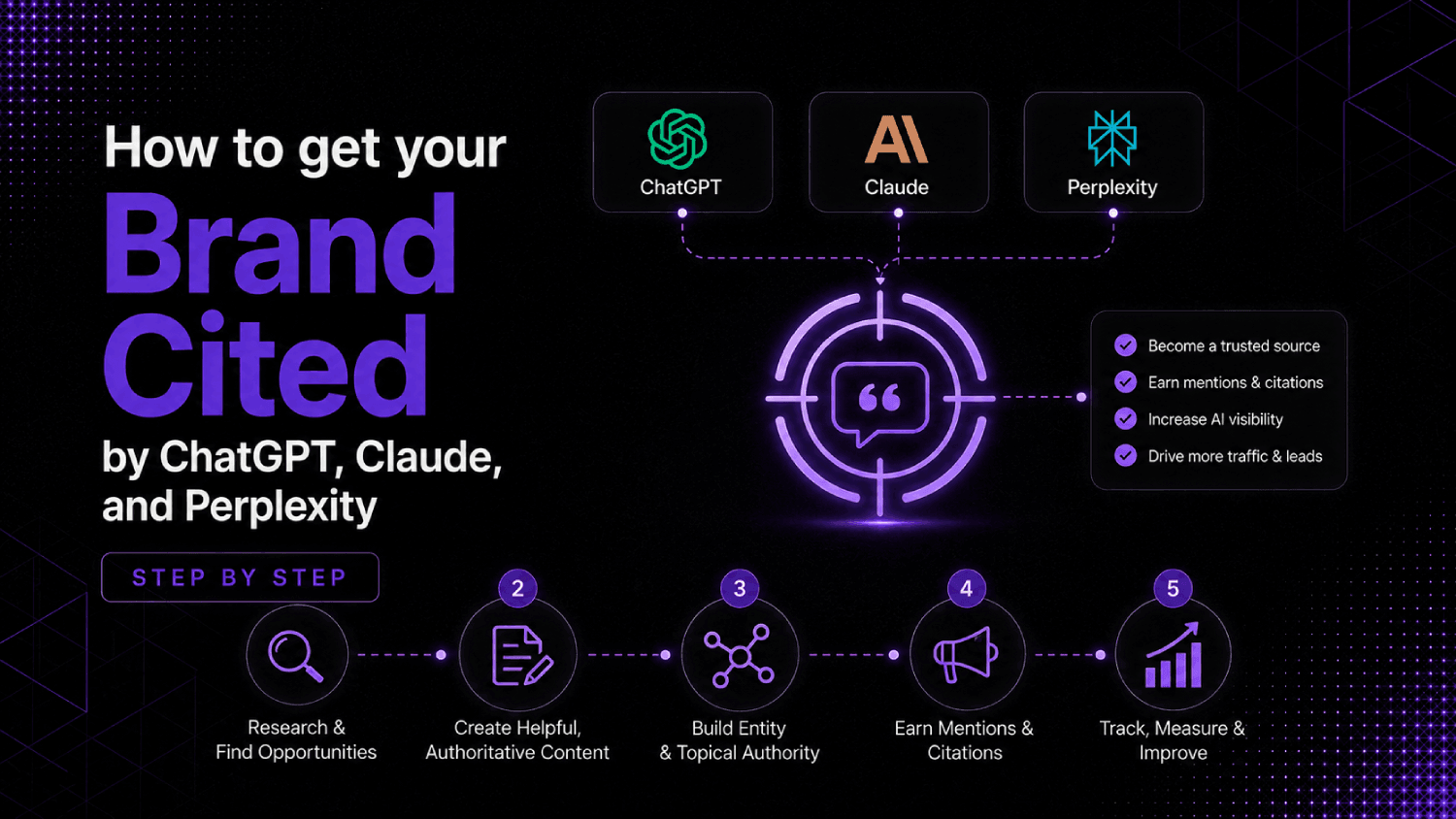
- AI citation is not random. ChatGPT, Claude, and Perplexity pull from a defined set of signals: source authority, entity clarity, structured content, and corroboration across multiple sources.
- The brands appearing most in AI answers have made themselves easy to summarize, easy to attribute, and easy to corroborate, not necessarily the most trafficked or the most linked.
- A framework called the SECA Model (Source authority, Entity clarity, Corroboration, Answerability) maps every controllable citation lever across these three platforms.
- Tracking AI visibility requires different tools than traditional SEO rank trackers. Most teams are flying blind because their current stack does not surface LLM mention data.
- Optimizing for AI citation and optimizing for Google are now diverging disciplines. Some tactics help both. Several help only one.
How to get cited by ChatGPT, Claude, or Perplexity comes down to building a content and technical presence that AI systems can accurately summarize, confidently attribute, and corroborate through multiple independent sources. Publish original research or data, structure your content to answer specific questions directly, establish your brand as a named entity with a consistent description across authoritative third-party sites, and use structured markup to signal what your content is about. This process is repeatable and measurable.
Why most brands are invisible to AI assistants right now
Most marketing teams optimized for a system that rewarded volume and keyword density. AI language models do not work that way. ChatGPT, Claude, and Perplexity are not search indexes. They are synthesis engines that weight confidence, clarity, and corroboration over raw link counts.
When a user asks Perplexity “what is the best CRM for a 50-person sales team,” Perplexity does not crawl the web live for most queries. It pulls from its training corpus and, for real-time queries, from a curated retrieval layer. Both layers favor sources that are unambiguous about what they are, what they cover, and what position they take. A brand that publishes hedged, generic content gets ignored regardless of domain authority.
The deeper issue is attribution confidence. An AI system will only cite a source by name if it can attribute a claim to that source with high confidence. Vague, unattributed, or internally inconsistent content gets absorbed into the model’s general knowledge and cited as nothing. This is why some genuinely authoritative brands are invisible in AI answers while smaller, clearer publications get named repeatedly.
What signals actually drive AI citation across ChatGPT, Claude, and Perplexity?
These three platforms differ architecturally, but they share the same citation prerequisites. ChatGPT (GPT-4o and later) uses retrieval-augmented generation for browsing-enabled queries and relies on training data for closed queries. Claude (Anthropic’s flagship model) is trained on a broad corpus and uses similar retrieval logic when connected to tools. Perplexity indexes the web in near-real-time and cites sources inline, making it the most transparent of the three about what it is reading.
Despite these differences, the citation inputs converge around four categories.
Source authority
Established editorial publications, academic sources, industry analysts, and brands with strong third-party mention profiles get weighted higher. This is not purely about domain rating. It is about whether the model has seen the source cited by other trusted sources. A brand mentioned in TechCrunch, cited in a G2 review thread, and linked from a Gartner blog carries more authority weight than a brand with a high-DA site that nobody discusses externally.
Entity clarity
AI models recognize named entities. Your brand needs a consistent, structured identity: the same company description across your site, your Crunchbase profile, your LinkedIn, your Wikipedia entry (if applicable), and every publication that mentions you. Inconsistent positioning across these surfaces confuses entity resolution and reduces citation confidence. If your site calls you “a growth platform” and LinkedIn calls you “a sales intelligence tool” and G2 lists you under “marketing automation,” an AI model may not resolve those as the same entity at all.
Corroboration
A claim cited by one source is weaker than a claim cited by three independent sources. Perplexity’s citation logic is especially visible here: it pulls from multiple sources and surfaces the ones that agree. If your brand appears across independent review sites, press coverage, community discussions (Reddit threads, LinkedIn posts, Slack communities), and structured directories, that corroboration raises the confidence threshold an AI needs before naming you.
Answerability
The most underrated signal. AI systems select sources that contain a complete, extractable answer to the query at hand. A 5,000-word pillar page that buries its answer in paragraph eight loses to a 600-word page that leads with a direct answer and supports it clearly. Structured content, FAQ blocks, tables, and definition-first writing all improve answerability.
The SECA Model: a framework for making your brand citation-ready
The four signals above form a diagnostic framework. Run every major content asset and brand surface through these four checks before declaring it AI-optimized.
S , Source authority: Is this page linked or cited by sources an AI would already trust? If not, which outreach or PR effort would change that?
E , Entity clarity: Does every surface where your brand appears use a consistent, specific descriptor? “B2B marketing attribution software for revenue teams” is better than “marketing technology.” Precision helps entity resolution.
C , Corroboration: How many independent, trusted sources say the same thing about you? Below three, you are below citation threshold for most queries. Above five, you are in contention.
A , Answerability: Does your content answer a specific question completely in the first 100 words? If the answer is buried or implicit, the content will not get extracted.
Run the SECA Model as a quarterly audit, not a one-time setup. The sources AI systems retrieve from evolve as models are updated and as Perplexity’s index shifts.
Step-by-step: how to get cited by ChatGPT, Claude, and Perplexity
Step 1: Define your brand entity profile
Before any content work, get your entity definition right. Write one authoritative, specific sentence that describes what your brand does, who it serves, and what makes it distinct. Something like: “Acme is a B2B marketing attribution platform that connects multi-touch pipeline data to closed revenue for teams with 30-to-500-person sales organizations.” That sentence should appear verbatim or near-verbatim on your homepage, your About page, your LinkedIn company description, your Crunchbase entry, and in your press kit boilerplate. Consistency across surfaces is what allows an LLM to resolve your brand as a single, trusted entity rather than an ambiguous cluster of similar names.
Step 2: Produce original data that demands citation
The fastest path to AI citation is publishing data that no one else has. Original surveys, benchmark reports, proprietary analysis of anonymized customer data, or even a clearly labeled illustrative model built on publicly available figures all create what content strategists call a “citation gravity point.” AI systems cannot summarize a proprietary statistic without attributing it. Say a B2B SaaS company publishes an annual benchmark showing median sales cycle lengths by company size segment, drawn from 300 anonymized customer accounts. That figure gets picked up by analysts, referenced in roundups, and cited by AI assistants in answers about sales cycles, without any additional optimization work.
This is the single highest-return investment in AI visibility, and most marketing teams skip it because it requires coordination with data or product teams.
Step 3: Restructure your content for direct answers
Every major content asset needs an answer-first rewrite. The structure that performs best for AI retrieval mirrors what good technical documentation does: state the answer in the first sentence, then provide the explanation, then add nuance or caveats. This is the inverse of the traditional SEO content pyramid that front-loaded keyword context before getting to substance.
For how-to content, use numbered steps. For comparative content, use tables. For definitional content, use a bolded definition followed by one paragraph of expansion. These structural patterns are not just reader-friendly. They match the extraction patterns AI systems use when pulling content to synthesize answers. For more on how generative engine optimization (GEO) diverges from traditional SEO, the tactical differences are sharper than most teams expect.
Step 4: Build corroboration across independent surfaces
Corroboration requires deliberate distribution, not passive syndication. Target the specific surfaces AI retrieval layers actually index: G2 and Capterra review profiles with detailed, specific reviews (not generic ones), Reddit threads in subreddits relevant to your category, LinkedIn articles from internal experts, mentions in trade publications with real editorial standards, and appearances on podcasts with published transcripts. Each of these surfaces contributes an independent signal. Five of them saying the same thing about your brand creates enough corroborating evidence that AI systems will cite you by name.
Podcast transcripts are specifically underused here. Perplexity indexes published transcripts, and podcast content tends to be more candid and specific than polished marketing copy, which aligns better with the conversational query patterns AI users submit.
Step 5: Add structured markup to your key pages
FAQPage schema, HowTo schema, and Article schema with proper authorship markup all serve as machine-readable signals that tell retrieval systems what a page contains and how to extract it. FAQPage schema is particularly valuable because it maps directly to the question-answer retrieval pattern that ChatGPT and Perplexity use most often. Every page targeting a specific question should have FAQPage markup with at least three to five self-contained question-answer pairs.
Organization schema on your homepage also matters for entity resolution. Include your brand name, description, URL, founding date, and official social profiles in a single @type: Organization block. This gives AI systems a canonical reference point for your brand entity.
Step 6: Earn placement in trusted roundups and listicles
When Perplexity answers “what are the best tools for X,” it frequently pulls from editorial roundups on established publications. Appearing in those roundups is not a PR vanity play. It is a direct citation input. Prioritize placements in publications with genuine editorial standards over pay-to-play directories. AI systems have been trained on enough content to implicitly down-weight sources that look like paid directories, even if they cannot explicitly distinguish them.
The practical approach: build relationships with the editors and writers who cover your category. Send them real data. Offer briefings with named spokespersons who can go on record. Give them access to your product before announcements. This is traditional PR work, and it remains the most reliable path to the third-party mentions that AI retrieval systems treat as authoritative.
Step 7: Track your AI visibility and iterate
None of this works without measurement. Standard SEO tools do not track whether your brand appears in ChatGPT, Claude, or Perplexity answers. A separate category of tools has emerged for exactly this purpose, and running this process without them is like running an SEO program without rank tracking. The full breakdown of AI visibility tracking tools covers the leading options in detail, including which platforms monitor which AI assistants and how their methodology differs.
The minimum viable measurement setup: run a weekly batch of 20 to 30 queries relevant to your category through ChatGPT, Claude, and Perplexity, and log whether your brand is mentioned, cited, or recommended. Track this over time. When it moves, you can correlate the change to specific content or PR activity and understand what actually drove it.
How do ChatGPT, Claude, and Perplexity differ in how they cite sources?
The three platforms have meaningfully different citation behaviors, and optimizing for one does not automatically optimize for the others.
| Platform | Citation visibility | Primary retrieval source | Best content format for citation | Typical citation frequency |
|---|---|---|---|---|
| ChatGPT (browsing) | Inline links, sometimes no attribution | Web retrieval via Bing index | Structured how-to and definitional content | Selective; cites fewer sources per answer than Perplexity |
| ChatGPT (no browsing) | No live citation; relies on training | Training corpus | High-distribution, heavily cited content | No live citations; brand recognition from corpus frequency |
| Claude | Minimal inline citation; names sources in prose | Training corpus + tool integrations | Long-form authoritative pieces with named authorship | Low; names sources occasionally in prose rather than inline links |
| Perplexity | Explicit numbered citations, visible sources panel | Real-time web index | Direct-answer pages, FAQ schema, fresh content | High; typically cites 4 to 8 sources per answer with visible attribution |
Perplexity is the most tractable for short-term citation work because its retrieval is live. Publishing a well-structured page targeting a specific query can result in a Perplexity citation within days of indexing. ChatGPT’s closed-query behavior depends on training data, which means brand presence built before a training cutoff matters more. Claude’s citation pattern sits between the two: it names sources in prose when it can attribute a claim, but its source transparency is lower than Perplexity’s.
For teams evaluating AEO and GEO tools built specifically for AI answer optimization, the platform-specific differences in retrieval behavior are one of the key variables those tools address.
What common mistakes knock brands out of AI answers?
Several patterns reliably suppress AI citation even for brands with strong content programs.
Thin third-party presence is the most common. A brand can publish excellent original content and still be invisible in AI answers if the only place that content appears is its own domain. AI systems need corroboration. A single strong source is not enough.
Inconsistent entity naming is the second most common suppressor. If your brand has gone through a rebrand, uses different abbreviations across platforms, or operates multiple product lines under different names without clear linking, entity resolution breaks down. Audit every external mention and standardize the name and descriptor.
Over-reliance on gated content is the third. Content behind a login or a form wall cannot be retrieved by AI systems. If your best data and research lives in gated PDFs, the AI visibility benefit is zero. Ungating at least the executive summary and key data points from each research asset directly increases AI retrievability.
Finally, ignoring conversational query formats. Most SEO content was likely written for keyword queries (“best CRM software”), not conversational queries (“what CRM should a 40-person B2B sales team use if they’re already on HubSpot”). AI assistants receive the latter form. Content that does not match that conversational structure gets passed over in favor of content that does.
How long does it take to start appearing in AI answers?
Perplexity: days to weeks, depending on indexing speed and query competition. A well-structured page targeting a low-competition query can appear in Perplexity results within a week of publication.
ChatGPT (browsing mode): days to weeks for browsing-enabled queries, assuming Bing indexing. Closed-query presence depends entirely on training cutoffs and cannot be accelerated in the short term.
Claude: months, because it depends heavily on training corpus inclusion. Consistent presence in authoritative publications over time is the primary input.
The implication is that Perplexity should be the primary benchmark for early-stage AI visibility work. It gives the fastest feedback loop. Use it to validate which content formats and query types are working before extrapolating to slower-moving platforms.
Frequently asked questions
How do I get my brand mentioned by ChatGPT?
ChatGPT cites brands through two distinct pathways. In browsing mode, it retrieves from the Bing-indexed web, so publishing structured, direct-answer content that Bing indexes is the main lever. In closed mode (no browsing), it draws on training data, which means sustained presence in high-authority publications, review platforms, and editorial roundups over time is what creates brand recognition in the model. Consistent entity definition across all brand surfaces accelerates both pathways by making your brand unambiguous to the model’s entity resolution layer.
How do I show up in Perplexity answers?
Perplexity retrieves from a real-time web index and cites sources inline. The fastest way to appear in Perplexity answers is to publish pages that directly answer specific questions your target audience asks, add FAQPage schema to those pages, get them indexed quickly (submit to Bing Webmaster Tools, which Perplexity draws from), and build corroborating mentions on independent sources like G2, Reddit, and industry publications. Perplexity weights freshness and answer quality heavily, so new content targeting conversational queries can surface within days.
Does domain authority still matter for AI citation?
Domain authority as a pure metric matters less than the combination of entity clarity, corroboration, and content structure. A brand with a moderate-DA site that is consistently cited across independent sources and publishes original data will outperform a high-DA site with generic content in AI answers. That said, domain authority is partially a proxy for the kind of editorial credibility and inbound link profile that AI systems do weight, so it is not irrelevant. Treat it as one input among several, not the primary objective.
What type of content is most likely to get cited by AI assistants?
Original data and research get cited because AI systems cannot attribute proprietary figures without naming the source. Direct-answer content structured with FAQ schema, numbered steps, and comparison tables performs well because it matches AI retrieval patterns. Long-form authoritative content with named authorship from identifiable experts performs particularly well in Claude’s citation behavior. Content that exists only on your own domain without third-party corroboration rarely gets cited regardless of quality.
How do I track whether my brand is being cited by AI?
Standard SEO rank trackers do not measure AI citation. A dedicated category of AI visibility tools has emerged to address this. Platforms like Profound and Otterly run automated query batches across ChatGPT, Claude, and Perplexity and log brand mention data over time; the two differ in their query coverage, monitoring frequency, and how they surface share-of-voice data, which is worth evaluating directly against your use case. At minimum, a manual weekly tracking process, running 20 to 30 category-relevant queries across each platform and recording mention and citation status, gives you a baseline. For a broader view of the category, the AI visibility tools roundup covers additional platforms and methodology differences.
Is there a difference between being mentioned and being cited by an AI?
Yes, and it matters for measurement. A mention is when an AI assistant names your brand in a response without attributing a specific claim or linking to your content. A citation is when the AI attributes a specific fact, quote, or recommendation to your brand and often provides a source link (most visible in Perplexity). Citations carry more brand authority and more referral traffic potential. An AI visibility strategy should track both, but optimizing specifically for citations requires the structured content and entity clarity steps described in this guide.
Do I need to produce content specifically for AI assistants, or does existing SEO content work?
Existing SEO content partially works, but most of it requires restructuring rather than replacement. Traditional SEO content was written for keyword matching and link earning, which means it often buries its main answer, uses hedged language, and lacks structured markup. AI retrieval favors content that leads with the answer, uses explicit structure (numbered lists, tables, FAQ blocks), and carries named authorship. Auditing your top-traffic pages through the SECA Model will show which ones are already citation-ready and which need a structural rewrite rather than a net-new piece.
What tracking infrastructure do you actually need before this work pays off?
Running an AI citation program without measurement infrastructure is like running paid search without conversion tracking. The effort disappears into a black box. Before scaling content production or PR outreach with AI visibility in mind, put a basic tracking layer in place: a tool or manual process that monitors your brand’s presence across ChatGPT, Claude, and Perplexity on a defined set of category queries, refreshed at least weekly.
The category of AI visibility tools built specifically for this measurement problem has matured quickly. Some platforms focus on share-of-voice across AI answers, some on citation frequency, some on sentiment. The right choice depends on how many queries you need to monitor and which AI platforms matter most to your buyer’s research process. If your buyers are researchers and analysts, Perplexity visibility matters most. If they are using ChatGPT for vendor comparisons, browsing-mode performance on Bing-indexed content is the primary lever. Measurement infrastructure lets you connect those platform-specific insights to specific content and distribution decisions, which is the only way this process compounds over time.
The underlying shift is not complicated to state but takes real commitment to act on. AI systems cite sources they can trust, summarize, and corroborate. Building that profile is not a one-quarter sprint. It is a sustained program of producing original data, distributing it across independent surfaces, maintaining entity consistency, and structuring content for extraction. Every brand that treats AI citation as uncontrollable is ceding ground to competitors who have already started the SECA work. The gap compounds with every model update.