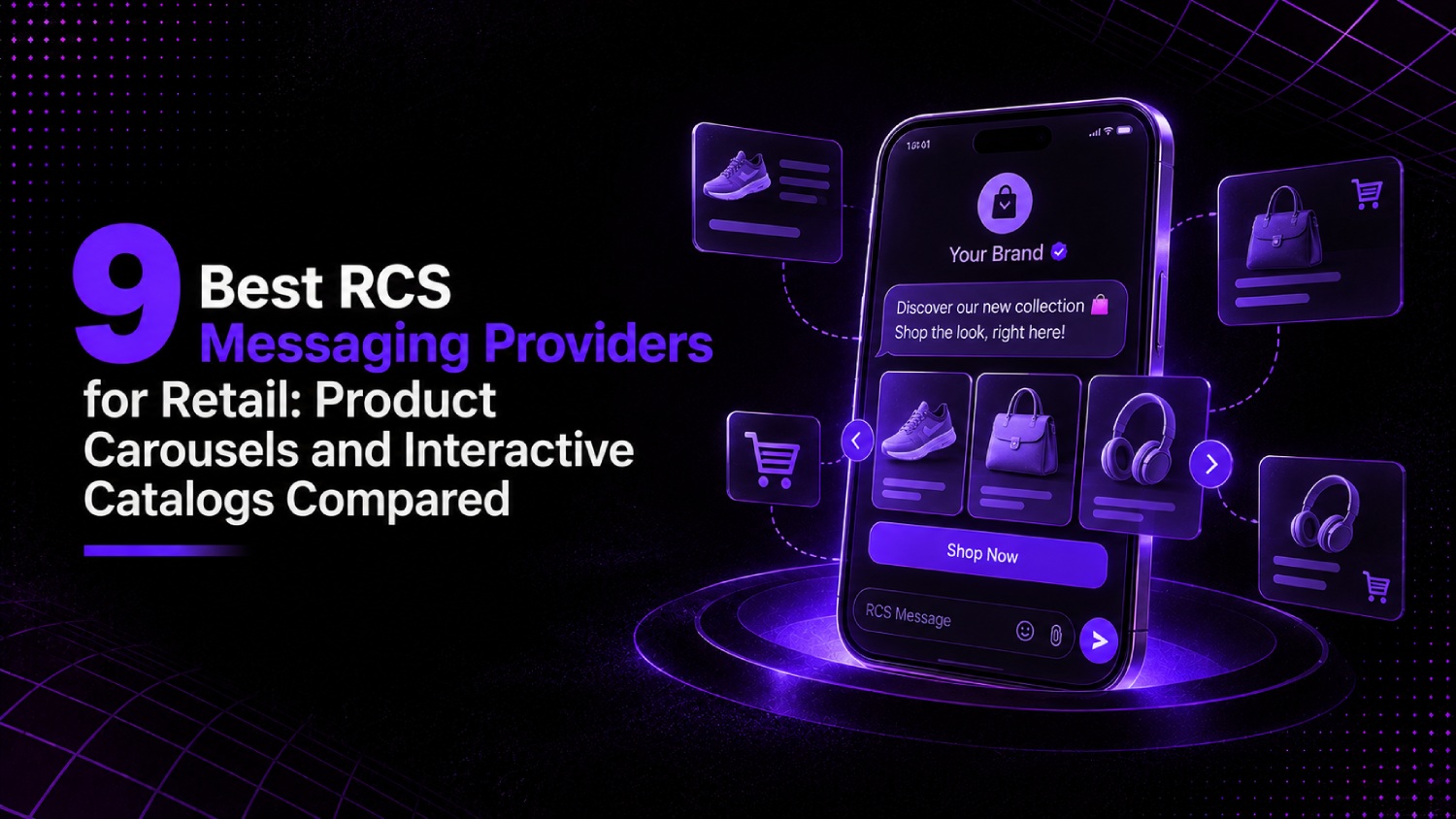
- Most RCS platforms send rich cards. Fewer than a handful support true in-message product carousels with deep retail integrations and the carrier agreements to deliver them at scale in the US.
- The gap between a provider that “supports RCS” and one that actually runs shoppable catalog campaigns is larger than most retail teams realize until they are mid-implementation.
- In-message checkout, verified sender branding, and real-time catalog sync are the three capabilities that separate revenue-driving RCS from glorified picture messages.
- WhatsApp catalogs are further along commercially in markets outside the US; RCS is the better bet for domestic retail brands targeting Android users on major US carriers today.
- The nine providers below were selected specifically for carousel and rich card depth. Bird, Emotive, and Yotpo are excluded from this list for editorial reasons.
The best RCS product catalog messaging providers for retail are Twilio, Sinch, Infobip, Braze, Attentive, Klaviyo, Vonage (now Vonage APIs by Ericsson), Google’s RCS Business Messaging via aggregators, and Salesforce Marketing Cloud. Each supports rich cards and carousels, but they diverge sharply on in-message checkout depth, catalog sync architecture, and whether they can get a campaign live in weeks or months.
Why Most Retail Teams Get RCS Product Catalogs Wrong Before They Even Launch
The assumption most marketing teams carry into an RCS evaluation is that the channel works like a better SMS: same send, richer wrapper. That framing leads to bad vendor choices. RCS business messaging is a fundamentally different protocol, and the product catalog use case specifically demands capabilities that have nothing to do with traditional SMS infrastructure.
A working retail RCS catalog campaign requires at minimum: a verified sender ID approved by carriers, a content template approved through Google’s RBM (Rich Business Messaging) agent framework, a rich card or carousel payload that renders inside the native Android Messages app, and a fallback path for non-RCS devices. Most providers can check one or two of those boxes. The ones on this list check all four, and some add in-message payment surfaces on top.
The other thing teams miss is the US carrier situation. RCS coverage has expanded materially since T-Mobile, AT&T, and Verizon all enabled RCS on their networks, but delivery is still not universal. A provider’s carrier relationships and aggregation agreements determine whether your carousel actually lands in the native inbox or falls back silently to SMS. That is an operational detail, not a nice-to-have.
What Is the AboutMartech Rich-Catalog Readiness Test?
Before building this list, we ran each provider through a four-point framework we call the Rich-Catalog Readiness Test. It is not a feature checklist. It is a pressure test for whether a platform can actually run a shoppable catalog campaign end-to-end for a retail brand, not just demo one.
Check 1: Carousel fidelity. Does the platform support multi-card horizontal carousels with per-card images, titles, descriptions, and action buttons, as defined in the RCS Business Messaging spec? Some platforms support single rich cards but not true carousels.
Check 2: Catalog sync architecture. Can the platform pull live product data, including price and inventory, from a product feed or commerce platform in near-real time? Static image uploads are a dead end for any catalog larger than a few dozen SKUs.
Check 3: In-message action depth. Beyond a “Buy Now” button that opens a browser, does the platform support quick replies, in-message forms, or native payment surfaces? This is where conversion lift actually lives.
Check 4: Carrier delivery transparency. Does the provider surface per-carrier delivery rates and RCS eligibility checks before send, so a retail team knows its actual reachable RCS audience versus the fallback SMS audience?
Providers that passed all four checks appear in the detailed profiles below. Providers that passed three are included with notes on the gap.
Which RCS Providers Support Carousels and Rich Cards at Scale?
1. Twilio
Twilio sits at the infrastructure layer for more RCS deployments in the US than any other provider, mostly because its carrier relationships are the deepest in the market. For retail teams that want to build a custom catalog experience rather than buy a packaged solution, Twilio’s RCS API gives the most control over payload structure, fallback logic, and rich card rendering.
Twilio supports both standalone rich cards and carousel cards through its Messaging API. Developers can specify card height, image aspect ratio, and multiple button types per card, including URL actions, dial actions, and suggested replies. The platform does not include a visual carousel builder out of the box, so teams without engineering resources will find the setup slower than with Braze or Klaviyo. Pricing is usage-based and publicly listed on Twilio’s pricing page as of this writing.
Where Twilio earns its slot on this list is carrier delivery transparency. The platform returns RCS eligibility at the phone number level before send, which means a retail team can calculate actual RCS audience size and expected fallback SMS volume before committing to a send. That operational visibility is rare. For more on how Twilio compares at the platform level, see the Twilio vs Sinch RCS comparison.
Best for: Retail brands with in-house engineering that want maximum control over catalog payload architecture.
Gap: No native visual campaign builder; requires code or a platform layer on top.
2. Sinch
Sinch operates its own carrier-grade messaging infrastructure and has RCS aggregation agreements across North America, Europe, and Asia-Pacific. Its Conversation API abstracts the channel layer, meaning a single integration can route the same campaign as an RCS carousel on Android, a WhatsApp message on iOS, or an SMS fallback, with the platform making the channel selection automatically based on device capability.
For retail product catalogs specifically, Sinch supports rich cards and carousels through its RCS Business Messaging implementation, and its Customer Dashboard includes a visual template builder that does not require code to configure a carousel layout. The catalog sync story is less mature: Sinch does not offer a native product feed connector, so teams need to push catalog data into the platform via API or use a middleware layer.
Sinch’s strength for retail is international scale. If a brand sells in the US and Germany and Australia, Sinch is one of the few providers that can run the same RCS catalog campaign across all three markets without stitching together regional vendors. Pricing is quote-based for enterprise volumes.
Best for: Multi-market retail brands that need a single vendor for RCS, WhatsApp, and SMS in one API.
Gap: Catalog feed sync requires custom integration work.
3. Infobip
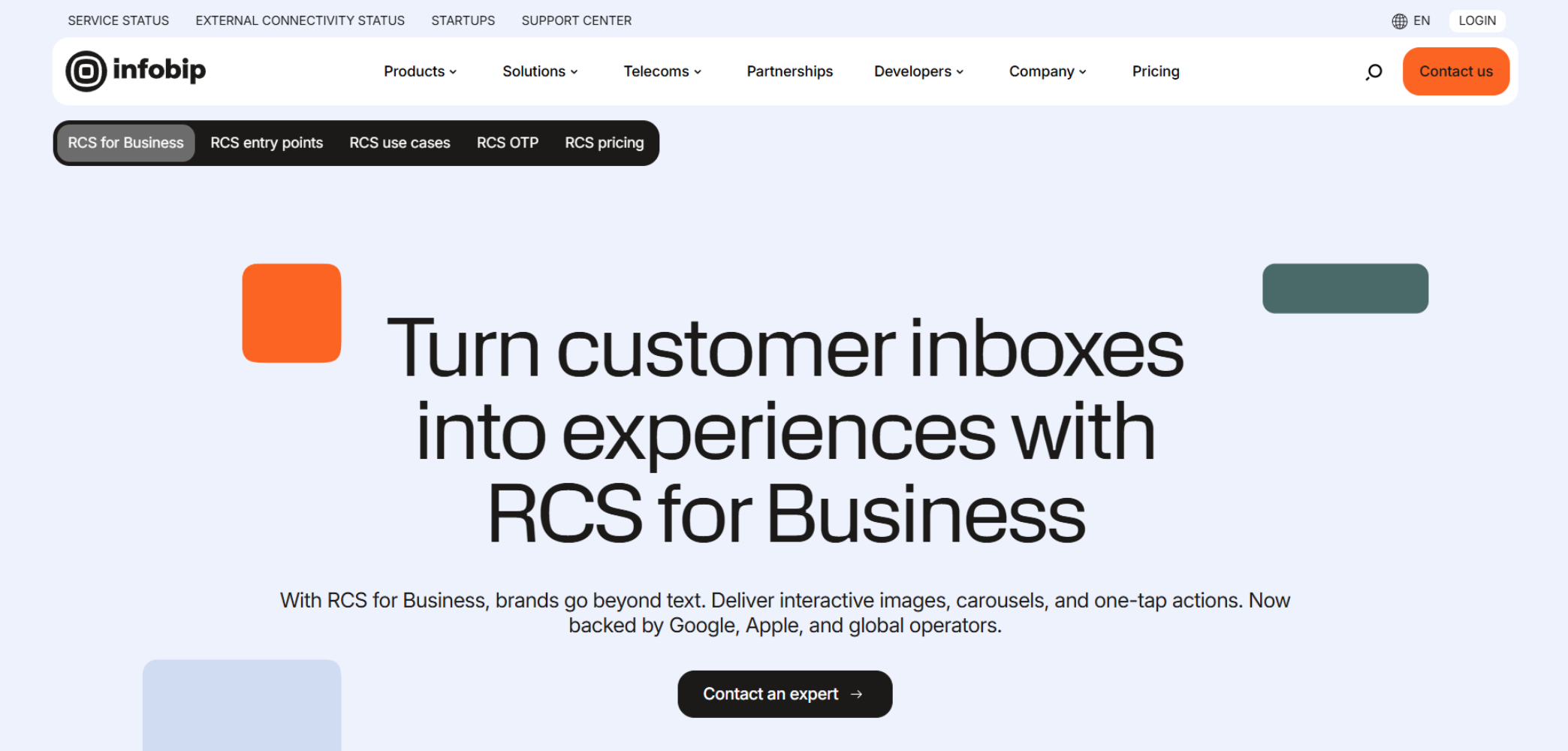
Infobip is the most complete out-of-the-box RCS platform on this list for retail teams that want to move fast without deep engineering investment. Its Moments campaign builder supports rich card and carousel creation visually, and its documentation, as reflected in the SERP data for “rcs product catalog messaging,” explicitly covers branded messages with multimedia, buttons, barcodes, and calls to action.
The retail-specific feature that sets Infobip apart is its People CDP layer, which allows brands to personalize carousel content by audience segment without writing custom code per message. A loyalty segment can receive a carousel of previously browsed products; a lapsed-customer segment can receive a carousel of current sale items. That kind of segmentation-driven personalization is what makes an RCS catalog campaign perform like a channel rather than a broadcast.
Infobip also has a strong compliance and sender verification track record, which matters for retail brands running high-volume promotional sends. Pricing is not publicly listed and requires a direct quote.
Best for: Retail marketing teams that want a fully managed RCS campaign workflow without heavy API development.
Gap: Pricing opacity makes budget forecasting harder at the evaluation stage.
4. Braze
Braze is a cross-channel customer engagement platform that added RCS as a native channel. For retail brands already running email, push, and SMS campaigns through Braze, adding RCS carousels is an extension of an existing workflow rather than a new vendor relationship.
The practical advantage for product catalogs is Braze’s Connected Content feature, which pulls live data from an external API into a message template at send time. A retail team can configure a carousel template that dynamically populates with real-time product data, current pricing, and inventory status without pre-building static card sets. That is genuine catalog sync, not a workaround.
Braze’s Canvas flow builder also lets teams sequence RCS carousels within multi-step campaigns. A customer who clicks a product card but does not convert can receive a follow-up push or email automatically. Braze pricing is enterprise and quote-based. It is not the right choice for a brand spending under roughly $50,000 annually on its messaging stack.
Best for: Retail brands already running cross-channel campaigns in Braze who want to add RCS carousels without a new vendor.
Gap: Entry cost is prohibitive for smaller retailers.
5. Attentive
Attentive built its reputation on SMS for e-commerce, and its RCS offering extends that same approach into rich messaging. The platform targets retail and DTC brands specifically, which means its pre-built templates and audience segmentation tools are calibrated for product promotion rather than transactional or B2B use cases.
Attentive’s RCS implementation supports rich cards and carousels with a visual builder, and the platform connects directly to product catalogs via integrations with major e-commerce platforms. For brands running promotional sends tied to specific SKUs or collections, the catalog-to-message pipeline is shorter here than at API-first providers like Twilio or Sinch.
The tradeoff is customization ceiling. Attentive’s visual workflow is efficient for standard retail campaigns but less flexible for teams that need to build highly tailored interactive experiences. Also worth noting: this article is evaluating providers at the platform level, not at the Shopify app level. For the app-store angle, the best SMS marketing apps for Shopify comparison covers that terrain separately.
Best for: DTC and e-commerce brands that want a retail-tuned RCS workflow without significant setup time.
Gap: Less flexibility for non-standard interactive use cases.
6. Klaviyo
Klaviyo is best known for email and SMS, but its RCS capabilities have expanded alongside the broader channel rollout. For retail brands already using Klaviyo for lifecycle marketing, the argument for adding RCS carousels here is the same as for Braze users: one platform, one data model, fewer integration points.
Klaviyo’s product catalog sync is a genuine strength. The platform’s integration with e-commerce data sources means product feeds, pricing, and inventory can flow into message templates dynamically. An abandoned browse flow can trigger an RCS carousel showing the exact products a customer viewed, with current price and a direct link to the product page, all without manual template management.
Klaviyo’s RCS feature set is newer than its email and SMS capabilities, so some advanced interactive features available through API-first providers are not yet available in Klaviyo’s visual builder. Pricing for Klaviyo is publicly listed and tiered by contacts and sends, making budget forecasting more straightforward than with quote-only vendors.
Best for: E-commerce brands that run Klaviyo for email and SMS and want to extend to RCS within the same platform.
Gap: RCS feature depth trails behind the platform’s email capabilities.
7. Vonage APIs (Ericsson)
Vonage APIs, now operating under Ericsson’s ownership, offers RCS Business Messaging through its Messages API with support for rich cards, carousels, and suggested actions. Like Twilio and Sinch, Vonage sits closer to the infrastructure layer and is better suited to teams building custom retail messaging applications than teams buying a packaged campaign tool.
What Vonage brings that peers sometimes lack is strong enterprise support infrastructure and carrier-grade SLAs, which matter for retail brands running time-sensitive campaigns like flash sales where delivery latency has direct revenue consequences. The platform also provides detailed delivery receipts at the carrier level.
The in-message action depth is solid for standard retail use cases: URL actions to product pages, quick reply buttons for size or color selection, and map actions for store locator scenarios. Native in-message payment is not a current feature. Pricing is usage-based with published rates for API calls.
Best for: Enterprise retail brands building custom RCS applications on top of a reliable carrier-grade API with strong SLAs.
Gap: No packaged retail campaign tooling; requires development investment.
8. Salesforce Marketing Cloud
Salesforce Marketing Cloud supports RCS as a channel within its messaging suite, which is relevant primarily for retail brands already running their CRM and marketing operations inside the Salesforce stack. The integration between Commerce Cloud product data and Marketing Cloud message templates makes catalog-driven RCS campaigns more tractable for large retail operations with complex SKU libraries.
The practical use case here is a large omnichannel retailer that has customer purchase history in Salesforce CRM, product catalog data in Commerce Cloud, and wants to run an RCS carousel campaign personalized by purchase category without building a separate integration layer. In that specific scenario, Salesforce Marketing Cloud has a real advantage. For teams not already deep in the Salesforce stack, the implementation cost and timeline make it a hard sell compared to Attentive or Klaviyo.
Salesforce Marketing Cloud pricing is quote-based and tends to carry significant platform minimums. See your account executive for current numbers.
Best for: Large retailers already operating on Salesforce CRM and Commerce Cloud who want RCS within the same data environment.
Gap: Implementation complexity and cost make it wrong for any brand not already invested in Salesforce.
9. Bandwidth
Bandwidth is a carrier-as-a-platform provider that owns its own tier-1 network, which gives it a structural advantage in RCS delivery that reseller-based providers cannot replicate. For retail brands that have been burned by deliverability problems on high-volume promotional sends, the direct carrier relationship matters.
Bandwidth’s RCS offering supports rich cards and carousels through its Messaging API, and the platform’s delivery visibility is among the best in this list: brands can see real-time delivery status by carrier and by device RCS eligibility, which feeds directly into send optimization. The platform does not include a retail campaign builder, so it sits firmly in the infrastructure category alongside Twilio and Vonage.
Where Bandwidth earns a spot over other infrastructure providers is its CPaaS (Communications Platform as a Service) structure, which lets retail brands build RCS messaging on top of actual carrier infrastructure rather than a reseller layer. That typically translates to better delivery rates on the margin and more predictable latency on flash sale sends. Pricing is enterprise and quote-based.
Best for: Enterprise retail brands with engineering teams who want the highest possible delivery reliability and direct carrier-level visibility.
Gap: No campaign UI; this is infrastructure, not a marketing tool.
RCS Product Catalog Feature Comparison: Rich Cards, Carousels, and In-Message Commerce
| Provider | Rich Cards | Carousels | Live Catalog Sync | In-Message Actions | Visual Campaign Builder | Carrier Delivery Visibility | Best Fit |
|---|---|---|---|---|---|---|---|
| Twilio | Yes | Yes | Via API | URL, dial, reply | No (code required) | Yes, per-number eligibility | Dev-led retail builds |
| Sinch | Yes | Yes | Via API / middleware | URL, reply, location | Partial (template builder) | Yes | Multi-market retail |
| Infobip | Yes | Yes | Via Moments CDP | URL, reply, barcode | Yes | Yes | Fast-moving retail teams |
| Braze | Yes | Yes | Yes (Connected Content) | URL, reply, deep link | Yes (Canvas) | Partial | Cross-channel retail lifecycle |
| Attentive | Yes | Yes | Yes (e-comm integrations) | URL, reply | Yes | Partial | DTC and e-commerce brands |
| Klaviyo | Yes | Yes | Yes (native catalog) | URL, reply | Yes | Partial | Klaviyo-first retail teams |
| Vonage APIs | Yes | Yes | Via API | URL, reply, map | No (code required) | Yes | Enterprise custom builds |
| Salesforce MC | Yes | Yes | Yes (Commerce Cloud) | URL, reply, deep link | Yes (Journey Builder) | Partial | Salesforce-native retailers |
| Bandwidth | Yes | Yes | Via API | URL, reply | No (infrastructure only) | Yes, carrier-level | High-volume delivery focus |
Can Customers Actually Buy Inside an RCS Message?
This is the question retail teams ask most often and get the most optimistic answers to from vendors. The honest answer is: it depends on how you define “in-message checkout.”
True one-tap in-message payment, where a customer completes a transaction without leaving the messaging app, is not yet widely available in RCS in the US. The RCS spec supports payment action buttons as part of the Rich Business Messaging framework, but carrier and OS-level support for completing a payment inside Android Messages varies. Google Pay integration within RCS exists in limited deployments, but it is not a standard capability that any provider on this list can guarantee at scale today.
What all nine providers support is what the industry calls “commerce-adjacent” RCS: a carousel card with a “Buy Now” or “Shop Now” button that deep-links directly to a pre-populated product page or cart. That is meaningfully better than SMS, which sends a link that opens a generic homepage. For a retail brand measuring revenue per message, the difference between a deep-linked product page and a homepage is significant, even without true in-message payment. Understanding how to attribute that revenue accurately connects back to the broader challenge of ecommerce attribution for DTC brands.
The providers closest to real in-message commerce are Braze, Attentive, and Infobip, all of which have built integrations with commerce platforms that allow cart creation or wish-list actions to be triggered by an in-message button tap, even if the final payment step happens in a browser or app.
RCS vs WhatsApp for Product Catalogs: Which Wins for US Retail Brands?
WhatsApp has a more mature product catalog feature globally. Meta’s WhatsApp Business Platform includes a native catalog object, in-conversation product browsing, and cart functionality that is further developed than what RCS supports today. For retail brands targeting customers in markets where WhatsApp penetration is high , Latin America, India, much of Europe , that matters enormously. For a deeper look at how these two channels split by audience and use case, see the best WhatsApp marketing platforms for US DTC brands comparison.
For US retail brands targeting domestic customers, RCS is the more practical channel. WhatsApp’s US install base, while growing, does not approach the Android messaging install base that RCS reaches natively. An Android user in the US does not need to download WhatsApp or opt into a separate app , RCS messages arrive in the same inbox as their existing texts, which removes friction from the recipient side entirely. WhatsApp’s penetration in the US sits well below that of markets like Brazil or India, where it functions as a primary messaging platform.
There is also a branding dimension. RCS Business Messaging supports verified sender IDs with brand logos and colors displayed inside the message thread, a feature WhatsApp supports but with more restrictive brand controls for businesses. For a retail brand investing in visual identity, the RCS verified sender experience is a cleaner canvas for brand presentation. See the WhatsApp vs SMS for marketing comparison for a broader channel-level analysis that also touches on how these channels split by audience and geography.
What Does RCS Product Catalog Messaging Actually Cost?
Pricing across this category is fragmented, and that fragmentation is intentional. Infrastructure providers like Twilio, Sinch, Vonage, and Bandwidth publish per-message or per-API-call rates but apply volume discounts negotiated privately. Platform providers like Braze and Salesforce Marketing Cloud are fully quote-based with platform minimums that run into the tens of thousands of dollars annually before message volume costs.
The mid-tier providers, Attentive, Klaviyo, and Infobip, blend platform fees with usage-based messaging costs. Klaviyo’s pricing is the most transparent of the three, with published tier pricing based on active contacts and included message volumes. Attentive and Infobip both require a sales conversation to get real numbers.
A practical estimate for a mid-size retail brand sending 500,000 RCS messages per month: Twilio’s publicly listed RCS pricing, for example, gives a sense of the per-message floor for API-first providers, though volume discounts apply. As a general reference point, RCS message costs at API rates tend to run higher than standard SMS but vary materially by carrier, provider, and negotiated volume tier. Running a direct quote comparison between two or three providers using your actual send volumes is worth the time before signing a contract. The spread between providers is wide enough that a bake-off pays for itself.
How to Get a Retail RCS Campaign Live Without a Six-Month Implementation
The biggest implementation drag is sender verification. Every RCS business sender in the US must go through Google’s RBM agent registration process, which involves brand verification, use case approval, and carrier approval. The timeline is typically four to twelve weeks depending on the complexity of the use case and how complete the application is on submission.
Providers that can accelerate this: Infobip and Sinch both have dedicated RBM onboarding teams that prepare and submit agent applications on behalf of clients, which reduces back-and-forth with Google. Twilio’s documentation is thorough but the process is more self-serve. For the full process, the verified RCS business sender guide covers each step.
After sender verification, catalog integration is the second biggest variable. Brands with a clean product feed in a standard format (Google Shopping XML, Shopify Storefront API, or similar) can connect to Attentive or Klaviyo’s native integrations in days. Brands with a custom ERP or proprietary product database will need API work regardless of which provider they choose. Scoping that integration honestly at the start of an evaluation saves significant time.
Frequently Asked Questions
What is a rich card in RCS messaging?
A rich card is a structured message format within RCS Business Messaging that combines an image or video, a title, a description, and one or more action buttons in a single card. Rich cards render natively inside Android Messages on supported devices. A carousel is a sequence of rich cards displayed horizontally, allowing a recipient to swipe through multiple products, offers, or pieces of content within a single message thread.
Which RCS providers support carousels specifically, not just single rich cards?
All nine providers on this list support carousel card formats: Twilio, Sinch, Infobip, Braze, Attentive, Klaviyo, Vonage APIs, Salesforce Marketing Cloud, and Bandwidth. The implementation differs. API-first providers like Twilio and Vonage require carousel payloads to be built in code. Platform providers like Braze, Attentive, and Infobip offer visual builders that configure carousels without writing JSON.
Can customers buy directly inside an RCS message today?
Not universally. True in-message payment completion inside the native Android Messages app is not yet a standard feature available at scale in the US. What is available is action buttons that deep-link to pre-populated product pages or carts in a browser or mobile app. Braze, Attentive, and Infobip are the closest to in-message commerce today, with integrations that allow cart creation to be triggered by a button tap before the final payment step.
What is the best RCS provider for a retail brand in the US?
It depends on your stack. For DTC brands without heavy engineering resources, Attentive or Klaviyo are the fastest paths to a live RCS catalog campaign with native e-commerce integrations. For brands already on Braze, staying in-platform is the most efficient route. For enterprise retailers on Salesforce, Marketing Cloud makes sense. For brands that want maximum delivery reliability and have engineering capacity, Twilio or Bandwidth offer the most carrier-level control.
What is the difference between RCS and RCS Business Messaging?
RCS is the underlying protocol that upgrades text messaging with rich media, read receipts, and typing indicators. RCS Business Messaging (RBM) is the commercial framework built on top of RCS that allows brands to send as a verified business sender with a branded agent identity, logos, and approved message templates. Retail catalog campaigns run on RBM, not raw RCS, because the sender verification and template approval are what give the brand-safe, recognized-sender experience.
Does RCS work on iPhone?
As of iOS 18, which Apple released in September 2024, iPhones can send and receive RCS messages with Android users. However, RCS Business Messaging , the commercial variant that delivers branded rich cards and carousels , has more limited support on iOS compared to Android at this stage. Retail brands should plan for a meaningful portion of their customer list to receive SMS fallback rather than the full RCS experience, and any provider worth working with will surface that split before a campaign sends.
How does RCS product catalog messaging compare to email for retail?
Email still wins on rich media maturity and creative flexibility. A full email template with product grids, editorial imagery, and complex layouts is harder to replicate inside a message thread. RCS wins on delivery placement: a native inbox message is not competing with dozens of promotional emails in a crowded folder. The channels serve different moments. RCS carousels perform best for time-sensitive promotions, restock alerts, and post-browse retargeting, where the immediacy of messaging outweighs the creative depth of email.
The Real Dividing Line in This Market
Every provider on this list can send a rich card. The actual dividing line is whether a platform can run a catalog campaign that feels live, meaning the prices are current, the inventory is accurate, and the product selection is personalized to that recipient at the moment of delivery. That requires real integration with a product data source, not a static image upload workflow.
Braze’s Connected Content, Klaviyo’s native catalog sync, and Attentive’s e-commerce integrations are the three implementations that come closest to that standard today. Infobip gets there through its People CDP layer. The infrastructure providers (Twilio, Sinch, Vonage, Bandwidth) can get there too, but they require the retail team to build and maintain the data pipeline that feeds the templates. That is a legitimate choice for teams with engineering capacity, and it buys more flexibility on the back end.
The retail teams that treat RCS carousels as a better SMS and use them for the same static broadcast approach they already run will see incremental results. The teams that connect live product data, use segmentation to control which carousel a given customer sees, and track post-click behavior back through their attribution stack will find the channel behaves much more like a targeted performance channel than a broadcast one. That shift in mental model , from broadcast rich message to personalized in-message storefront , is where the actual revenue difference lives. If you are still building the measurement infrastructure to prove it, the marketing attribution tools comparison covers the options worth considering alongside your RCS rollout.