
- OOH attribution is no longer guesswork. Mobile device IDs, programmatic DOOH data, and media mix modeling let you connect billboard exposure to site visits, store traffic, and revenue.
- The vendors on this list use a mix of deterministic geofencing, probabilistic identity graphs, and panel-based methods. Each has a different strength depending on whether you run static OOH, programmatic DOOH, or a blended campaign.
- Pricing is almost universally quote-based at this tier. Expect to spend meaningful budget before any vendor will engage seriously.
- The biggest gap in most attribution stacks is offline-to-online linkage. These tools solve that differently, and the method matters more than the brand name.
- If you already use a marketing mix modeling tool or a CDP, check integration depth before signing a contract.
The OOH attribution vendors worth evaluating include Billups, StreetMetrics, Veritone One, Placer.ai, Quividi (now part of Alfi), and the DOOH measurement layer inside The Trade Desk. Each takes a different technical approach to connecting outdoor ad exposure to downstream behavior, from mobile device geofencing to camera-based impression counting to probabilistic modeling against purchase panels.
Why OOH Attribution Is Harder Than Digital, and Why That’s Changing
A paid search click is a transaction with a timestamp. A billboard impression is an exposure event with no pixel, no cookie, and no consent string. For decades, that gap made OOH a brand spend category that lived outside performance budgets entirely.
Three things changed that. First, the proliferation of mobile devices means most people who pass a billboard carry a persistent identifier in their pocket. Second, programmatic DOOH platforms now log impression timestamps and screen coordinates with machine precision. Third, identity resolution technology matured to the point where device-level data can be matched, probabilistically or deterministically, to known customers or audience segments.
The result is a measurement category that looks increasingly like digital attribution, with its own version of the familiar trade-offs between deterministic accuracy and probabilistic scale. If you are already thinking through those trade-offs for your broader attribution stack, the best marketing attribution tools overview on AboutMartech covers the foundational models that OOH measurement sits inside.
How OOH Attribution Actually Works: The Four Signal Types
Before evaluating vendors, you need to understand what signals they actually use. Most use at least two of the following four, and the combination determines both accuracy and the privacy risk your legal team will flag.
Geofencing and mobile device IDs: A virtual perimeter is drawn around a billboard or OOH unit. When a mobile device passes through that perimeter, its advertising ID is recorded. The vendor then tracks whether that device later visits a store, website, or conversion point. Coverage depends on how many apps have location SDKs installed on a given device, which varies by region and demographic.
Programmatic impression data: Digital OOH screens log play events with timestamps and geolocation. Vendors who plug into DSPs or SSPs can correlate impression windows with device-level exposure data from mobile signals. This works only for DOOH inventory, not static boards.
Panel-based exposure modeling: A panel of opted-in consumers report OOH exposure through surveys or GPS-tracked apps. Their behavior is extrapolated to broader audiences. Lower resolution than device-level methods, but cleaner from a consent standpoint.
Camera and sensor data: Some DOOH vendors attach cameras or infrared sensors to screens and count actual viewers, sometimes with demographic estimation (age range, gender). This is audience measurement, not conversion attribution, but it feeds into reach and frequency calculations that upstream attribution models need.
The AboutMartech OOH Attribution Fit Matrix
Evaluating these vendors purely on feature lists misses what actually matters: the fit between your measurement problem and their signal methodology. The table and comparison sections below are organized around a framework we call the AboutMartech OOH Attribution Fit Matrix, a two-axis structure that maps every vendor by signal type (device-ID-heavy vs. panel-and-modeling-heavy) and campaign type (static OOH vs. programmatic DOOH).
The matrix is not decorative. It produces a specific selection logic. Deterministic, device-ID-based vendors sit in the upper-left quadrant: higher confidence per attributed conversion, but increasingly exposed to signal loss as Apple’s ATT framework and Android’s equivalent erode passive location collection. Panel and modeling vendors sit in the lower-right quadrant: wider confidence intervals, but privacy-compliant by design and more defensible in regulated categories. Camera-based vendors occupy their own lane entirely, they measure the quality of exposure upstream, before the conversion chain begins.
A brand running a short-burst DOOH campaign in a dense metro needs a different quadrant than a regional retailer measuring foot traffic from static highway boards over eight weeks. Knowing where your measurement problem sits tells you which vendor to call first, and which methodology your legal and analytics teams need to pressure-test before you sign.
Where this connects to your broader stack: the signal-type axis maps directly onto the identity-resolution debate in CDPs and attribution platforms. If you are already working through that question, the CDP evaluation guide on AboutMartech covers the deterministic-vs-probabilistic tradeoff in detail, and the same logic applies here.
6 OOH Attribution Vendors Worth Evaluating
1. Billups

Billups is one of the few companies that straddles both OOH planning and attribution under one roof. They started as an OOH agency and built measurement capabilities in-house, which means their attribution methodology is tied directly to their media buying data. That vertical integration is an advantage if you want one vendor handling execution and measurement. It is a conflict of interest if you want fully independent verification.
Their attribution approach uses mobile location data to build exposure audiences around OOH placements, then tracks downstream digital behavior, including site visits, app opens, and search lift. They report on metrics like visitation lift and online conversion lift, with control groups derived from device panels that did not pass the exposure zone. Pricing is not publicly disclosed and is tied to campaign scope.
In the Fit Matrix, Billups sits in the device-ID-heavy, static-plus-DOOH quadrant, making them the natural starting point for mid-market buyers who want a single partner managing both the buy and the measurement, and who run blended OOH campaigns rather than pure programmatic.
Best for: Mid-market advertisers running planned OOH campaigns through an agency model who want measurement baked into the buy rather than bolted on after.
2. StreetMetrics
StreetMetrics focuses specifically on transit OOH, including buses, trains, and rideshare vehicles. That focus is unusual enough to matter. Transit OOH has different dwell times, audience profiles, and geographic patterns than static roadside billboards, and most general OOH attribution vendors do not model for it specifically.
Their methodology uses GPS data from transit vehicles combined with mobile device exposure data to build audience segments around transit routes. They then measure behavior change in exposed segments versus unexposed control groups. In Fit Matrix terms, StreetMetrics occupies a specialized cell that most vendors leave empty: device-ID-based signal paired with a campaign type, moving transit, that geofences alone cannot handle cleanly. For brands targeting urban commuters or running transit media buys through transit authorities, this specificity is hard to replicate with a general-purpose OOH attribution tool. Pricing is quote-based.
Best for: Brands running transit OOH in major metros who need a vendor that models for route-level exposure rather than static geofences.
3. Veritone One
Veritone One is primarily known for audio advertising, but their attribution offering covers traditional media broadly, including OOH. Their approach leans on AI-driven media mix modeling rather than device-level tracking, which positions them in the modeling-heavy, multi-channel quadrant of the Fit Matrix, the right call when you are measuring OOH as one input in a broader offline spend, not as a standalone channel.
Because they sit inside the broader Veritone platform, their OOH attribution can be combined with radio, podcast, and streaming TV measurement in a single model. For brands running broad upper-funnel campaigns across multiple offline channels, that cross-channel modeling capability is genuinely useful. The trade-off is that media mix modeling gives you channel-level attribution, not campaign-level or placement-level precision. If you need to know whether a specific board on I-95 drove conversions, a geofencing-based vendor will give you more granularity.
This vendor pairs well with a review of marketing mix modeling tools if your team is still evaluating whether MMM is the right methodology for your measurement stack.
Best for: Brands spending across traditional offline channels who want unified measurement rather than OOH-specific reporting.
4. Placer.ai
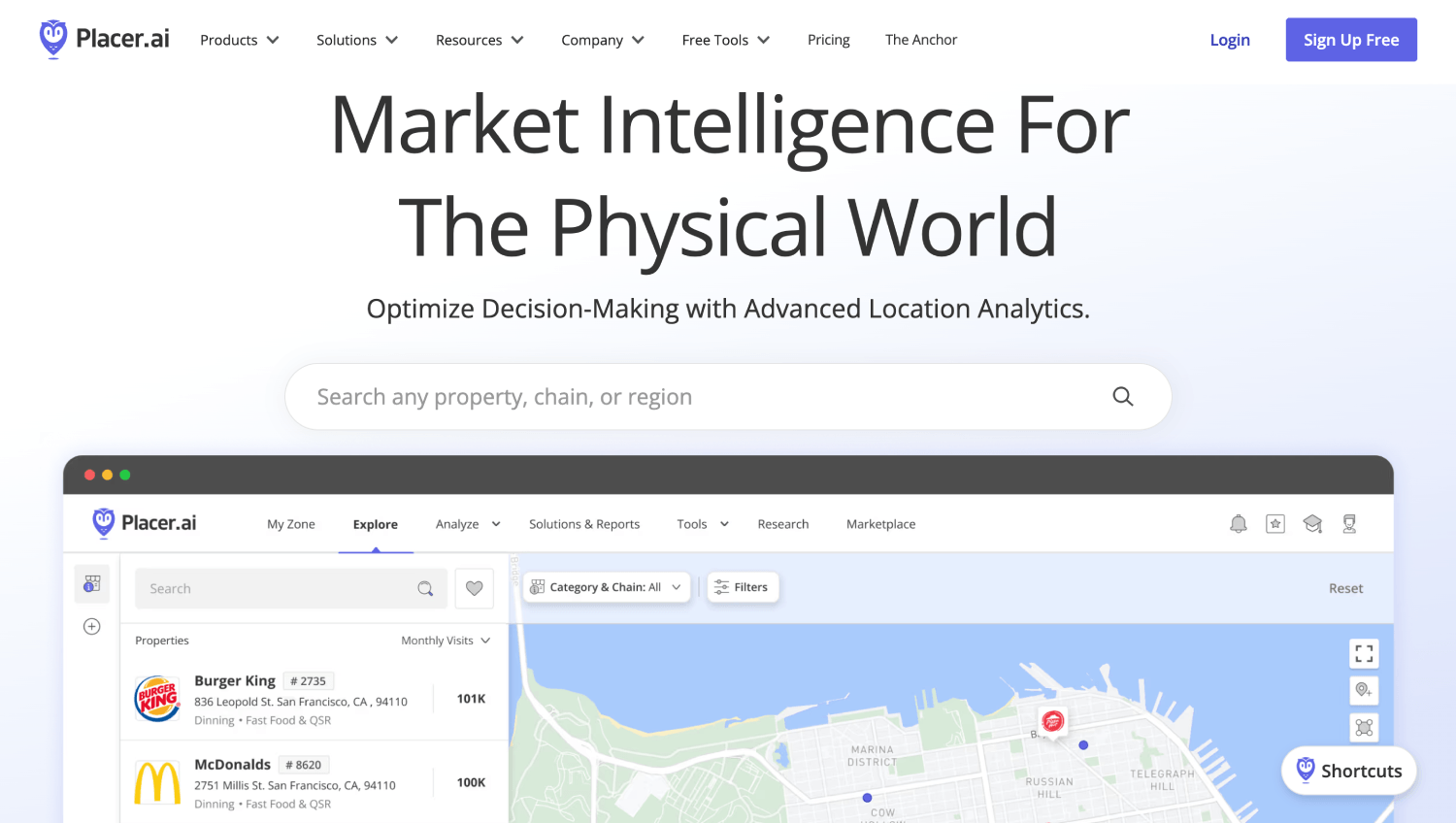
Placer.ai is primarily a foot traffic analytics platform, but the way advertisers use it for OOH attribution is worth understanding. Their core product ingests anonymized mobile location data to estimate visits to physical locations. For retailers and QSRs, the use case maps naturally onto OOH attribution: run a campaign near a store, measure whether foot traffic to that store increased in the exposed audience segment.
Placer.ai does not position itself as an OOH attribution vendor specifically, but its audience filtering and visit analysis tools are used that way by many OOH buyers. In Fit Matrix terms, it sits in a hybrid position, panel-and-modeling-leaning on the signal axis, but practical for static and DOOH campaigns alike, as long as the conversion event is a physical visit. The platform’s location data coverage is extensive enough that you can build reasonably strong control groups and exposed audience comparisons without relying on the OOH vendor to self-report. That independence is valuable. Pricing is subscription-based but not publicly listed at the platform tier most enterprise advertisers need.
Best for: Retail, QSR, and location-based businesses that already use foot traffic data and want to extend it into OOH measurement without buying a dedicated attribution platform.
5. Quividi (Alfi)
Quividi, now operating under the Alfi umbrella after acquisition, takes a fundamentally different approach: they measure OOH audiences at the screen level using camera-based AI. Rather than tracking what happens after exposure, they focus on counting and classifying who actually saw the ad, estimating attention time, and feeding that data into reach and frequency reporting.
In the Fit Matrix, Quividi occupies its own vertical, camera-and-sensor signal, DOOH campaign type, and the right way to think about them is as an upstream input to attribution, not an attribution tool in itself. Camera-based methods tell you how many people looked at your creative and for how long, but they do not tell you whether those people later bought something. For brand campaigns where the goal is reach frequency and attention quality, that is exactly the right metric. For performance advertisers who need conversion linkage, this vendor alone does not close the loop.
Quividi’s technology is most widely deployed in Europe and Asia, where DOOH infrastructure is more mature. North American coverage is growing but thinner. Pricing is not publicly disclosed.
Best for: DOOH buyers and media owners who want to measure and optimize for attention quality and audience composition rather than conversion events.
6. The Trade Desk DOOH Measurement

The Trade Desk is a DSP, not an OOH attribution specialist, but their DOOH measurement layer is worth including because of where the industry is heading. As more OOH inventory moves to programmatic, the measurement infrastructure inside DSPs becomes the de facto attribution layer for DOOH campaigns. The Trade Desk can ingest DOOH impression data alongside digital display, CTV, and audio, and build cross-channel attribution models against a unified identity graph.
In Fit Matrix terms, The Trade Desk sits in the upper-right quadrant: programmatic impression data as the primary signal, programmatic DOOH as the campaign type. That is a precise fit for teams already buying DOOH through the platform, and a poor fit for anyone measuring static boards or non-programmatic inventory. For teams already running programmatic campaigns through The Trade Desk, adding DOOH inventory and attribution through the same platform eliminates a reconciliation step that external OOH attribution vendors require.
Understanding how device-level identity resolution works across channels is easier if you have already mapped out your CDP and identity infrastructure. The Trade Desk’s UID 2.0 identity framework connects at that layer.
Best for: Teams already buying programmatic DOOH through The Trade Desk who want unified cross-channel attribution without a separate point solution.
OOH Attribution Vendor Comparison Table
| Vendor | Primary Signal Type | Best Campaign Type | Conversion Attribution? | Pricing Model | Best For |
|---|---|---|---|---|---|
| Billups | Mobile device ID, geofencing | Static + DOOH | Yes (site visits, in-store) | Quote-based | Mid-market, agency-style buying |
| StreetMetrics | GPS + mobile device ID | Transit OOH | Yes (segment-level) | Quote-based | Urban transit campaigns |
| Veritone One | Media mix modeling | Broad offline (OOH + audio) | Channel-level only | Quote-based | Multi-channel offline advertisers |
| Placer.ai | Mobile location (anonymized) | Retail/location OOH | Foot traffic proxy | Subscription (quote) | Retail, QSR, location-based |
| Quividi (Alfi) | Camera-based AI | DOOH (screen-level) | No (attention only) | Quote-based | Brand reach and attention quality |
| The Trade Desk | Programmatic impression + UID 2.0 | Programmatic DOOH | Yes (cross-channel) | DSP-based (% of spend) | Programmatic buyers, unified measurement |
What Should You Evaluate Before Signing an OOH Attribution Contract?
The six questions below are not a generic checklist. They reflect the specific failure modes in OOH attribution contracts that teams discover after signing.
First, ask how control groups are constructed. The difference between a vendor who uses a randomized holdout and one who uses a modeled control group is the difference between causal inference and correlation. Most vendors use the latter and do not volunteer that distinction.
Second, ask about coverage in your specific markets. Location data density varies significantly by city, region, and demographic. A vendor who covers New York and Los Angeles well may have thin signal in secondary markets where your boards actually run.
Third, ask whether their methodology has been independently audited. The Media Rating Council publishes standards for OOH measurement. Vendors who have sought MRC accreditation or third-party audit have put their methodology under external scrutiny. Those who have not may be measuring accurately, but you have no way to verify it.
Fourth, understand the latency between campaign exposure and reported conversions. Some platforms report near-real-time. Others have a 2-4 week reporting lag because of how location data is aggregated and cleaned. If you are optimizing a short-duration campaign, reporting lag makes the data nearly useless for in-flight decisions.
Fifth, confirm what data they retain and for how long, and whether your campaign data is commingled with other clients’ data in shared panels or models. This matters both for competitive confidentiality and for emerging state-level privacy regulations that affect location data collection.
Sixth, ask explicitly how their attribution interacts with your existing stack. If you run marketing mix models, do they export data in a format your MMM vendor can ingest? If you are building a first-party data strategy, can their exposure audiences be matched back to your CRM without a third party holding the keys? The data portability question is as important as the methodology question.
Illustrative Scenario: What OOH Attribution Looks Like in Practice
Consider a regional QSR chain running a four-week DOOH campaign across 80 programmatic screens in three metros, Chicago, Dallas, and Atlanta. They are spending on inventory through a DSP and running creative that rotates between a lunch promotion and a new menu item depending on daypart. They want to measure whether the campaign drove incremental store visits versus a control population, and they need the answer broken out by market because their franchisee cost-sharing model requires it.
A geofencing-based vendor like Billups would draw exposure zones around each of the 80 screen locations, capture device IDs that passed through during active campaign windows (accounting for daypart scheduling so a device recorded at 2 a.m. outside an inactive screen is excluded), and then track whether those devices appeared at any of the chain’s locations in the following 14 days. A control group of device IDs with similar demographic and behavioral profiles, matched on home location, visit frequency to QSR categories generally, and income proxy, that did not pass through exposure zones gives you the baseline. The vendor reports visitation lift as the percentage difference between the two groups, cut by metro and by creative variant.
That method works. It also has known gaps. Devices without location-enabled apps are invisible. Households where one person saw the ad but a different person visited the store show as a non-conversion. And the geofence radius around a busy urban DOOH screen in Chicago’s Loop captures a lot of people who were walking past with their heads down, not looking at the screen at all.
This is why layering Quividi’s attention data on top of geofencing data produces a more defensible numerator. Instead of attributing conversions to everyone who passed through the exposure zone, you weight the exposed audience by the estimated attention rate Quividi measures at each screen, so a screen with 40% average dwell-attention gets a proportionally smaller exposure credit than one with 65%. You are not attributing conversions to everyone who walked past. You are attributing them to the estimated share who actually registered the creative. The methodology is still probabilistic, but the logic is tighter, and you have a screen-level quality metric to bring into the franchisee conversation. This kind of multi-vendor measurement architecture, geofencing for reach, camera data for attention quality, matched against a first-party visit graph, is where the more disciplined OOH buyers are heading.
How Does OOH Attribution Connect to Your Broader Measurement Stack?
OOH attribution does not exist in isolation. The conversion events these vendors measure, whether site visits, store visits, or purchase events, are the same events your digital attribution stack tracks. That creates a double-counting risk that is easy to overlook and hard to unwind after the fact.
If a consumer sees your billboard, then clicks a retargeted display ad 48 hours later, and then converts, your digital attribution model will likely give most or all of the credit to the display click. Your OOH attribution vendor will count the same conversion as a billboard-driven visit. Both are right about the exposure. Neither is right about the cause.
The only clean solution is a unified measurement framework that treats OOH as one channel in a multi-touch or media mix model, not as a silo with its own conversion counter. For B2B teams dealing with similar multi-touch complexity, the B2B attribution tools overview covers how multi-touch models handle this kind of cross-channel overlap, and most of the logic transfers directly to OOH.
Teams that use a reverse ETL pipeline to push CRM and conversion data back into their measurement tools have a structural advantage here, because they can feed first-party conversion events into OOH attribution models rather than relying on the vendor’s proprietary conversion graph. That architecture is worth building before you start layering in OOH measurement.
Frequently Asked Questions About OOH Attribution Vendors
What is the difference between OOH attribution and DOOH measurement?
OOH attribution broadly refers to connecting any out-of-home ad exposure, including static billboards, transit, street furniture, and digital screens, to downstream behavior like store visits or website conversions. DOOH measurement specifically refers to digital OOH screens, where programmatic impression data is available. DOOH measurement is generally more precise because impression timestamps and screen coordinates are logged automatically. Static OOH attribution relies entirely on inferred exposure from mobile location signals, with no direct impression record.
How accurate is billboard attribution software?
Accuracy varies by methodology and geography. Geofencing-based methods depend on the density of location-enabled devices in the exposure area and the quality of the vendor’s device graph. In dense urban environments with high smartphone penetration, exposure modeling can be reasonably precise. In rural or suburban areas, signal quality drops. Panel-based methods have wider confidence intervals but are methodologically cleaner. No OOH attribution vendor provides deterministic accuracy at the individual impression level for static OOH. Treat reported lift numbers as directional, not exact.
Do OOH attribution vendors require access to my CRM or customer data?
It depends on what you want to measure. If the conversion event you care about is a website visit or in-store foot traffic, most vendors can measure that without CRM access. If you want to attribute OOH exposure to revenue or CRM pipeline, you will need to pass conversion data to the vendor or match your CRM records against their device graph. Ask explicitly about the data handshake process and who retains what after the engagement ends.
Can OOH attribution work for B2B advertisers running out-of-home campaigns?
It can work, with limitations. B2B OOH campaigns, typically targeting commuters in specific office corridors or airport advertising near conference venues, can use geofencing to identify exposed device IDs and then attempt to match those devices to known business email addresses or LinkedIn profiles through identity resolution. The match rate is lower than consumer campaigns, and the attribution chain from billboard to enterprise pipeline is long. B2B OOH attribution is feasible for measuring awareness metrics like branded search lift, but connecting it to closed revenue is methodologically difficult.
What does OOH attribution cost?
Every vendor on this list operates on a quote-based pricing model. Cost typically scales with the number of OOH units being measured, the geographic scope, the measurement duration, and the depth of reporting required. Custom analytics, dedicated account management, and API data delivery add to baseline measurement costs. Budget conversations should begin well before campaign launch, as some vendors require a setup period to establish geofences and baseline device panels before the campaign runs.
Is location data used in OOH attribution compliant with privacy regulations?
The regulatory picture is evolving. Location data collection through mobile SDKs is subject to app-level consent frameworks, Apple’s App Tracking Transparency, and Google’s equivalent on Android. Some states, including California under CCPA, impose additional restrictions on the sale and use of precise location data. Vendors who use opted-in panels rather than passively collected device IDs carry lower regulatory risk. Ask any vendor to specify the consent framework their data collection operates under and whether their methodology has been reviewed against current state-level privacy laws.
The Core Tension Every OOH Advertiser Has to Resolve
The most important thing to understand about OOH attribution is that it measures a proxy, not the thing itself. No vendor gives you a direct causal link between a billboard impression and a conversion. What they give you is a statistically reasoned argument that people who were exposed behaved differently than people who were not. That is useful information. It is not the same as a click-through rate.
That distinction should change how you present OOH attribution data internally. If you take a vendor’s “visitation lift” figure and compare it directly to a digital channel’s cost-per-conversion, you will make a bad decision, because the confidence intervals are not equivalent. OOH measurement is best used to defend channel-level budget allocation within a media mix model, not to calculate per-unit ROI in the same way you would for paid search.
The teams getting the most from these tools are the ones who have already resolved the foundational measurement question of how their channels interact, and who are using OOH attribution to fill a specific gap in that model. If your broader attribution architecture still needs attention, start there before adding another measurement layer on top. The cookieless measurement playbook on AboutMartech covers the foundational decisions that make OOH data actually usable once it arrives.