- Rule-based lead scoring assigns points manually, which means your model reflects whoever built it, not what actually predicts conversion.
- Predictive lead scoring uses historical win/loss data to surface patterns humans miss, including firmographic combinations and behavioral sequences that correlate with closed revenue.
- The tools on this list fall into three model types: rule-based, predictive/ML, and intent-driven. Matching the model type to your data maturity matters more than feature checklists.
- MadKudu and Breadcrumbs are purpose-built for B2B revenue teams; HubSpot and Salesforce Einstein are best when you are already deep in those CRM platforms; 6sense adds the intent layer most scoring tools lack.
- Pricing ranges from free (HubSpot starter tiers) to five-figure annual contracts (6sense, ZoomInfo). Budget is a real constraint, so this list includes options across the range.
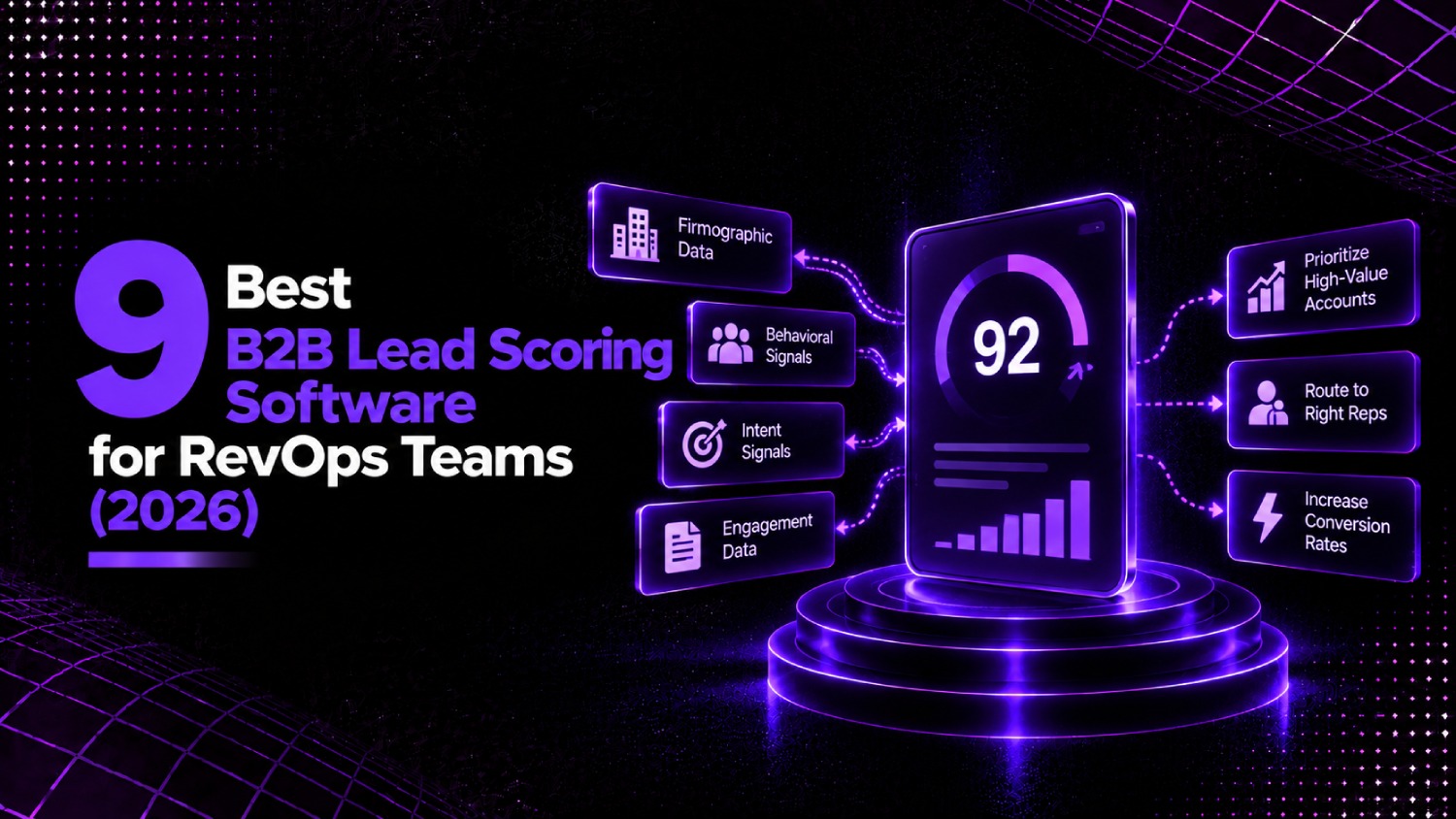
The best lead scoring software for B2B teams in 2026 includes MadKudu, 6sense, HubSpot Marketing Hub, Salesforce Einstein Lead Scoring, Breadcrumbs, Marketo Engage, ActiveCampaign, Leadspace, and ZoomInfo. MadKudu leads for data-warehouse-native predictive scoring; 6sense leads when third-party intent data is the priority; HubSpot and Salesforce Einstein are the right picks when your team is already inside those CRMs and does not want a separate tool.
Why Manual Lead Scoring Fails B2B RevOps Teams
Most marketing teams build their first lead scoring model the same way: assign 10 points for a job title match, 5 for a whitepaper download, 15 for a demo request, and hand off anyone above 50. It feels systematic. It is not.
The problem is that manual point models are built on opinions, not outcomes. No one actually checks whether the 15 leads who hit a score of 80 last quarter converted at a higher rate than the ones who scored 45. The model reflects the assumptions of whoever configured it, often a marketing ops hire in 2021 who is no longer with the company.
Predictive scoring inverts this. The model trains on your historical closed-won and closed-lost data, then surfaces the firmographic and behavioral combinations that actually predicted revenue, not the ones your team thought would. A $10M ARR SaaS company in fintech that visited your pricing page twice may outscore a Fortune 500 enterprise that downloaded three ebooks, even if your manual model would flip that ranking. That gap between perceived quality and actual conversion is where MQL-to-SQL leakage happens, and it is expensive.
This matters more in 2026 than it did three years ago. Go-to-market teams have contracted, sales cycles have lengthened, and buyers are doing more research before ever raising their hand. A lead scoring model that can distinguish a researcher from a buyer, using behavioral signals across your site, product, and third-party intent feeds, is now a budget-defense tool, not just a nice-to-have.
The Three Lead Scoring Model Types: Which One Fits Your Stack
Before evaluating any specific tool, you need to know which model type you are buying. The difference is not cosmetic.
Rule-based scoring assigns points according to criteria you define: job title, company size, industry, page visits, form fills. Every CRM and marketing automation platform offers this. It requires no historical data to start, which makes it fast to deploy. The cost is ongoing maintenance: someone has to audit whether the rules still hold, and most teams never do.
Predictive/ML scoring trains a model on your own closed-won and closed-lost records. It finds patterns across dozens or hundreds of attributes without you specifying them. Tools like MadKudu, Salesforce Einstein, and Marketo’s predictive features fall here. The requirement is data volume: typically a few hundred to a few thousand closed opportunities before the model has enough signal to outperform a good manual model.
Intent-driven scoring adds third-party behavioral data, what accounts are researching across the broader web, into the score. Platforms like 6sense and ZoomInfo pull this signal from publisher networks and search data to identify in-market accounts before they visit your site. Intent scoring is account-level by nature, which makes it a fit for ABM motions rather than individual MQL routing.
Many tools in this list blend two of these. That is not a problem as long as you understand which layer is actually driving the score. If you pair intent data with a weak rule-based model, you get expensive noise.
The 9 Best Lead Scoring Software Tools for B2B RevOps Teams
| Tool | Model Type | Best For | CRM Fit | Pricing Starts |
|---|---|---|---|---|
| MadKudu | Predictive/ML | Data-rich B2B SaaS teams | Salesforce, HubSpot, Marketo | Quote-based |
| 6sense | Intent + Predictive | ABM and intent-led teams | Salesforce, HubSpot, Marketo | Quote-based |
| HubSpot Marketing Hub | Rule-based + Predictive (Pro+) | Teams already on HubSpot CRM | HubSpot (native) | $800/mo (Pro) |
| Salesforce Einstein | Predictive/ML | Salesforce-native teams | Salesforce (native) | Included in Sales Cloud Enterprise+ |
| Breadcrumbs | Rule-based + Co-dynamic | Mid-market teams, no data science | HubSpot, Salesforce, Marketo | Free tier; paid from $199/mo |
| Marketo Engage | Rule-based + Predictive | Enterprise marketing automation buyers | Salesforce, Microsoft Dynamics | Quote-based |
| ActiveCampaign | Rule-based + ML-assisted | SMBs with email-driven funnels | Native CRM + integrations | From $149/mo (Plus) |
| Leadspace | Predictive + Intent | Enterprise ABM + data enrichment | Salesforce, Marketo, HubSpot | Quote-based |
| ZoomInfo | Intent + Rule-based | Teams prioritizing third-party intent data | Salesforce, HubSpot, Marketo | Quote-based |
MadKudu
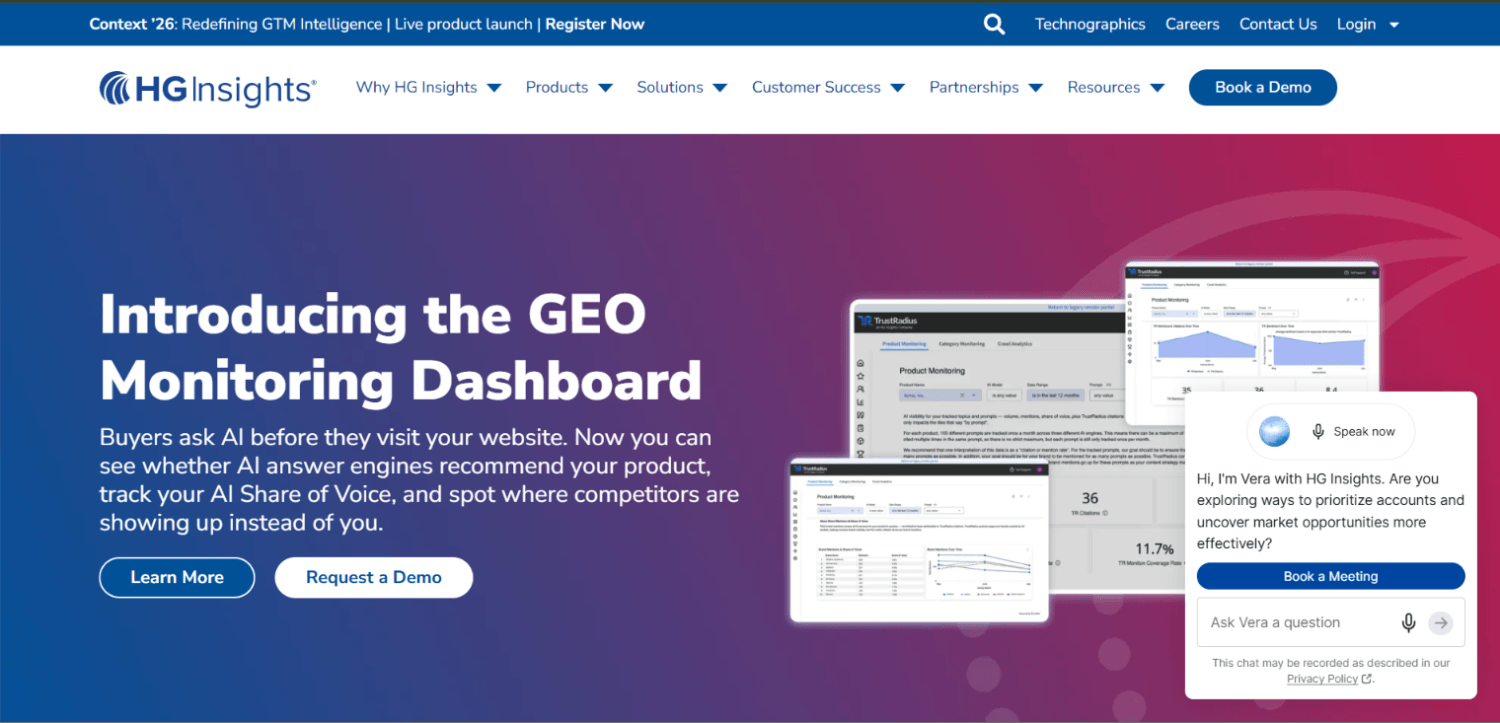
MadKudu is the most technically rigorous lead scoring tool built specifically for B2B SaaS. It connects directly to your data warehouse, trains predictive models on your historical pipeline data, and outputs scores that update as new behavioral signals come in. For teams running Snowflake or BigQuery alongside Salesforce or HubSpot, this warehouse-native approach means the score is always working from a complete picture, not a subset of synced data.
Where MadKudu separates itself is in the explainability layer. Sales reps can see why a lead scored the way it did: which attributes contributed most and how the account compares to your historical closed-won profiles. That transparency reduces the “why is this lead even here” friction that tanks SDR adoption of scoring tools. Pricing is not published; MadKudu operates on a quote basis, which typically puts it in the mid-five-figures annually for a team of meaningful size.
6sense
6sense approaches lead scoring from the account level, not the individual level. It layers third-party intent data from its publisher network onto your own behavioral and firmographic signals to predict which accounts are actively in a buying cycle. The result is an account grade plus a buying-stage indicator: awareness, consideration, decision.
This is fundamentally different from contact-level MQL scoring. If your sales motion is account-based, 6sense can surface companies researching your category before any contact has ever visited your site. That is a genuine capability gap versus rule-based tools. The downside is complexity and cost. 6sense is enterprise-priced and requires meaningful onboarding to configure intent topics correctly. Teams without a dedicated MOps resource will struggle to extract full value. Pricing is quote-based and not publicly disclosed.
HubSpot Marketing Hub
HubSpot Marketing Hub offers two scoring modes. The base contact scoring is fully rule-based and available on the Starter tier. At Professional ($800/month as of HubSpot’s public pricing page) and above, predictive lead scoring becomes available, applying machine learning to your contact database to predict likelihood to close based on historical patterns.
HubSpot’s predictive scoring is not as configurable or transparent as MadKudu, and it works only within the HubSpot data model, so it will not train on data living in your warehouse or product backend. For teams already running HubSpot CRM and Marketing Hub, it is the right default before adding a point solution. For teams on Salesforce, it is not the right fit.
Salesforce Einstein Lead Scoring
Salesforce Einstein Lead Scoring is included in Sales Cloud Enterprise and Unlimited editions. It trains on your historical converted and unconverted leads within Salesforce, then surfaces a score from 1 to 100 alongside the top reasons driving that score. The native integration means there is no data export, no separate sync, and no additional model to maintain.
Einstein works best when your Salesforce data is clean, your lead objects are properly populated, and your conversion events are tracked consistently. If your Salesforce is a mess of duplicate records and missing fields, the model will produce unreliable scores because it trains on whatever data is actually there. Teams investing in Salesforce data quality will see a meaningful payoff here. Teams that have not cleaned their CRM will get garbage in, garbage out.
Breadcrumbs
Breadcrumbs takes a different structural approach than most tools on this list. It uses what the company calls a co-dynamic scoring model, splitting the score into two dimensions: fit (how well the lead matches your ICP) and activity (how engaged they are). That two-dimensional structure is Breadcrumbs’ own framing rather than an industry-standard category, but the underlying logic is sound: a high-fit, low-activity lead and a low-fit, high-activity lead should be treated differently by sales, and Breadcrumbs makes that distinction explicit rather than collapsing both signals into a single number.
Breadcrumbs is notably accessible compared to the enterprise players here. It offers a free tier, and paid plans start at $199/month based on the public pricing page. The interface is visual enough that a MOps manager without data science support can build and maintain models. It connects to HubSpot, Salesforce, Marketo, and several other platforms. For mid-market teams that want more scoring sophistication than native CRM rules but cannot justify a MadKudu contract, Breadcrumbs is the strongest middle option.
Marketo Engage
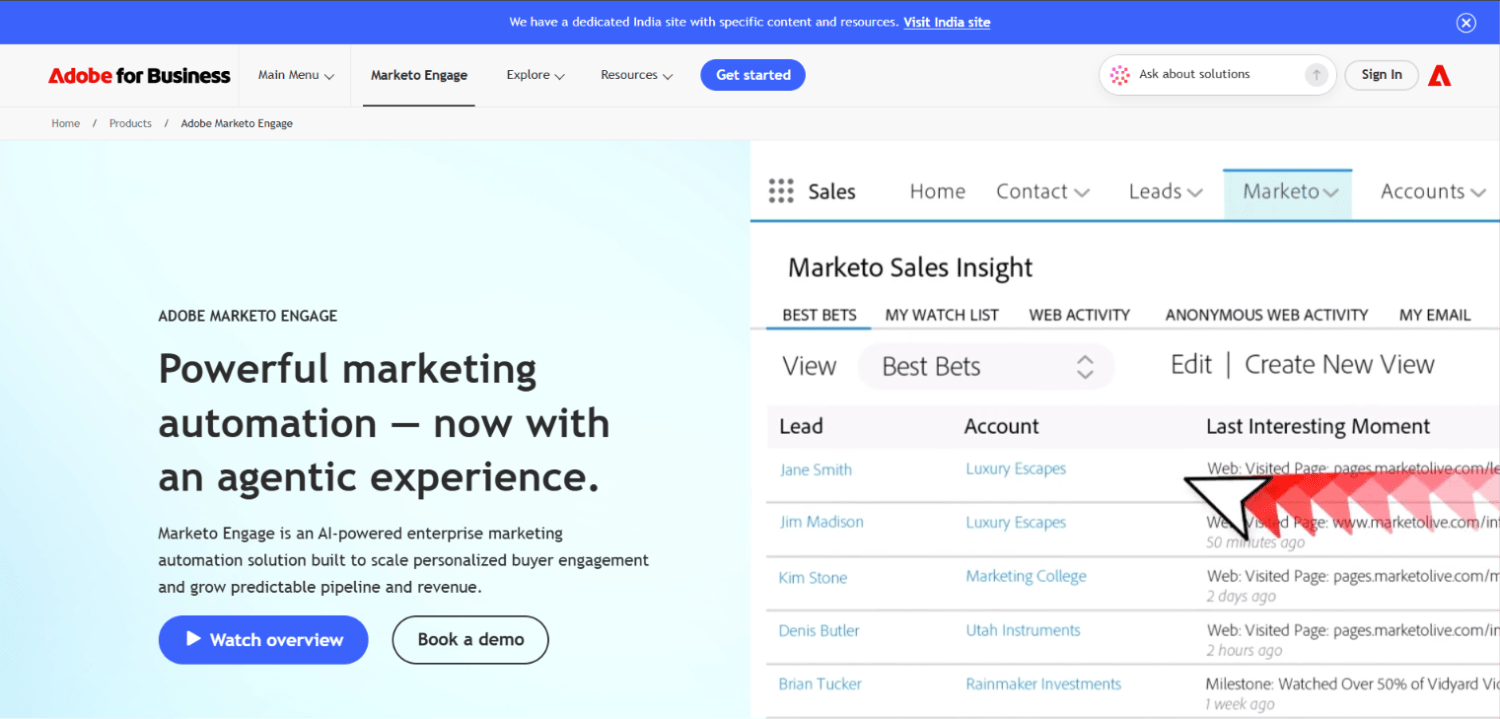
Marketo Engage (now Adobe Marketo) has one of the most mature lead scoring systems available inside a marketing automation platform. Its native rule-based scoring handles positive and negative scoring across behavioral triggers and demographic attributes, with decay logic to reduce scores for leads that go dark. Marketo also offers predictive content and predictive audience features at higher tiers through its AI/ML layer.
Marketo’s scoring is best suited to organizations already running the full Marketo stack for automation, and it is priced accordingly: quote-based, typically structured around database size, and positioned at the enterprise tier. Teams looking for a standalone scoring tool will find Marketo overbuilt and oversold. Teams evaluating marketing automation platforms who want strong lead scoring native to the platform will find it competitive. It is worth noting that the learning curve is steeper than HubSpot’s, which is a real operational cost for smaller MOps teams.
ActiveCampaign
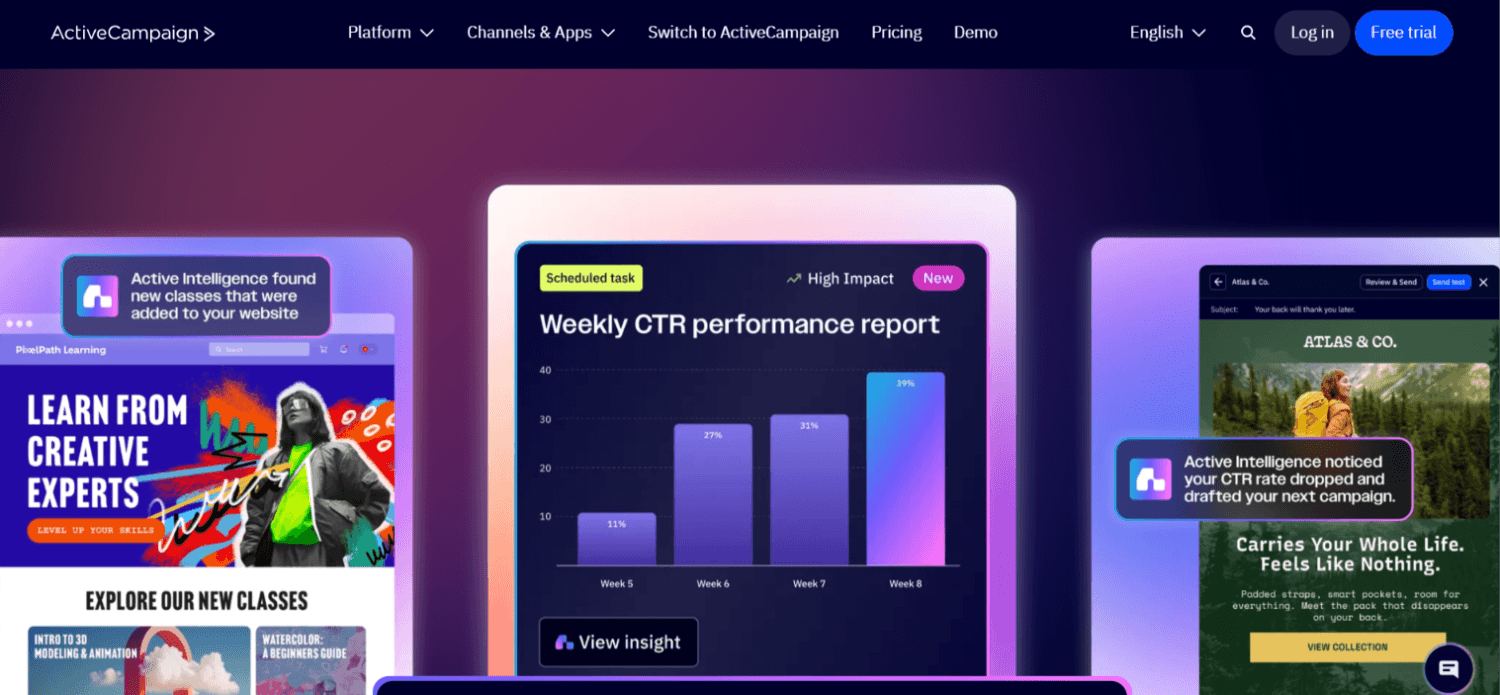
ActiveCampaign includes lead scoring in its Plus plan and above, starting at $149/month for up to 1,000 contacts according to its public pricing page. The scoring is primarily rule-based, tied to email engagement, site tracking events, and form submissions, with some ML-assisted features in higher tiers. For SMBs and mid-market teams running email-heavy demand generation, it covers the fundamentals without adding a separate tool or contract.
ActiveCampaign’s scoring does not match the depth of MadKudu or the intent layer of 6sense. What it offers is tight integration with email sequences and automation workflows, so a score threshold can directly trigger a sales notification or a CRM task without any middleware. For teams with simpler go-to-market motions and smaller contact databases, that operational tightness is more valuable than advanced ML.
Leadspace
Leadspace operates at the intersection of data enrichment and predictive scoring, which makes it distinct from pure scoring tools. It builds an audience graph from first-party data, third-party intent, and its own B2B identity data, then applies predictive models to score accounts and contacts across fit and intent dimensions. The result feeds into Salesforce, Marketo, or HubSpot as enriched, scored records.
Leadspace is positioned at the enterprise segment and is quote-based. It is most relevant for teams that have a simultaneous need for contact enrichment and predictive scoring, rather than teams that already have a strong data enrichment provider and just need the scoring layer. The overlap between what Leadspace does and what a combination of a CDP plus a scoring tool would do is worth mapping before committing to the contract.
ZoomInfo
ZoomInfo is primarily a B2B data and intelligence platform, but its scoring features, particularly intent scoring through ZoomInfo Intent and Scoops, give it a place on this list. ZoomInfo tracks intent signals across its content network and allows you to apply scoring thresholds to accounts showing buying intent in your defined topics. That scoring can surface in Salesforce or HubSpot through the native integration.
The limitation is that ZoomInfo’s scoring is heavily dependent on its own data network, which makes it more of an intent layer than a configurable predictive scoring engine. Teams that are already ZoomInfo subscribers and want to extend their existing contract with a scoring dimension will find this reasonable. Teams evaluating lead scoring as a primary use case should weigh whether they need the full ZoomInfo data platform or whether a more purpose-built scoring tool would serve them better at lower cost. Pricing is quote-based.
How to Choose a Lead Scoring Tool: The AboutMartech Fit-Signal Test
The standard advice for picking a lead scoring tool is to list your requirements and match features. That produces the same shortlist for every company and ignores the fact that a tool’s value depends entirely on what data you can actually feed it.
A more useful framework is what we call the Fit-Signal Test, a four-part check that maps your current data state to the right scoring model type before you look at any vendor. Each check functions as a gate: failing one changes which tool category is appropriate, not just which features to prioritize.
- Historical outcome volume: Do you have at least 500 closed opportunities (won and lost combined) in your CRM with consistent lead source and activity data attached? If yes, predictive scoring models have enough signal to outperform manual rules. If no, start with rule-based scoring and set a date to revisit.
- Behavioral data coverage: Does your scoring tool candidate receive data from all the places a lead actually interacts with you: your website, your product (if PLG), your email sequences, and your events? Scoring only on CRM fields misses the engagement layer that often predicts intent better than demographics.
- Account vs. contact motion: If your AEs work accounts, not individual leads, you need account-level aggregation in your scoring model. Contact-only scoring tools will not give you a usable account signal without custom rollup logic. This is the ABM boundary that separates 6sense and Leadspace from most other tools.
- Sales adoption realism: A score that SDRs cannot interpret is a score that gets ignored. Tools with explainability features, where reps can see why a lead ranked high, consistently outperform black-box models in actual pipeline impact. Weight this heavily.
Running this test before issuing an RFP saves significant evaluation time. A team that fails the historical volume check should not be demoing MadKudu yet. A team with a pure account-based motion is wasting time evaluating contact-scoring tools. Matching the tool to your current state, not your aspirational state, is how RevOps teams avoid buying software they cannot use.
For teams building out the broader data infrastructure behind their scoring model, the modern marketing data stack guide for RevOps teams covers how these tools fit into a complete architecture.
How Does Predictive Lead Scoring Actually Work?
Most explanations of predictive scoring stop at “machine learning analyzes your data.” That is not enough to make a buying decision. Here is what is actually happening.
A predictive lead scoring model takes your historical closed-won and closed-lost records and trains a classification algorithm, typically a gradient boosting model or a logistic regression, to predict which of the two categories a new lead is more likely to fall into. It does this by finding correlations across every attribute attached to those historical records: company size, industry, technology stack, job title, time between first touch and demo, number of sessions before conversion, and dozens of other signals.
The model outputs a probability, which the scoring tool converts into a score or tier. That score is only as good as the data it trained on. If your closed-won records are missing lead source data because your attribution was broken for six months, the model will work around that gap, but its predictions will be weaker. If your lost records include deals that went dark and were never formally marked as lost, the model trains on a biased negative class.
Consider a B2B SaaS company selling to mid-market fintech firms with a 90-day average sales cycle. Say this team has 600 closed opportunities across 18 months, roughly 160 won and 440 lost. A predictive model trained on this data might surface that companies with 100 to 500 employees, a Stripe integration in their tech stack, and two or more visits to the pricing page within the first two weeks have a win rate three times the base rate. A manual scoring model would never discover that three-factor interaction. That is the gap predictive scoring fills.
For teams evaluating how scoring connects to downstream lead routing and enrichment, lead enrichment and routing tools for RevOps teams covers the tools that complement a scoring layer.
What Does Lead Scoring Software Cost in 2026?
Pricing in this category varies more than in almost any other martech segment, partly because the tools span from SMB automation platforms to enterprise intelligence suites.
HubSpot Marketing Hub Professional, which includes predictive lead scoring, starts at $800/month as of HubSpot’s public pricing page. ActiveCampaign Plus starts at $149/month. Breadcrumbs offers a free tier and paid plans from $199/month based on its public pricing page. These three represent the accessible end of the market.
Salesforce Einstein Lead Scoring is included with Sales Cloud Enterprise and Unlimited, so if you are on those tiers already, there is no incremental line item. Marketo Engage, 6sense, MadKudu, ZoomInfo, and Leadspace are all quote-based. Enterprise teams should expect MadKudu to run in the mid-five-figures annually based on what is publicly discussed in the MOps community, though the actual contract depends on database size and integrations. 6sense contracts are typically larger, reflecting the intent data layer and the broader platform scope.
The relevant comparison is not tool price versus tool price. It is tool price versus the cost of misallocating sales effort on low-quality leads. A RevOps team that can demonstrate a measurable improvement in MQL-to-SQL conversion rate after deploying predictive scoring has a straightforward budget justification. Teams that cannot measure that baseline should instrument it before buying.
Which Lead Scoring Tools Work Best with HubSpot?
HubSpot’s native predictive scoring at the Professional tier is the obvious starting point for HubSpot shops. It requires no additional integration, trains on your existing contact data, and surfaces scores directly in the CRM views your sales team already uses. For most HubSpot teams with fewer than 50,000 contacts and a standard inbound motion, it is the right answer.
When HubSpot’s native scoring falls short, three tools are worth evaluating. MadKudu has a well-documented HubSpot integration and is the most common upgrade path for HubSpot teams that have grown to the point where they need warehouse-level data in their scoring model. Breadcrumbs also connects natively to HubSpot and is the better option for teams that want more scoring configuration without a significant budget increase. 6sense integrates with HubSpot if the team is running an ABM motion and needs account-level intent data layered on top of contact scores.
How Does Lead Scoring Fit Into a Broader RevOps Stack?
Lead scoring does not operate in isolation. It sits at the junction between your data layer (CRM, MAP, product analytics, intent feeds) and your sales routing logic. The score is only useful if it changes what happens next: which leads go to which reps, which triggers a follow-up sequence, which accounts get added to an ABM target list.
That routing function is where many scoring implementations break down. A team deploys a sophisticated predictive model, the scores appear in Salesforce, and the SDR team keeps working leads in the same order they always did because no one changed the queue logic. Deploying lead scoring without updating your RevOps tooling and workflow automation to act on the scores is one of the most common implementation failures in this category.
The other missing link is attribution. Scoring tells you which leads are likely to convert. Attribution tells you which channels and campaigns produced those leads in the first place. Without both, you can optimize lead quality without being able to reproduce the sources that generate it. Teams running predictive scoring should also have a view into B2B attribution for long sales cycles, particularly if their scoring model is trained on pipeline data that spans multiple quarters.
Frequently Asked Questions About Lead Scoring Software
What is the best lead scoring software for B2B teams?
For teams with sufficient historical pipeline data, MadKudu delivers the strongest predictive accuracy for B2B SaaS. For account-based motions requiring third-party intent data, 6sense leads. For teams on HubSpot without a separate tool budget, HubSpot Marketing Hub Professional’s native predictive scoring covers most needs. The right answer depends on your CRM, your data volume, and whether you score contacts or accounts.
How does predictive lead scoring differ from rule-based scoring?
Rule-based scoring assigns points you define manually based on attributes like job title or page visits. Predictive scoring trains a machine learning model on your historical closed-won and closed-lost opportunities to find patterns that actually correlate with revenue. Predictive models discover multi-factor interactions that manual scoring misses, but they require a minimum volume of historical data, typically several hundred closed opportunities, to outperform well-configured rules.
How is a lead score calculated in a CRM?
In most CRMs, lead scores are calculated by summing points assigned to matching criteria: a job title match might add 10 points, a pricing page visit might add 20, an unsubscribe might subtract 15. Predictive scoring in tools like Salesforce Einstein or HubSpot replaces this manual sum with a probability output from a trained classification model, then normalizes that probability to a 0-100 score displayed in the CRM record.
What data does a predictive lead scoring model need to work?
At minimum, a predictive model needs several hundred historical records with a labeled outcome (converted or not converted), plus a set of input attributes like company size, industry, job title, and behavioral data. More data volume improves accuracy. Missing or inconsistent data in the training set, like leads with no activity records or deals closed without a clear outcome, degrades the model. Clean CRM data is a prerequisite, not a nice-to-have.
Can you use lead scoring software without a CRM?
Not effectively for B2B teams. Every tool on this list outputs scores that need to live somewhere accessible to sales reps and marketing automation. Without a CRM, scores have nowhere to route. Tools like ActiveCampaign bundle a basic CRM with scoring in the same platform, which sidesteps the problem, but standalone scoring without a CRM integration produces data that does not change sales behavior.
What is the difference between lead scoring and lead grading?
Lead scoring measures engagement and behavioral intent: how actively a lead is interacting with your content, site, and emails. Lead grading, or fit scoring, measures how closely a lead matches your ideal customer profile based on firmographic and demographic attributes. Breadcrumbs makes this split explicit with its two-dimensional co-dynamic model. Most other tools collapse both signals into a single score, which can make it hard to distinguish a low-fit but highly engaged lead from a high-fit but cold one.
What is intent data and how does it improve lead scoring?
Intent data is behavioral signal collected across third-party publisher networks showing which companies are actively researching topics related to your product category. Tools like 6sense and ZoomInfo aggregate this data to identify accounts in an active buying cycle before they ever visit your site. When layered into a scoring model, intent data improves the accuracy of account-level scoring for ABM teams, though it adds cost and complexity compared to scoring purely on first-party behavioral data.
How often should a lead scoring model be retrained or audited?
Predictive models should be retrained every six to twelve months, or whenever there is a significant change in your ICP, your product line, or your go-to-market motion. Rule-based models should be audited against actual conversion data at least quarterly. The most common failure mode is a model that was accurate at deployment and has drifted as the market and buyer profile shifted, while the MOps team treats it as set-and-forget infrastructure.
The Scoring Model You Have Is Probably Already Wrong
Manual lead scoring is not neutral. Every rule in a point-based model encodes an assumption about what predicts conversion, and most of those assumptions were never validated against actual data. Teams that audit their existing scoring models against historical conversion rates often discover the model has no predictive power at all: leads in the highest scoring tier convert at the same rate as leads in the middle tier, meaning sales is working the wrong queue.
The shift to predictive scoring is not about technology preference. It is about closing the feedback loop between what marketing scores and what sales actually closes. The tools that do this well, MadKudu, Salesforce Einstein for Salesforce shops, HubSpot’s predictive tier for HubSpot shops, 6sense for ABM teams, share a common trait: they use your own outcome data to define quality, rather than asking you to define it in advance.
The practical path forward is simpler than most teams make it. Start by pulling your last 12 months of closed-won and closed-lost data and checking whether your current high-scoring leads actually closed at a higher rate. If they did not, your scoring model needs to change before anything else on your RevOps roadmap matters. If they did, you already have the baseline to train a predictive model that can do even better.