
- AppsFlyer’s pricing scales with installs, which makes it expensive for apps growing past a few hundred thousand monthly actives.
- Adjust, Singular, Branch, Kochava, Airbridge, Tenjin, and Appsumer all offer core deterministic attribution at lower per-event costs or flat pricing.
- The biggest switching risk is losing your historical attribution data and breaking existing deep links, not the SDK migration itself.
- Singular’s combined MMP-plus-aggregated-cost-data model is the clearest differentiator in the category; teams running paid UA heavy on Meta and Google should evaluate it first.
- Tenjin is the only credible free-tier option for early-stage apps; paid plans start at $200/month according to their public pricing page.
The best AppsFlyer alternatives for most growing apps are Adjust, Singular, and Branch. Adjust matches AppsFlyer’s attribution depth with more predictable pricing at scale. Singular combines attribution with aggregated ad spend data in a single platform, cutting the need for a separate cost aggregation tool. Branch leads on deep linking and cross-platform user flow tracking. Kochava, Airbridge, Tenjin, and Appsumer round out the field for teams with more specific needs around pricing, region, or analytics depth.
To anchor the cost argument early: a team running 200,000 monthly installs across Meta, Google, TikTok, and three regional networks can expect a four-to-six-week migration window when moving to any of these alternatives , SDK swap, link migration, and partner recertification included. That timeline is covered in detail in the switching cost section below, but knowing it upfront shapes how teams plan the evaluation.
Why do teams switch off AppsFlyer in the first place?
AppsFlyer is a strong product. Most teams that leave are not escaping a broken tool. They are escaping a pricing model that compounds as the app grows.
AppsFlyer charges based on conversions and in-app events attributed. As install volume climbs and as teams instrument more events per session, the bill grows in two directions simultaneously. For an app scaling from 50,000 to 500,000 monthly installs, the cost difference between AppsFlyer’s model and a flat-rate competitor can run into tens of thousands of dollars annually. Exact figures depend on contract negotiation and event volume, since AppsFlyer does not publish per-install rates publicly.
The second driver is feature overlap. AppsFlyer’s full suite includes audience segmentation, creative analytics, and fraud protection stacked on top of attribution. Teams that already have a customer data platform for segmentation and a separate fraud vendor are paying for capabilities they do not use. A leaner MMP at a lower price point covers the core without the redundancy.
What is the AboutMartech MMP Cost-at-Scale Test?
Before comparing vendors, it helps to have a consistent framework. The AboutMartech MMP Cost-at-Scale Test applies four checks to any MMP candidate:
- Event pricing transparency: Does the vendor publish a pricing model, or is every deal custom? Opaque pricing always favors the vendor at renewal.
- Deterministic match rate: What percentage of installs does the vendor attribute deterministically (via device ID, SKAN, or privacy-safe signals) versus probabilistically? A lower deterministic rate inflates reported performance.
- SDK footprint: How large is the SDK, and does it require a hard app update to migrate? This is the real switching cost, not the contract.
- Partner network depth: Does the vendor have certified integrations with every ad network the team runs? Missing a network means blind spots in attribution.
Run every vendor below through these four checks against your own stack before shortlisting.
Which 7 MMPs cost less than AppsFlyer at scale?
| MMP | Pricing model | Best for | Key differentiator | Notable limitation |
|---|---|---|---|---|
| Adjust | Quote-based, event-tiered | Mid-market to enterprise apps | Deepest fraud prevention in class | Pricing not self-serve |
| Singular | Quote-based | UA-heavy teams on paid social | Attribution + cost aggregation in one | Smaller partner network than AppsFlyer |
| Branch | Quote-based | Apps with complex deep linking | Cross-platform link tracking | Less granular in-app analytics |
| Kochava | Consumption-based, published tiers | CTV + mobile combined measurement | Free tier up to 100K attributions/month | Interface complexity |
| Airbridge | Quote-based | APAC-region apps, global expansion | Strong APAC ad network coverage | Smaller Western partner network |
| Tenjin | Free tier; paid from $200/month | Early-stage and indie apps | Only MMP with a credible free plan | Limited enterprise features |
| Appsumer | Quote-based | Hypercasual and gaming studios | Aggregated spend intelligence layer | Attribution is secondary to spend analytics |
Adjust vs AppsFlyer: which wins on total cost?
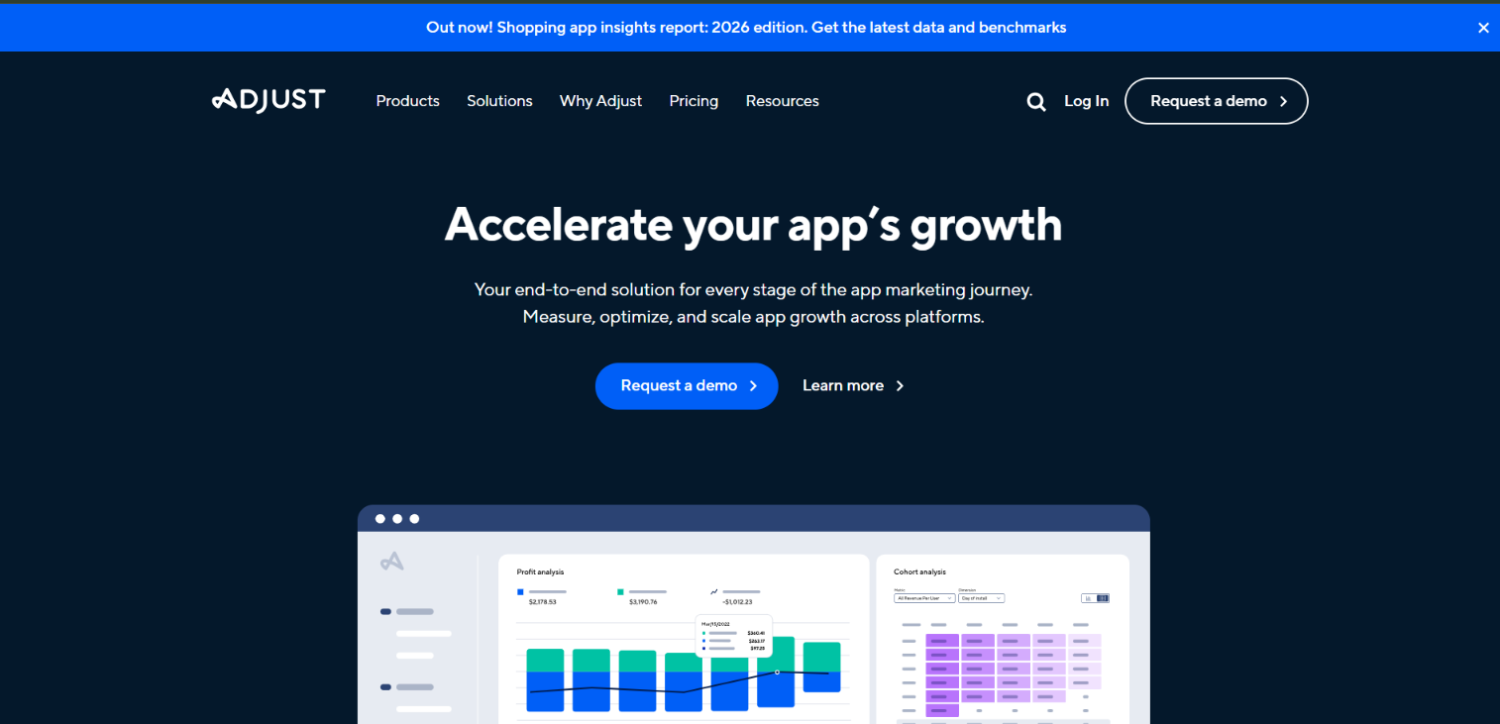
Adjust is the most direct AppsFlyer replacement for teams that want full MMP parity without changing their workflows. The feature set covers deterministic and probabilistic attribution, SKAdNetwork support, deep linking, audience builder, and fraud protection. Neither vendor publishes per-install pricing publicly; both negotiate enterprise contracts based on event volume and attribution type.
Where Adjust tends to win on cost is in its fraud protection being bundled rather than sold as an add-on. AppsFlyer’s Protect360 fraud suite sits on top of the base attribution cost. For teams running significant spend through ad networks with elevated invalid traffic, Adjust’s bundled approach can produce a lower total cost even if the headline attribution rate is similar.
The migration path is well-documented. Adjust maintains an SDK migration guide, and the technical lift is a single SDK swap plus a partner integration update. The harder work is aligning the new platform’s attribution windows and model defaults to your historical AppsFlyer settings so that reported numbers stay comparable across the transition period.
Singular vs AppsFlyer: the cost aggregation argument

Singular’s clearest argument against AppsFlyer is not attribution quality. It is the elimination of a second tool. Most growth teams running paid UA across Meta, Google, TikTok, and Apple Search Ads also pay for a cost aggregation or marketing analytics platform to pull spend data together. Singular combines both in one contract.
On pure attribution, Singular matches AppsFlyer on the major privacy frameworks including SKAdNetwork, Google Privacy Sandbox, and conversion value mapping. The partner network is smaller, which matters if your media mix includes niche ad networks common in emerging markets or gaming. For mainstream paid social and search, coverage is complete.
Teams evaluating Singular vs AppsFlyer should ask specifically about ROI reporting at the creative level. Singular’s cost data integration means ROAS by creative is native to the platform. With AppsFlyer, that requires either their Creative Analytics add-on or a separate tool. For UA teams that live in creative iteration cycles, that difference is concrete and daily.
Branch: the deep linking case
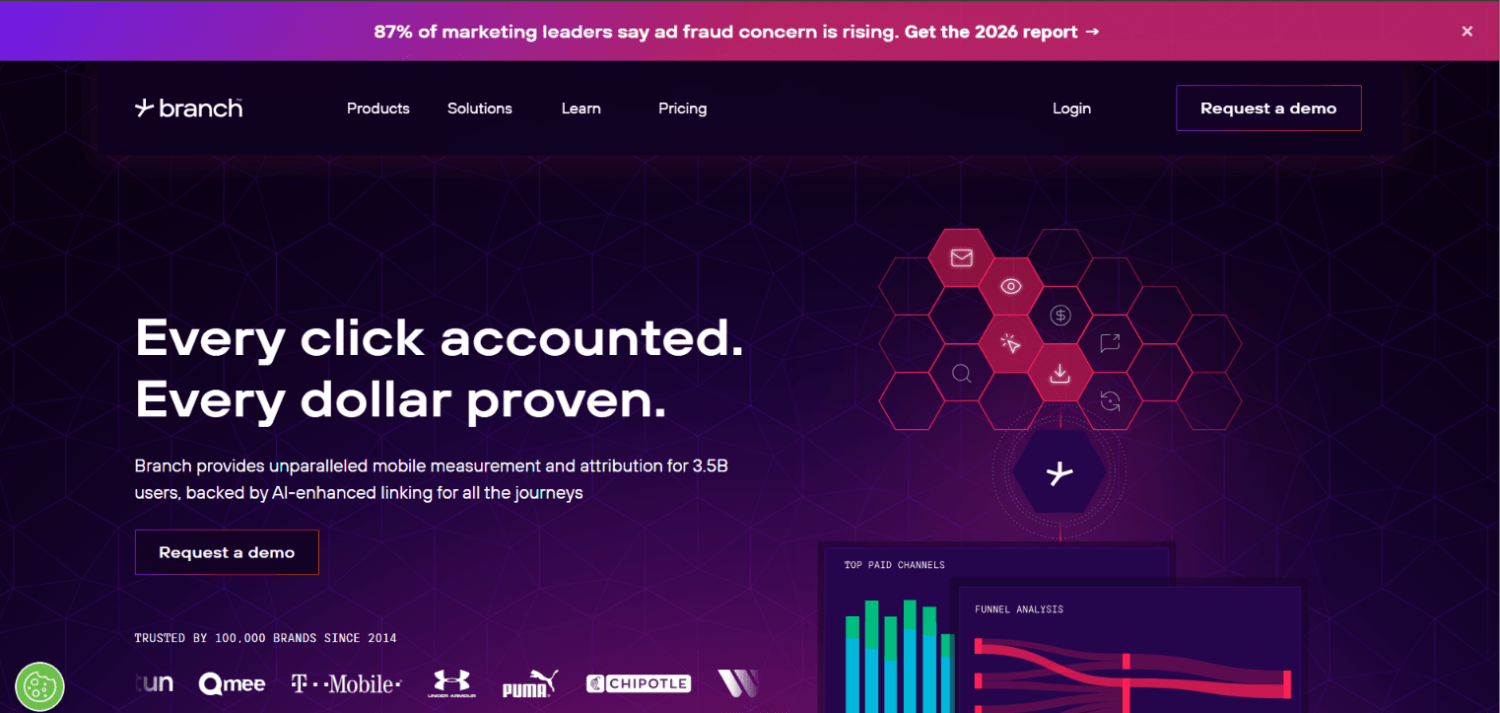
Branch built its reputation on deep linking before expanding into full attribution. For apps where the user flow spans web, email, SMS, QR codes, and app store install, Branch handles cross-platform attribution in a way that pure-play MMPs often patch together. The Universal Ads attribution product competes directly with AppsFlyer on paid channel measurement.
Branch is not the cheapest option here. Pricing is fully quote-based and scales with monthly active users and attributed events. For apps with simpler media mixes, paying for Branch’s deep linking infrastructure when you only need install attribution is overkill. For apps with content-driven growth, referral programs, or heavy email-to-app flows, Branch’s cross-platform stitching justifies the price over a standard MMP. Our mobile app attribution tools comparison covers Branch’s attribution methodology in more detail.
Kochava: the free tier and CTV angle

Kochava is the only major MMP in this list that publishes a consumption-based pricing structure with a free tier. According to Kochava’s public pricing page, the free plan covers up to 100,000 attributions per month. That makes it the practical entry point for apps under that volume threshold before they outgrow it and move to Tenjin’s paid tier or a full enterprise contract.
Beyond free, Kochava’s differentiation is connected TV measurement. For apps or brands running CTV campaigns alongside mobile, Kochava’s Identity Link product resolves household-level identity across devices. AppsFlyer has CTV measurement capabilities too, but Kochava positions it as a core product rather than an extension, which tends to show up in implementation quality and support depth.
The interface is the persistent complaint in user reviews. Kochava’s dashboard carries the complexity of a platform built over many years without a full redesign. Teams coming from AppsFlyer’s relatively modern UI will feel the difference on day one. If budget is the primary constraint and CTV is relevant, that trade-off is worth making. If clean reporting UX matters to non-technical stakeholders, it is worth noting before you sign.
Airbridge: the APAC-first alternative
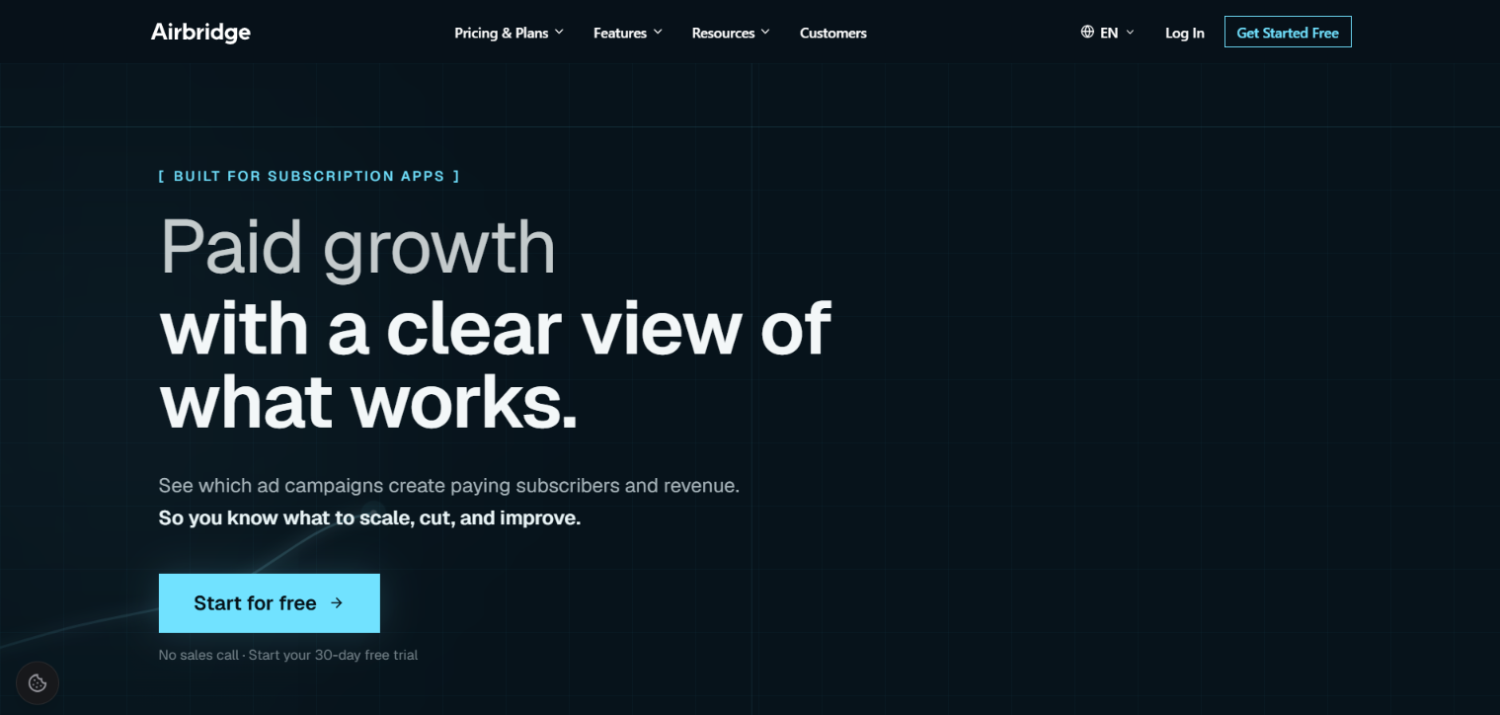
Airbridge is a South Korea-based MMP with a growing international footprint. For apps targeting Southeast Asia, Japan, or Korea as primary markets, Airbridge’s ad network integrations cover regional platforms that AppsFlyer supports but does not prioritize. Kakao, Naver, and LINE integrations are native rather than bolted on.
For Western-primary apps, Airbridge covers the standard major networks and matches AppsFlyer on SKAdNetwork and privacy framework compliance. Pricing is quote-based and, according to teams that have benchmarked it, tends to come in below AppsFlyer’s standard contract rates for comparable event volumes. The trade-off is a smaller set of third-party integrations, particularly for data connectors and BI tool hooks outside the major platforms.
Tenjin: the cheapest MMP for apps under scale
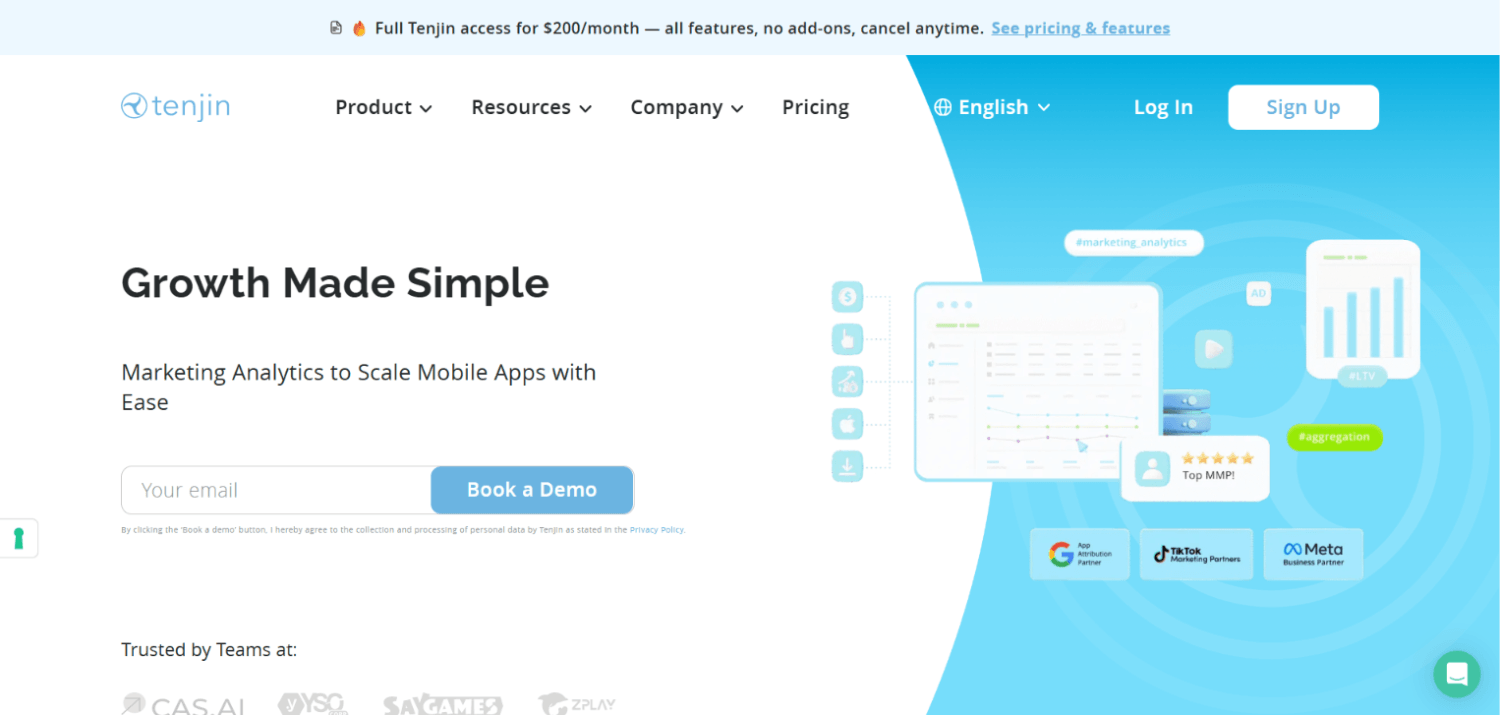
Tenjin operates a different model from every other vendor on this list. The free plan is not a trial. According to Tenjin’s public pricing page, apps can run attribution with no monthly fee, with paid plans starting at $200/month for teams that need advanced features or higher data volumes.
The catch is feature depth. Tenjin is attribution plus basic reporting, not a full growth platform. There is no built-in fraud protection suite, no audience builder, and no creative analytics layer. For an indie game studio or a pre-seed startup validating channels, those absences are fine. For a Series B app running $500K per month in paid UA, those gaps require compensating tools.
Tenjin also has a strong position in the gaming vertical specifically. Its GameAnalytics acquisition gives gaming apps integrated event analytics on top of attribution, which is genuinely useful for LTV modeling in hypercasual and casual games without buying a separate product analytics tool.
Appsumer: spend intelligence over attribution
Appsumer sits at the edge of what counts as an MMP. Its core product is aggregated ad spend intelligence: pulling spend, impressions, and performance data across networks into a unified view for UA managers. Attribution is part of the offering but secondary to the spend analytics layer.
For hypercasual gaming studios running dozens of campaigns across many networks simultaneously, Appsumer’s spend intelligence is genuinely useful in a way that a standard MMP dashboard is not. The attribution data feeds the spend view, and the combined output is a UA command center rather than a standalone attribution product.
Teams that want a direct AppsFlyer replacement should not start with Appsumer. Teams that find themselves spending as much on a separate analytics or spend aggregation platform as they do on AppsFlyer should evaluate whether Appsumer’s combined model covers both needs at a lower combined cost.
What does switching from AppsFlyer actually cost in time and risk?
The SDK migration itself is not the hard part. Every major MMP has documented migration guides, and the actual code change is a like-for-like SDK swap. A competent mobile engineer handles it in days, not weeks.
The real switching costs are three things most teams underestimate. First, historical attribution data. AppsFlyer stores your attributed install data. When you leave, you export what you can, but the new platform starts cold. Any analysis that joins new attribution data with historical cohorts requires careful bridging logic. Second, deep link infrastructure. If you have built universal links or app links through AppsFlyer’s OneLink, those need to be rebuilt or migrated to the new platform’s link infrastructure. That is not trivial for apps with thousands of active campaign links. Third, partner recertification. Certified MMP integrations with ad networks are platform-specific. Moving to a new MMP means recertifying integrations, which can take two to four weeks with some networks.
A team running 200,000 monthly installs across Meta, Google, TikTok, and three regional networks, with 40 active OneLink campaign URLs, is a practical benchmark for estimating this timeline. The SDK swap takes a week. The link migration is another two weeks if done carefully with URL-by-URL testing. Recertification with the major networks runs in parallel but adds a two-week buffer before the new platform’s data is fully trusted. Total: roughly four to six weeks to clean transition with one dedicated engineer. That is the realistic fence between “switching is too risky” and “switching is manageable with a plan.”
For teams evaluating attribution more broadly beyond mobile, our roundup of marketing attribution tools covers web, cross-channel, and B2B attribution alongside mobile measurement platforms.
How do these MMPs handle iOS privacy constraints?
Every credible MMP now supports SKAdNetwork. The differentiation is in how each vendor handles conversion value mapping, the limited signal Apple returns to advertisers through SKAN, and how they model the data gap.
AppsFlyer’s SKAN solution, called SKAN 4.0 support with their measurement protocol, is mature. Among the alternatives, Singular has invested heavily in SKAN and publishes detailed documentation on its conversion value schema management. Adjust’s SKAN support is equally mature and includes automated conversion value optimization. Branch’s SKAN implementation is solid but less documented publicly.
Where smaller MMPs sometimes fall short is in the modeling layer on top of SKAN. When SKAN returns null values or delayed postbacks, platforms model in the missing attribution. The quality of that modeling varies, and vendors do not publish their model architectures. The practical advice: ask every vendor for SKAN match rate data from comparable apps in your category. Any vendor unwilling to share benchmark data from similar apps should move down the shortlist.
Privacy measurement connects directly to the broader challenge of building attribution without third-party identifiers. Our guide on measuring marketing ROI without third-party cookies covers the methodology that applies across web and mobile channels.
Which AppsFlyer alternative is right for your specific situation?
The answer depends on three variables: current install volume, media mix complexity, and which features beyond attribution you are actually using.
For teams under 100,000 monthly installs, Kochava’s free tier or Tenjin’s free plan covers attribution without a monthly fee. There is no reason to pay AppsFlyer rates at that volume. For teams between 100,000 and 1 million monthly installs running primarily on Meta and Google, Singular is the most defensible choice because the cost aggregation feature eliminates a second tool. For teams at any scale with complex deep linking or content-driven growth loops, Branch earns its price. For enterprise apps where fraud protection is the dominant concern and total cost of ownership matters more than any single feature, Adjust is the closest AppsFlyer equivalent at a lower total cost for most contracts.
If your app is gaming-primary and scaling in Asia, start with Airbridge. If you are an indie developer or a gaming studio under a few hundred thousand installs, Tenjin’s economics are hard to argue against. For UA-centric gaming teams obsessed with cross-network spend visibility, Appsumer solves a different problem than standard attribution but may solve the more important one.
Frequently asked questions about AppsFlyer alternatives
How much does AppsFlyer cost?
AppsFlyer does not publish a public pricing page with specific rates. Pricing is negotiated based on monthly attributed conversions, in-app events tracked, and which product modules are included. The base attribution platform, fraud protection (Protect360), Creative Analytics, and Audiences are each priced separately or bundled in enterprise agreements. Teams evaluating AppsFlyer should expect quote-based pricing and budget accordingly. Third-party accounts suggest costs scale significantly past 100,000 monthly installs.
What is an MMP, and why does it matter which one you choose?
A mobile measurement partner (MMP) is a platform that sits between your app and your ad networks, attributing each install or in-app event to the campaign that drove it. The MMP is the source of truth for paid UA performance. Choosing the wrong one means either overpaying for attribution capacity you do not use, missing fraud signals that inflate reported installs, or losing data fidelity when migrating later. The choice matters most at scale, when small differences in match rate or event pricing compound into large budget and data quality differences.
Is Singular a direct replacement for AppsFlyer?
For teams running mainstream paid social and search, Singular covers the same attribution ground as AppsFlyer with the added benefit of native cost data aggregation. The gap appears in niche ad network coverage, where AppsFlyer’s larger partner network has more certified integrations. If your media mix includes gaming networks, regional DSPs, or emerging channels beyond Meta and Google, verify Singular’s specific integration coverage before switching. For standard growth teams, it is a direct replacement with a cost advantage.
What is the real risk of switching MMPs mid-campaign?
The main risk is a three-to-six-week data gap where attribution data from the old and new platforms overlaps imperfectly. Running both SDKs simultaneously during migration creates double-counting. Switching cold creates a period of reduced attribution coverage. Most teams plan the migration around a lower-spend period, such as post-peak season, and use the transition to clean up their event taxonomy. The risk is manageable with planning; it is not a reason to stay on an overpriced platform indefinitely.
Which MMP is cheapest for a startup with under 50,000 installs per month?
Kochava and Tenjin are both free at low install volumes. Kochava’s free tier covers up to 100,000 attributions per month according to their public pricing page. Tenjin’s free plan is available indefinitely with paid plans starting at $200/month for additional features. Both provide credible deterministic attribution for early-stage apps. Kochava has a broader feature set; Tenjin has stronger gaming-specific integrations through its GameAnalytics product.
Does Branch compete with AppsFlyer on attribution, or only on deep linking?
Branch competes on both. Branch’s Universal Ads product is a full attribution platform covering paid social, search, and display measurement with SKAdNetwork support and fraud detection. Its deep linking infrastructure is more mature than AppsFlyer’s OneLink for complex cross-platform flows. The common misconception is that Branch is only a deep linking tool; it has been a full MMP for several years. The difference is that deep linking is a genuine strength rather than an add-on, which makes it the right choice for apps where the pre-install and post-install flow spans multiple surfaces.
What should I ask an MMP vendor before signing a contract?
Ask for SKAN match rate benchmarks from apps in your category. Ask whether fraud protection is bundled or a separate line item. Ask for a specific breakdown of which events count toward your contracted volume, because different platforms define billable events differently. Ask about data export rights: can you pull raw attribution logs, and in what format? Ask what happens to your data if you cancel. And ask for references from teams that migrated to them from AppsFlyer specifically, because the migration experience is as revealing as the product itself.
The one thing most AppsFlyer switchers get wrong
Most teams that switch MMPs focus the evaluation on feature parity. They build a matrix of capabilities, compare it against AppsFlyer’s feature list, and pick the closest match at the lowest price. The matrix rarely captures the actual cost driver: event volume architecture.
Before signing any new MMP contract, audit your current AppsFlyer event implementation. Count how many in-app events you are tracking, how many are firing redundantly, and how many drive actual optimization decisions versus sitting in a dashboard no one reads. Teams commonly discover they are paying attribution fees on 15 events per session when their UA optimization runs on three. Cleaning the event taxonomy before migrating reduces the contracted volume on the new platform and often produces a larger cost saving than the difference between vendors.
The platform you switch to matters less than the event architecture you bring to it. A clean, intentional event taxonomy on Kochava’s free tier will outperform a bloated implementation on any paid platform. That is the insight most switcher evaluations skip, and it is the one that produces the clearest cost reduction at scale.
For teams building out the broader measurement stack alongside an MMP migration, the marketing mix modeling tools comparison covers incrementality and MMM approaches that complement MMP-level attribution, particularly for teams where paid channels are only part of a larger growth mix.