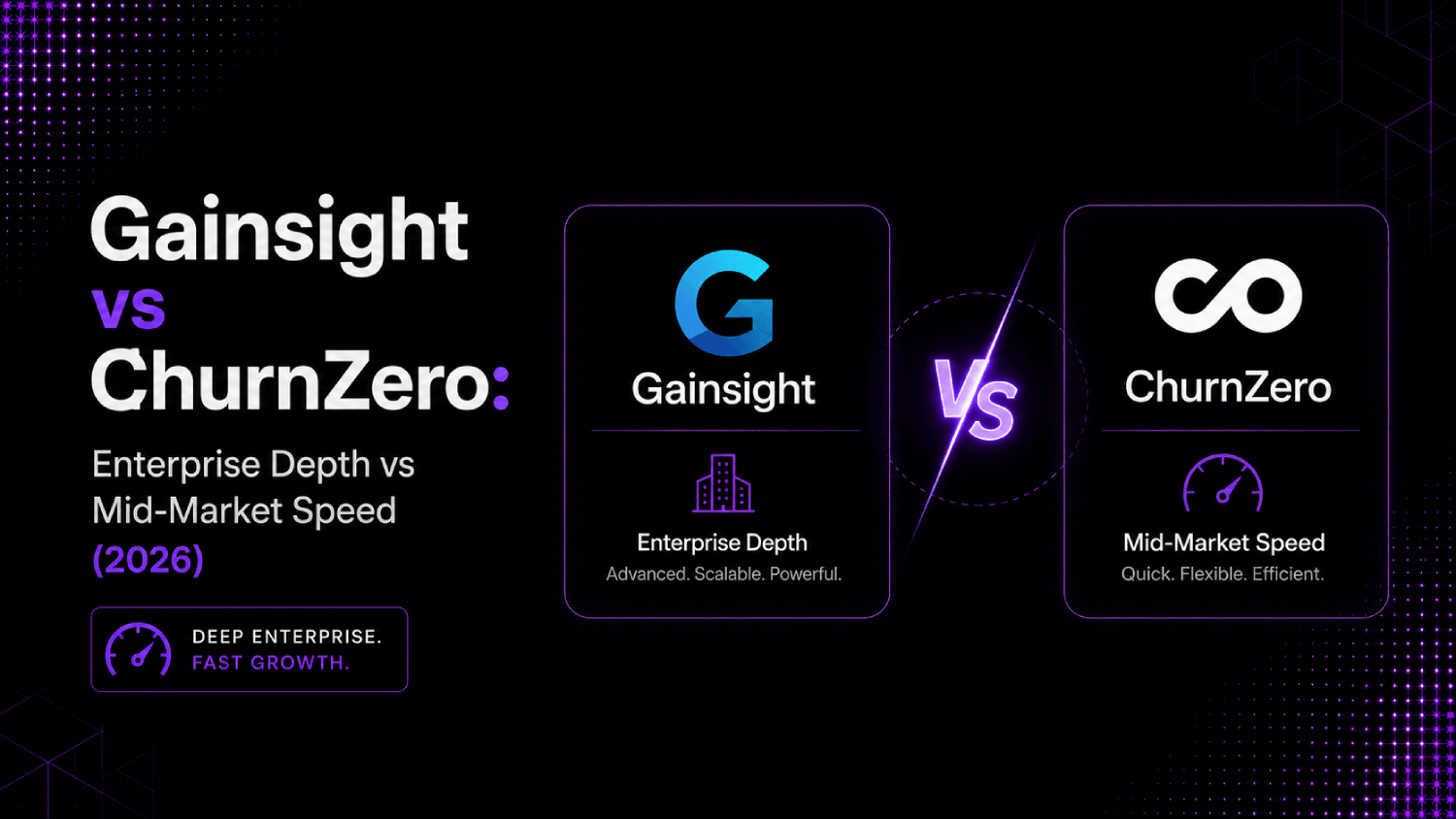
- Gainsight is the more capable platform by feature count, but that capability comes with an implementation timeline measured in months, not weeks, and a price tag that rarely lands below six figures annually.
- ChurnZero is purpose-built for mid-market SaaS teams that need a CS platform running in weeks, with CSMs seeing value inside the first quarter rather than the first fiscal year.
- The real dividing line is not features. It is whether your CS org has the headcount and ops bandwidth to configure and maintain a complex system, or whether it needs something that works out of the box.
- Enterprise teams with complex, multi-product customer bases and dedicated CS operations staff will get more from Gainsight’s depth. Teams under roughly 500 accounts with lean CS staffing should look at ChurnZero first.
- Both platforms are quote-based, but Gainsight’s pricing architecture reflects its enterprise positioning, while ChurnZero’s structure is more accommodating for teams not yet running at scale.
Gainsight and ChurnZero are the two most-compared customer success platforms in B2B SaaS , and the gainsight vs churnzero decision is one that comes up repeatedly for teams evaluating CS infrastructure at scale. Gainsight is the better fit for enterprise teams with complex account structures, dedicated CS operations, and multi-product customer bases who can absorb a longer implementation. ChurnZero wins for mid-market SaaS companies that need a CS platform deployed fast, used daily by CSMs without heavy admin overhead, and priced for a team that has not yet built a CS operations function.
Who is each platform actually built for?
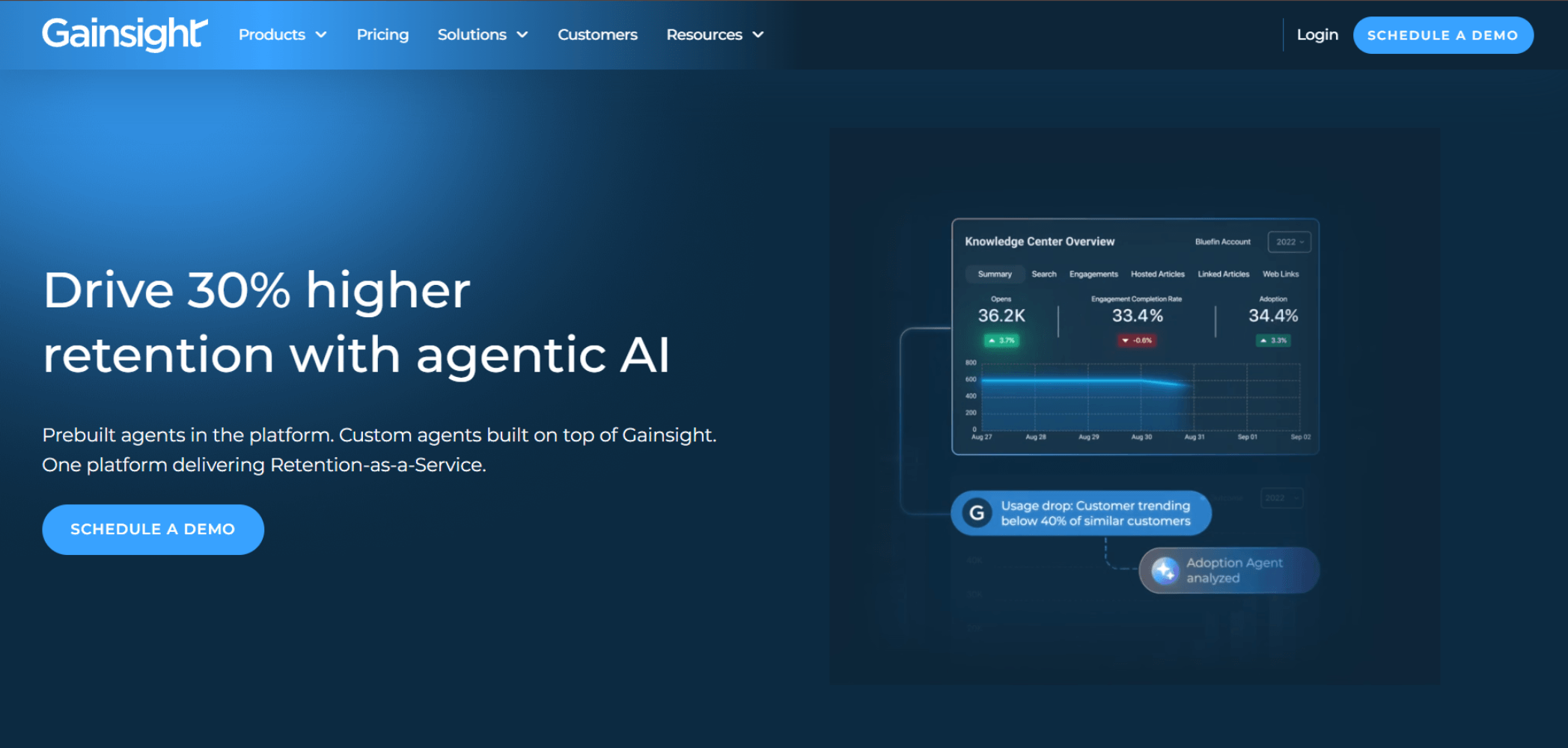
Gainsight was founded in 2013 and has spent over a decade accumulating features that enterprise CS teams ask for: multi-dimensional health scoring, advanced playbook orchestration, revenue intelligence, and a product analytics module called Gainsight PX that sits alongside the core platform. The feature set is genuinely deep. It is also genuinely complex, and that complexity is not accidental. It reflects the reality of enterprise CS work, where a single account might involve dozens of stakeholders, multiple products, and a renewal cycle involving both the CS team and an account executive.
ChurnZero was built later and for a different buyer. The platform targets SaaS companies in the 50-to-500 account range, where a small CS team needs to segment customers, trigger automated plays, track health scores, and run in-app communications without a full-time admin managing the tool. Its interface prioritizes CSM adoption over configuration flexibility, which is exactly the right trade-off for lean teams.
This is not a case where one vendor simply does the other’s job worse. They are optimized for different operating conditions.
How do their core feature sets compare?
| Feature area | Gainsight | ChurnZero |
|---|---|---|
| Customer health scoring | Multi-dimensional, highly configurable | Configurable, faster to set up |
| Journey / playbook automation | Advanced, multi-stage orchestration | Solid, focused on CSM workflows |
| In-app messaging | Via Gainsight PX (separate product) | Native in-app communications |
| Customer portal / hub | Horizon customer community | ChurnZero Success Center |
| Revenue intelligence / expansion | Native, with NRR forecasting | Present, less developed |
| Reporting and dashboards | Comprehensive, requires configuration | Pre-built, role-specific views |
| CRM integrations | Salesforce (deep), HubSpot, others | Salesforce, HubSpot, others |
| Data warehouse connectivity | Snowflake, BigQuery, Redshift | More limited native warehouse support |
| Implementation timeline | 3-6 months typical | 4-8 weeks typical |
| CSM adoption without admin help | Lower out of the box | Higher out of the box |
Where Gainsight has a genuine edge
Gainsight’s data model handles complexity that ChurnZero does not. If you manage a customer relationship that spans multiple products, multiple business units, or a parent-child account hierarchy, Gainsight’s architecture accommodates that natively. ChurnZero’s data model is flatter, which makes it simpler to configure but constrains it when account structures get complicated.
Gainsight PX is also a meaningful differentiator for product-led or hybrid CS teams. It tracks in-product behavior with granularity that most CS platforms leave to a separate product analytics tool. Teams already running dedicated product analytics tools may find some overlap, but for CS teams that want behavioral signals without stitching together another integration, PX covers significant ground.
Where ChurnZero has a genuine edge
ChurnZero’s in-app communication capabilities are built into the base product, not a separate module. CSMs can trigger in-app messages, walkthroughs, and announcements directly from customer health data without context-switching to another tool. For a team trying to reduce time-to-value for new customers, this matters. Our coverage of the best customer onboarding tools shows how much early-stage engagement drives retention, and ChurnZero’s native in-app layer gives CS teams a meaningful lever here without extra implementation work.
ChurnZero’s plays and automation are also more immediately usable. A new CSM can learn the interface and run a meaningful churn-risk outreach campaign within their first week. Gainsight’s equivalent workflows deliver more power but require more configuration time to get there.
What does each platform actually cost?
Both Gainsight and ChurnZero are quote-based. Neither publishes a public pricing table with hard numbers. Based on what both vendors have communicated in analyst briefings and publicly available customer reviews, Gainsight’s contracts typically start in the range that triggers CFO involvement, while ChurnZero is structured to be more accessible for teams in the 50-200 customer account range who are not yet running CS at enterprise scale.
Gainsight’s pricing is typically seat-based and includes factors like customer count, product modules, and level of implementation support. Teams that want Gainsight PX alongside the core CS platform are buying what is effectively two products. ChurnZero’s pricing is similarly seat-and-volume based but tends to land lower at comparable team sizes, partly because its scope is narrower.
If budget is genuinely constrained, neither platform is cheap. Our roundup of the best customer success platforms covers the full range including lighter-weight alternatives for teams not yet ready for either.
How does implementation reality differ between the two?
This is where the Gainsight-is-safe narrative breaks down. Gainsight’s reputation as the enterprise standard is deserved on features. It is less deserved as a proxy for low risk. Implementation timelines of three to six months are common, and teams routinely underestimate the ongoing admin work required to keep health scores accurate, playbooks updated, and data integrations clean.
Consider a SaaS company with a 5-person CS team, 300 accounts, and a Salesforce CRM that is reasonably well-structured. Choosing Gainsight means dedicating one person, at minimum, to managing the configuration during rollout, and likely hiring or appointing a CS ops resource to maintain it afterward. If that resource does not exist, the platform will either be underused or misconfigured within six months. The features that justified the purchase will sit dormant.
The same team choosing ChurnZero is more likely to have CSMs logging in daily within six to eight weeks, running plays on at-risk accounts, and generating health score data that the CS leader can actually act on. The ceiling is lower, but the floor is higher.
For larger teams, the calculus flips. A company managing enterprise accounts across multiple products, with a CS ops function already in place, will find Gainsight’s ceiling worth the implementation investment. ChurnZero’s simpler data model becomes a constraint rather than an asset at that scale.
The AboutMartech CS Platform Stack-Fit Test
Before defaulting to Gainsight because it feels like the safe choice, run these four checks against your current operating reality:
- Account complexity check. Do your customer accounts involve parent-child hierarchies, multiple products, or multi-stakeholder relationships that require separate tracking? If yes, Gainsight’s data model handles this; ChurnZero’s does not do it well.
- CS ops capacity check. Does your team have, or plan to hire within six months, someone whose primary job is managing the CS platform? Gainsight requires this. ChurnZero does not, at least not immediately.
- Time-to-value check. When does your CS team need to be running active churn-prevention plays? If the answer is this quarter, ChurnZero is more likely to deliver. If you can absorb a six-month ramp, Gainsight’s eventual depth pays off.
- Revenue complexity check. Are expansion revenue tracking, NRR forecasting, and renewal pipeline visibility critical features, or nice-to-haves? If critical, Gainsight’s revenue intelligence capabilities are more developed. If nice-to-have, ChurnZero covers the basics.
Two or more “yes” answers in checks one, two, and four point toward Gainsight. A “no” on check two combined with urgency on check three points toward ChurnZero, regardless of anything else.
How do they handle integrations and data infrastructure?
Both platforms integrate with Salesforce and HubSpot as the primary CRM connectors, and both support Zendesk and several other common SaaS tools. The divergence shows up in data warehouse connectivity. Gainsight has native connectors to Snowflake, BigQuery, and Redshift, which matters for teams whose customer data lives in a warehouse and needs to flow into health scoring without a custom ETL build. For teams building a modern marketing and revenue data stack, Gainsight’s warehouse connectivity is a meaningful advantage over ChurnZero’s more limited options in this area.
ChurnZero covers the standard integration surface well, and for most mid-market SaaS teams, the integrations that matter are CRM, billing, and product usage data. All three are manageable. Where it falls short is when a CS or RevOps team wants to push customer health data back into a warehouse for cross-functional analytics, or pull complex segmentation from a CDP. That kind of bidirectional data work is harder in ChurnZero.
What do real users report as the biggest frustrations?
Gainsight users consistently cite two issues across review platforms: the steepness of the learning curve for new CSMs and the time required to maintain configurations as the business changes. When a company renames a product, redefines a customer segment, or changes its health score methodology, Gainsight’s flexibility becomes a maintenance burden. Teams that invested in configuration work often find themselves rebuilding it after internal changes.
ChurnZero users report fewer complaints about usability, but more frustration around the ceiling of the reporting and analytics capabilities. Custom reporting that goes beyond the standard views requires workarounds, and teams that outgrow the platform’s data model sometimes find themselves re-evaluating sooner than expected. A company that starts at 200 accounts and reaches 1,000 enterprise accounts in three years may find ChurnZero’s simpler architecture becoming a constraint.
How does ChurnZero compare to Gainsight on AI and automation in 2026?
Both vendors have invested in AI-assisted features in recent product cycles. Gainsight’s AI layer , marketed under the Gainsight AI brand, with predictive capabilities surfaced through its Horizon platform , focuses on predictive health scoring and risk identification at scale. For enterprise teams managing hundreds of accounts per CSM, AI-assisted risk flagging reduces the cognitive load of account prioritization meaningfully.
ChurnZero has added AI-assisted email drafting for CSM outreach and automated play recommendations. These features are useful and represent a genuine quality-of-life improvement for busy CSMs. They are not, at this stage, as sophisticated as Gainsight’s predictive modeling at scale, but for teams managing 50-300 accounts per CSM, the gap is less consequential than it sounds.
Frequently asked questions
Is Gainsight worth the cost for a Series B SaaS company?
It depends almost entirely on whether you have, or plan to hire, a CS operations resource to manage the platform. Gainsight’s feature depth is genuine, but it requires active administration to deliver value. A Series B company with 200-400 customers and a 4-6 person CS team will likely get faster, more consistent ROI from ChurnZero until they have the operational maturity to use Gainsight fully. Our guide to customer success tools for early-stage SaaS startups covers platforms better suited to that stage.
Can ChurnZero handle enterprise accounts?
ChurnZero can manage large customer accounts by revenue, but it is not designed for account hierarchies where a single “customer” contains multiple subsidiaries, business units, or product relationships that require independent health tracking. Enterprise CS teams that need that structural complexity will hit ChurnZero’s data model ceiling. For straightforward large accounts where the relationship is direct, ChurnZero works fine.
How long does it take to go live on each platform?
ChurnZero implementations typically take four to eight weeks for a team with clean CRM data and a clear health score methodology. Gainsight implementations are generally three to six months, and enterprise deployments with multiple product modules and custom integrations can run longer. Both timelines assume a dedicated implementation resource. Understaffed rollouts on either platform take longer.
Which platform has better Salesforce integration?
Gainsight’s Salesforce integration is deeper, with bidirectional data sync, native Salesforce object support, and the ability to surface Gainsight data inside Salesforce views without leaving the CRM. ChurnZero’s Salesforce integration covers the core use cases well, but it is less deeply embedded in the Salesforce data model. For teams where CS and sales operate primarily within Salesforce, Gainsight’s integration advantage is meaningful.
Is there a meaningful difference in customer support quality between the two?
Gainsight’s support resources are extensive, including a large customer community, detailed documentation, and dedicated success managers at higher tiers. Response quality at lower tiers is more variable according to user reviews. ChurnZero’s support is consistently rated well by mid-market teams, with faster response times reported at comparable spend levels. Neither vendor’s support is uniformly excellent, but ChurnZero’s support experience appears more consistent across its target customer segment.
What alternatives exist if neither is the right fit?
Teams that find Gainsight too complex and ChurnZero too limited often look at Totango, Vitally, or Planhat. Our comparison of Gainsight alternatives for teams without enterprise budgets covers the most credible options in detail, including where each one trades off against Gainsight on depth versus speed to value. For a direct head-to-head on Gainsight against another major enterprise CS platform, see our Gainsight vs Totango comparison. If ChurnZero is on your shortlist alongside other mid-market options, the ChurnZero vs Vitally breakdown is worth reading before you decide.
Which platform should you choose?
The assumption that Gainsight is the safe enterprise choice obscures a real cost: the cost of buying capability you cannot operationalize. A platform that takes six months to implement and requires ongoing admin work to stay accurate is not safe. It is expensive and fragile, especially if the CS ops function supporting it is thin or nonexistent. Gainsight earns its place on the shortlist for enterprise teams managing complex, multi-product customer relationships with the operational infrastructure to match. For everyone else, it is often the expensive option that delivers less value in the first year than a simpler tool would have.
ChurnZero wins on time-to-value for mid-market SaaS teams because it was built for the operating conditions most mid-market teams actually have: lean CS staffing, one or two CRM integrations, a need for daily CSM usability over configuration flexibility, and a runway that cannot absorb a six-month implementation before the platform starts producing results. The ceiling is real, but most teams worrying about ChurnZero’s ceiling have not yet hit it.
The decision comes down to where your team sits on the AboutMartech CS Platform Stack-Fit Test above. If you have account complexity, CS ops capacity, and revenue intelligence requirements that score toward Gainsight, the investment is justified. If you need plays running this quarter and cannot staff a platform admin, ChurnZero is not the compromise option. It is the right one.