
- Most B2B marketing teams treat customer proof as a one-off project. Dedicated platforms turn it into a repeatable system with a live reference bench, automated case study workflows, and evidence libraries that sales can pull from without emailing customer success every time.
- The category splits into three distinct tool types: reference management platforms (for coordinating live customer reference calls), testimonial and review collection tools (for capturing and displaying quotes and ratings), and full customer advocacy platforms (which combine both plus content co-creation).
- Pricing ranges from self-serve plans under $500/month to enterprise contracts that are quote-only. The right choice depends on whether your proof bottleneck is volume, velocity, or sales-floor access.
- ReferenceEdge, Influitive, Orca, Deeto, Base (formerly Camp), Testimonial Heroes, and Vidyard Customer Stories are the seven platforms worth evaluating in this category right now.
- The AboutMartech Proof-Stack Fit Test is a four-check diagnostic that helps you pick the right platform before you sign anything.
The best customer proof platform for most B2B SaaS marketing teams is either ReferenceEdge (for CRM-native reference management at scale), Influitive (for full advocacy programs), or Deeto (for automated evidence collection without a dedicated team). The right choice depends on whether your primary problem is managing live reference calls, collecting written and video proof at scale, or surfacing existing customer evidence to sales reps quickly. No single platform wins every use case.
Why “Chasing Case Studies” Is a Systems Problem, Not a Bandwidth Problem
Marketing teams that feel perpetually behind on customer proof almost always have the same root issue: proof creation is triggered by individual requests rather than by a systematic intake process. A sales rep needs a reference call for a financial services deal. A demand-gen manager wants a video testimonial for a new campaign. Someone in product wants a co-authored blog post. Each request goes to customer success, who checks a mental map of which customers are happy enough to say yes right now.
That mental map does not scale. It relies on relationships, not data, and it burns goodwill with customers who get tapped repeatedly because they are the only friendly faces anyone knows. Dedicated customer proof platforms replace the mental map with a structured reference bench, automated opt-in flows, and usage tracking so no single customer gets over-rotated.
For teams building out the broader customer relationship infrastructure, the guide on the best customer success platforms for B2B SaaS provides useful context on where proof management sits inside the CS stack.
What Is a Customer Proof Platform, and How Is It Different from Review Software?
A customer proof platform is software that manages the full lifecycle of customer evidence: recruitment, collection, storage, governance, and delivery to sales or marketing at the moment they need it. The category is distinct from review aggregators like G2 or Capterra, which are buyer-facing directories rather than internal evidence management systems.
The distinction matters because the workflow is different. Review software captures a rating and a paragraph of text, then publishes it on a third-party site. A customer proof platform captures that same content, plus video testimonials, approval-tracked case studies, reference call availability, and the metadata about which customer segments and deal stages each piece of evidence is most relevant to. Sales reps access that library inside their CRM rather than Googling for a PDF.
Three sub-types of tool often get lumped together under the customer proof label:
- Reference management platforms coordinate live reference calls between prospects and existing customers. They track availability, referee fatigue, and referee-to-deal attribution.
- Testimonial and case study collection tools automate the process of gathering written quotes, video clips, and approval-tracked stories from customers at scale.
- Customer advocacy platforms combine proof collection with structured advocacy programs, challenges, and community mechanics to incentivize ongoing participation.
The AboutMartech Proof-Stack Fit Test
Before evaluating any vendor, run these four checks. They will tell you which sub-category of tool you actually need and prevent you from buying an advocacy platform when you needed a reference coordinator.
Check 1: Proof Bottleneck Diagnosis. Is your problem that you have zero proof, or that the proof you have is invisible to sales? Zero proof points to a collection tool. Invisible proof points to a delivery and access tool (reference management or CRM-connected library).
Check 2: Volume vs. Velocity. Does sales need many pieces of evidence (a library), or do they need one live reference call closed fast? Libraries favor advocacy platforms with rich tagging. Fast reference calls favor dedicated reference management tools with scheduling automation.
Check 3: CS Headcount Reality. Tools that require a human to manually recruit and manage advocates need at least one dedicated person. If your CS team has no bandwidth, you need a platform with automated recruitment and self-serve customer participation flows.
Check 4: CRM Integration Depth. If sales lives in Salesforce, your proof platform needs a native Salesforce app or a deep bidirectional sync, not just a Zapier connector. A proof library that sales can only access by leaving the CRM is a proof library that sales will not use.
What Types of Customer Evidence Matter Most in B2B Deals?
| Evidence Type | Best Deal Stage | Typical Format | Managed By |
|---|---|---|---|
| Live reference call | Late-stage, enterprise | Phone / video call | Reference management platform |
| Written case study | Mid-funnel, evaluation | PDF, web page | Advocacy or case study tool |
| Video testimonial | Mid-funnel, awareness | Embedded video | Testimonial collection or video tool |
| Review platform quote | Early evaluation | G2 / Capterra badge | Review management tool |
| Verified stat or ROI data | Any stage | Data point in sales deck | Advocacy or research platform |
| Community advocacy post | Awareness, expansion | Social post, forum | Customer advocacy platform |
The 7 Best Customer Proof Platforms for B2B Marketing Teams
1. ReferenceEdge
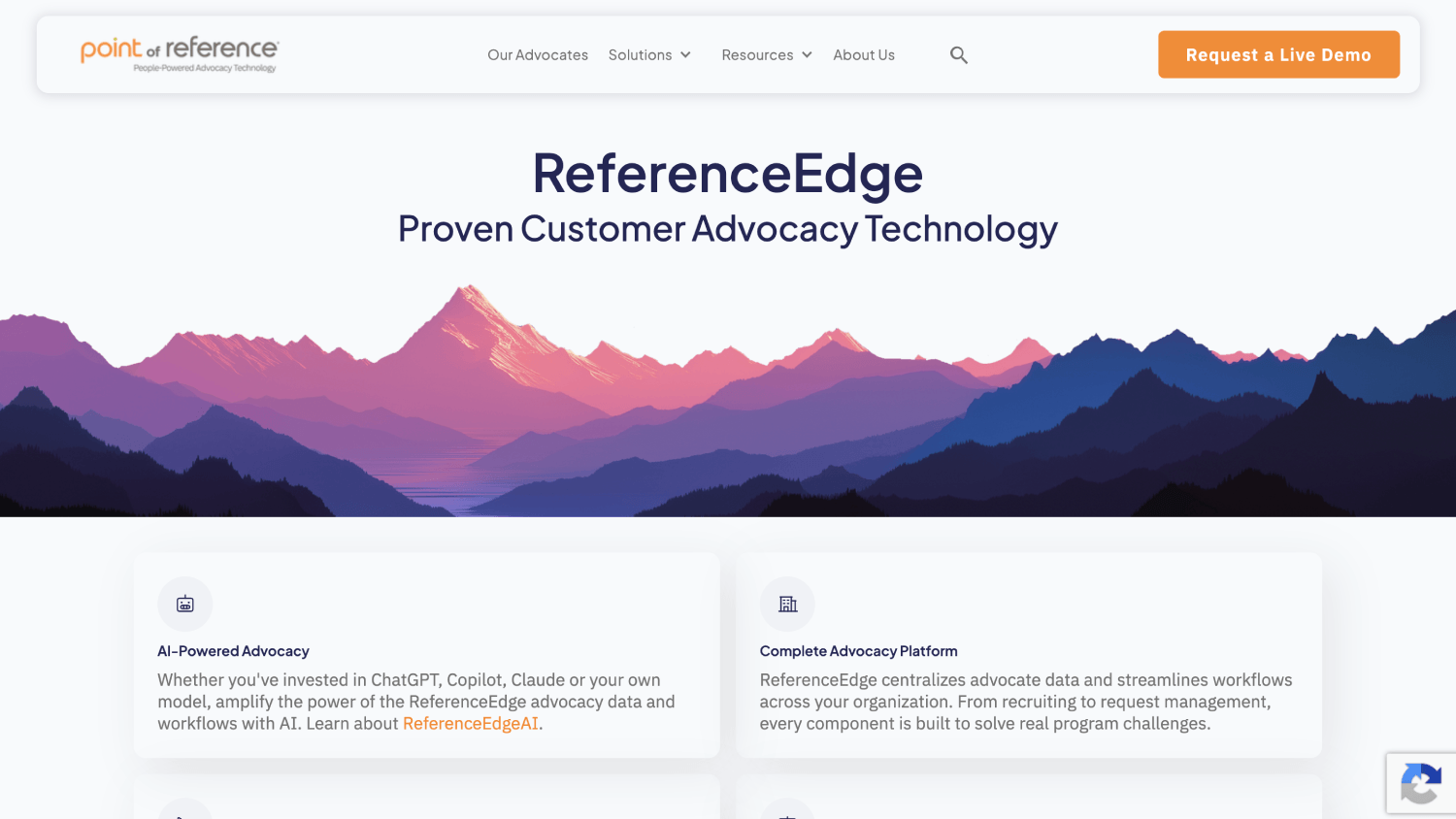
ReferenceEdge, built by Point of Reference, is the most purpose-built reference management platform in the category. It runs as a native Salesforce app, which means reference activity, customer availability, and reference-to-close attribution all live inside the CRM where sales already works. There is no separate portal to log into and no manual data export to reconcile.
The platform’s core value is bidirectional reference tracking: sales reps can request a reference directly from the Salesforce opportunity record, and program managers can see which references are being over-rotated before anyone burns a relationship. This referee fatigue visibility is something generic CRM workflows cannot replicate without significant custom development.
ReferenceEdge is priced on an annual subscription basis. Point of Reference does not publish list pricing publicly, so budget conversations will start with a discovery call. The platform is built for enterprise and upper mid-market Salesforce shops with an active customer marketing or reference program function. Teams without a dedicated reference program manager will underutilize it.
2. Influitive
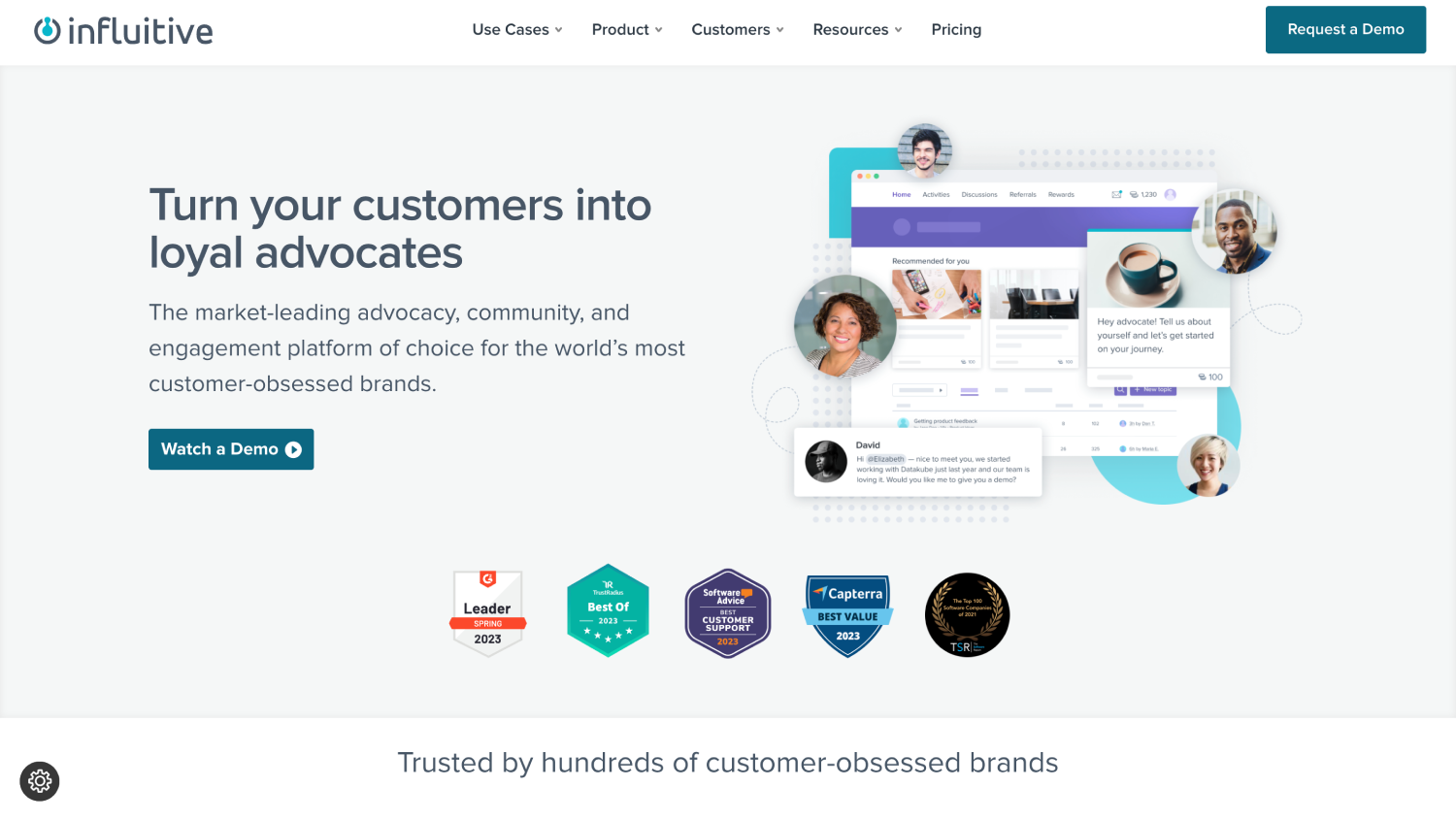
Influitive is the most established name in customer advocacy. The platform combines a branded advocate hub with challenge mechanics, gamification, and a reference coordination layer. Customers opt into an advocacy community, complete activities (writing reviews, recording videos, accepting reference calls), and earn rewards. Marketing gets a structured pipeline of proof in multiple formats rather than a stack of ad hoc requests.
The advocacy hub model works particularly well for SaaS companies with large customer bases and active user communities. It is less suited to companies with fewer than 50 named accounts, because the community mechanics require enough volume to feel alive. Influitive integrates with Salesforce and Marketo, and the platform includes analytics that show which advocacy activities correlate with expansion revenue.
Pricing is not publicly disclosed. Influitive serves mid-market and enterprise buyers, and contracts typically include an implementation and onboarding phase. The investment is real, and it justifies itself when there is already a customer success motion that surfaces willing advocates rather than relying on the platform to find them cold.
3. Orca
Orca is a newer entrant focused on peer-to-peer customer networks for B2B SaaS. The concept is closer to a managed reference network than a traditional advocacy hub: Orca connects prospects with existing customers through a structured peer conversation framework, rather than a community forum with challenges and badges. The vendor positions this as a response to the declining trust in vendor-curated testimonials.
What distinguishes Orca is the structured conversation layer. Reference calls are guided by question frameworks that surface specific use cases, pain points, and outcomes rather than open-ended conversations that drift. For sales teams that have struggled with reference calls that failed to move deals forward, this structure addresses a real gap. Pricing is not publicly listed, and the platform targets growth-stage and enterprise SaaS companies.
4. Deeto
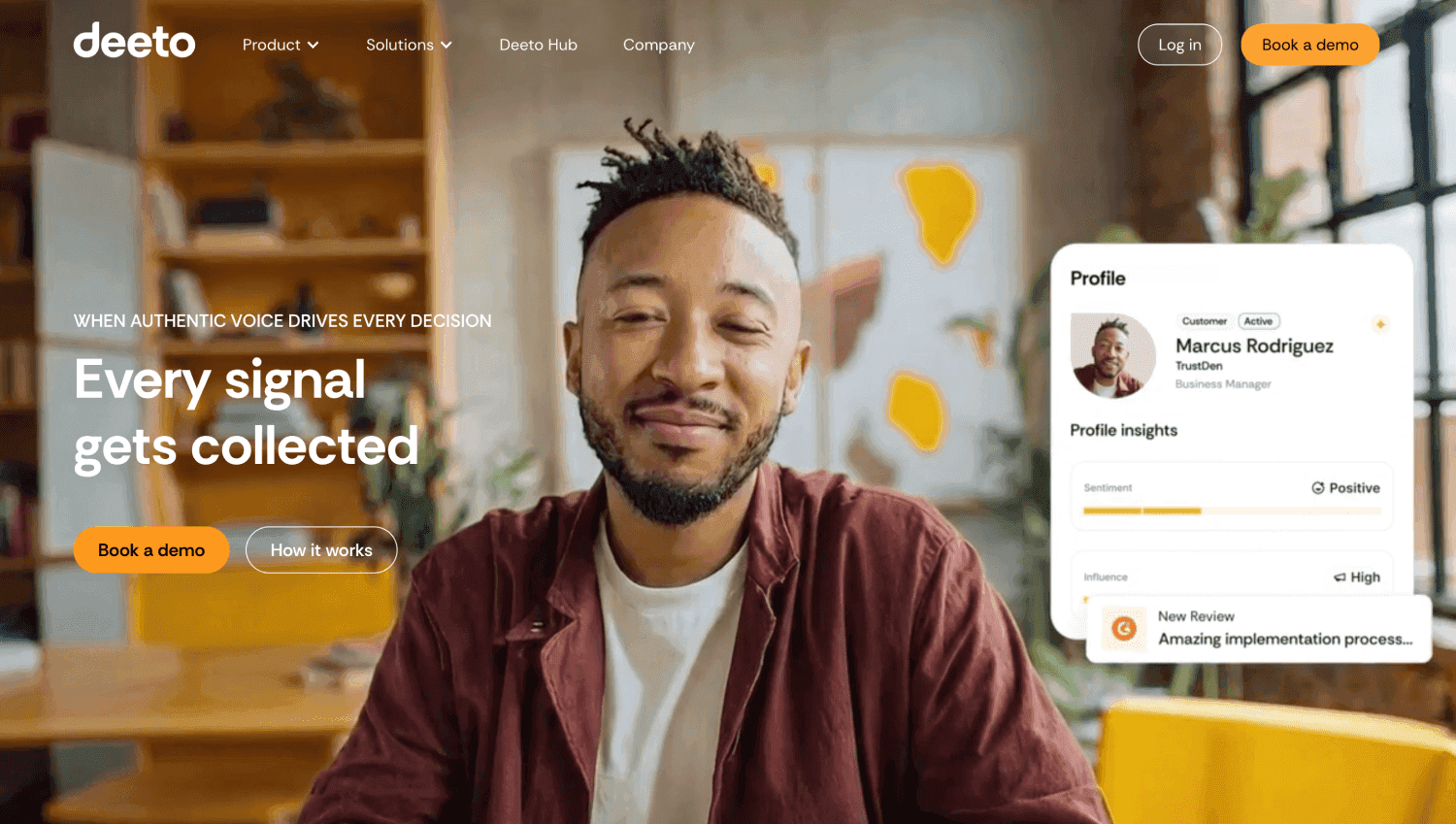
Deeto positions itself as an AI-powered customer proof platform that automates the collection and organization of evidence without requiring a dedicated customer marketing headcount. The platform identifies moments in the customer lifecycle where advocates are likely to be willing to participate, sends automated outreach, and routes collected evidence into a searchable library that sales can access through integrations with Salesforce and HubSpot.
Deeto’s differentiator is the automated recruitment loop. Most advocacy platforms still require manual identification and outreach to recruit advocates. Deeto uses behavioral signals and CS health data to prioritize outreach timing, which means the platform can operate with lighter human oversight. For marketing teams at Series A or B companies that cannot staff a dedicated advocate program, this automation-first approach is a meaningful distinction from Influitive or ReferenceEdge.
The vendor offers pricing tiers, though exact plan pricing requires a demo conversation. The platform integrates with major CRMs and marketing automation tools.
5. Base (formerly Camp)
Base is a customer marketing platform that includes customer proof management as a core use case alongside customer-facing materials creation and CS collaboration. The rebranding from Camp reflects a broader scope than advocacy alone: Base aims to be the operating system for the customer marketing function, covering everything from QBR content to reference tracking to win/loss capture.
For marketing teams that do not want to run three separate tools (one for references, one for case studies, one for CS collaboration), Base offers a consolidated layer. The trade-off is that no individual feature is as deep as a dedicated point solution. Reference management is not as mature as ReferenceEdge, and advocacy program mechanics are not as developed as Influitive. Base earns its place for customer marketing teams that need breadth and organizational clarity over depth in any one area.
Pricing is not publicly listed. Base targets mid-market SaaS companies with a dedicated customer marketing manager or team.
6. Testimonial Heroes
Testimonial Heroes occupies a narrower but highly specific niche: it is a production service and platform combination that produces B2B video case studies and testimonials at scale. Unlike pure software platforms that hand you the tooling and expect your team to execute, Testimonial Heroes manages the interview scheduling, filming (including remote video capture), editing, and delivery. The output is a finished asset, not raw footage.
This service-plus-software model makes it relevant for marketing teams that have the budget and the willing customers but lack the internal production capacity to turn raw testimonials into polished video assets. It is not the right fit for teams that want to build an internal advocate program or manage reference calls. It is the right fit for a demand-gen team that needs six to ten high-quality video case studies produced in a quarter without hiring a video producer. Pricing is project-based and available on request.
7. Vidyard Customer Stories
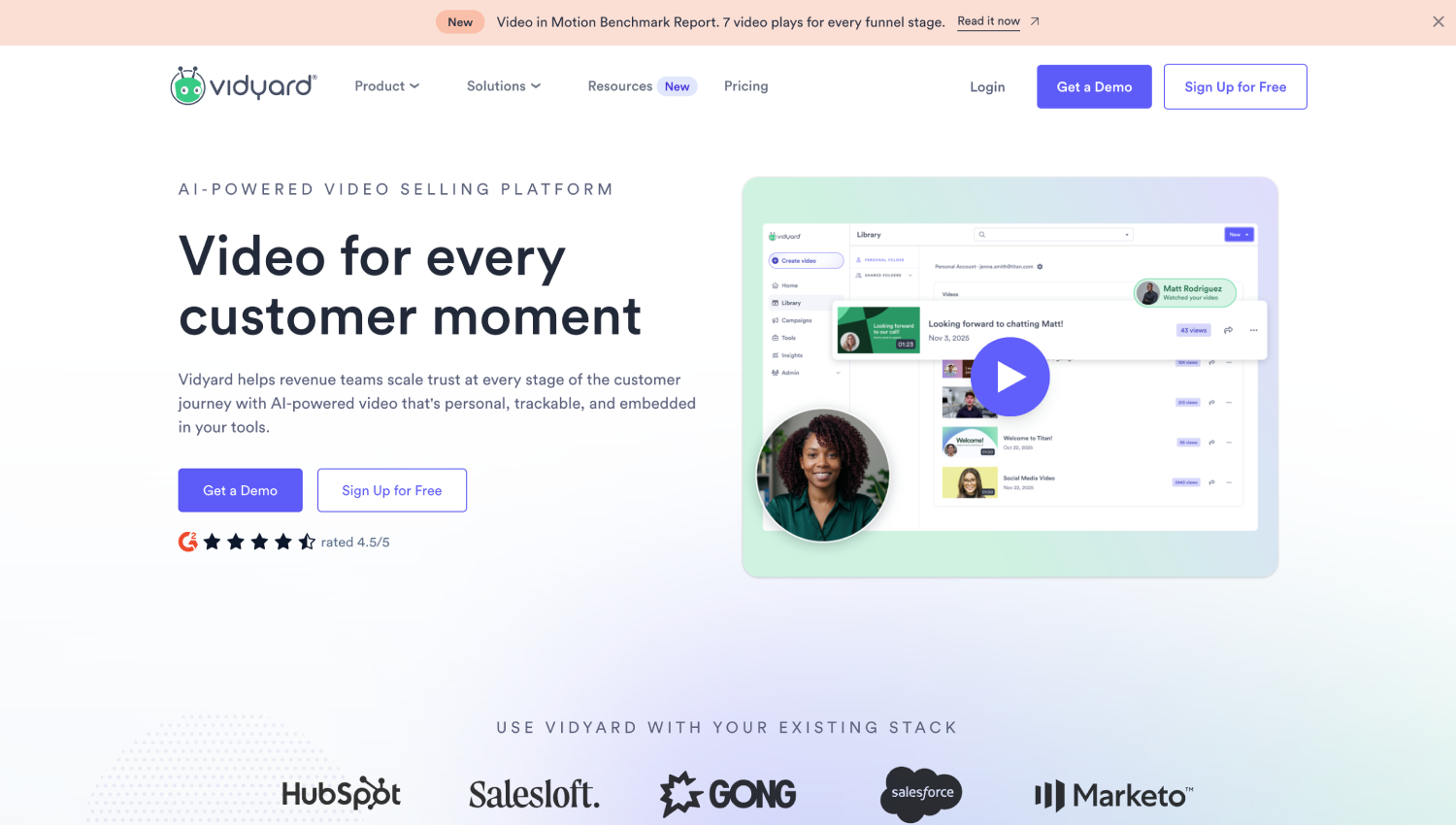
Vidyard is primarily known as a video platform for sales and marketing, but its customer stories and testimonial capture functionality makes it worth evaluating as a proof collection and distribution tool. Marketing teams can send personalized video request links to customers, who record asynchronous testimonials on their own schedule without needing a production call or professional setup. Those testimonials are stored, tagged, and shareable via tracked links or embedded on web properties.
Vidyard’s advantage over standalone testimonial tools is the existing video infrastructure: hosting, analytics, sharing, and CRM integration are already built. Teams already using Vidyard for sales prospecting video can extend the same platform to capture customer proof without adding a new vendor. The customer stories functionality is not the deepest reference management or advocacy system in this list, but for Vidyard shops, it removes a tool procurement process entirely. Vidyard’s public pricing page lists plans starting with a free tier, with paid plans available, though full platform pricing for teams requires a quote.
How Do These 7 Platforms Compare on Key Buying Criteria?
Note on Automation Depth: the High/Medium/Low ratings below are relative assessments within this category, not independently audited scores. Use them as a directional signal, not a specification.
| Platform | Best For | CRM Integration | Automation Depth | Public Pricing | Video Support |
|---|---|---|---|---|---|
| ReferenceEdge | Enterprise reference management in Salesforce | Native Salesforce app | Medium | No | Limited |
| Influitive | Mid-market / enterprise advocacy programs | Salesforce, Marketo | High | No | Yes |
| Orca | Peer-to-peer reference networks | Yes (CRM integrations) | Medium | No | No |
| Deeto | Lean teams needing automated proof collection | Salesforce, HubSpot | High | No | Yes |
| Base | Customer marketing teams wanting one platform | Yes (CRM integrations) | Medium | No | Yes |
| Testimonial Heroes | Video case study production without in-house capacity | Limited | Low (service-led) | No (project-based) | Yes (core product) |
| Vidyard Customer Stories | Teams already on Vidyard | Salesforce, HubSpot | Medium | Partial (freemium) | Yes (core product) |
How Do You Collect Customer Evidence at Scale Without Burning Advocate Relationships?
The core operational risk in any proof program is advocate fatigue. A customer who gets tapped for a reference call, a case study interview, a webinar guest spot, and a G2 review request inside three months will decline or disappear. Platforms that track reference usage at the individual customer level, and surface that data before a new request goes out, are not a luxury. They are the mechanism that makes a program sustainable.
Consider a SaaS company with 400 active accounts and a sales cycle averaging 90 days. If 15% of active deals request a reference call in any given quarter, that is roughly 60 reference requests against a pool of advocates who may represent only 10 to 15% of the customer base. Without a tracking system, the same 20 to 30 customers end up handling the bulk of calls. With a platform that enforces a cooling-off period and surfaces alternative references by segment match, the load distributes across 50 or 60 advocates instead. That is the operational case for platform investment.
For teams thinking about how customer proof infrastructure fits into a broader revenue operations stack, the best RevOps tools for revenue operations covers the adjacent tooling where proof delivery intersects with sales enablement.
What Should You Look for When Evaluating Case Study Software vs. a Testimonial Collection Tool?
Case study software and testimonial collection tools solve different parts of the same problem. Testimonial collection tools (and the testimonial features inside advocacy platforms) are optimized for speed and volume: get a short quote or 60-second video from a customer in under five minutes with minimal friction. Case study software is optimized for depth and governance: guide a customer through a structured story arc, collect approval sign-offs, version-control the content, and produce a finished PDF or web asset.
The practical question is which constraint is actually slowing your team down. If you have 200 customers and zero quotes, start with testimonial collection. If you have 30 quotes and can’t turn any of them into a full story because the approval process takes four months, you need a structured case study workflow with defined review stages and customer-facing approval portals.
Some teams need both, and that is the segment that advocacy platforms like Influitive or Base serve. But buying a full advocacy platform when you only need one of those two workflows is over-buying. Spend the saved budget on customer incentives instead.
How Do You Get Verified Customer Stats for Marketing Without Fabricating Data?
Verified customer statistics (“reduced onboarding time by 40%,” “closed 3x more deals”) are the most persuasive form of proof and also the most legally and reputationally exposed. The safest operational process involves three steps: capture the metric from the customer in their own words, have your legal or compliance team review the claim if it implies financial performance, and document the source with a dated approval sign-off stored in your proof platform.
Platforms like Deeto and Influitive support structured data capture during testimonial collection, where customers fill in specific outcome fields rather than leaving open-ended comments. That structured capture is what makes a stat defensible: it came from the customer’s own input, not from a marketing team’s interpretation of a vague quote. The difference matters when a prospect asks to verify the claim or when a competitor challenges it publicly.
Related to this, teams investing in verified customer evidence as an AI search citation asset should read the guide on how to get your brand cited by ChatGPT, Claude, and Perplexity. Customer case studies with specific, attributable metrics are among the highest-quality citation signals an AI search engine can find.
How Does a Customer Proof Platform Connect to the Broader CS Stack?
Customer proof platforms are not standalone tools. The health data that lives in your customer success software determines which customers are in a good enough place to be asked for a testimonial. The CRM stores the reference call outcomes that close late-stage deals. The marketing automation platform distributes the finished case studies. A proof platform that does not connect to any of these systems creates a manual reconciliation problem that negates the efficiency it was supposed to deliver.
The integration check is the most underweighted criterion in proof platform evaluations. A native Salesforce app is more durable than a Zapier connection. A bidirectional HubSpot sync is more useful than a CSV export. Before signing, ask whether the integration writes data back to the source system (not just reads from it), because reference usage data is only worth acting on when it lives inside the tools your sales and CS teams already check daily.
Teams that are restructuring their broader data stack around this kind of bidirectional activation pattern will find the comparison of the best reverse ETL tools for data activation useful context for how proof data can flow through a modern warehouse-native architecture.
Frequently Asked Questions
What is a customer proof platform?
A customer proof platform is software that manages the collection, storage, governance, and delivery of customer evidence for B2B sales and marketing. This includes reference call coordination, video and written testimonials, case study approvals, and ROI data capture. The category is distinct from review aggregators like G2, which are buyer-facing directories rather than internal evidence management systems for vendor teams.
How is customer reference management software different from customer advocacy software?
Customer reference management software focuses specifically on coordinating live reference interactions between prospects and existing customers, including scheduling, tracking, and attribution. Customer advocacy software is broader: it combines reference management with community mechanics, content co-creation, incentive programs, and multi-format evidence collection. Reference management is a point solution for a specific workflow. Advocacy platforms are full programs that require more setup, budget, and internal ownership to run effectively.
How much do customer proof platforms cost?
Most enterprise-tier customer proof platforms, including ReferenceEdge, Influitive, Orca, Deeto, and Base, do not publish list pricing publicly. Budget conversations typically start with a discovery call, and annual contract values vary widely depending on company size and scope. Vidyard offers a publicly listed freemium tier with paid plans available, and Testimonial Heroes charges on a project basis. Any vendor in this category with quote-only pricing should be asked for a rough budget range before investing time in a full demo cycle.
Can small B2B teams run a customer proof program without a dedicated headcount?
Yes, but the platform choice matters significantly. Influitive and Base are built around structured advocacy programs that benefit from a dedicated customer marketing manager. Deeto and Vidyard Customer Stories are more automation-forward and can operate with lighter human oversight. For very small teams, Testimonial Heroes offloads the production burden entirely in exchange for project fees. The minimum viable proof program for a lean team is automated testimonial collection via Deeto or Vidyard, with manual reference call coordination handled through a simple CRM tag system until volume justifies a dedicated reference platform.
What is the difference between a case study tool and a testimonial collection tool?
Testimonial collection tools capture short-form evidence quickly: a written quote, a star rating, or a 60-second video, typically with minimal customer friction. Case study tools manage a longer production workflow: structured interview guides, customer approval stages, co-authored editing, and final asset delivery in PDF or web format. Most advocacy platforms include both, but they serve different content needs. Testimonial tools supply volume for web pages and sales decks. Case study tools supply depth for late-stage deal support and analyst relations.
How do I prevent advocate fatigue when running a reference program?
Advocate fatigue happens when the same customers get repeatedly tapped because they are the most visible happy accounts. Preventing it requires tracking every reference interaction at the individual customer level, enforcing a minimum cooling-off period between requests (typically 60 to 90 days), and maintaining enough breadth in your advocate pool that no single customer accounts for more than a small fraction of total reference volume. Platforms like ReferenceEdge and Influitive surface usage data before a new request goes out, which is the operational mechanism that makes sustainable reference programs possible.
Should a B2B SaaS company use a customer proof platform or just G2 and Capterra?
G2 and Capterra are buyer-facing directories that generate reviews for public consumption. They do not manage internal reference programs, case study workflows, or the delivery of evidence to sales reps inside a CRM. Both types of tool serve different jobs. Review aggregators help prospects discover and trust you. Customer proof platforms help your sales team use existing evidence at the right moment in a specific deal. Most B2B SaaS companies need both, but they solve different problems and should not be treated as substitutes for each other.
Which Customer Proof Platform Is Actually Right for Your Team?
The decision tree is shorter than most evaluations suggest. If your primary problem is enterprise reference call coordination inside Salesforce, ReferenceEdge is the purpose-built answer. If you need to build a structured, multi-format advocacy program and have the headcount to run it, Influitive is the most mature option. If you are a growth-stage SaaS company with limited customer marketing resources and need automated evidence collection, Deeto is worth a serious look before anything else.
Orca is worth evaluating specifically when your reference calls are failing to move deals because the conversations are unstructured. Base makes sense if you need a single platform covering customer marketing operations broadly rather than a point solution. Testimonial Heroes solves a production problem, not a program problem, so it belongs in deals where the constraint is video asset creation, not evidence strategy. Vidyard Customer Stories earns its place only for teams already running Vidyard for sales, where adding a testimonial collection layer requires no new vendor relationship.
The underlying principle is that no platform turns a reluctant customer into an enthusiastic advocate. What these tools do is remove the friction that prevents willing customers from participating, make the evidence they produce findable and usable at the moment sales needs it, and give program managers the visibility to run a reference bench without burning it out. That is the program. The platform just makes it repeatable.