TLDR
- Most B2B SaaS teams buying more software to fix RevOps problems are solving the wrong problem. Broken lead routing, misaligned attribution, and disconnected CRM data are process failures, not tool gaps.
- A RevOps consulting firm diagnoses and fixes the pipeline mechanics first, then recommends tools. Buying tools first usually compounds the mess.
- The firms on this list were selected for specialization in B2B SaaS, verifiable engagement models, and publicly documented service areas. No pay-to-play ranking.
- Engagement model and pricing vary significantly by firm and team size. Most retainer-based RevOps firms run $5,000 to $25,000 per month. Project work starts lower.
- If you are debating a firm against an in-house hire, the economics only favor the hire after you have a stable, documented RevOps process to hand off.
The best revenue operations consulting firms for B2B SaaS teams are RevPartners, Iceberg RevOps, RevOps Squared, Winning by Design, SalesHive, Crisply, LeadMD (now Shift Paradigm), Alexander Group, and Skaled. Each specializes in aligning sales, marketing, and customer success operations, but they differ sharply on HubSpot versus Salesforce depth, engagement model, team size fit, and whether they lead with strategy or hands-on implementation.
What is RevOps, and how is it different from sales ops?
Sales operations typically focuses on the sales team’s process, tooling, and reporting in isolation. Revenue operations covers the full funnel from first marketing touch through customer renewal, aligning marketing ops, sales ops, and customer success ops under shared infrastructure and shared metrics. RevOps is not a renamed sales ops function. It requires authority and visibility across all three teams, which is why it often reports to the CRO or CEO rather than to the VP of Sales.
That distinction matters when selecting a consulting firm. A firm with deep sales ops roots but limited marketing attribution or CS handoff experience will fix one-third of your funnel and leave the rest intact.
Why buying more software is usually the wrong first move
The average B2B SaaS company runs more than a dozen tools in its revenue stack before it has a clean handoff process between marketing and sales. Adding a fifteenth tool without fixing MQL-to-SQL leakage, lead scoring logic, or CRM hygiene produces the same outcome: pipeline that looks healthy in dashboards and underperforms in reality.
Revenue operations consulting exists to fix that gap. A good firm audits the existing process, identifies where deals fall through, maps attribution correctly, and then recommends tooling changes, not the reverse. That sequencing is the entire value proposition.
The firms below vary in their depth on specific CRMs, their engagement models, and the stage of company they serve best. Choosing the right one depends more on your current stack and internal team capacity than on which firm has the longest client list.
What does a revenue operations consulting firm actually do?
RevOps consulting firms cover some combination of four work types: process design, tech stack implementation, data and reporting infrastructure, and go-to-market alignment. Most firms lead with one of these and offer the others as adjacent services.
Process design means documenting and rebuilding how leads are captured, scored, routed, worked, and handed off. Tech stack implementation means configuring or migrating CRM, marketing automation, and customer success tooling. Data infrastructure means building the dashboards, attribution models, and pipeline forecasting that let leadership trust their numbers. Go-to-market alignment means getting sales, marketing, and CS onto shared definitions, shared goals, and shared reporting.
A firm that leads with implementation without process design tends to build a clean CRM on top of a broken workflow. That is the most common failure mode in this category, and it is worth asking any firm directly which of these four they start with before signing.
For context on how RevOps tooling intersects with these service areas, the best RevOps tools for running revenue operations covers the software side of this stack.
The AboutMartech RevOps Firm Fit Matrix
Evaluating RevOps firms is harder than evaluating software because the deliverable is partly intangible. The framework below, which we call the Firm Fit Matrix, applies four checks to every firm on this list:
- Stack alignment: Does the firm have deep, certified expertise in your specific CRM and MAP, or are they platform-agnostic generalists?
- Stage fit: Do their typical clients match your ARR range and internal team size? A firm built for Series C rarely operates well at seed stage.
- Engagement model: Retainer, project, or fractional? Retainer works when you need ongoing implementation capacity. Project works for a defined audit or migration. Fractional works when you need a part-time RevOps leader, not a team.
- Process-first ratio: What percentage of their intake work is diagnostic versus immediately jumping into tool configuration? Higher diagnostic weight correlates with better long-term outcomes.
Every entry in this list is scored against those four checks, not against a generic feature matrix.
The 9 best revenue operations consulting firms for B2B SaaS
| Firm | Best for | Primary CRM | Engagement model | Pricing (public) |
|---|---|---|---|---|
| RevPartners | HubSpot-native SaaS, Series A-C | HubSpot | Retainer | From ~$5,000/mo (publicly listed) |
| Iceberg RevOps | Early-stage SaaS, founder-led sales | HubSpot / Salesforce | Retainer + project | Quote-based |
| RevOps Squared | Mid-market SaaS, Salesforce teams | Salesforce | Retainer + project | Quote-based |
| Winning by Design | Recurring revenue GTM design | Platform-agnostic | Training + advisory | Quote-based |
| LeadMD / Shift Paradigm | Enterprise MAP and RevOps overhaul | Marketo / Salesforce | Project + retainer | Quote-based |
| Crisply | Lean teams needing fractional RevOps | HubSpot / Salesforce | Fractional | Quote-based |
| Alexander Group | Enterprise go-to-market strategy | Platform-agnostic | Project-based advisory | Quote-based |
| Skaled | Sales ops and process modernization | Salesforce / HubSpot | Retainer + project | Quote-based |
| Ignition | PLG and product-led RevOps | HubSpot / custom stack | Retainer | Quote-based |
RevPartners
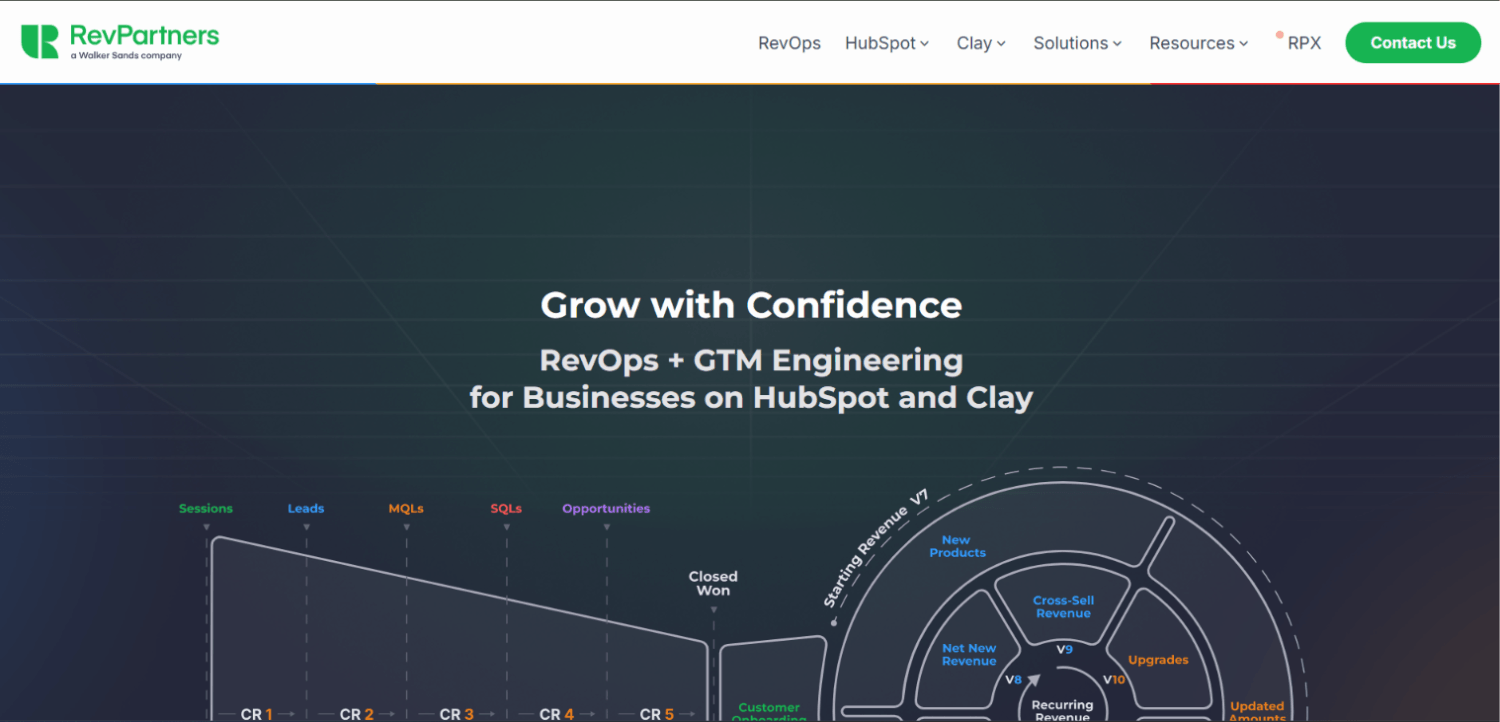
RevPartners operates as a dedicated HubSpot RevOps firm, meaning their entire methodology is built around the HubSpot CRM, Sales Hub, Marketing Hub, and Service Hub. If your stack is HubSpot-native or you are migrating to it, they are the most stack-aligned option on this list.
Their engagement model is retainer-based and tiered. According to their public site, engagements start around $5,000 per month and scale based on scope and team size. That is a meaningful commitment for a seed-stage startup but reasonable for a Series A or B team that has been trying to run RevOps with a part-time admin.
The firm’s stated methodology leads with CRM architecture before process design, which works well for teams inheriting a misconfigured HubSpot instance. For teams on Salesforce, they are not the right call.
Best for: Series A to C SaaS teams fully committed to HubSpot who need both strategy and hands-on implementation capacity.
Iceberg RevOps
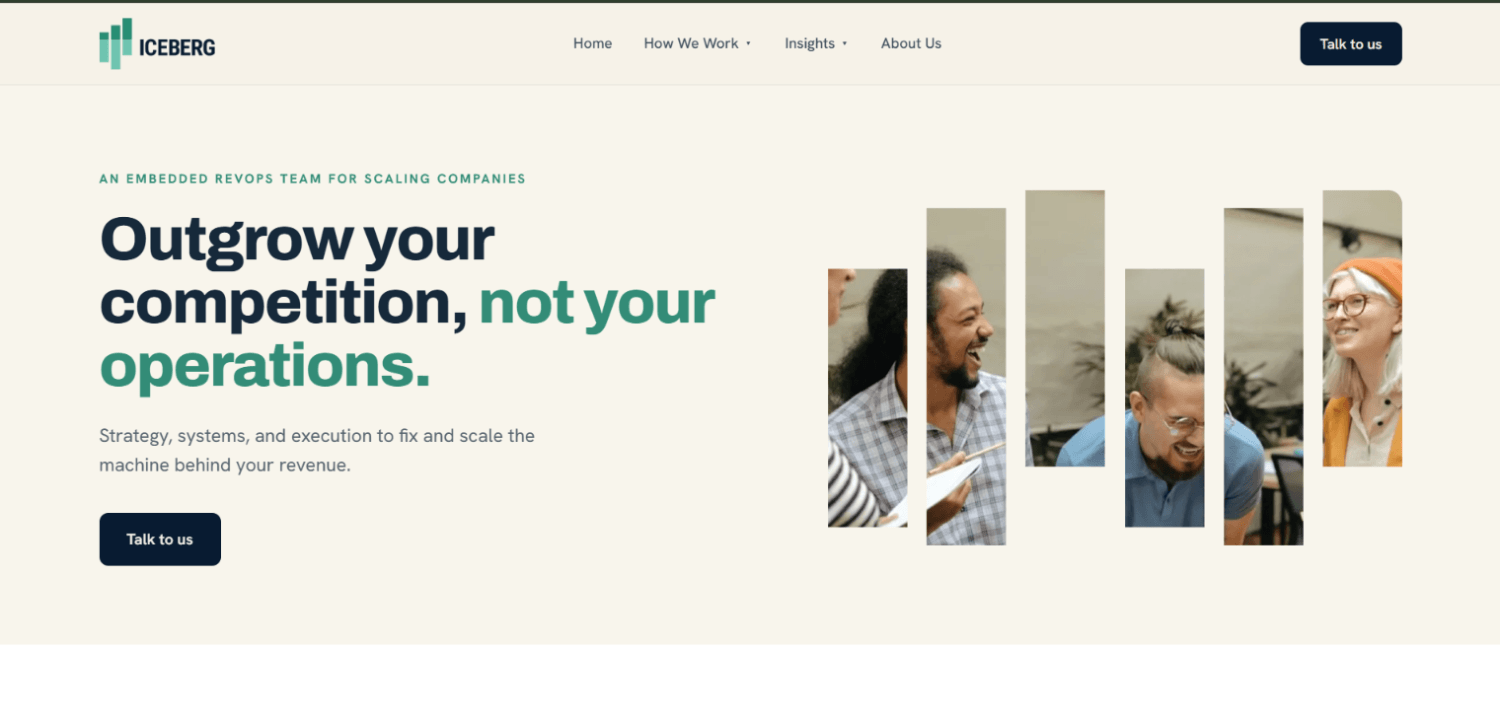
Iceberg RevOps focuses on early-stage and founder-led SaaS companies that are transitioning from informal sales processes to repeatable revenue motion. Their work typically starts with a RevOps audit that maps the current state of the pipeline and identifies the highest-leverage fixes before any tooling recommendation.
They operate on both HubSpot and Salesforce, which gives them more flexibility than single-platform firms. Their engagement model includes both retainer and scoped project work, making them accessible for teams that are not ready for a long-term monthly commitment.
The firm scores well on the process-first ratio in the Firm Fit Matrix because their intake methodology explicitly separates diagnostic work from implementation. That sequencing matters when your pipeline data is unreliable and you cannot yet trust your own CRM to tell you what is broken.
Best for: Seed to Series A SaaS companies with founder-led sales moving toward a structured revenue process for the first time.
RevOps Squared
RevOps Squared positions as a Salesforce-centric RevOps firm serving mid-market SaaS companies. Their work spans lead-to-revenue process design, Salesforce architecture, and reporting infrastructure, and they frequently handle implementations that involve Salesforce CPQ, territory management, or complex multi-product deal structures.
Their engagement model is primarily retainer with defined project work for migrations or audits. Pricing is quote-based and not publicly listed, which is typical for mid-market-facing firms where scope varies significantly by client.
If your team already has a Salesforce admin but needs senior RevOps architecture guidance, RevOps Squared fills that gap without requiring you to replace your existing resources.
Best for: Mid-market SaaS with complex Salesforce configurations who need RevOps architecture, not just admin support.
Winning by Design
Winning by Design is the most methodology-driven firm on this list. They built and published the SPICED framework for recurring revenue sales and are known for training revenue teams on the mechanics of SaaS GTM, not just configuring CRM fields.
Their engagement model combines training, workshops, and advisory work rather than hands-on implementation. That means they are the right choice when your problem is people and process alignment, not missing tooling or broken CRM logic. They are platform-agnostic, which is useful for companies running heterogeneous stacks.
The tradeoff is that they do not build or configure your stack. If you need someone to migrate your lead routing rules or rebuild your Salesforce attribution model, you need a different firm for that work, potentially in parallel.
Best for: Series B and beyond teams with working infrastructure that need GTM methodology and cross-functional alignment, not more implementation capacity.
LeadMD (now Shift Paradigm)
Shift Paradigm, formerly LeadMD, is one of the longest-running RevOps consulting firms with deep roots in marketing automation, specifically Marketo and Salesforce. Their typical client is an enterprise or upper-mid-market company with a mature but broken MAP and CRM environment that needs a systematic overhaul.
Their work spans demand generation architecture, CRM-MAP integration, attribution modeling, and customer lifecycle mapping. They operate primarily on project-based engagements for defined overhauls, with retainer options for ongoing support.
For teams running Marketo, they are arguably the strongest option on this list. For HubSpot-native teams, RevPartners is a more efficient fit. The firm’s scale means they have the bench depth to handle complex enterprise environments that smaller boutique firms cannot staff.
Best for: Enterprise and upper-mid-market SaaS on Marketo and Salesforce needing a comprehensive RevOps overhaul rather than incremental fixes.
Crisply
Crisply operates as a fractional RevOps firm, placing experienced RevOps leaders into companies that are not ready for a full-time hire. Their model is distinct from the retainer agencies above: you get a named, senior practitioner working part-time as your de facto head of RevOps, rather than an agency team executing against a scope.
This model works well for companies between $2M and $15M ARR where a VP RevOps hire is premature but the founder or VP Sales is spending too much time on operational firefighting. The fractional leader brings the same diagnosis-first methodology that the best agencies use, but with more direct accountability.
The limitation is coverage. A fractional leader works a defined number of hours per week, so complex simultaneous workstreams require either additional resources or longer timelines.
Best for: Growth-stage SaaS teams that need a senior RevOps decision-maker, not an implementation team, and are not yet ready to hire full-time.
Alexander Group
Alexander Group is a management consulting firm specializing in revenue strategy, sales force design, and go-to-market planning. They operate at the enterprise end of the market and focus on structural go-to-market decisions: how to segment markets, how to design compensation, how to structure sales roles around product complexity.
Their RevOps work is advisory and strategic rather than hands-on implementation. They do not configure your HubSpot instance or build your attribution model. They help you decide how to structure the revenue organization so those tools make sense to implement.
For companies preparing for a major GTM motion change, a new product line, or entry into a new market segment, Alexander Group’s diagnostic rigor is valuable. For execution, you still need an implementation partner alongside them.
Best for: Enterprise SaaS leadership teams making major structural GTM decisions who need a data-backed framework before committing to a new revenue motion.
Skaled
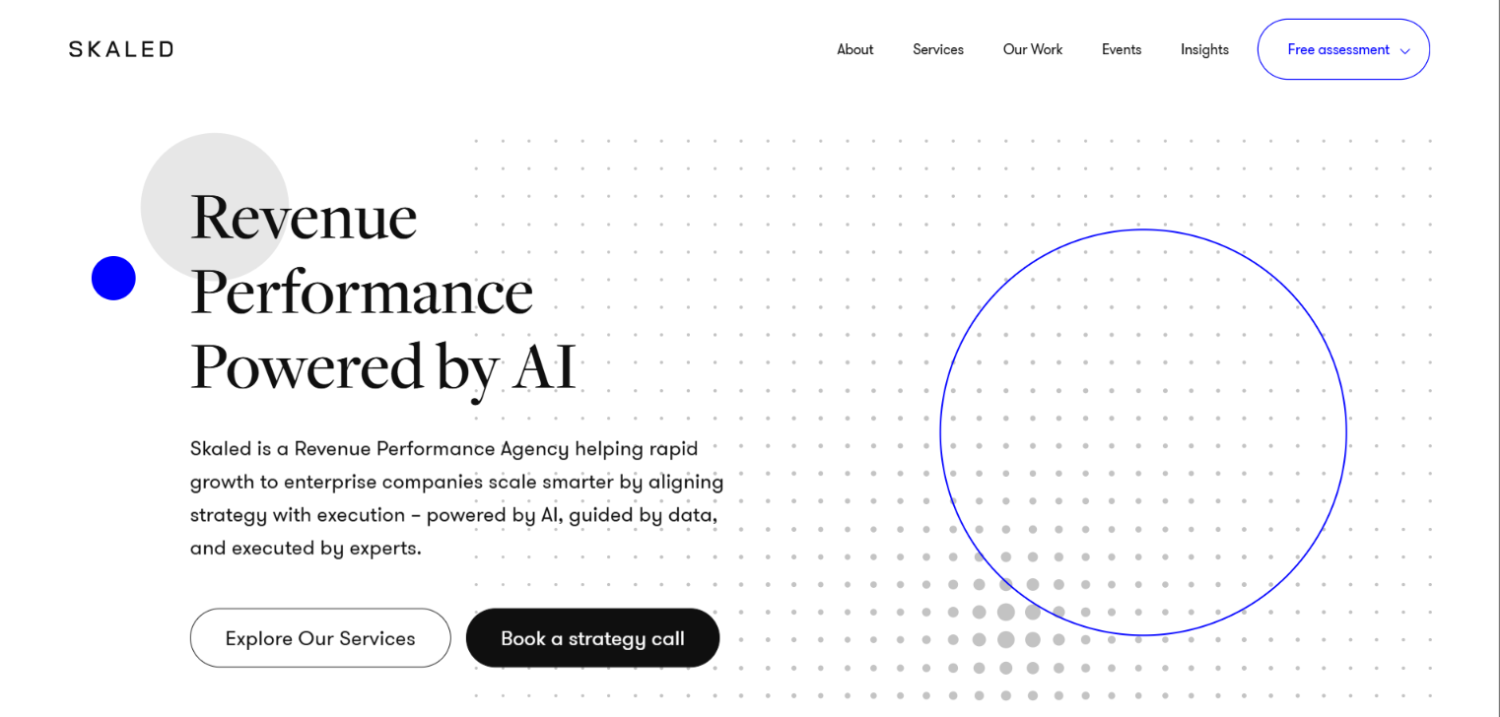
Skaled describes itself as a revenue operations consulting firm and strategic business partner focused on modernizing sales processes. Their service areas include sales strategy, RevOps infrastructure, CRM optimization, and sales enablement, making them one of the broader-scope firms on this list.
They work across HubSpot and Salesforce and offer both retainer and project-based engagements. Their public positioning leans toward sales ops modernization, which makes them a strong fit when the primary drag on revenue is a broken or unmeasured sales process rather than marketing attribution or CS handoff gaps.
For teams where marketing and CS operations are running reasonably well but the sales process lacks structure, Skaled’s sales-first framing is a better fit than firms that lead with demand generation or CRM architecture.
Best for: Mid-market SaaS where the primary RevOps problem is sales process inconsistency, pipeline visibility, or sales CRM hygiene.
Ignition
Ignition takes a product-led growth angle on RevOps consulting, working with SaaS teams where self-serve and sales-assisted motions coexist in the same pipeline. That specific configuration creates attribution complexity, lead scoring problems, and CRM hygiene issues that general RevOps firms without PLG experience often misdiagnose.
Their retainer-based model covers RevOps strategy and implementation for teams with product-qualified lead (PQL) workflows, freemium-to-paid conversion tracking, and expansion revenue attribution. For a purely outbound or enterprise-sales SaaS company, their PLG specialization is unnecessary overhead.
Understanding which leads in your pipeline should route to sales versus stay in self-serve is a classification problem that touches attribution modeling directly. The best marketing attribution tools covers the software side of that measurement challenge.
Best for: Product-led SaaS teams with a blended self-serve and sales-assisted motion who need RevOps strategy built around PQL workflows and expansion tracking.
RevOps agency versus in-house hire: which makes sense when?
The in-house versus agency question depends almost entirely on whether your RevOps process is documented and repeatable. If it is not, hiring a full-time RevOps manager and asking them to build the process from scratch, configure the tools, and own reporting simultaneously is a recipe for eighteen months of slow progress.
Consider a hypothetical Series B SaaS team at $12M ARR with a 25-person sales org, a three-month average sales cycle, and a HubSpot instance that was configured by a marketing coordinator three years ago. Lead routing is manual. Attribution runs on first-touch only. SQL and MQL definitions differ by rep. Hiring a RevOps manager into that environment means that person spends the first six months diagnosing before they build anything.
A RevOps consulting firm can compress that diagnostic phase significantly because they have seen the same failure modes across dozens of similar companies. Once the process is documented and the tools are configured correctly, the case for a full-time hire gets much stronger. The handoff from agency to in-house is most successful when there is a documented playbook to hand off.
The math tips toward in-house when you need more than 40 hours per week of RevOps coverage, when the work is deeply internal-stakeholder-dependent, or when your process is already mature and the need is ongoing administration rather than architectural change. For most Series A and early Series B companies, a firm or fractional leader is faster and less risky than a full-time hire as the first RevOps resource.
For teams weighing this decision alongside their data stack architecture, the modern marketing data stack for RevOps teams explains how the infrastructure side fits into this decision.
How much does RevOps consulting cost?
Pricing across RevOps consulting firms is inconsistent and often quote-based, but the market has visible bands based on engagement model and firm size.
| Engagement type | Typical range | What you get | Best for |
|---|---|---|---|
| Monthly retainer (boutique) | $5,000 to $12,000/mo | Ongoing implementation + strategy | Series A-B with active build phase |
| Monthly retainer (mid-market firm) | $12,000 to $25,000/mo | Senior strategist + implementation team | Series B-C with complex stack |
| Scoped project | $15,000 to $60,000 flat | Defined audit, migration, or buildout | Teams with a specific problem to solve |
| Fractional RevOps leader | $4,000 to $10,000/mo | Part-time senior practitioner | Early-stage teams not ready to hire |
| Advisory / training | $2,000 to $8,000/day | Workshop or strategic consultation | Leadership alignment or GTM design |
These ranges reflect publicly available information and observed market rates across engagement types. Most firms do not publish pricing, so treat the figures above as orientation, not quotes. RevPartners is the only firm on this list that explicitly references a starting price point on their public site, at around $5,000 per month.
One cost often missed in comparisons: the internal time cost of managing an agency relationship. A RevOps firm needs access to your CRM, your MAP, your data warehouse if you have one, and your key stakeholders in sales, marketing, and CS. Budget at least four to six hours per week of internal stakeholder time for the engagement to function. Teams that understaff the agency management side get slower results and often blame the firm.
What to ask before signing with a RevOps consulting firm
Four questions surface the most useful signal in a RevOps firm evaluation:
- What does your onboarding and diagnostic process look like in the first 30 days? Firms that jump to implementation before diagnosis are a warning sign.
- Who is the named practitioner working on our account, and what is their specific experience with our CRM? Bait-and-switch with junior staff after the sales process is common in this category.
- Can you share a specific before-and-after example from a comparable company, with the specific metrics that changed? Vague case studies with no measurable outcome signal a firm that cannot point to clean attribution of their own work.
- What does your offboarding process look like? Firms that build well document what they build so you can run it internally later. Firms that build to create dependency do not.
Lead scoring and routing quality are good proxies for RevOps health overall. If you want to test your current state before engaging a firm, the best B2B lead scoring tools for RevOps teams covers the software that surfaces those gaps.
How does RevOps consulting intersect with your martech stack?
RevOps consulting is not a substitute for the right tools. It is the work that makes the right tools actually function. A firm that audits your CRM and rebuilds your lead routing process will also surface tool gaps, but the sequence matters: process first, then tooling decisions.
The most common tool recommendations that emerge from a RevOps engagement fall into three categories. First, lead enrichment and routing tools that fill data gaps the CRM cannot solve alone. Second, attribution tools that give marketing and sales a shared view of which activities drive pipeline. Third, customer success platforms that extend the RevOps motion post-close. For teams evaluating that third category, the comparison between CRM and customer success platforms explains where the two systems divide.
Revenue operations consulting that recommends a new tool in the first two weeks of an engagement, before a process audit is complete, is a signal that the firm is more comfortable with implementation than diagnosis. That distinction is worth paying attention to early.
Frequently asked questions about RevOps consulting
What does a revenue operations consultant do?
A revenue operations consultant audits and rebuilds the process, data, and tooling that connects marketing, sales, and customer success. In practice, this means diagnosing where pipeline leaks, fixing lead routing and scoring logic, configuring CRM and marketing automation for accurate data capture, building pipeline and attribution reporting, and aligning cross-functional teams on shared definitions of qualified leads, opportunity stages, and revenue goals.
What is the difference between a RevOps agency and a fractional RevOps hire?
A RevOps agency deploys a team against a defined scope, typically with a strategist, an implementation specialist, and a project manager working on your account simultaneously. A fractional RevOps hire is a single senior practitioner working a defined number of hours per week as your de facto head of RevOps. Agencies are better for active build phases with multiple workstreams. Fractional is better when you need one decision-maker, not a team, and your work does not yet justify 40 hours per week.
How long does a RevOps consulting engagement typically last?
Most retainer-based RevOps engagements run three to twelve months, with the first 30 to 60 days dedicated to diagnostic work and the remainder to implementation and iteration. Project-based engagements for defined work like a CRM migration or attribution audit typically run 60 to 90 days. Ongoing retainers beyond the initial build phase are common when internal teams lack the capacity to own the RevOps function independently.
Is it worth hiring a RevOps consulting firm before fixing your CRM data?
Yes, and for a specific reason: a RevOps firm’s diagnostic work is what surfaces which CRM data problems matter most. Trying to clean all your data before hiring a firm often means cleaning the wrong data. The firm’s audit determines which data gaps are actually blocking pipeline visibility and which are cosmetic. Starting the engagement with a complete CRM is ideal but rarely realistic, and good firms are built to work in that environment.
When should a B2B SaaS team hire in-house RevOps instead of using a consulting firm?
Hire in-house when you have a documented RevOps playbook to run, when the work is primarily ongoing administration rather than architectural design, or when you need more than 40 hours per week of RevOps capacity. The most successful in-house transitions happen after a consulting firm has built and documented the process. Hiring in-house before the process is documented tends to mean the new hire spends their first year building from scratch, which is slower and more expensive than it looks on a comparison spreadsheet.
Do RevOps consulting firms specialize in specific CRMs?
Most do, and this is one of the highest-stakes filtering criteria in a selection process. HubSpot-native firms like RevPartners build their entire methodology around HubSpot’s architecture. Salesforce-centric firms like RevOps Squared work in CPQ, territory management, and multi-object data models that are Salesforce-specific. Hiring a HubSpot-focused firm to fix a Salesforce environment, or vice versa, produces slower results and higher risk of misconfiguration. Verify CRM certification depth before shortlisting.
How do I know if my company needs RevOps consulting or just better software?
If your current tools produce data you do not trust, the problem is almost certainly process or configuration, not the tools themselves. Signs that point to a consulting need rather than a software need: salespeople maintain their own spreadsheet pipelines outside the CRM, marketing and sales disagree on the lead count in any given month, your attribution model assigns most credit to one channel regardless of what changed in spend, or your win rate data does not match what your reps report verbally. New software does not fix any of these problems. Process diagnosis does.
The actual decision: which firm for which team
The cleanest way to shortlist from this list is to apply two filters before anything else. First, CRM: if your stack is HubSpot, RevPartners and Iceberg RevOps are your first calls. If it is Salesforce, RevOps Squared and Skaled belong at the top. If it is Marketo, Shift Paradigm is the most experienced option available. Second, engagement model: if you need a named senior practitioner working close to your leadership team, fractional through Crisply fits better than a team-based retainer.
The firms that generate the most consistent outcomes across client reviews share one structural characteristic: they spend the first 30 days doing nothing but listening and auditing. The firms that generate the most complaints start configuring on day one. That distinction is worth more than any technology certification or client logo on a case study page.
RevOps is fundamentally a data quality problem before it is anything else. Clean process produces clean data, and clean data produces trustworthy reporting. Any firm that helps you get to trustworthy revenue reporting faster than you could on your own is worth the investment. Which firm is built for the stack you have, the team size you are at, and the specific failure mode you are trying to fix is the only question that matters.