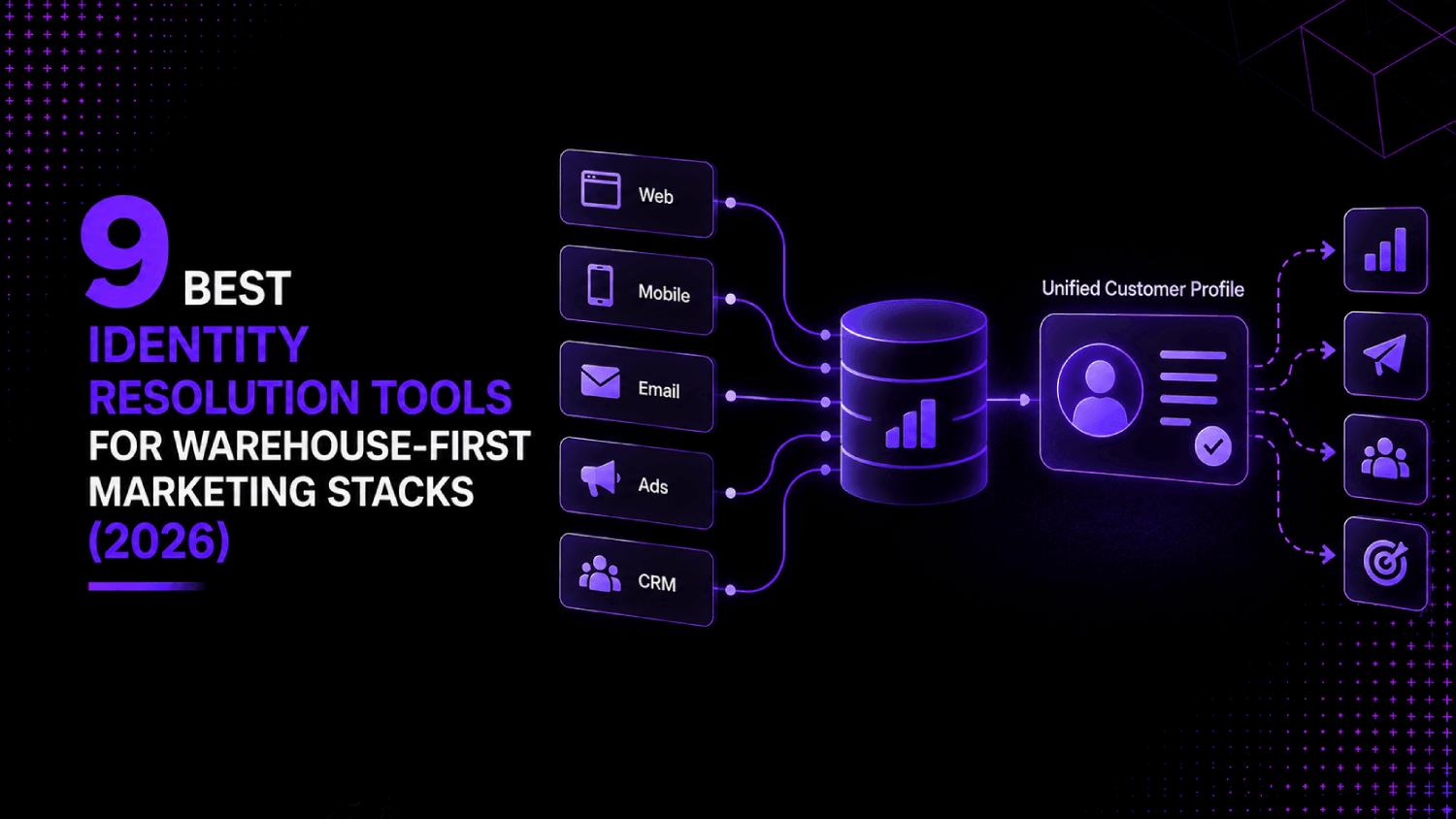
- Most CDPs perform identity stitching on known, logged-in users. The hard problem is resolving anonymous sessions, offline touchpoints, household members, and cross-device signals into a single golden record before activation.
- Deterministic matching is more accurate but covers fewer records. Probabilistic matching covers more records but introduces noise. Production-grade identity resolution tools run both in sequence.
- Warehouse-first identity tools write resolved IDs back to Snowflake, BigQuery, or Databricks without pulling your data into a vendor-controlled silo, which matters for privacy compliance and data residency.
- B2B identity resolution adds a layer most consumer tools ignore: account-to-contact mapping, job-change detection, and buying-committee assembly at the account level.
- LiveRamp and Zeotap are deliberately excluded from this list. Both are covered elsewhere. The nine vendors below are evaluated specifically for warehouse-native or warehouse-compatible stacks.
Identity resolution tools unify fragmented customer identifiers, including emails, device IDs, cookies, phone numbers, and offline transaction records, into a single persistent customer profile called a golden record. The best tools for warehouse-first stacks write resolved identities directly back to Snowflake, BigQuery, or Databricks, support both deterministic and probabilistic matching, and expose APIs or reverse ETL connectors for downstream activation without moving your data into a vendor silo.
What Most Teams Get Wrong About Identity Resolution
The default assumption is that a CDP handles this. For a narrow definition of identity, it does. When a user logs in with a known email, most CDPs merge that session with an existing profile. That is not identity resolution. That is email-keyed deduplication, and it covers maybe 20 to 40 percent of your actual traffic on a good day.
The real problem is everything outside the logged-in session: anonymous browsers who later convert via a call center, a household with three devices and one shipping address, a B2B buyer who used a personal email on a webinar form and a work email on a demo request. A CDP joins records on known keys. An identity resolution tool builds the inference layer that connects unknown signals to known ones, then maintains that graph as identifiers change over time.
If your team is already running a warehouse-native data stack, the architecture question matters as much as the matching logic. Tools that pipe your data into a proprietary identity graph and return an opaque ID create vendor lock-in and GDPR headaches. The vendors below are evaluated on matching accuracy, warehouse compatibility, B2B versus B2C fit, and whether they can actually explain their graph to a data team.
For context on how identity resolution fits into the broader activation workflow, the guide to warehouse-native CDPs for the modern data stack covers how resolved identities move into audience building and campaign execution.
Deterministic vs Probabilistic Matching: Which Method Actually Wins?
Deterministic matching links records using exact, verified identifiers: a hashed email, a phone number, a login token. When two records share the same SHA-256 hashed email, the system merges them with near-100% confidence. The coverage ceiling is the limiting factor. If a user never provides a consistent identifier across touchpoints, deterministic logic cannot connect them.
Probabilistic matching uses statistical inference across behavioral signals: IP address ranges, device fingerprints, browsing patterns, time-of-day activity, and geographic proximity. Coverage expands dramatically, but false positive rates climb with it. A household where two adults share a Wi-Fi network and similar browsing habits can produce phantom identity merges that corrupt personalization logic downstream.
Production systems worth buying run deterministic first, then apply probabilistic logic to the residual unmatched population. The ratio matters. A tool that runs 70% probabilistic on a consumer DTC catalog introduces enough noise to make suppression lists unreliable and frequency capping meaningless. A B2B tool that is 95% deterministic on business email domains will miss the CFO who researches on a personal iPad over the weekend.
The AboutMartech Identity Depth Test
Before evaluating any vendor, run what we call the Identity Depth Test across four dimensions. First, ask what percentage of their match rates come from deterministic versus probabilistic signals on your specific data inputs. Second, ask whether they can segment match confidence by identifier type, not just report an aggregate match rate. Third, ask what their false positive rate is on household resolution specifically, not just individual ID resolution. Fourth, ask whether resolved IDs persist through identifier changes, like an email address update or a cookie reset, and for how long.
Vendors who cannot answer all four with specific numbers rather than slide-deck claims are selling a graph you cannot audit. That is a meaningful disqualifier for any team running serious suppression, frequency management, or compliance workflows.
How Does Identity Resolution Work Inside a Warehouse?
Warehouse-native identity resolution treats your Snowflake, BigQuery, or Databricks instance as the system of record rather than a destination. The vendor’s matching logic runs as SQL transformations, dbt models, or Python packages that execute inside your own compute environment. Resolved identity tables land in your warehouse schema, not in a vendor-controlled graph you query via API.
The alternative, used by most legacy identity vendors, pulls your raw identifier data into their proprietary environment, runs matching there, and returns a resolved ID or audience segment. That model creates a copy of your most sensitive PII outside your governance perimeter. For teams operating under GDPR Article 25 or CCPA data minimization requirements, it is increasingly untenable.
Warehouse-native tools typically expose resolved IDs as tables or views that reverse ETL tools like Hightouch, Census, or Polytomic can push downstream to CRMs, ad platforms, and marketing automation. That pattern keeps the golden record in the warehouse and pushes copies of derived attributes to activation surfaces, rather than the reverse.
Do You Need an Identity Graph If You Already Have a CDP?
It depends on what your CDP actually does with unknown visitors. Enterprise CDPs like Adobe Real-Time CDP and Salesforce Data Cloud include identity resolution capabilities, but they are often constrained to their own ingestion pipeline. If a touchpoint does not go through the CDP’s SDK or connector library, it does not exist in the identity graph. Offline call center data, point-of-sale transactions, and partner data that lands in your warehouse first are common blind spots.
A standalone identity resolution tool sits upstream of the CDP. It resolves identities at the data layer, produces a canonical customer ID, and then that ID flows into the CDP, the CRM, and any other system. The CDP then does what it is good at: segmentation, campaign orchestration, and real-time personalization against a cleaner input record.
For a detailed comparison of how CDPs handle identity versus how dedicated tools approach it, the guide to B2B CDPs covers the identity capabilities of the major platforms honestly, including where they fall short.
The 9 Best Identity Resolution Tools for Warehouse-First Stacks
| Vendor | Best For | Matching Method | Warehouse-Native | B2B/B2C | Pricing Model |
|---|---|---|---|---|---|
| Amperity | Enterprise B2C with complex household resolution | Probabilistic + deterministic (ML-weighted) | Partial (Snowflake output) | B2C | Quote-based |
| Neustar (TransUnion) | Offline-to-online resolution, regulated industries | Deterministic-first, probabilistic fallback | No (API-based) | B2C | Quote-based |
| Atdata (formerly TowerData) | Email-centric enrichment and validation | Deterministic | Partial (API) | Both | Volume tiers, public |
| Acxiom Real Identity | Large-scale consumer identity with offline data | Deterministic + probabilistic | No (managed service) | B2C | Quote-based |
| Unified ID 2.0 (UID2) | Open-standard email-based ID for programmatic | Deterministic | Yes (operator model) | Both | Open source / operator fees |
| Hightouch Identity Resolution | Warehouse-native teams already running Hightouch | Deterministic + configurable probabilistic | Yes (native) | Both | Add-on to Hightouch plans |
| Segment (Twilio) | Mid-market teams on the Segment CDP | Deterministic with merge rules | No (sends to warehouse) | Both | MTU-based, public tiers |
| RudderStack | Engineering-led teams wanting full control | Deterministic (Identity Stitching) | Yes (warehouse-native) | Both | Open source + cloud plans |
| CustomerLabs | First-party data ops for mid-market marketers | Deterministic (1PD Ops) | Partial (integrations) | B2C/DTC | Tiered, public pricing |
1. Amperity

Amperity is the most technically sophisticated consumer identity tool on this list. Its identity graph runs a machine learning pipeline that scores and ranks potential identity matches rather than applying binary merge rules. That approach handles the genuinely hard cases: a customer who used three email addresses over five years, purchased both online and in-store, and appears in loyalty, POS, and email databases as separate records.
Amperity writes resolved identity tables to Snowflake and supports Databricks, which makes it a reasonable choice for enterprise teams that want to keep the golden record in the warehouse. The limitation is that Amperity is priced and scoped for large enterprises with substantial first-party data volumes. Teams under a few million customer records will find the cost structure hard to justify against simpler alternatives.
Its cluster-and-link model is genuinely differentiated. Rather than collapsing all candidate records into a single profile on first match, Amperity maintains a probabilistic cluster that can be audited and adjusted by data teams. That auditability matters for compliance and for catching runaway merge logic before it corrupts a suppression list.
2. Neustar Identity (TransUnion)
Neustar Identity, now operating under the TransUnion umbrella, is built on one of the largest offline identity spines in the United States, derived from credit bureau, telecom, and property records. That gives it a specific strength in offline-to-online resolution that pure digital-signal tools cannot match.
For industries like financial services, insurance, healthcare, and automotive, where a significant share of the customer relationship happens offline, Neustar’s deterministic foundation on verified personally identifiable information is a genuine advantage. The trade-off is that it is not a warehouse-native tool. Resolution happens via API calls or file-based batch processing, and the resolved IDs return to your environment rather than running inside it.
Pricing is quote-based and typically structured around record volume and match depth. Teams evaluating Neustar for marketing activation should also evaluate whether they need TransUnion’s broader data enrichment suite or just the resolution layer, since the two are increasingly bundled.
3. Atdata
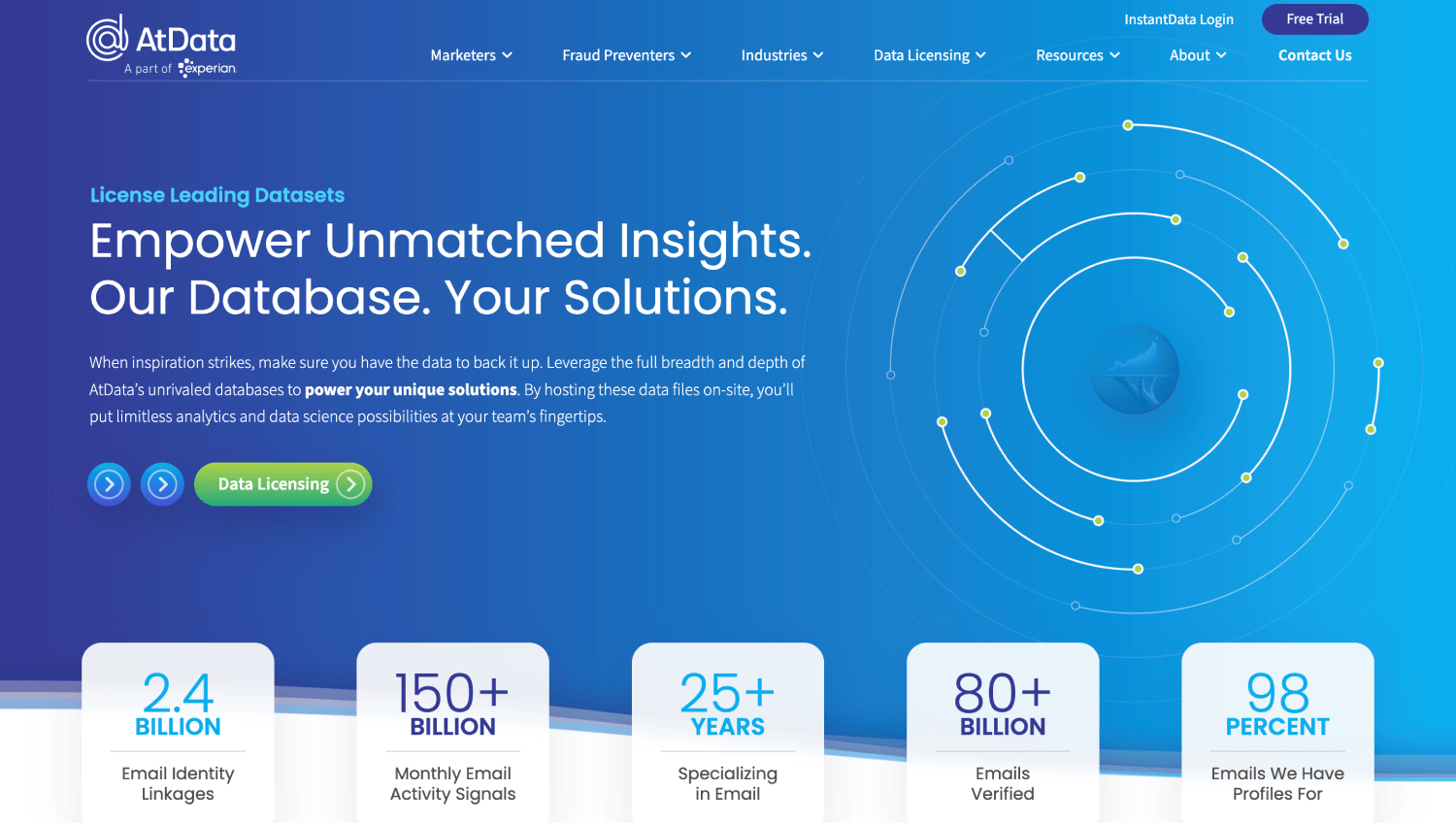
Atdata (formerly TowerData) takes a narrower position than the enterprise identity platforms: it focuses on email as the primary identifier and builds outward from there. Its core product validates email addresses, appends demographic and behavioral attributes, and links email to other identifiers including phone and postal address.
For teams where email is the dominant acquisition channel and the primary activation surface, Atdata’s focused approach produces high-confidence deterministic matches without the complexity of a full identity graph deployment. The public pricing tiers make budget planning straightforward, which is rare in this category. It connects via API, making warehouse-native integration a configuration task rather than a native capability.
Atdata is not the right choice if you need cross-device resolution or household modeling. It is a strong choice if your primary identity gap is validating and enriching email lists before import into a marketing automation platform or CRM.
4. Acxiom Real Identity
Acxiom Real Identity is one of the oldest and most data-rich identity resolution platforms in the market, built on Acxiom’s decades of compiled consumer data. Its graph combines online identifiers with offline purchase, demographic, and household data at a scale few pure-play software vendors can replicate.
The honest limitation is the same one that has followed Acxiom for years: it is a managed service more than a software platform, and data portability is constrained. Resolved identities tie tightly to Acxiom’s own data assets, which makes migration painful. Teams that want to own the identity logic and the resulting ID graph should evaluate carefully before committing.
Where Acxiom excels is in breadth of the offline data spine and in household-level resolution for consumer marketing. For direct mail, retail, and financial services programs where household is the unit of targeting rather than the individual device, Acxiom’s coverage is hard to match with first-party data alone.
5. Unified ID 2.0 (UID2)
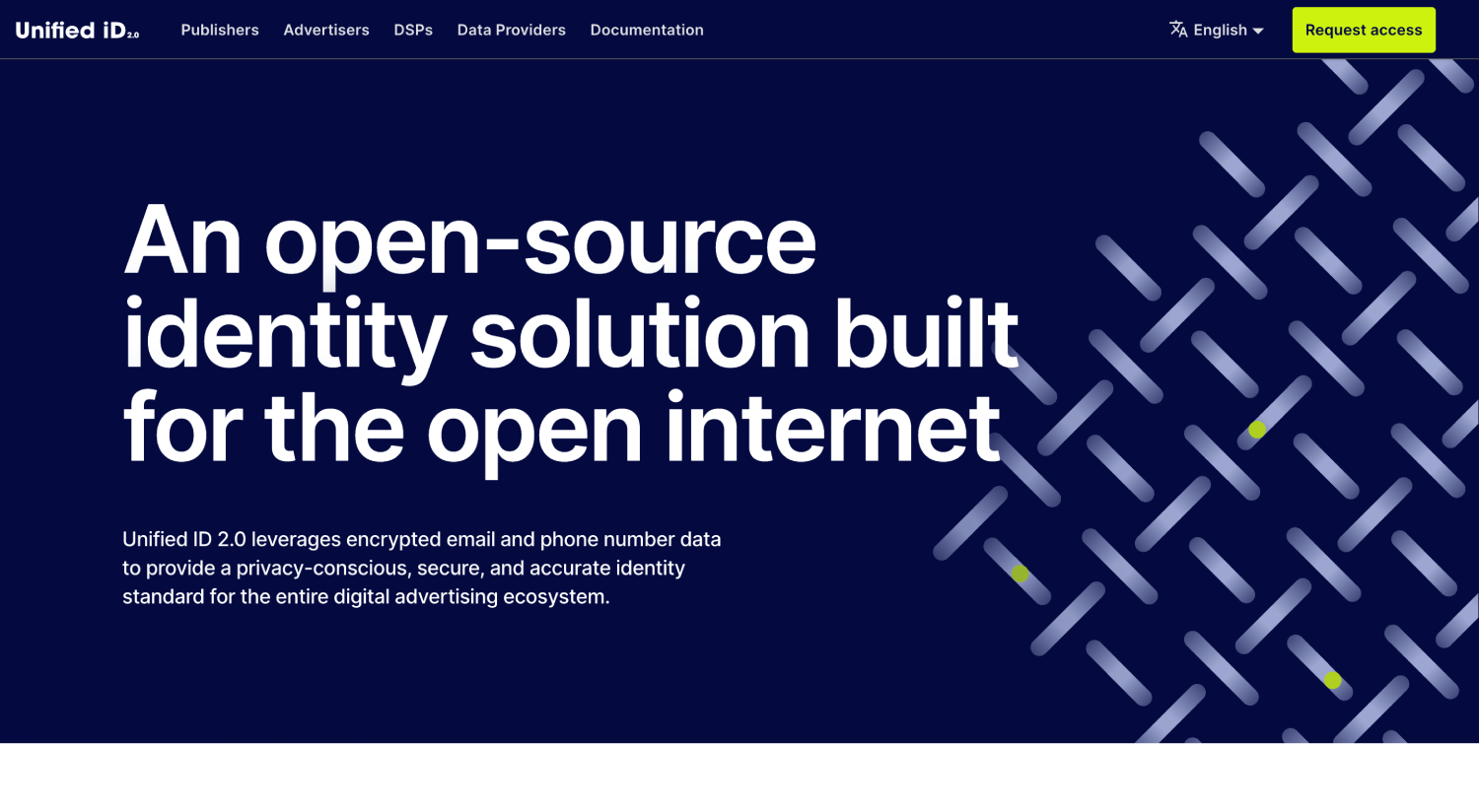
Unified ID 2.0 is not a vendor in the traditional sense. It is an open identity standard, governed by the IAB Tech Lab and operated by participating publishers, DSPs, and SSPs, designed to replace third-party cookie-based identity in programmatic advertising with a consent-based, hashed email approach.
For warehouse-first marketing teams running programmatic activation, UID2 is the infrastructure layer, not the identity resolution tool. You still need a system that resolves your first-party identifiers into UID2 tokens. But understanding UID2’s operator model matters: teams can run a private UID2 operator inside their own cloud environment, which makes it genuinely warehouse-compatible in a way that most identity standards are not.
UID2 is most relevant for teams that rely heavily on programmatic media buying and need a durable, consent-respecting replacement for third-party cookies. It complements first-party identity resolution tools rather than replacing them. The open-source nature means implementation costs are largely engineering time rather than licensing fees, though operator infrastructure has associated cloud compute costs.
6. Hightouch Identity Resolution
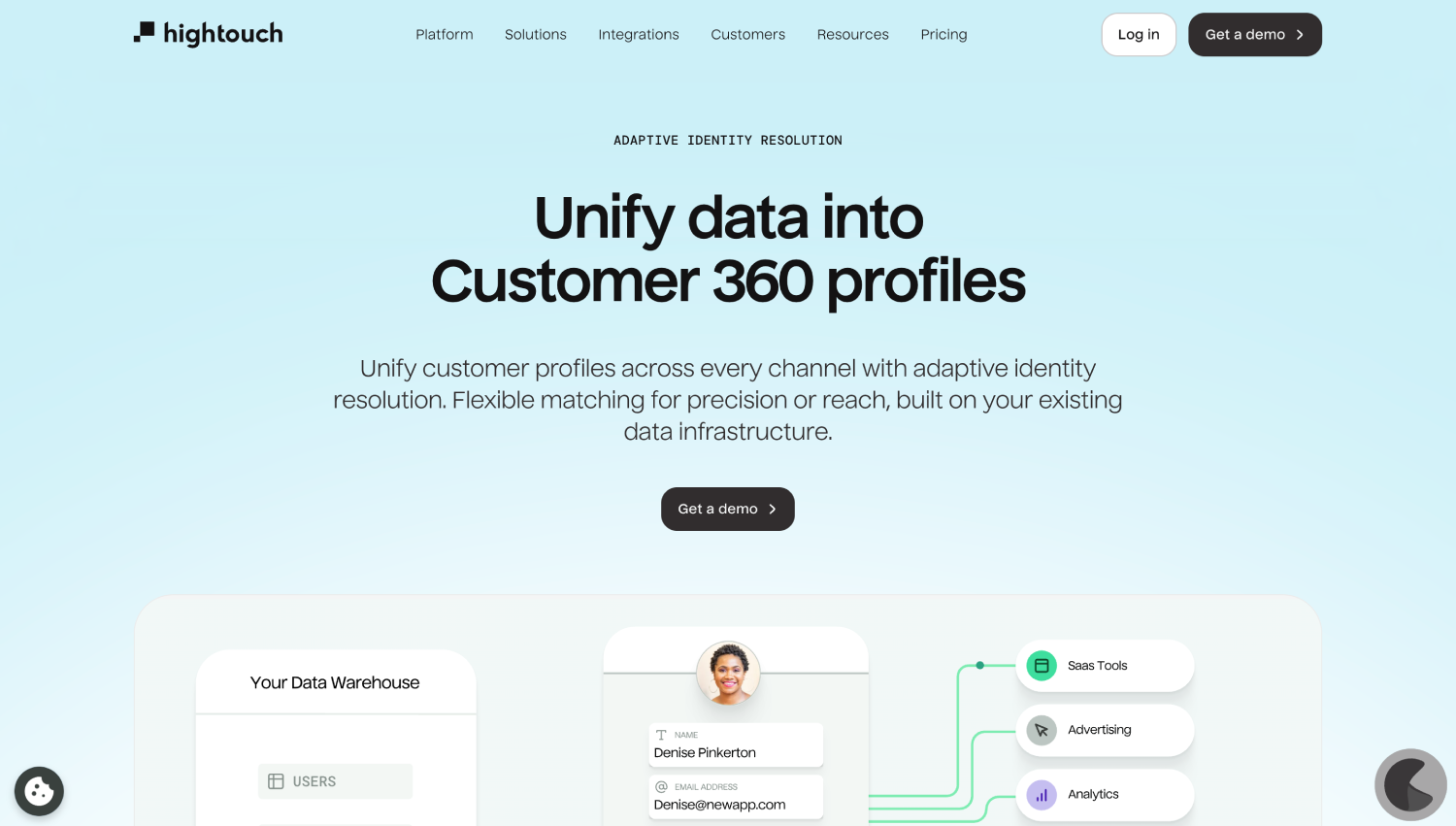
Hightouch Identity Resolution is the most natural fit for teams already running a warehouse-native activation stack. Because Hightouch’s entire architecture runs on top of your data warehouse, identity resolution tables land in your Snowflake or BigQuery schema and immediately flow into audience sync workflows without moving data to a third-party environment.
The matching configuration is declarative: you define which identifier types to use as deterministic anchors, set thresholds for probabilistic fallback, and Hightouch generates the resolved ID graph as a materialized table. Data teams can inspect the merge logic as SQL, which makes it auditable and debuggable in a way that black-box identity APIs are not.
Hightouch Identity Resolution is an add-on to existing Hightouch plans rather than a standalone product, which means teams evaluating it should consider the full Hightouch footprint. For teams already using Hightouch for reverse ETL, the marginal cost to add identity resolution is lower than deploying a separate identity vendor. The Hightouch vs Census comparison covers the broader platform trade-offs in detail.
7. Segment (Twilio)
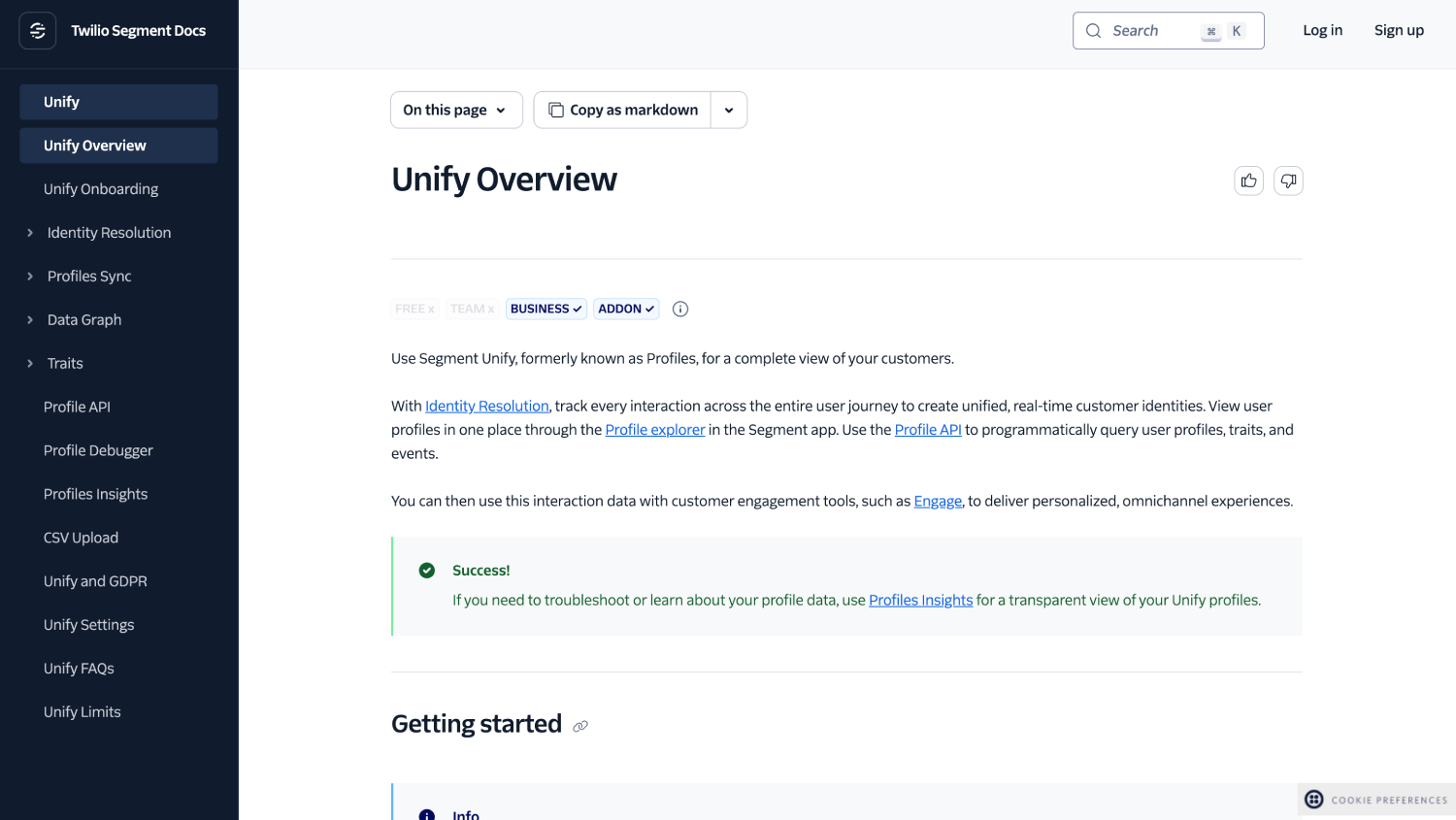
Segment’s Unify product is its identity resolution layer, built into the Twilio Segment CDP. It merges user profiles based on configurable merge rules: if two anonymous sessions resolve to the same email at login, Unify links the pre-login anonymous trail to the identified profile. The merge rules are transparent and editable, which is better than most CDPs offer.
The warehouse relationship works in the opposite direction from a warehouse-native tool. Segment collects events, resolves identities in its own environment, and then syncs the resolved profile data to your warehouse via Segment Data Lakes or direct connectors. That is fine for teams where Segment is the system of record, but it creates a dependency if your canonical data lives in the warehouse first.
Pricing is based on monthly tracked users (MTUs), published on Segment’s public pricing page, with a free tier for low-volume use and Team and Business tiers above that. For teams already on Segment who need identity resolution without adding another vendor, Unify is the lowest-friction option. Teams running a warehouse-first architecture and finding Segment limiting should read the Segment alternatives analysis before committing to Unify.
8. RudderStack
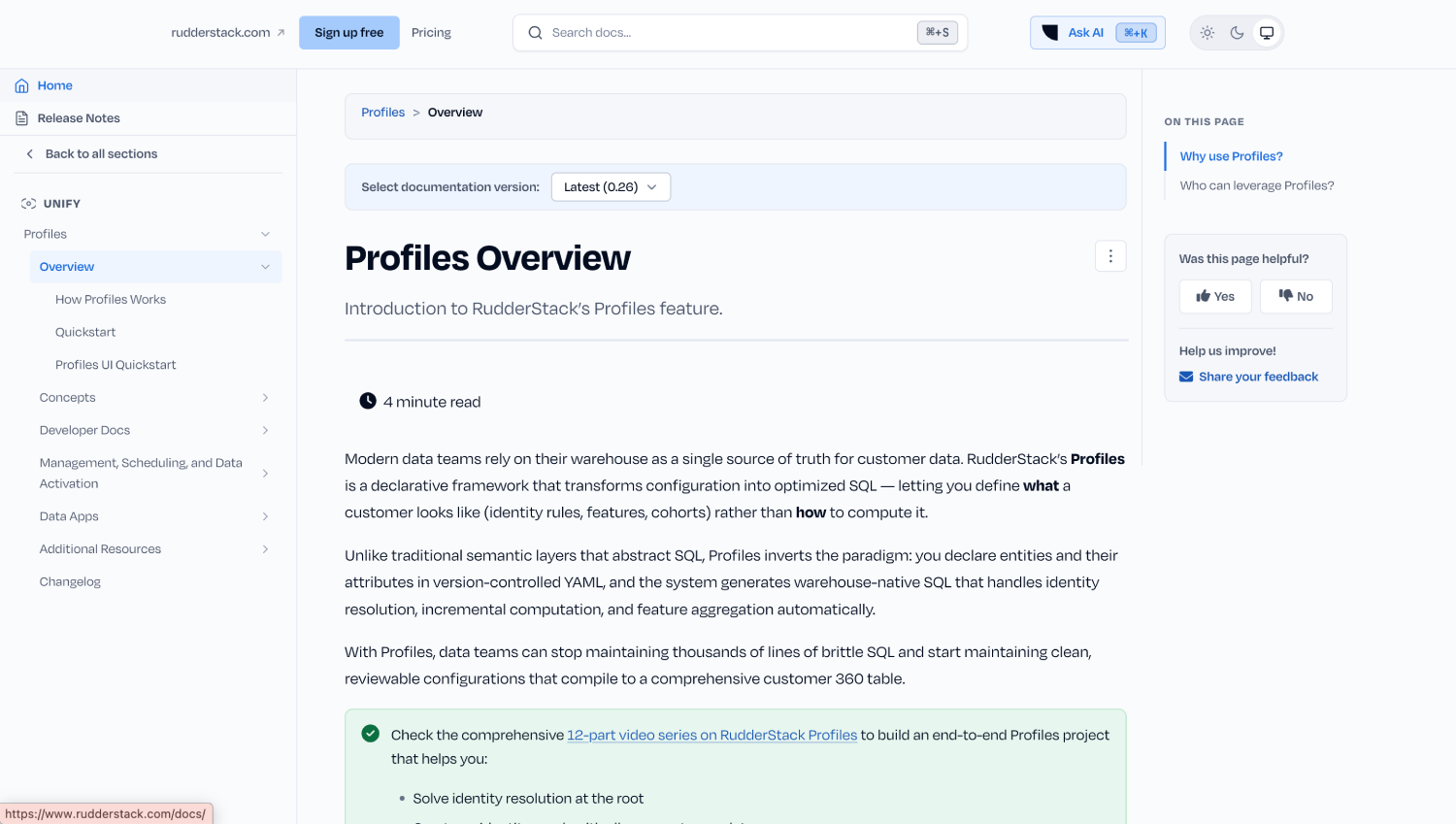
RudderStack’s Identity Resolution feature (called Identity Stitching in their documentation) is built for engineering-led teams that want deterministic merge logic they can inspect and control. RudderStack is open-source at its core, which means the stitching logic is not a vendor black box. Data teams can read the code, adjust the merge rules, and run the whole pipeline inside their own infrastructure.
The warehouse-native angle is genuine. RudderStack can be deployed with your warehouse as the primary store, and identity resolution runs as part of the transformation pipeline rather than as a separate service. Resolved profiles write back to Snowflake, BigQuery, or Redshift tables that other tools in the stack can query directly.
The trade-off is implementation complexity. RudderStack’s identity resolution requires more configuration than turnkey SaaS products. A data engineer needs to define the identifier priority hierarchy, configure the merge graph, and test for edge cases like phantom merges on shared-device households. Teams without a dedicated data engineer will struggle. Teams with one will appreciate the control. The RudderStack vs Hightouch comparison works through the broader platform trade-offs for data activation teams deciding between the two.
9. CustomerLabs
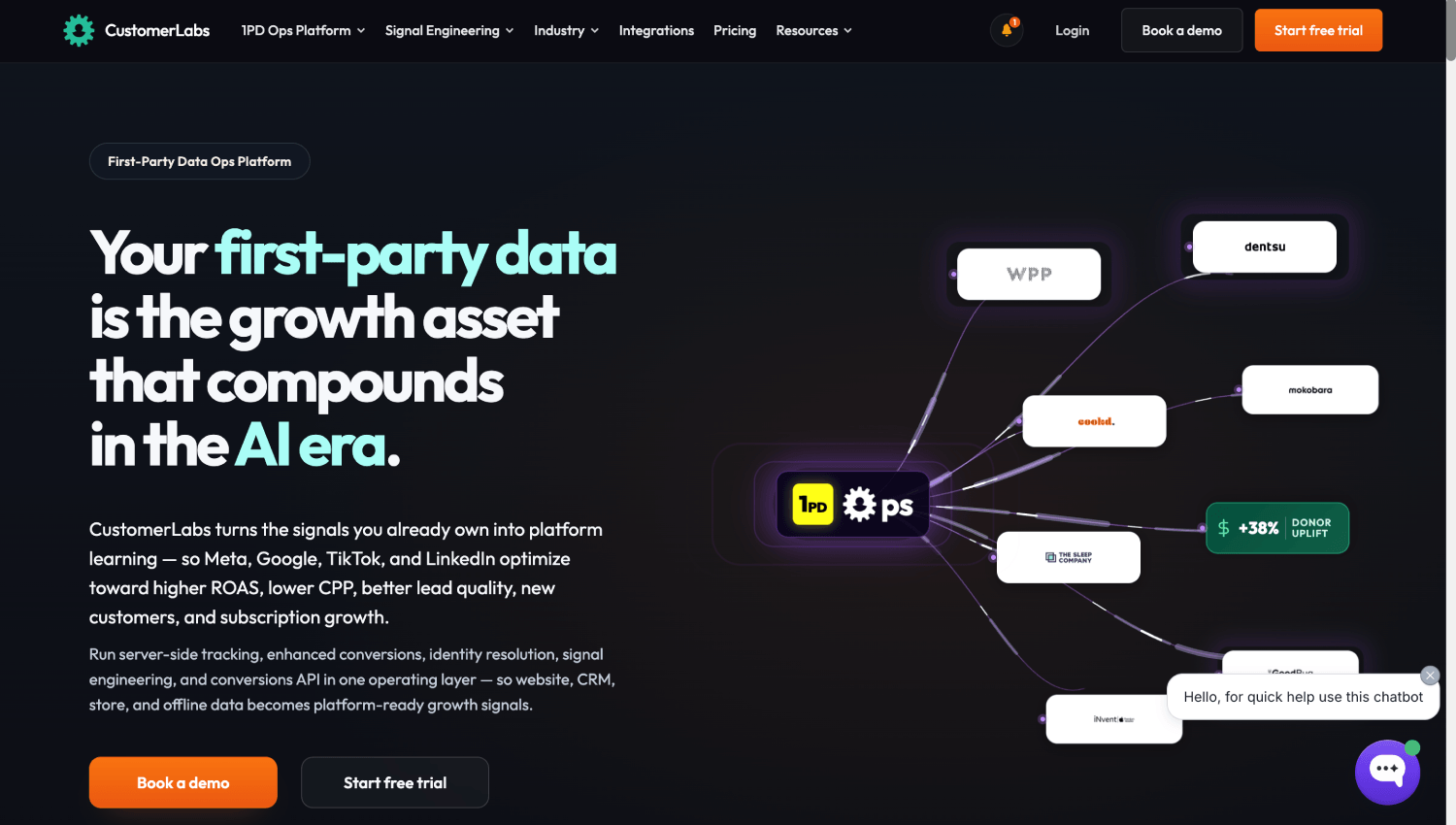
CustomerLabs 1PD Ops takes a distinct approach aimed at mid-market marketers who need first-party identity resolution for advertising activation without a dedicated data engineering team. It focuses on capturing and stitching anonymous web and ad-click identifiers to first-party CRM or email records, then syncing the resolved audiences to ad platforms.
The product is not a full identity graph in the enterprise sense. It does not handle household modeling, offline-to-online resolution, or probabilistic inference across behavioral signals at scale. What it does well is close the attribution and activation gap between your first-party CRM data and your paid media platforms, with a configuration interface that a marketing operations manager can operate without SQL.
Pricing is tiered and publicly listed, which makes it easier to evaluate against budget constraints. For DTC brands and mid-market B2C teams that need workable first-party identity resolution for Meta, Google, and TikTok activation, CustomerLabs sits in a practical middle ground between enterprise identity platforms and CDP-native stitching that cannot be configured.
What Does Identity Resolution Look Like in a Real Warehouse Stack?
Consider a DTC apparel brand with 800,000 customer records across four systems: Shopify (purchase history), Klaviyo (email engagement), a loyalty platform, and a call center CRM. Each system has its own customer ID. A customer who placed two orders with different email addresses and called support under a phone number not linked to either order exists as three separate records across the stack. No single system knows this is one person.
A warehouse-first identity resolution workflow ingests all four record sets into Snowflake via ELT. The identity tool runs deterministic matching first: any two records sharing a hashed email or phone number merge with high confidence. That pass resolves perhaps 60% of the cross-system duplicates. The probabilistic pass then looks at shipping address, order timing proximity, and device fingerprint overlap to resolve another 20%. The remaining 20% stay as separate profiles because the evidence is insufficient for a defensible merge.
The output is a golden record table in Snowflake: one canonical customer ID per person, with all associated identifiers and system IDs joined to it. A reverse ETL tool then pushes audience segments built on that golden record to Klaviyo, Meta, and the loyalty platform. Every system now targets the same resolved person rather than three different records. Suppression lists work. Frequency caps hold. Attribution counts one conversion instead of three.
This workflow also creates the foundation for accurate marketing attribution, since attribution models can only correctly assign credit when the converting customer is the same record as the one who saw the ad.
Best Identity Resolution Vendor for B2B: What Changes at the Account Level
B2B identity resolution has a dimension that consumer tools do not address: account-to-contact mapping. In a B2B buying motion, the unit of targeting is the account, not the individual. An identity resolution tool that correctly merges three personal profiles is useless if it cannot also map those contacts to a parent account, a subsidiary hierarchy, and a buying committee.
The signal types are also different. B2B identifiers include business email domains, LinkedIn profile URLs, company domains, job titles, DUNS numbers, and firmographic attributes that change more frequently than consumer identifiers. Job changes invalidate email addresses. Company acquisitions collapse two accounts into one. An identity graph that does not refresh on these changes degrades quickly.
Hightouch and RudderStack are the strongest warehouse-native options for B2B because they support custom identifier schemas. You define what a B2B customer entity looks like, including the account-contact hierarchy, and the merge logic respects that structure. Neustar has strong B2B enrichment data through TransUnion’s business data assets. Amperity is designed for consumer data models and does not natively handle account hierarchy.
Teams evaluating B2B identity alongside lead enrichment should also look at lead enrichment and routing tools, which address the top-of-funnel identity problem before data reaches the warehouse.
How Do You Build a Golden Customer Record in Snowflake?
The golden record is a resolved, deduplicated customer profile that serves as the authoritative source for all downstream systems. Building one in Snowflake requires four components: ingestion, identity resolution, persistence, and governance.
Ingestion brings raw identifier data from every source system into Snowflake staging tables. Identity resolution runs the matching logic, either via a native tool like Hightouch or RudderStack, or via SQL and dbt models that implement the merge rules your data team writes. Persistence materializes the resolved identity table on a refresh schedule, typically daily or near-real-time depending on data velocity. Governance defines what triggers a merge, what requires human review, and what rules govern identifier suppression for opt-outs and deletions.
The persistence layer is where teams most often cut corners. Running identity resolution as a one-time batch job produces a golden record that decays immediately. A customer changes their email. A new device appears. A loyalty account merges. Without a scheduled re-resolution pass and a mechanism to propagate updated IDs downstream, the golden record becomes a historical artifact within weeks.
Frequently Asked Questions About Identity Resolution Tools
What is the difference between identity resolution and identity stitching?
Identity stitching typically refers to linking anonymous session data to a known user after a login or form fill event, usually within a single platform or CDP. Identity resolution is the broader process of unifying records across multiple systems, devices, and data sources into a single persistent profile. Stitching is a component of resolution, not a synonym for it. Many CDPs do stitching well. Few do full cross-system resolution well.
What is an identity spine, and why does it matter?
An identity spine is the underlying dataset of verified consumer or business records that an identity resolution vendor uses as a reference graph to match and enrich incoming identifiers. Vendors like Neustar and Acxiom have large offline identity spines derived from credit, telecom, and property records. A strong identity spine increases match rates on records with limited digital signal, particularly for offline or call-center-originated data. Vendors without a proprietary spine depend entirely on your first-party identifiers for resolution.
How do identity resolution tools handle GDPR and CCPA compliance?
Compliant identity resolution requires consent management at the identifier level, the ability to delete all records associated with a resolved ID on a data subject access request, and data minimization during the resolution process. Warehouse-native tools have a structural advantage here: data does not leave your governed environment, and deletion propagates through your existing data governance workflows. API-based tools that copy PII to a vendor environment require explicit data processing agreements and clear deletion SLAs. Before deploying any identity vendor, verify their data processing agreement covers the full identifier set you are sharing, not just the resolved output.
What match rate should I expect from an identity resolution tool?
Vendors frequently advertise match rates above 90%, but those numbers are almost always calculated against their own reference graph, not against your specific input data. A more useful metric is the addressable match rate: what percentage of your actual customer records can be resolved to a unified profile with sufficient confidence for marketing activation. In practice, deterministic match rates on consumer data with email and phone as primary identifiers typically land between 50% and 75% depending on data quality. Adding probabilistic methods can push total coverage higher, at the cost of increased false positives. Ask vendors for a proof-of-concept match run on a sample of your own data rather than accepting published benchmarks.
Do I need a separate identity resolution tool if I use Adobe Real-Time CDP or Salesforce Data Cloud?
Not always, but often yes. Both platforms include identity resolution capabilities tied to their own ingestion pipelines. If all your data enters the CDP through its native connectors or SDK, the built-in identity graph may be sufficient. The gap appears when touchpoint data lands in your warehouse first, when you have offline or partner data that does not flow through the CDP, or when you need cross-channel household resolution that the CDP’s merge rules cannot configure. A standalone identity tool upstream of the CDP resolves these gaps and passes a clean canonical ID into the CDP, improving every downstream capability the CDP provides.
What is household resolution, and when does it matter for marketing?
Household resolution groups individual profiles sharing a physical address into a household unit, which becomes the targeting entity instead of the individual. It matters most in categories where purchase decisions are joint, including financial services, home improvement, automotive, and insurance. Running frequency caps at the individual level in these categories can result in two members of the same household each receiving the full campaign cadence, effectively doubling exposure while suppression at the household level would cap it. Not all identity resolution tools support household modeling. Acxiom, Neustar, and Amperity do. Most CDP-native identity tools and developer-focused warehouse tools do not natively support household grouping without custom configuration.
Which Identity Resolution Tool Should You Actually Buy?
The choice comes down to where your data lives, who will maintain the identity logic, and what resolution depth your use cases require. Teams running a warehouse-native stack with engineering resources should evaluate Hightouch Identity Resolution or RudderStack first. Both write resolved IDs back to your warehouse, expose the merge logic in inspectable form, and connect directly to the reverse ETL layer for activation. The data stays in your environment.
Teams with large consumer databases and complex household resolution requirements, particularly in retail, loyalty, and financial services, should look at Amperity for its ML-weighted matching model or Neustar for its offline identity spine. Both require accepting a managed service relationship with a vendor who holds some portion of your data, but the match depth on hard cases justifies it for the right use case.
B2B teams should treat Hightouch and RudderStack as primary options for warehouse-native work, and layer in a B2B data provider for enrichment rather than looking for a single vendor that does both well. Consumer identity vendors consistently underperform on account hierarchy and job-change signal. The architecture that works is a warehouse-native identity tool for the merge logic, with a B2B enrichment layer writing fresh firmographic attributes to the same golden record table on a regular refresh cycle.
The CDP question comes last, not first. Resolve identities at the data layer, produce a clean canonical ID, and then let your CDP or marketing automation tool work from that resolved foundation. Buying a better CDP to fix an identity resolution problem is like buying a better spreadsheet to fix a data quality problem. The problem is upstream, and so is the solution.