- Referral programs built inside loyalty platforms or CRMs are almost always limited to basic share links with no program logic, fraud controls, or attribution depth. Dedicated referral software is a different category.
- The right platform depends on whether you are running a B2B SaaS program (where the reward trigger is a converted trial, not a purchase) or a DTC program (where speed and reward redemption UX dominate).
- SaaSquatch and Friendbuy are the two most feature-complete options; the gap between them is primarily about B2B event depth versus DTC purchase-trigger breadth.
- Several mid-market tools (Referral Rock, GrowSurf, Referral Factory) cost a fraction of enterprise platforms and cover 80% of program needs for teams under 200 employees.
- Fraud detection, double-sided reward logic, and webhook-based event triggers separate purpose-built referral software from everything else.
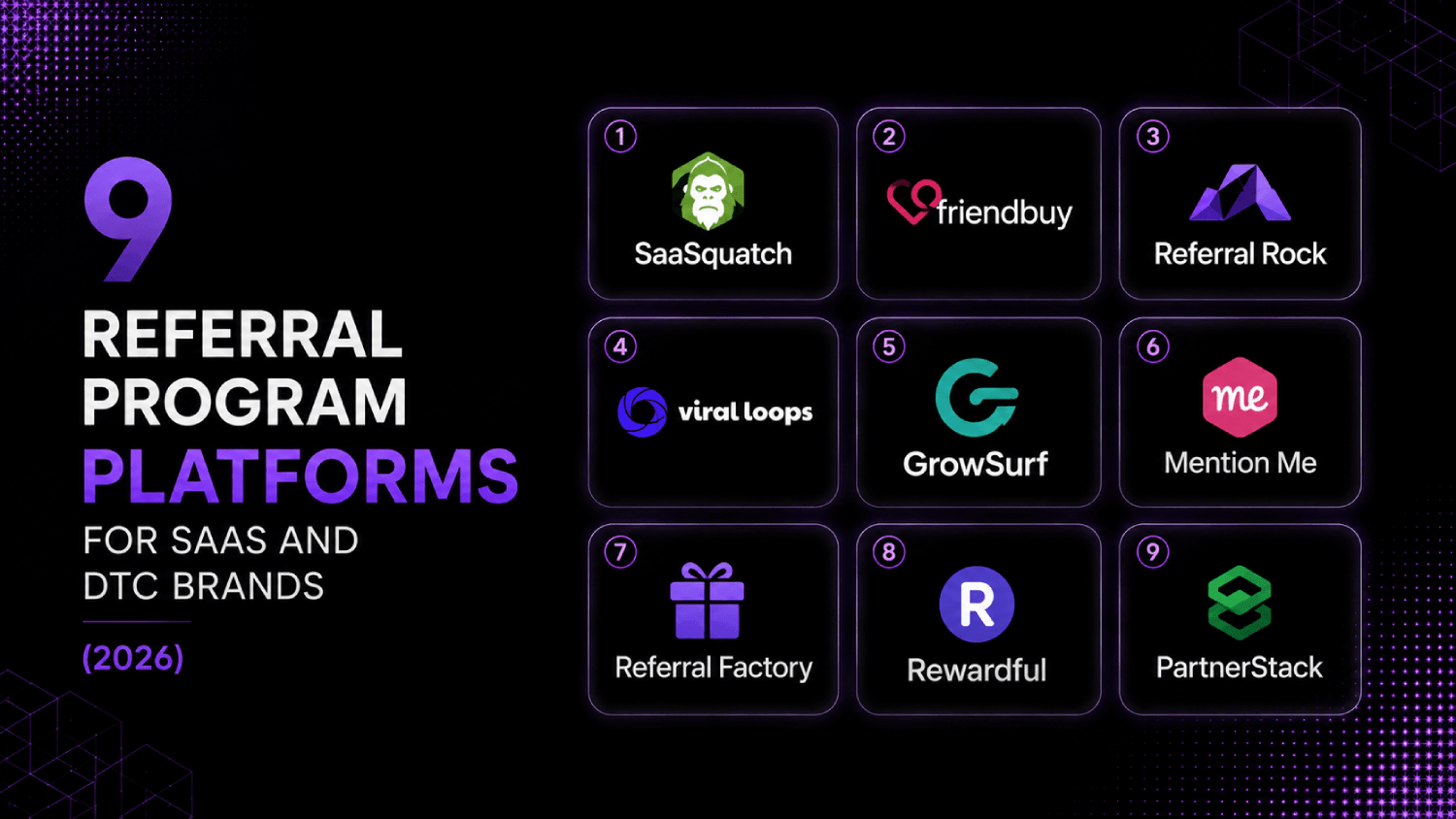
The nine referral program platforms below cover the full range from enterprise SaaS programs with complex event-based reward logic to DTC refer-a-friend flows launched in a day. SaaSquatch leads for B2B SaaS infrastructure, Friendbuy leads for DTC volume, and Referral Rock is the sharpest mid-market option for teams that need both without a six-figure contract. All pricing reflects publicly available information at the time of writing.
Why your loyalty app’s referral feature is not referral program software
Most loyalty platforms bolt a referral link onto their points module and call it a referral program. What that actually gives you is a single-sided share URL, a flat reward, and no ability to define the event that triggers the reward (signup, first payment, 60-day retention). True referral software works more like a headless incentive engine: you define the program rules, the qualifying event, the reward type, and the fraud logic separately, then fire events into the platform via API or webhook as users move through your funnel.
That distinction matters most for SaaS. A DTC brand can reasonably trigger a reward on “order placed.” A SaaS company needs to trigger it on “referred user reached paid subscription after trial” , a conditional event that happens weeks after the initial share. Loyalty apps with referral features almost never support that kind of deferred, conditional reward logic without custom engineering. Dedicated referral platforms do it natively.
There is also a fraud problem. Without IP deduplication, self-referral detection, and reward velocity rules, a naive referral link will get gamed within days of launch. The platforms below address that. Most loyalty-app referral features do not.
The AboutMartech Referral Stack Fit Test: four checks before you buy
Before comparing vendors, run these four checks. They will eliminate half the shortlist immediately. The goal is not to find the platform with the most features , it is to find the one whose architecture matches how your funnel actually works.
Event depth: Can the platform trigger and track rewards on a custom backend event (not just a URL visit or form fill)? If you need rewards tied to a SaaS billing event or a Shopify subscription renewal, event depth is non-negotiable. Ask specifically: does the platform accept arbitrary webhook payloads, or is it constrained to a fixed list of supported trigger types? The answer separates SaaSquatch and GrowSurf from Viral Loops and Referral Factory immediately.
Reward flexibility: Does the platform support both cash/PayPal and non-cash rewards (store credit, discount codes, gift cards) on the same program? Single-reward platforms force you to pick one mechanism and live with it. More importantly, ask whether reward types can vary by program segment , an advocate who has referred five customers may warrant a different reward than one who has referred one.
Fraud controls: Does the platform offer at minimum: self-referral blocking, duplicate email detection, and IP-based abuse limits? Ask for a demo of the fraud dashboard specifically. If the vendor cannot show you a fraud review queue in the demo, assume the controls are cosmetic.
Integration surface: Does it connect to your CRM, ESP, and payment processor natively, or does it require a middleware layer? A Zapier dependency in a high-volume program is a liability, not a solution. The integration that matters most is the one carrying the reward trigger event , if that path goes through Zapier and Zapier has a rate limit or outage, your program stops paying out correctly without any visible error.
Which referral program platforms are worth evaluating in 2026?
1. SaaSquatch
SaaSquatch is the platform most enterprise SaaS teams reach for when referral programs need to match the complexity of their subscription billing logic. The core product is a rules engine that lets you define reward triggers on arbitrary events , trial start, first payment, 90-day retention, MRR threshold , via a webhook or SDK integration. That flexibility is rare.
Program templates, A/B testing of reward structures, and a participant portal (where users can track their referral status) are all included. Fraud controls include duplicate detection, self-referral blocking, and manual review queues. Pricing is not publicly listed; SaaSquatch operates on custom contracts, typically starting in a range appropriate for mid-market and enterprise buyers. Teams looking for SaaSquatch alternatives often land here after outgrowing simpler tools, not as a starting point.
2. Friendbuy
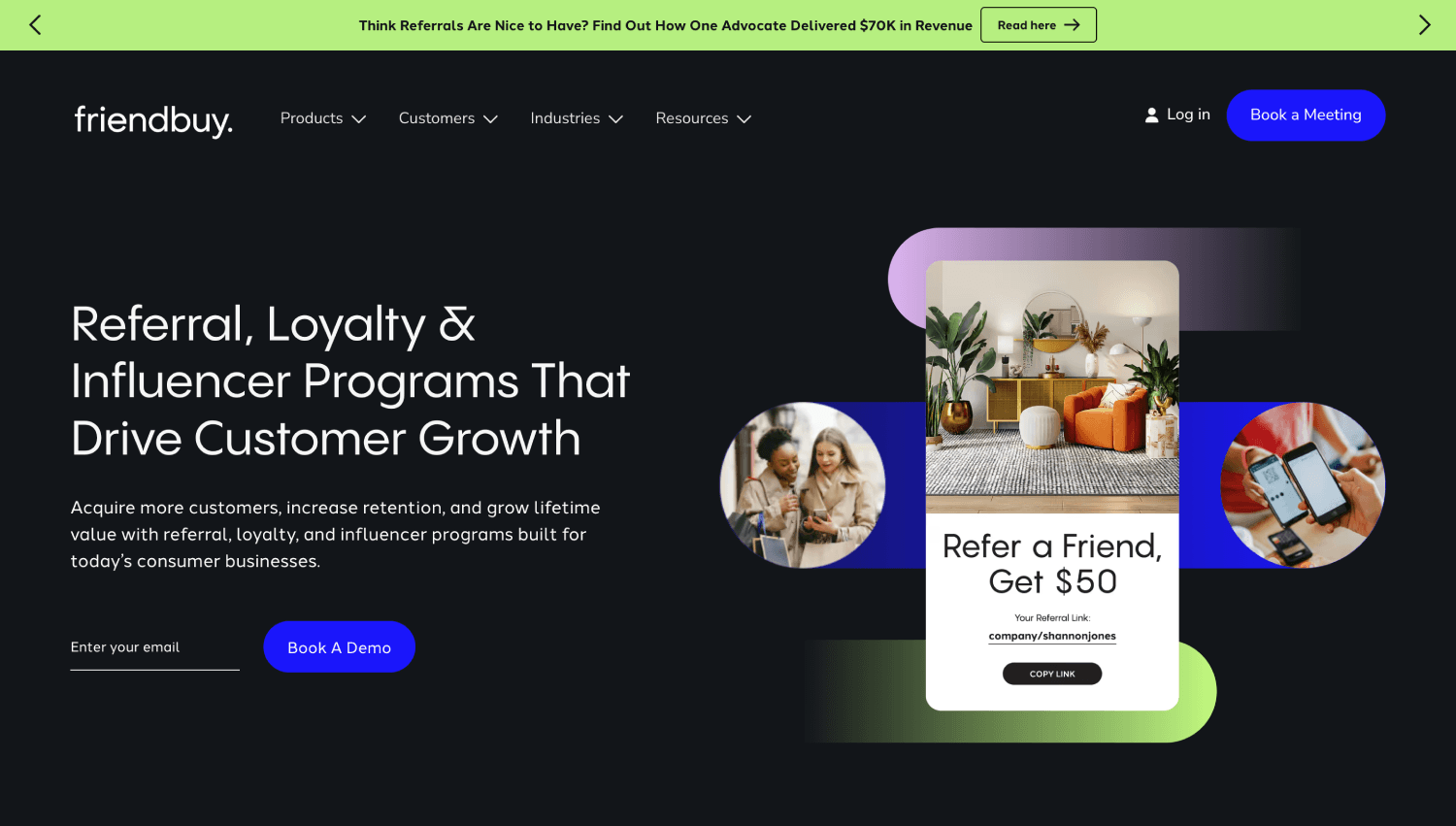
Friendbuy is the dominant referral platform for DTC ecommerce brands. Its tight integrations with Shopify, Klaviyo, and Attentive mean that a team already running those tools can launch a refer-a-friend program without significant engineering involvement. The widget builder is genuinely fast , placing a referral prompt post-purchase or in the account dashboard takes an afternoon, not a sprint.
Where Friendbuy earns its position is in high-volume programs. The platform handles millions of referral events per month without degrading, and its analytics surface CAC-by-channel comparisons that let you stack referral against paid acquisition directly. Pricing is quote-based at the enterprise tier; a starter tier for smaller DTC brands is available on their public pricing page. It is less suited to B2B SaaS programs where reward triggers are subscription events rather than purchases.
3. Referral Rock
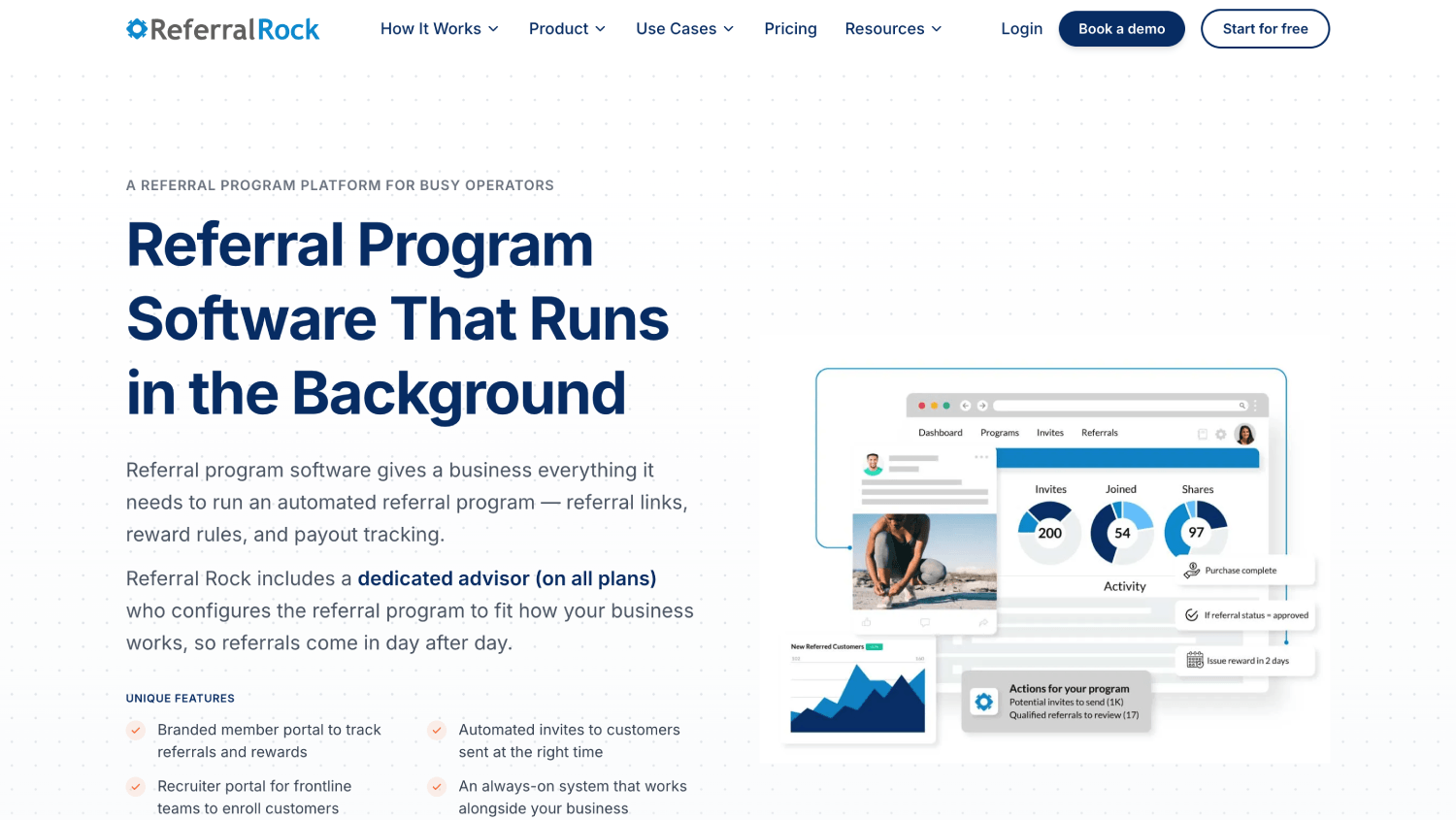
Referral Rock covers both SaaS and DTC use cases at a price point that does not require budget approval from the CFO. Public pricing starts around $200 per month for smaller programs, with higher tiers for larger participant volumes. The platform includes double-sided rewards, custom reward types, branded member portals, and integrations with HubSpot, Salesforce, and Stripe.
The tradeoff is depth. Referral Rock’s event logic is solid but not as granular as SaaSquatch’s. For teams that need to reward on “customer reached month three of a paid subscription,” the platform can handle it, but expect to use webhooks rather than a native integration. For a SaaS team with a straightforward trial-to-paid trigger, or a DTC brand running a standard refer-a-friend, Referral Rock delivers the highest feature-to-cost ratio on this list.
4. Viral Loops
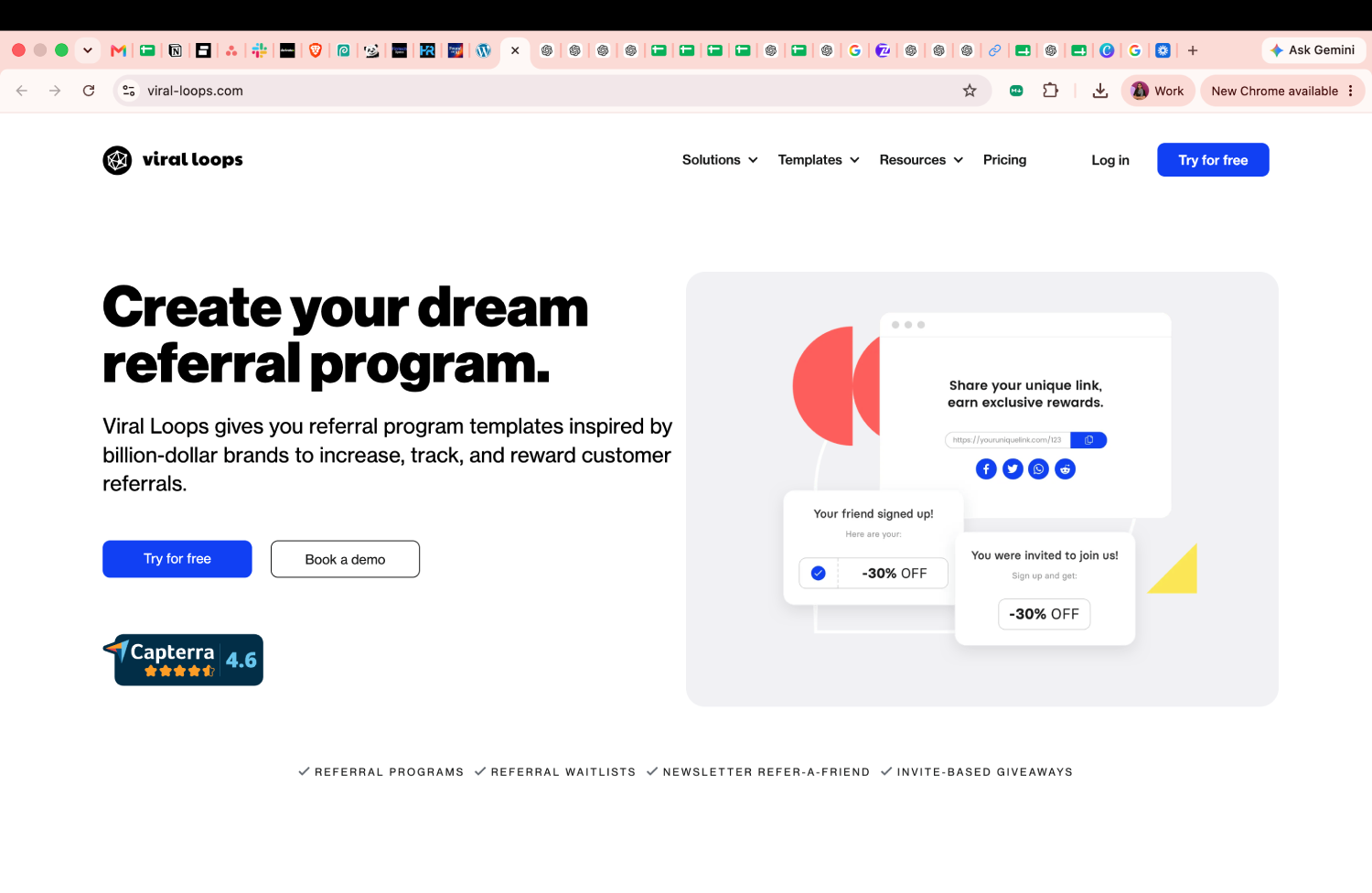
Viral Loops is template-first. Rather than building program logic from scratch, you select a campaign template (classic referral, waitlist with leaderboard, milestone reward) and configure it. For teams launching a referral program for the first time, that structure reduces decision fatigue and shortens time-to-live significantly.
The limitation is customization ceiling. If your program needs reward logic that does not fit a standard template, Viral Loops becomes frustrating quickly. It works well for DTC brands running seasonal campaigns or SaaS teams building pre-launch waitlists with social incentives. Public pricing starts at $49 per month on their published pricing page, making it a reasonable starting point before graduating to a more configurable platform.
5. GrowSurf
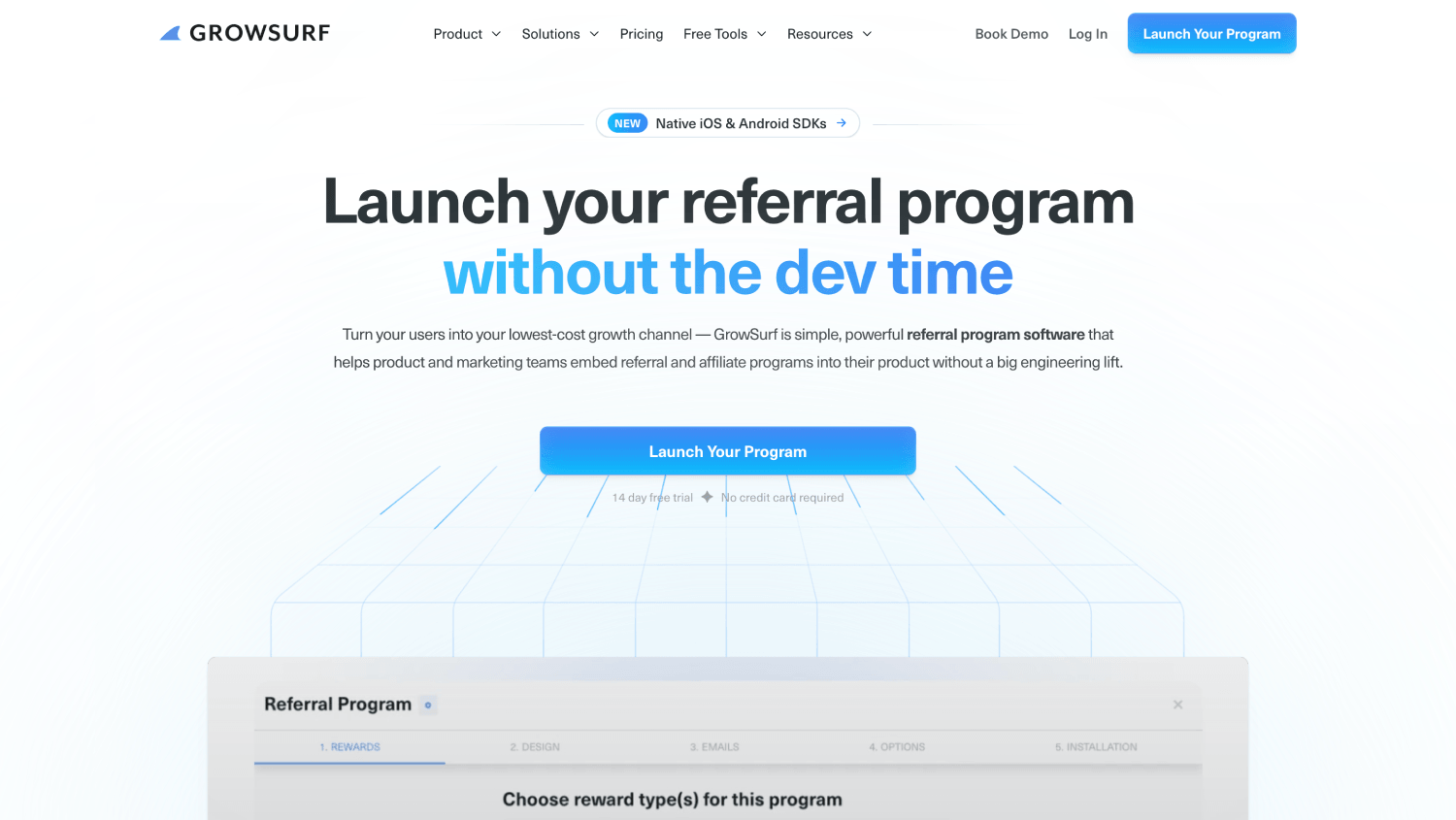
GrowSurf targets B2B SaaS teams specifically and shows it in the product design. The embed widget, email referral links, and participant dashboard are all built for software products, not retail checkout flows. The API is clean, the documentation is thorough, and the platform generates unique referral links per participant without requiring a participant to create an account first , a friction point that kills conversion in many competing tools.
GrowSurf’s public pricing is tiered by number of participants in the program, which creates predictable costs for teams with large user bases but infrequent referral activity. It lacks the enterprise fraud controls and program-complexity features of SaaSquatch, but for a SaaS team with 10,000 to 100,000 users running a standard double-sided referral campaign, it is a strong fit. Customer success teams tracking referred users through to activation will find the webhook-to-CRM flow works reliably.
6. Mention Me
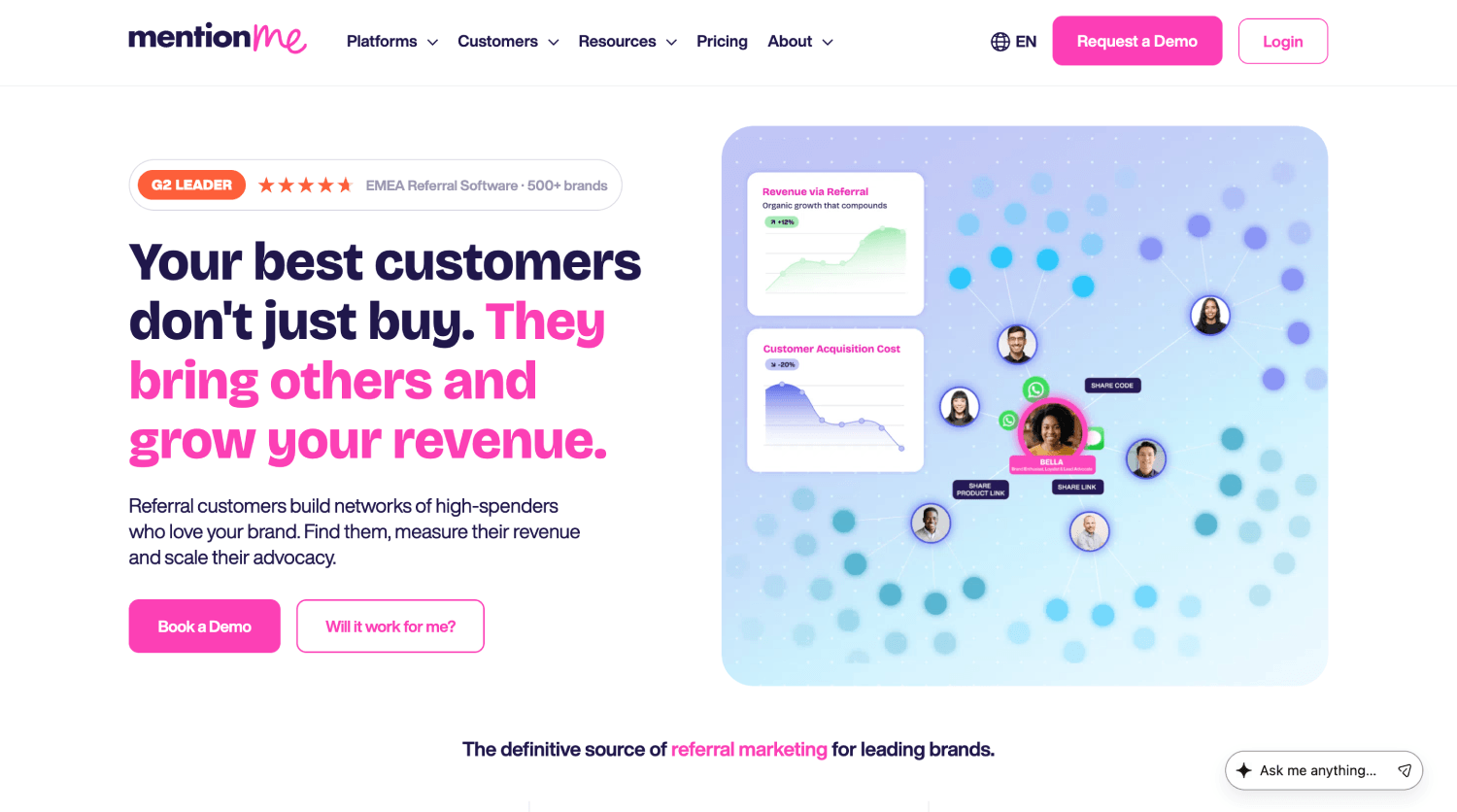
Mention Me takes a different angle. Beyond standard share links, it captures “name sharing” , the behavior where a customer mentions a brand to a friend verbally and the friend then types that name into a referral field at checkout. That capture mechanism surfaces referral volume that other platforms miss entirely, because it tracks word-of-mouth that never started with a digital share.
Mention Me’s analytics layer, which the company calls Referee Intelligence, gives marketers data on which customer segments generate the highest-quality referrals, not just the highest volume. That distinction matters when optimizing reward spend. Pricing is enterprise and quote-based. The platform is best suited to established DTC brands with meaningful purchase volume, not early-stage programs.
7. Referral Factory
Referral Factory competes primarily on ease of setup. The no-code campaign builder, pre-built integrations with HubSpot and Pipedrive, and a large library of reward types (including Visa gift cards and custom webhooks) make it accessible to marketing teams without engineering resources. Public pricing starts under $100 per month for starter plans.
The platform supports both B2B and DTC use cases, though neither as deeply as the specialists on this list. For a marketing team that needs a functioning referral program live within a week and does not have engineering bandwidth to build a webhook-based event trigger, Referral Factory is a practical choice. It is not the right tool for programs requiring complex conditional reward logic or high-volume fraud management.
8. Rewardful
Rewardful occupies a specific niche: SaaS teams running on Stripe who want affiliate and referral programs without a separate platform. It connects directly to Stripe, creates commission and reward structures based on actual MRR, and handles payouts through Stripe’s payment infrastructure. Setup for a Stripe-native SaaS product takes hours, not weeks.
The tradeoff is that Rewardful’s referral features are essentially its affiliate features applied to customers rather than partners. It does not have a participant portal with the depth of SaaSquatch or GrowSurf, and fraud controls are basic. For a bootstrapped or early-stage SaaS team that already runs Stripe and wants to test customer referral as a channel without significant tooling investment, Rewardful is the most direct path. Public pricing is available on their site, with plans starting well below $100 per month.
9. PartnerStack
PartnerStack is primarily a partner and affiliate management platform, but its customer referral module is worth including for B2B SaaS teams that want a single platform managing partners, affiliates, and customer advocates under one roof. Running three separate tools for those three program types adds reconciliation overhead and attribution complexity that a unified platform eliminates.
The referral functionality within PartnerStack is not as deep as a dedicated tool , reward logic is more limited, and the participant experience is built for partners first. But if your primary program is partner-led and customer referral is a secondary motion, consolidating onto PartnerStack avoids the integration tax of connecting multiple referral and attribution systems. Pricing is quote-based. Teams evaluating partner attribution specifically will find relevant context in the top partner and affiliate attribution tools covered separately on AboutMartech.
How do these platforms compare on the features that actually matter?
| Platform | Best For | Custom Event Triggers | Fraud Controls | Reward Types | Public Pricing |
|---|---|---|---|---|---|
| SaaSquatch | Enterprise SaaS | Yes (deep) | Advanced | Cash, credit, codes | Quote only |
| Friendbuy | DTC ecommerce | Yes (purchase-focused) | Advanced | Discount codes, cash | Starter + enterprise |
| Referral Rock | SMB SaaS + DTC | Yes (webhook) | Standard | Cash, credit, gift cards | From ~$200/mo |
| Viral Loops | DTC campaigns, waitlists | Limited (templates) | Basic | Varies by template | From $49/mo |
| GrowSurf | B2B SaaS (mid-market) | Yes (API) | Standard | Custom (webhook) | Yes (by participants) |
| Mention Me | DTC (established brands) | Yes (purchase events) | Advanced | Discount codes, cash | Quote only |
| Referral Factory | No-code, SMB | Limited | Basic | Gift cards, codes, webhooks | From under $100/mo |
| Rewardful | Stripe-native SaaS | Via Stripe events | Basic | MRR commissions, credits | Yes (tiered) |
| PartnerStack | B2B SaaS (partner-led) | Yes (limited referral) | Standard | Cash, revenue share | Quote only |
What does a realistic referral program budget look like?
Consider a B2B SaaS team with 8,000 active users, a $150 average monthly contract value, and a goal of generating 50 qualified referrals per quarter. The program logic requires a reward trigger on “trial converted to paid subscription” , not on signup, because rewarding on signup would produce a flood of fake accounts chasing the incentive. That trigger requirement alone eliminates Viral Loops and Referral Factory from the shortlist, since neither handles deferred conditional events reliably without custom engineering.
At that scale, Referral Rock or GrowSurf handles the program technically. Referral Rock’s ~$200/month plan covers programs up to a certain participant count; GrowSurf’s tiered pricing by active participants would land similarly for a base of 8,000 users where only a fraction are actively referring in any given quarter. Either way, platform cost runs $200 to $500 per month. A one-time integration sprint of roughly 8 to 12 engineering hours connects the Stripe “subscription activated” webhook to the referral platform’s reward API. That is a real cost, but it is a one-time cost.
If the program generates 50 qualified referrals per quarter at a $150 MRR each, that is $7,500 in new monthly recurring revenue per quarter from the channel. Total program cost including platform fees, reward payouts (assume a $50 two-sided reward per conversion, so $2,500 per quarter in rewards), and the amortized integration work stays well under 50% of that revenue in the first year. Compare that to the same 50 conversions via paid search at a typical B2B SaaS CAC, and the economics favor referral materially.
SaaSquatch would give more program flexibility , multi-variant reward testing, granular fraud dashboards, a managed participant portal , but its contract cost only makes sense once you are running multiple concurrent program variants or need enterprise-grade audit trails for compliance reasons. A team at 8,000 users running a single program variant has no business paying enterprise rates for features they will not use.
For a DTC brand doing $5 million in annual revenue and running a double-sided refer-a-friend (advocate gets store credit, new customer gets a first-order discount), Friendbuy’s starter tier or Referral Rock covers the mechanics. Mention Me earns its premium at brands where word-of-mouth is already a measurable acquisition source and the team wants to quantify and amplify it rather than build from scratch. Teams evaluating how referral fits into broader acquisition measurement should also look at how marketing attribution tools handle advocate-driven conversions, since referral revenue frequently gets misattributed to paid search when a referred user clicks an ad before converting.
How does referral software integrate with a modern martech stack?
Most of the platforms above connect to CRMs (HubSpot, Salesforce), ESPs (Klaviyo, Mailchimp), and payment processors (Stripe, Braintree) through native integrations or webhooks. The integration pattern that matters most is the reward trigger event: the platform needs to receive a signal from your billing or activation system before it can release a reward.
For SaaS teams, this usually means a webhook from Stripe or Chargebee when a subscription converts or renews. For DTC brands, it is typically an order-confirmed event from Shopify or a custom API call. GrowSurf and SaaSquatch handle these patterns cleanly. Viral Loops and Referral Factory are less reliable for custom event triggers and work better when the reward fires on a simpler action like email confirmation.
Teams running sophisticated data infrastructure may want referral event data flowing back into their warehouse for attribution analysis. That is where a customer data platform or reverse ETL connection becomes relevant , pushing referral participant data and reward events into a central analytics layer rather than living only inside the referral tool’s dashboard.
Should SaaS teams worry about referral fraud at scale?
Yes, and sooner than most teams expect. The most common fraud pattern in SaaS referral programs is self-referral: a user creates a second account with a variation on their email address, refers themselves, and collects both the advocate and referee reward. A second pattern is reward farming, where a small group of users generates a disproportionate share of referrals using fake accounts or purchased email lists.
SaaSquatch and Mention Me have the most mature fraud tooling on this list, including IP fingerprinting, device fingerprinting, and behavioral anomaly detection. Friendbuy’s fraud controls are strong for DTC purchase-based programs. GrowSurf and Referral Rock offer standard email deduplication and self-referral blocking, which catches most casual abuse. Rewardful and Viral Loops have the lightest fraud coverage; teams expecting high-volume programs should factor that in. Customer success teams monitoring referred user behavior post-activation will find additional context in the best customer success platforms for B2B SaaS comparison, since referred users often show different activation patterns than organic signups.
Frequently asked questions about referral program software
What is the difference between referral program software and affiliate software?
Referral program software is designed for customer-to-customer advocacy: an existing user shares a link with a friend, and both parties receive a reward when the friend converts. Affiliate software manages external publishers or influencers who earn revenue share for driving traffic and sales. The audience is different (customers versus partners), and the reward structures are different (fixed incentives versus percentage commissions). Some platforms like PartnerStack handle both; most specialize in one. Do not buy an affiliate platform expecting it to run a customer referral program well.
How much does referral marketing software typically cost?
Public pricing for self-serve and mid-market tools ranges from $49 per month (Viral Loops entry tier) to around $500 per month (Referral Rock higher tiers, GrowSurf for larger participant counts). Enterprise platforms including SaaSquatch, Mention Me, Friendbuy’s enterprise tier, and PartnerStack do not publish pricing and operate on annual contracts. Budget conversations for those platforms typically start in the range of five figures per year based on publicly reported buyer experiences, though the vendors do not confirm specific figures.
Can referral software integrate with Shopify and Klaviyo?
Friendbuy, Referral Rock, Viral Loops, and Referral Factory all have documented Shopify integrations. Klaviyo connections , used to send referral invitations and reward notifications through your existing email flows , are available natively in Friendbuy and Referral Rock, and via webhook in most others. Before signing a contract, confirm the integration goes both directions: referral events should flow into Klaviyo for segmentation, not just use Klaviyo as a send channel.
What event triggers are supported for B2B SaaS referral programs?
The most capable platforms (SaaSquatch, GrowSurf, Referral Rock) support custom webhook-based event triggers, meaning the reward fires when your backend sends a qualifying event to the platform’s API. That supports complex triggers like “subscription upgraded to paid after 14-day trial” or “user active for 60 consecutive days.” Template-first platforms like Viral Loops and Referral Factory generally support simpler triggers: link click, form submission, or purchase confirmation. Know your trigger requirement before starting a trial.
Is SaaSquatch the right choice for most teams looking for referral software?
SaaSquatch is the right choice for enterprise SaaS teams with complex program logic, multiple concurrent campaigns, and engineering resources to manage a deep API integration. For teams under 500 employees without dedicated engineering support for the integration, Referral Rock or GrowSurf delivers comparable program outcomes at significantly lower cost and faster implementation. SaaSquatch’s enterprise pricing only justifies itself when you need its full feature surface: multi-program management, advanced fraud controls, and granular reward-event customization running simultaneously.
How do I measure whether a referral program is actually working?
The core metrics are referred customer CAC (total program cost divided by converted referred customers), referred customer LTV compared to other acquisition channels, and referral conversion rate (participants who share divided by participants who generate a qualifying referral). Most platforms surface the first two natively. LTV comparison requires connecting referral platform data to your billing system or analytics layer. Teams running more rigorous attribution should also account for the halo effect: referred users who convert via paid search after receiving a share link, which makes referral-sourced revenue appear lower than it is in last-touch models. The distinction between multi-touch and last-touch attribution matters here more than in almost any other channel.
Which referral platform should you actually choose?
The clearest split on this list is between SaaS complexity and DTC speed. If your program reward depends on a billing event that happens after a trial period, you need a platform with real webhook-based event logic , SaaSquatch at the enterprise end, GrowSurf or Referral Rock in the mid-market. If your program fires on purchase confirmation and you are already running Shopify and Klaviyo, Friendbuy is the most direct path to a high-volume program. Mention Me earns its position specifically when you want to measure and amplify word-of-mouth that is already happening, not just instrument digital shares.
The platforms that get overlooked most often are Rewardful and Referral Rock. Rewardful is genuinely the fastest path to a working SaaS referral program for a Stripe-native product, assuming you accept its fraud control limitations. Referral Rock covers both SaaS and DTC at a price point that does not require a procurement process. Neither is flashy, and both are reliably competent.
One framing that helps: referral software is attribution infrastructure as much as it is a marketing tool. The value of a dedicated platform is not just the share widget , it is knowing which customer referred which revenue, with what reward, and at what total program cost. Teams that run referral as a feature inside a loyalty app lose that data fidelity entirely. Once you need to optimize reward spend or prove referral CAC to a CFO, that data gap becomes expensive. The best customer loyalty platforms for DTC brands are worth evaluating separately, but they should complement a referral platform, not replace it.