- SMS reaches virtually every mobile phone globally with no app required; WhatsApp has over two billion active users but requires an installed app and is dominant in specific regions like Latin America, India, and Western Europe.
- WhatsApp Business API messages support images, PDFs, video, and interactive buttons; SMS is plain text with a 160-character segment limit, though MMS extends that at higher cost.
- SMS compliance in the US is governed by TCPA and 10DLC registration requirements; WhatsApp operates through Meta’s Business API with its own template approval process and per-conversation pricing.
- For US-focused ecommerce brands, SMS wins on reach and infrastructure maturity; WhatsApp wins for international audiences, higher-ticket conversations, and any use case that benefits from rich media.
- The real mistake is treating them as interchangeable broadcast tools. They differ in cost structure, regulatory exposure, and the kind of engagement they produce.
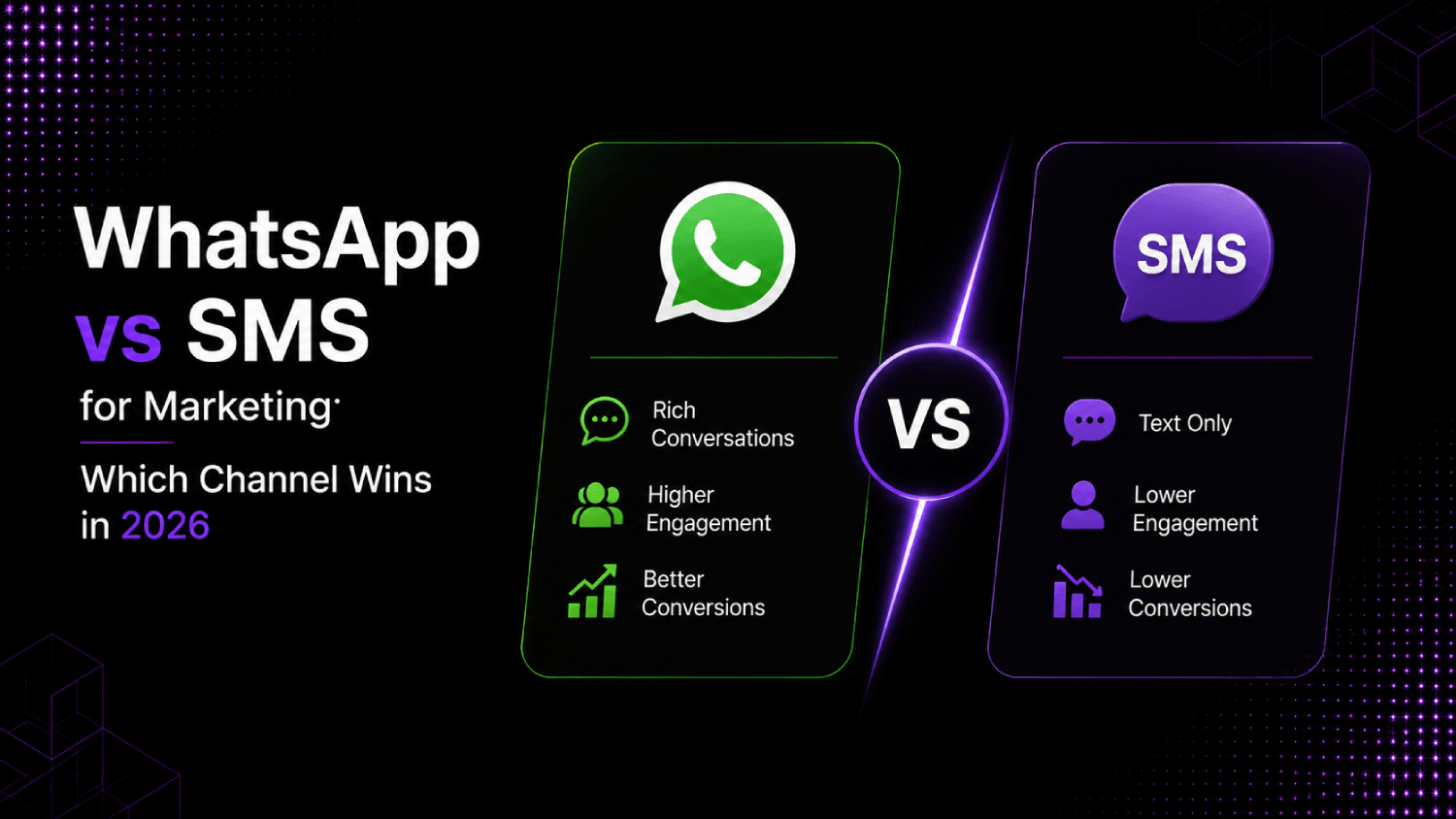
WhatsApp vs SMS marketing is not a question of which channel looks better in a deck. SMS is a carrier-level protocol that works on every phone without software; WhatsApp is a Meta-owned app with over two billion users, rich messaging capabilities, and a conversation-based pricing model that changes the economics entirely. Which one belongs in your marketing stack depends on where your customers are, what you need to say, and whether your compliance team has already handled 10DLC registration or Meta’s Business API onboarding.
What Are the Core Differences Between WhatsApp and SMS for Marketing?
SMS is a telecommunications standard, not a product. Any mobile number can receive a text message, full stop. WhatsApp is an application layer built on internet data, which means recipients need the app installed and an active data connection. That distinction shapes everything downstream: reach, cost, message format, and how regulators treat each channel.
On message format, SMS tops out at 160 characters per segment (or 153 characters per segment in multi-part messages), though most platforms stitch segments together transparently. MMS allows images and short video but costs more per message and has inconsistent rendering across carriers. WhatsApp messages through the Business API support images, documents, video, audio, location sharing, product catalogs, and interactive buttons with no per-segment limitation.
The pricing structure is also fundamentally different. SMS pricing is typically per message or per segment, billed through an SMS platform like Twilio, Attentive, or Postscript. WhatsApp Business API charges per 24-hour conversation window, with rates that vary by country and conversation category. A marketing-initiated conversation to a US number costs more per window than a service conversation, and Meta updates these rates periodically on its WhatsApp Business Platform pricing page.
Where Does Each Channel Actually Win on Reach?
In the United States, SMS wins without much contest. Every subscriber has a phone number; very few brands can reliably assume their entire list has WhatsApp installed. WhatsApp’s US user base is a fraction of its global presence, concentrated in Hispanic communities and recent immigrants from regions where WhatsApp is dominant. Building a US marketing program on WhatsApp means accepting that you will miss a significant portion of your list.
Flip the geography and the math reverses. In Brazil, India, Mexico, Indonesia, Spain, and most of sub-Saharan Africa, WhatsApp is effectively the default messaging inbox. Sending an SMS to a Brazilian subscriber while ignoring that they almost certainly have WhatsApp open all day is leaving engagement on the table. For brands with meaningful traffic from those markets, WhatsApp is not optional; it is the highest-probability channel.
The segmentation question, then, is not “SMS or WhatsApp” but “which market am I in.” A US-only Shopify brand runs SMS. A cross-border DTC brand selling into Latin America and Europe should run both, with audience segmentation by country before any campaign goes out.
How Does Engagement Quality Actually Differ Between the Channels?
Aggregate open rate comparisons circulate constantly in martech content, and most are vendor-sourced or unverifiable. What is structurally true: SMS lands in the native messaging app alongside personal texts from family and friends, which creates an intimacy that is difficult to replicate. WhatsApp also lands in a personal messaging inbox, but users often maintain stricter mental separation between their WhatsApp chats and business messages, particularly in markets where WhatsApp Business is visually separated from personal contacts.
The richer the message format, the more WhatsApp pulls ahead on click-through. A promotional message that includes a product image, a short video, and a one-tap “Shop Now” button performs differently than a 155-character SMS with a shortened URL, not because WhatsApp users are more engaged, but because the friction to act is lower. A customer who can see the product in the message and tap once to buy it has fewer steps between intent and conversion.
For transactional messages, order confirmations, shipping updates, appointment reminders, and the like, SMS has a structural advantage. It requires no app, no data connection in most cases, and delivers in milliseconds. A delivery notification via WhatsApp fails if the recipient’s phone is offline; an SMS lands the moment connectivity restores. For time-sensitive alerts, that reliability gap matters.
What Does Compliance Actually Look Like for Each Channel?
SMS compliance in the United States is governed by the Telephone Consumer Protection Act (TCPA), which requires express written consent before sending marketing messages, plus industry rules around 10DLC (10-digit long code) registration for brands sending at scale. Non-compliance exposes brands to TCPA litigation, which has produced settlements in the millions. The registration and compliance overhead is real, and the TCPA and 10DLC rules are not optional for any legitimate program.
WhatsApp operates under a separate framework. The Business API requires brands to submit message templates to Meta for approval before sending marketing campaigns. Templates must follow Meta’s commerce and messaging policies, and Meta reserves the right to reject templates or suspend accounts that generate high opt-out rates. The consent requirement is different: a user who messages your WhatsApp Business number first opens a user-initiated conversation window, allowing you to respond freely for 24 hours. Marketing messages outside that window require an approved template and explicit opt-in.
For international programs, WhatsApp compliance varies by country. The EU’s GDPR applies to WhatsApp marketing in Europe the same way it applies to email. Some countries have additional telecom regulations that affect both channels. The point is that WhatsApp is not a compliance-free alternative to SMS; it simply has a different compliance architecture managed through Meta rather than US carriers.
The Channel-Fit Matrix: How to Pick the Right Channel
Rather than defaulting to a single channel, marketing teams should pressure-test four variables before committing budget. At AboutMartech, we refer to this as the MARC Test , a proprietary channel-selection framework developed specifically for teams choosing between messaging channels: Market, Audience, Richness, and Compliance. Each variable has a clear answer that points toward one channel or the other.
Market asks where your customers are located. US-primary audiences favor SMS. International or mixed audiences in WhatsApp-dominant regions favor WhatsApp or a dual-channel approach.
Audience asks about the nature of the relationship. Cold-ish contacts who opted into SMS for discounts behave differently from warm customers who initiated a WhatsApp conversation. SMS scales better for one-to-many broadcast; WhatsApp scales better for two-way or conversational flows.
Richness asks whether the message needs more than text. A flash sale code needs nothing but a link. A product launch with lifestyle imagery, a size guide PDF, and a configurator link benefits from WhatsApp’s richer format.
Compliance asks what your legal and ops team can actually manage. If you have not completed 10DLC registration, SMS at scale is a liability. If you have not completed Meta’s Business API onboarding and template approval, WhatsApp is not operational regardless of how good the strategy sounds.
| Factor | SMS | |
|---|---|---|
| Global reach | Every mobile number | Requires app install; strong in LATAM, India, EU |
| US reach | Broad | Limited outside specific demographics |
| Message format | Plain text, 160 chars/segment; MMS for media | Text, images, video, documents, interactive buttons |
| Pricing model | Per message or per segment | Per 24-hour conversation window (varies by country and category) |
| US compliance | TCPA + 10DLC registration required | Meta Business API terms + GDPR (EU) + country-specific rules |
| Two-way messaging | Possible but limited by UX | Native, chat-like experience |
| Deliverability dependency | Carrier routing | Internet connectivity + app install |
| Template approval | No; subject to carrier filtering | Yes; Meta approves marketing templates before sending |
| Best use cases | Flash sales, alerts, US ecommerce, appointment reminders | Product launches, international campaigns, conversational commerce, support handoffs |
What Does the Cost Structure Look Like in Practice?
Say a mid-size DTC brand sends 50,000 promotional messages in a month. With SMS, cost is per message, typically fractions of a cent per message at volume, depending on the platform. Platforms like Klaviyo, Attentive, and Postscript all publish tiered pricing, and for 50,000 messages a brand is generally in a range where the per-message cost is meaningful but predictable. For an accurate figure, Klaviyo’s public pricing page shows SMS credits bundled with their email tiers.
With WhatsApp Business API, the same 50,000 promotional sends become 50,000 marketing-initiated conversation windows. Meta’s pricing is country-specific, and the per-conversation cost in the US or Germany is higher than in India or Mexico. The total cost for the same volume can be higher or lower than SMS depending entirely on which markets you are sending into. International sends into lower-cost WhatsApp markets can undercut SMS on a per-conversation basis because a single window allows unlimited messages back and forth within 24 hours.
The economic case for WhatsApp gets stronger when you factor in two-way conversations. A single WhatsApp conversation window can contain a full customer service exchange, a product recommendation, a payment link, and an order confirmation. The equivalent SMS flow would require multiple messages, each billed separately, with a far less fluid user experience.
Which Channel Fits Ecommerce Better?
For US ecommerce, SMS infrastructure is more mature. Platforms like Attentive and Postscript are purpose-built for Shopify and have deep integrations for abandoned cart recovery, post-purchase flows, and loyalty nudges. The best SMS marketing apps for Shopify have spent years refining flows that US consumer behavior responds to. List growth through SMS pop-ups, keyword opt-ins, and checkout capture is a proven playbook.
WhatsApp ecommerce is earlier-stage in the US but fully operational for international brands. WhatsApp Business supports product catalogs natively, allowing customers to browse items and add to cart inside the chat. For brands targeting Brazil or India, WhatsApp-native shopping flows have genuine traction. For a US-first Shopify brand, the tooling and customer behavior have not yet aligned the same way.
Where WhatsApp genuinely beats SMS for ecommerce, regardless of market, is in post-purchase support and returns. A customer who can photograph a damaged item and send it directly through WhatsApp, receive a return label as a document, and get a refund confirmation in the same thread is having a categorically different service experience than one who texts “HELP” and waits for a canned reply. If reducing support ticket volume is a goal, WhatsApp’s format makes that conversation possible without routing to email or a live chat widget. For teams evaluating how messaging fits into broader customer experience, the customer messaging channel comparison across revenue-driving channels is worth reading alongside this one.
What About RCS as a Third Option?
Rich Communication Services (RCS) is the carrier-level successor to SMS that supports rich media, read receipts, and interactive buttons natively in the Android messaging app. Google and major US carriers have pushed RCS adoption significantly, and Apple added RCS support starting with iOS 18. RCS is worth knowing about because it offers WhatsApp-like message richness with SMS-like reach, but without requiring a third-party app. The leading RCS business messaging platforms are still early compared to SMS or WhatsApp tooling, but the channel is maturing fast enough that a two-year messaging stack plan should account for it.
Frequently Asked Questions
Is WhatsApp or SMS better for marketing in the US?
SMS is better for most US marketing use cases. WhatsApp’s US user base is smaller and concentrated in specific demographics, while SMS reaches any mobile subscriber regardless of what apps they have installed. US ecommerce platforms like Attentive and Postscript have mature Shopify integrations built around SMS. WhatsApp becomes a stronger choice for US brands with significant international customer bases or those targeting communities where WhatsApp is the primary messaging app.
Can I use WhatsApp for marketing without the Business API?
The free WhatsApp Business app supports small-scale manual outreach, broadcast lists of up to 256 contacts, and basic catalog features. For automated campaigns, template-based sends, CRM integrations, and any volume above a few hundred contacts, the Business API accessed through a Meta-approved Business Solution Provider is required. The free app does not support programmatic messaging or the kind of workflow automation most marketing teams need.
How do opt-in and consent rules differ between SMS and WhatsApp?
SMS in the US requires express written consent under TCPA before sending any marketing message, and 10DLC registration is required for campaigns sent over local numbers at scale. WhatsApp requires opt-in before sending marketing templates outside a user-initiated conversation window, but the consent mechanism is governed by Meta’s Business Messaging Policy rather than TCPA. Brands operating in the EU face GDPR requirements for both channels. Neither channel is consent-free; they just have different regulatory frameworks managing that consent.
Which channel has better deliverability?
SMS deliverability is carrier-dependent. Messages from brands with strong 10DLC registration and low complaint rates generally deliver reliably, though carrier filtering can affect certain content types. WhatsApp deliverability depends on app install and data connectivity, and Meta can restrict or suspend sending for accounts with high opt-out rates or policy violations. For time-critical messages like OTP codes or shipping alerts, SMS has a structural edge because it does not require internet data or app presence.
What platforms support both SMS and WhatsApp marketing?
Several multi-channel messaging platforms handle both. Braze supports SMS and WhatsApp as coordinated channels within a single campaign builder. Twilio provides API-level access to both. Intercom and HubSpot have added WhatsApp alongside their existing messaging capabilities. For teams running both channels, the platform question is whether you want channel-specific best-of-breed tools or a unified platform that manages both with some trade-offs in depth.
Is WhatsApp marketing legal in Europe?
WhatsApp marketing is legal in Europe under GDPR when you have a lawful basis for processing, which for marketing typically means explicit opt-in consent. Businesses must also comply with Meta’s WhatsApp Business Policy, which prohibits certain content categories. The combination of GDPR consent requirements and Meta’s template approval process means WhatsApp marketing in Europe requires more upfront compliance work than broadcast email, but is fully operational for brands that have managed that setup correctly.
For which use cases does SMS clearly beat WhatsApp?
SMS is the better choice for flash sale broadcasts to large US lists, OTP and authentication codes, appointment reminders where internet access cannot be assumed, and any campaign targeting audiences unlikely to have WhatsApp installed. It also wins for brands that have already invested in 10DLC compliance and SMS list-building infrastructure. Switching channels mid-program means rebuilding opt-in lists, which is a real cost most brands underestimate.
Does WhatsApp support abandoned cart recovery like SMS does?
WhatsApp supports abandoned cart flows through the Business API. The mechanics are similar to SMS cart recovery: a triggered message after a defined abandonment window with a direct link to the cart. Platforms including Yotpo, Gupshup, and Respond.io have built ecommerce-specific WhatsApp workflows , each approaches the channel differently, so the right fit depends on your existing stack and which markets you are targeting. For markets where WhatsApp engagement is high and SMS is less established, these flows can outperform their SMS equivalents on click-through. The limiting factor is list size. Most DTC brands have larger SMS opt-in lists than WhatsApp opt-in lists, especially in the US, which affects the absolute revenue impact even when per-send performance is strong.
Which Channel Should You Actually Pick?
If your customers are primarily in the United States and you sell through Shopify or a comparable ecommerce platform, start with SMS. The compliance infrastructure (10DLC), the platform tooling, and the customer behavior have matured together in a way that makes SMS a known quantity for US DTC marketing. For a detailed look at where to start, the SMS welcome flow playbook covers the mechanics of a high-converting first touchpoint. The tooling comparison between Attentive and Postscript is also worth reviewing before platform selection.
If your customer base skews international, or if you already have traction in Brazil, India, Mexico, or Western Europe, WhatsApp should be in your stack. The richer format, the conversational commerce capability, and the market-level behavior in those regions make WhatsApp the higher-ROI channel for that audience. A dedicated evaluation of the best WhatsApp marketing platforms for US DTC brands covers the specific vendors worth considering.
The deeper point is about how these channels fit into a complete data and messaging infrastructure. A brand running both SMS and WhatsApp well needs clean audience segmentation, ideally from a CDP or warehouse that can route contacts to the right channel based on geography, opt-in status, and behavior. For DTC and growth-focused teams evaluating that layer, the full CDP comparison covers the platforms worth shortlisting. Channel selection without data infrastructure is just guessing which inbox to shout into.