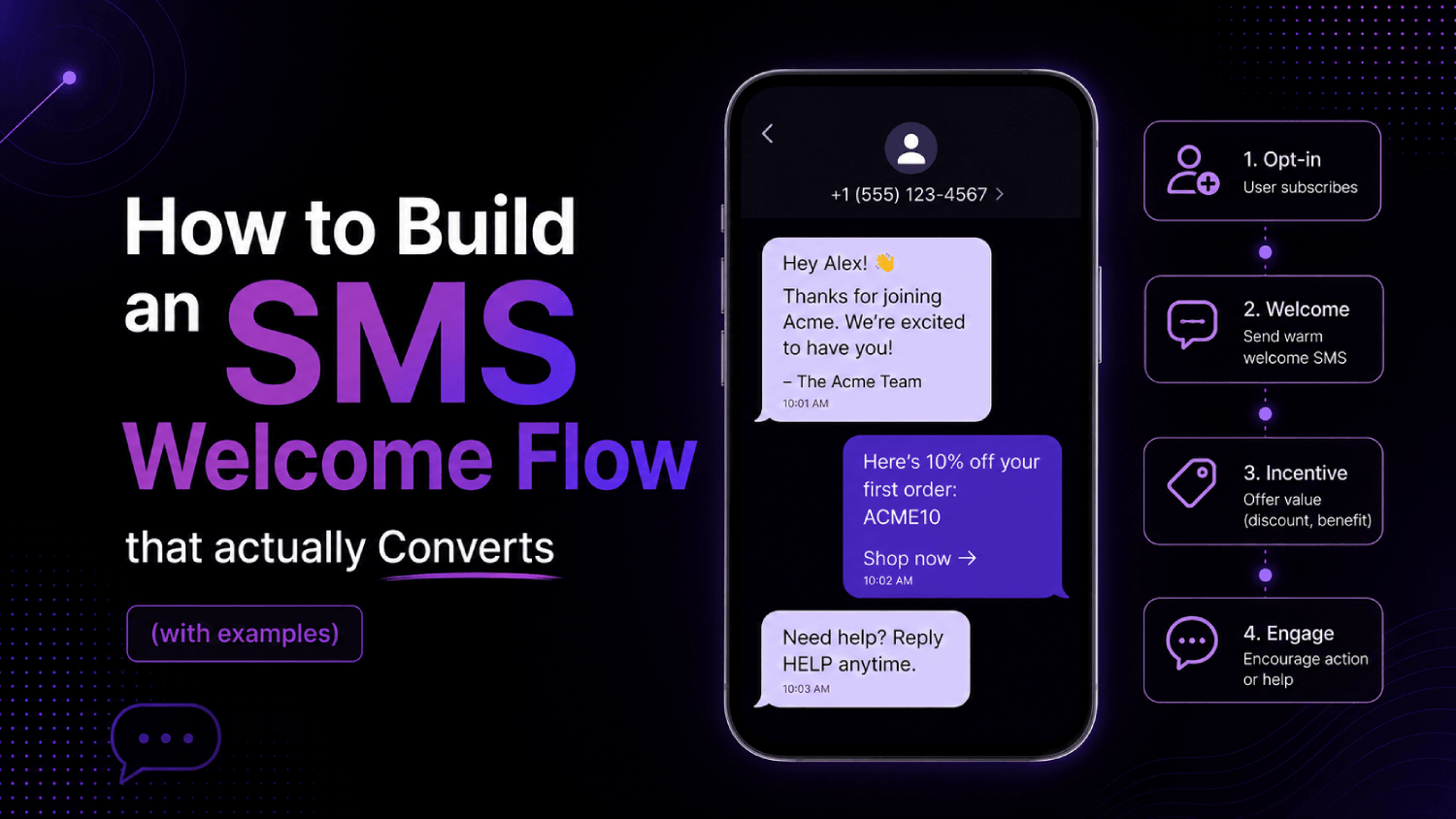

- An SMS welcome flow is not a single text. It is a timed, multi-message sequence that moves a new subscriber from opt-in to first purchase in the first 48 to 72 hours.
- The first message should fire within 60 seconds of opt-in and fulfill whatever promise brought the subscriber in, whether that is a discount code, a content piece, or a loyalty perk.
- Messages two through four handle objection removal, social proof, and a second conversion attempt, spaced at intervals that match your subscriber’s buying cycle.
- Most platforms that run SMS automation flows, including Klaviyo, Attentive, and Postscript, support conditional branching so non-converters get a different path than buyers.
- Compliance is not optional. TCPA requires written consent at opt-in and opt-out language in every welcome message.
An SMS welcome flow is a sequence of automated text messages sent to new subscribers immediately after they opt in, typically three to five messages over 48 to 72 hours. The first message delivers the opt-in incentive within 60 seconds. Subsequent messages build brand familiarity, remove purchase objections, and extend a second conversion window. The goal is to convert a permission into a transaction before the subscriber forgets why they signed up.
Why a single welcome text leaves money on the table
Most brands set up an SMS opt-in, write one thank-you message, and call it a flow. That is not a flow. It is an acknowledgment. The subscriber got the code or the confirmation, opened it, and then moved on with their day without ever thinking about the brand again.
The problem is timing and memory. A subscriber who opts in on a Monday morning while commuting may have zero purchase intent in that moment. They want the discount code. They will shop later, maybe. Without a follow-up sequence, “later” turns into “never” for a significant share of that list. A structured welcome series catches those subscribers at a second or third moment when they are ready to act.
There is also the deliverability reputation angle. Carriers and messaging aggregators look at engagement signals, including reply rates and link clicks, to assess whether a sender is trustworthy. A welcome flow that generates early interaction builds a positive sending reputation from the start, which improves inbox delivery for every campaign that follows.
What is the right structure for an SMS welcome flow?
The most effective welcome flows follow a four-message architecture. This publication calls it the Opt-In to Outcome sequence: Deliver, Educate, Prove, and Recover. Each message has exactly one job.
Message 1: Deliver (send within 60 seconds of opt-in)
This message fulfills the opt-in promise. If the subscriber signed up for 15% off, this is where they get it. Nothing more, nothing less. One link, one action. TCPA compliance requires this message to include your brand name and opt-out language (“Reply STOP to unsubscribe”). Keep the message under 160 characters if possible to avoid MMS pricing on most carriers.
Example: Hey [First Name], here’s your 15% off: [link]. Use it on any order. Reply STOP to opt out. , Brand Name
Message 2: Educate (send 24 hours after opt-in, if no purchase)
This message introduces the brand’s actual value proposition, not the discount. What makes your product worth buying even without a code? This is where you mention the specific thing that makes your brand different: the origin story, the manufacturing process, the guarantee. Keep it brief and conversational. One sentence of brand context, one link to a high-performing product page or collection.
Conditional logic matters here. Subscribers who already converted after Message 1 should enter a post-purchase flow, not this one. Most platforms handle this with a simple “has not placed an order” filter on the trigger.
Message 3: Prove (send 48 hours after opt-in, if no purchase)
Social proof via SMS. A short quote from a real customer review, a specific number (“4,200+ five-star reviews”), or a press mention. Pair it with a soft CTA that re-surfaces the original offer or extends urgency if the discount has an expiration. Do not manufacture fake urgency by saying the code expires when it does not. Subscribers remember.
Example: “The best purchase I’ve made this year.” , Sarah K. Your 15% off is still waiting: [link]. Expires [date]. Reply STOP to opt out.
Message 4: Recover (send 72 hours after opt-in, if no purchase)
The last conversion attempt before the subscriber moves into your standard broadcast list. This message can take one of two approaches depending on your brand’s tone: a final code reminder with a hard expiration, or a different angle entirely, like a bestseller recommendation or a limited-time bundle. The goal is to give a non-buyer one more reason to act that is different from everything they have already seen.
A complete example SMS welcome sequence
| Message | Timing | Trigger condition | Goal | Example copy |
|---|---|---|---|---|
| 1: Deliver | Immediately (within 60s) | New opt-in | Fulfill incentive, set compliance | Hey [Name], here’s 15% off: [link]. Reply STOP to unsubscribe. , Brand |
| 2: Educate | 24 hours | No purchase since opt-in | Brand differentiation | Fun fact: every [product] is [specific attribute]. Shop the full range: [link] |
| 3: Prove | 48 hours | No purchase since opt-in | Social proof + urgency | “Worth every penny.” , Jamie L. Your 15% off expires [date]: [link] |
| 4: Recover | 72 hours | No purchase since opt-in | Final conversion attempt | Last chance: your discount expires tonight. Our top seller right now: [link] |
The entire sequence above can be built in Klaviyo, Attentive, Postscript, or any platform that supports SMS automation flows with conditional branching. If you are running SMS on Shopify specifically, the best SMS marketing apps for Shopify stores covers which platforms handle branched flows versus simple drip sequences.
What are the TCPA compliance rules you cannot skip?
Every SMS welcome flow in the US must comply with the Telephone Consumer Protection Act. The rules are not complicated, but the penalties for ignoring them are significant. Under the TCPA, statutory damages range from $500 per violation for unintentional violations to $1,500 per violation for willful or knowing violations, as stated in the statute itself (47 U.S.C. § 227). Each individual message sent without proper consent can constitute a separate violation.
The required elements are: prior written consent at the point of opt-in (a checkbox alone is not enough if the language is buried), disclosure of message frequency, disclosure that message and data rates may apply, and opt-out instructions in every initial message. Most platforms include compliance templates that cover this automatically, but verify the output before going live.
Quiet hours also matter. The TCPA prohibits sending automated messages before 8 a.m. or after 9 p.m. in the recipient’s local time zone. Platforms like Attentive and Klaviyo have quiet hours controls at the flow level, but you need to turn them on.
How do you set timing and frequency without annoying subscribers?
The 24-48-72 hour cadence above works for most e-commerce brands because it mirrors a typical purchase consideration window. For higher-ticket products with longer decision cycles, extend the gaps. A furniture brand might run messages at day 1, day 4, and day 10. A daily consumable brand might compress to day 1, day 2, and day 3.
The only data that matters is your own unsubscribe rate by message. If Message 3 is generating a spike in opt-outs, either the timing is wrong or the copy is. Most platforms surface this at the flow step level. Check it weekly for the first month after launch.
One underrated tactic: send Message 2 and beyond only during a window when response rates are historically higher for your audience, typically mid-morning or early evening on weekdays. This requires the platform to support send-time restrictions within flows, which Klaviyo and Attentive both handle natively, but simpler tools like SimpleTexting do not.
Which platform features actually matter for building this flow?
Not all SMS automation tools are built the same way. When evaluating platforms, three capabilities separate functional welcome flow tools from limited ones.
Conditional branching at the step level
This is the ability to route subscribers down different paths based on what they did or did not do after the previous message. Without it, you cannot suppress buyers from receiving Messages 2 through 4. Every platform claims to do “automation,” but many only support linear drip sequences. Ask vendors to show you how a purchase-triggered exit from a flow works before you sign.
Native e-commerce data sync
Purchase data needs to flow into the SMS platform in near real-time for the “no purchase” conditionals to work. Platforms with native Shopify or BigCommerce integrations, like Postscript, Attentive, and Klaviyo, sync order data automatically. Platforms relying on Zapier or manual CSV imports introduce lag that breaks the logic. If your SMS and customer data live in different systems, the piece on the best customer data platforms for B2B teams is worth reviewing to understand how a CDP can unify that data before it reaches the SMS tool.
MMS support with link tracking
MMS adds images, GIFs, or product visuals to messages. Some brands see meaningfully higher engagement on MMS welcome messages. More important than MMS itself is tracked short links within messages, which let you attribute revenue at the flow step level rather than just at the campaign level. Blind attribution (knowing a sale came from “SMS” but not which message in the sequence) makes optimization impossible.
How do you measure whether an SMS welcome flow is working?
Three metrics matter: click-through rate by message, conversion rate by message, and total welcome flow revenue per subscriber. The last one is the north star. Divide total flow-attributed revenue by the number of subscribers who entered the flow. That number should improve as you iterate on copy and timing.
Secondary signals worth tracking: opt-out rate by step (tells you where friction is highest) and reply rate (a proxy for brand engagement and a positive carrier signal). Most platforms surface these natively in the flow analytics view.
For teams connecting SMS revenue back to broader marketing investment, attribution across channels is a separate but important problem. The guide to marketing attribution tools that prove what drives revenue covers how to handle SMS alongside paid, organic, and email in a multi-touch model.
What separates a high-converting welcome flow from an average one?
The difference is almost always in the specificity of copy, not the technology. Generic welcome texts fail because they read like every other brand’s welcome texts. Subscribers have seen “Welcome to the family! Here’s your code” approximately 400 times.
The brands that outperform use specific language: a real customer name in the social proof, a specific product detail in the educate message, a concrete expiration date on the code. Specificity creates the impression that the message was written for this subscriber, even though it was not.
A/B testing copy is also dramatically underused in SMS flows compared to email flows. Most platforms that support welcome flows also support split tests at the message level. Testing one variable per message, subject line versus no subject line for MMS, code-first versus brand-first copy, generates data that compounds over time as your list grows. Set up the tests at launch, not after you have decided the flow is underperforming.
If you are exploring richer messaging formats beyond standard SMS, newer RCS (Rich Communication Services) channels support carousels, buttons, and branded sender IDs. The best RCS business messaging platforms available in the US covers what is actually ready for production use versus what is still waiting on carrier support.
Frequently asked questions about SMS welcome flows
How many messages should an SMS welcome flow have?
Three to five messages is the standard range. Four messages over 72 hours covers the full purchase consideration window for most consumer brands without exhausting the subscriber’s patience. Fewer than three messages leaves conversion opportunities on the table for non-immediate buyers. More than five messages in the welcome period typically raises opt-out rates without proportional revenue gains. Adjust based on your product’s natural buying cycle and your unsubscribe data by message step.
What should the first SMS welcome message say?
The first message must do three things: identify your brand by name, deliver the opt-in incentive immediately, and include TCPA-required opt-out language. Keep it under 160 characters when possible to avoid MMS rates. Do not pack in brand storytelling or secondary CTAs. The subscriber opted in for the offer. Give it to them first. Everything else comes in later messages once you have demonstrated that you fulfill promises.
How do I prevent buyers from receiving the full welcome flow?
Use a conditional branch at each message step that checks for a completed order since opt-in. If the condition is true, exit the subscriber from the flow and route them into a post-purchase or cross-sell sequence instead. This requires a platform that syncs order data in near real-time and supports flow-level branching. Klaviyo, Attentive, and Postscript all handle this natively with Shopify. Simpler tools with linear drip-only logic cannot do this without workarounds.
What is a good conversion rate for an SMS welcome flow?
Publicly available benchmark data from SMS platforms varies widely by industry, list quality, and incentive type, so treat any published figure as directional. Reported ranges in platform case studies and industry surveys span from the low single digits to the mid-teens as a percentage of flow entrants, with incentive-led flows at the higher end. Rather than anchoring to an external benchmark, build a baseline from your own flow in the first 30 days after launch, then measure each copy or timing change against that number. Relative improvement against your own prior period is a more grounded target than comparison to an industry average that may reflect a different product category, list source, or incentive structure entirely.
Does an SMS welcome flow need to be different from an email welcome flow?
Yes, significantly. SMS messages are read in a different context than email. They are typically opened within minutes on a mobile device, they are shorter by necessity, and they sit in the same inbox as messages from the subscriber’s friends and family. That means the brand-to-subscriber dynamic is more personal and less tolerant of padding. Copy that works in a 400-word welcome email will not work in a 160-character text. Treat the SMS welcome flow as its own channel with its own copy strategy, not a truncated version of the email version.
What time of day should SMS welcome messages send?
Message 1 should always send immediately at opt-in regardless of time. For Messages 2 through 4, build send-time restrictions into the flow so they only deliver between 9 a.m. and 8 p.m. in the subscriber’s local time zone. This respects both TCPA quiet hours and common-sense engagement patterns. Mid-morning (10 a.m. to 11 a.m.) and early evening (7 p.m. to 8 p.m.) tend to see higher engagement, but test your own audience rather than assuming industry averages apply to your list.
Can I build an SMS welcome flow for B2B subscribers?
Yes, though the approach differs. B2B SMS opt-ins typically happen at events, through web forms, or inside onboarding sequences rather than through discount pop-ups. The welcome flow structure still applies, but the incentive in Message 1 is usually content (a report, a tool, a demo link) rather than a coupon code. Conversion goals shift from purchase to meeting booked or trial activated. For B2B teams managing this alongside broader onboarding infrastructure, the guide to customer onboarding tools that cut time-to-value covers the broader stack context.
What is the single thing most welcome flows get wrong?
They optimize for the first message and ignore the rest. The discount code in Message 1 gets workshopped over multiple rounds. Messages 2 through 4 get written in 20 minutes and never revisited. The result is a flow that front-loads everything compelling and then trails off into generic copy that no one reads.
The Opt-In to Outcome sequence works when each message is treated as a standalone creative asset with its own hypothesis and measurable outcome. Message 3 is not “the third text.” It is the social proof message, and it has a click-through rate target, a copy test running, and a review date on the calendar. That discipline is what separates brands that report strong SMS ROI from brands that report mediocre numbers and blame the channel.
The platform you choose matters less than most vendors want you to believe. Klaviyo, Attentive, and Postscript all support the four-message branched flow described here. The tool is not the constraint. The constraint is always the quality of the sequence strategy, the specificity of the copy, and the consistency of the optimization habit. Get those right, and the platform becomes a detail.