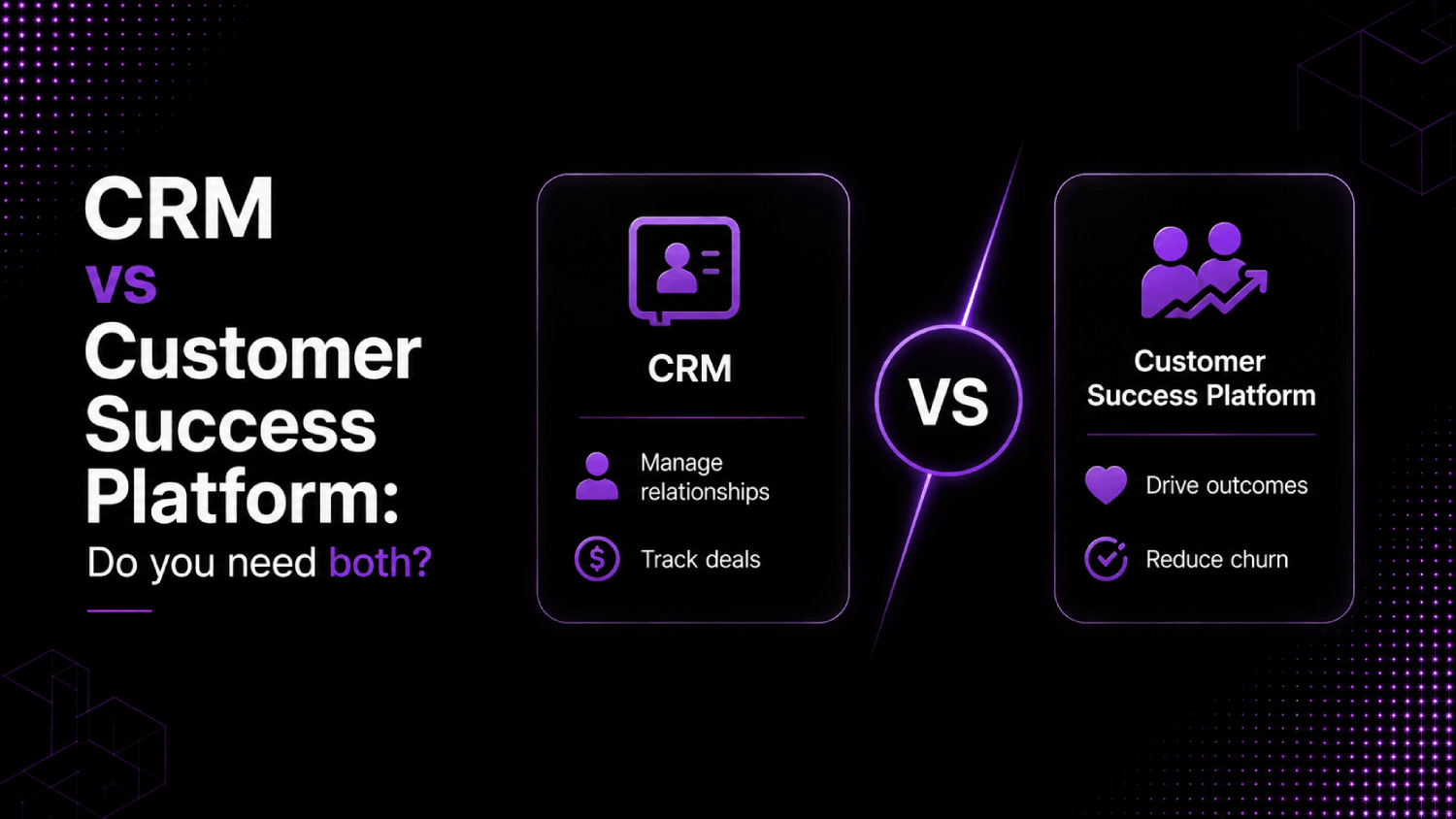
- A CRM tracks deals and pipeline; a customer success platform tracks health scores, product usage, and renewal risk after the contract is signed.
- Most B2B SaaS teams above 50 customers need both, because CRMs are built for sales motion, not post-sale account management.
- The clearest sign you need a dedicated CS platform: your customer success managers are logging notes in Salesforce while churn is happening in your product data with no alert firing.
- There is a middle ground for very early-stage teams, but it closes fast once you pass roughly a dozen accounts worth actively managing.
- The right answer depends on whether your revenue model rewards expansion and renewal, not just new logo acquisition.
A CRM and a customer success platform are not competitors doing the same job differently. They operate on opposite sides of the contract signature. A CRM manages the path to becoming a customer; a CS platform manages what happens after. Teams that treat their CRM as a full customer success solution consistently discover the gap only after churn has already happened.
What Does a CRM Actually Do for Customer Success Teams?
A CRM, at its core, is a system of record for sales activity. Products like Salesforce Sales Cloud, HubSpot CRM, and Pipedrive are built around contacts, companies, deals, and activities. They answer the question: what stage is this prospect at, and what happened last in the sales process?
That architecture is excellent for pre-sale workflows. It starts to strain when you try to bend it into a post-sale health monitoring tool. A CRM can store a renewal date in a custom field, but it cannot automatically alert a CS manager when a key user account goes dark, when feature adoption drops below a threshold, or when a support ticket pattern suggests an account is likely to churn.
To be fair to CRMs, many have added post-sale modules. Salesforce has Service Cloud and various partner integrations. HubSpot has a Service Hub. These close some gaps, especially for smaller teams. But they are still fundamentally contact-and-deal databases with customer service features bolted on, not health-score engines built around product engagement data.
What Does a Customer Success Platform Do That a CRM Cannot?
A dedicated CS platform is built around a different data model. Instead of deals and pipeline stages, it organizes around accounts, health scores, lifecycle stages (onboarding, adoption, renewal, expansion), and usage signals pulled from your product. Platforms like Gainsight, ChurnZero, Vitally, and Totango all operate on this model.
The mechanism that separates them from CRMs is the health score engine. A CS platform ingests product usage data, support ticket volume, NPS responses, license utilization, and stakeholder engagement, then computes a composite health score per account. That score drives automated playbooks. When an account’s health drops below a defined threshold, the platform fires a task, sends an internal alert, or triggers an outreach sequence without a human having to notice the signal first.
This matters because churn is almost never a surprise to the product data. It shows up weeks or months before a customer submits a cancellation request: login frequency drops, a power user goes inactive, a core feature stops being used. A CRM has no visibility into any of that unless someone manually logs it. A CS platform exists precisely to close that visibility gap.
The Stack-Fit Audit: How to Know Which Tools Your Team Actually Needs
Before buying anything, run this four-question check. We call it the AboutMartech Post-Sale Stack-Fit Audit, and it works for teams at 10 accounts or 10,000.
1. Where does post-sale data actually live? If your product usage data is in a data warehouse or a product analytics tool and never makes it into your CRM, your CS team is flying blind regardless of what CRM you use. A CS platform or a customer data platform that connects those systems is not optional at this point.
2. Do your CSMs manage more than 20 accounts? Below 20 accounts per CSM, manual CRM management is painful but survivable. Above 20, the cognitive load of tracking health manually across accounts becomes the reason churn happens. Automation becomes structural, not nice-to-have.
3. Is expansion revenue a meaningful part of your model? If upsell and renewal account for more than 20% of your annual revenue target, you need proactive signals, not reactive tickets. A CRM tells you a renewal is coming up in 90 days. A CS platform tells you the account is at risk of not renewing three months before that.
4. Can your team define a health score today? If the answer is “we look at whether they respond to our emails,” you do not have a health score; you have an activity log. A CS platform forces this discipline, which alone is often worth the investment. For a practical framework on health score design, covering signal weighting logic and what good versus gaming-the-metric looks like in practice, the AboutMartech guide to building a customer health score that predicts churn is a useful reference before you start configuring any tool.
CRM vs Customer Success Platform: A Direct Comparison
The capabilities below reflect each product category’s standard architecture as described in vendor documentation and publicly available product overviews. Individual implementations will vary based on configuration and integrations.
| Capability | CRM (e.g. Salesforce, HubSpot) | CS Platform (e.g. Gainsight, ChurnZero) |
|---|---|---|
| Contact and deal tracking | Core function | Secondary or imported from CRM |
| Product usage ingestion | Requires custom integration or third-party ETL | Native connectors or API built for this |
| Health score engine | Not native; possible with custom fields and workarounds | Core function with configurable signal weighting |
| Churn risk alerts | Manual rules at best; no behavioral triggers | Automated playbooks triggered by health threshold changes |
| Renewal and expansion tracking | Custom objects or deal stages; often messy | Native renewal forecasting and expansion workflows |
| Customer onboarding workflows | Sequence tools repurposed from sales cadences | Onboarding milestone tracking with product adoption signals |
| NPS and survey integration | Third-party only | Often native or deeply integrated |
| CSM workload management | Not designed for it | Portfolio views, task queues, risk-prioritized dashboards |
| Typical buyer | Sales, RevOps, Marketing | Customer Success, CS Ops, RevOps |
Do Early-Stage Teams Need a Dedicated CS Tool, or Does a CRM Cover It?
For a company with fewer than 30 to 50 customers and one or two people handling success work, a CRM with structured custom fields and disciplined manual logging is a reasonable starting point. The overhead of implementing a full CS platform, configuring health score models, and connecting product data often outweighs the benefit when account volume is that low.
The economics shift fast. Once a team hits 50 to 100 accounts under active management, the manual tracking burden typically exceeds what a CRM is designed to handle. At that point, the question becomes which CS platform to buy, not whether to buy one. If you are at that inflection point and evaluating options, the ranked comparison of customer success platforms for B2B SaaS covers 13 options with pricing and fit criteria.
There is also a middle path. Some teams use a lightweight tool like Vitally or Planhat specifically because they are less operationally heavy than Gainsight or ChurnZero, and they integrate directly with Salesforce as the system of record rather than replacing it. This is the stack most common at Series A to Series B companies: CRM for sales and as the source of truth on accounts, CS platform for health monitoring and playbook execution.
How Should the CRM and CS Platform Connect?
When both systems are in play, the typical integration pattern is bidirectional sync. The CRM owns the account record, contacts, and contract data. The CS platform reads that data, enriches it with product usage and engagement signals, and writes health scores and CS-owned fields back to the CRM so sales and leadership have visibility without logging into two systems.
Most enterprise CS platforms, including Gainsight and ChurnZero, publish native integrations with Salesforce. For teams running a data warehouse, a reverse ETL tool is often the cleanest way to push product telemetry into both systems without building and maintaining custom pipelines. This is especially true when product usage data lives in Snowflake or BigQuery and needs to flow into a CS platform’s health score model in near real time.
The integration matters more than people expect when evaluating tools. A CS platform that lacks a clean Salesforce sync creates a data reconciliation problem that ultimately falls on CS Ops or RevOps to maintain manually. Confirm the sync architecture before signing anything.
What About Platforms That Try to Do Both?
A handful of products position themselves as CRM-plus-CS in a single product. HubSpot’s customer success workspace is the most prominent example at the SMB end of the market. At the enterprise end, some teams use Salesforce with heavy customization and add-ons to approximate CS platform behavior.
The honest assessment: these hybrid approaches work until they do not. For teams with a small book of business and simple health score needs, they are often sufficient. For teams with complex product telemetry, multi-product portfolios, or CSMs managing 50-plus accounts each, the compromises in a generalist tool add up. You spend CSM time working around the tool’s limitations rather than working accounts.
Customer onboarding is one area where purpose-built tools consistently outperform CRM-based workarounds. If your onboarding is a structured multi-step process with milestone tracking tied to product adoption, dedicated customer onboarding tools solve that problem more cleanly than repurposed sales sequences.
What Is a Customer Success CRM, and Is It Different from Either?
The phrase “customer success CRM” circulates widely in job descriptions and vendor marketing, and it means different things depending on who uses it. Sometimes it describes a CS platform being used as the system of record for post-sale accounts, effectively replacing the CRM for CS workflows. Other times it describes a CRM that has been customized to support CS motions, with health score fields, renewal pipelines, and escalation workflows built on top of the native data model.
Neither is inherently wrong, but the terminology obscures a real architectural choice. If your CS team’s primary workspace is Gainsight or ChurnZero, calling that a “CS CRM” is fair in practice even if it is not a CRM in the technical sense. If your CS team lives in Salesforce with custom objects, you are running a CRM for customer success, which comes with all the trade-offs described in the table above.
For teams evaluating that architecture decision specifically, the ChurnZero vs Vitally comparison is useful because both represent different philosophies on how much to replace versus complement the existing CRM.
Frequently Asked Questions
Can I use Salesforce as my customer success platform?
Salesforce can support customer success workflows, but it requires significant customization: custom objects for health scores, third-party integrations for product data, and manual configuration of alerting logic. Teams that do this often find the maintenance burden high and the visibility into product engagement limited compared to a purpose-built CS platform. Salesforce works best as the system of record that a CS platform writes back to, not as the CS platform itself.
What is the difference between a customer success platform and a CRM?
A CRM is built to manage the sales process, from lead to closed deal. It is organized around contacts, activities, and pipeline stages. A customer success platform is built for the post-sale relationship. It ingests product usage data, computes health scores, triggers automated playbooks when accounts show churn signals, and gives CS managers a prioritized view of which accounts need attention. The two systems share account and contact data but serve fundamentally different workflows.
Do small SaaS companies need a customer success platform?
Below 30 to 50 actively managed accounts, a CRM with disciplined manual processes is often sufficient. Above that threshold, the manual overhead of tracking account health, monitoring product engagement, and managing renewal workflows typically exceeds what a CRM can efficiently support. Teams at the Series A to Series B stage are usually where the economics of a dedicated CS platform start to make sense, especially if expansion revenue is a meaningful part of the model.
What does a customer success CRM mean?
The term has no standardized definition. It usually means one of two things: a CS platform that functions as the system of record for post-sale accounts, replacing CRM workflows for CS teams; or a traditional CRM that has been configured with custom fields, pipelines, and integrations to approximate CS platform behavior. The latter is common at early-stage companies trying to avoid a second tool. The former is what most scaling teams migrate to once manual CRM-based CS breaks down.
How do customer success platforms connect to a CRM?
Most enterprise CS platforms publish native Salesforce integrations that sync account and contact data bidirectionally. The CS platform reads contract and deal data from the CRM, enriches it with product usage and health signals, and writes CS-owned fields back so sales and leadership retain visibility. For teams with product data in a warehouse, reverse ETL tools can handle the pipeline from warehouse to CS platform without custom engineering. Confirm the sync architecture before evaluating any CS platform, because gaps in that integration create manual reconciliation work.
Which customer success platforms integrate with HubSpot?
Vitally, ChurnZero, Planhat, and Totango all publish HubSpot integrations, though the depth of those integrations differs by vendor. Gainsight’s HubSpot connector exists but is documented primarily as a one-directional data push, unlike its Salesforce integration which supports full bidirectional sync including health score writeback. If your CRM is HubSpot, validate the specific sync fields and frequency with the CS vendor before committing, because some integrations require third-party middleware to achieve true bidirectional sync.
Is there a single platform that replaces both a CRM and a CS tool?
No single platform does both equally well today. HubSpot comes closest at the SMB level, with its CRM and customer success workspace sharing a common data layer. Salesforce with Service Cloud and partner integrations approximates this at the enterprise level. Both involve trade-offs: generalist tools sacrifice the depth of health score modeling and product-usage-driven automation that purpose-built CS platforms deliver. For teams with complex renewal or expansion motions, the compromise tends to show up in outcomes, not just features.
At what point should a team buy a dedicated CS platform instead of relying on a CRM?
The most reliable trigger is when CSMs cannot answer “which of my accounts is most at risk right now” without running a manual report or checking multiple systems. Other signals include renewal rates declining without an obvious cause, CSMs managing more than 20 to 30 accounts each, or product usage data that never makes it into the hands of the people responsible for retention. When any of those are true, the gap a CS platform fills has already started costing revenue.
The Decision in Plain Terms
A CRM tells you who your customers are and how they got there. A CS platform tells you whether they plan to stay. Those are different questions, and they require different data models, different alerting logic, and different workflows. Treating one as a substitute for the other is not a technology shortcut; it is a structural gap in how your team manages retention.
For most B2B SaaS teams past the earliest stage, the right answer is both, connected cleanly. The CRM remains the sales system of record. The CS platform owns health monitoring, playbook execution, and renewal forecasting. When those two systems share account data bidirectionally, CS managers work from one view and sales leaders do not have to log into a second tool to understand account risk.
If you are actively evaluating which CS platform fits your team’s stage, stack, and budget, the full ranked breakdown of customer success platforms for B2B SaaS covers pricing, integration depth, and which teams each tool is actually built for.