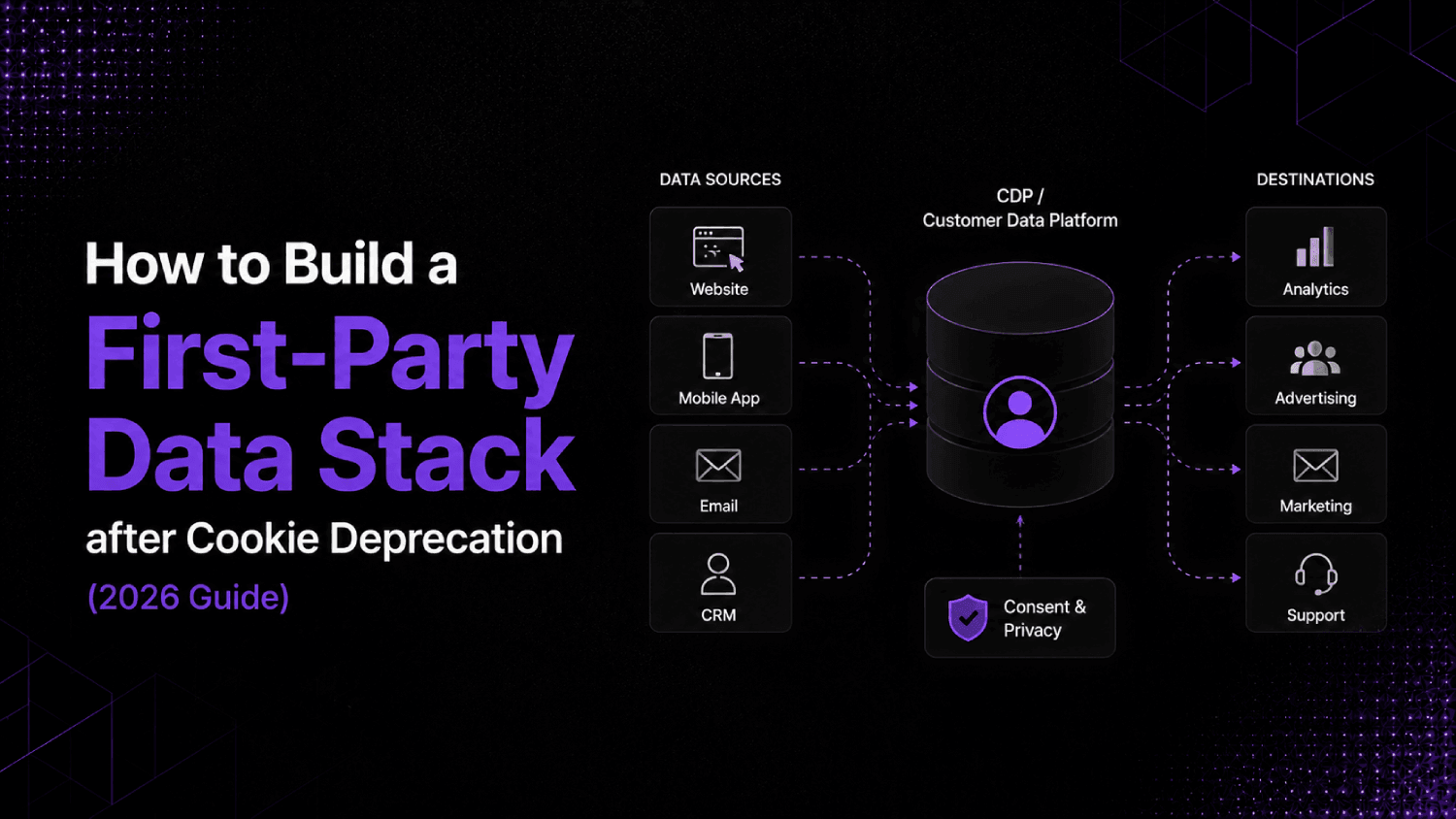
- A first-party data stack has four layers: collection, identity resolution, storage, and activation. Most teams stall because they skip identity resolution and wonder why their data never matches across tools.
- You do not need a CDP on day one. A well-configured data warehouse plus a reverse ETL tool can do most of what a CDP does at a fraction of the cost, especially for teams under 100,000 monthly active users.
- Consent architecture is not a legal checkbox. It is the foundation of the entire stack. If your consent layer breaks, every downstream signal becomes legally and analytically unreliable.
- The hardest part of building a first-party data stack is not the tooling. It is defining your identity spine: the single identifier that links a user across web, email, product, and CRM before you buy anything.
- Third-party cookie deprecation is already live in browsers like Safari and Firefox, and Chrome’s Privacy Sandbox has changed how attribution works. The transition window is closed for most teams.
Building a first-party data stack means owning the infrastructure that collects, resolves, stores, and activates user data you gathered directly from your own properties, without relying on third-party identifiers. For most B2B and DTC teams, that means wiring together a consent management platform, a server-side event pipeline, a warehouse or CDP for storage, and a reverse ETL or activation layer to push segments back into ad platforms, email tools, and CRMs.
Why third-party cookie deprecation changed what “data infrastructure” actually means
The shift is not hypothetical. Safari has blocked third-party cookies since 2017 via Intelligent Tracking Prevention. Firefox followed. Chrome’s deprecation, combined with the Privacy Sandbox initiative’s Topics API, effectively ended cross-site behavioral tracking for the open web. Retargeting audiences built on third-party pixel data are degrading. Attribution models that relied on cross-domain cookies are reporting gaps.
What replaced them is not better tracking. It is more intentional data collection: email capture, product telemetry, CRM signals, and zero-party data from surveys and preference centers. Teams that built first-party infrastructure before the deadline are now running cleaner audiences and more reliable attribution than they ever had with third-party data. Teams that did not are spending budget on ads that cannot be measured and audiences that cannot be refreshed.
The honest version of post-cookie data infrastructure is not “just use first-party data instead.” It is a complete rethinking of which events matter, where they are stored, who owns them, and how they flow downstream.
What does a first-party data stack actually look like?
A first-party data stack has four functional layers, and the order matters. You cannot activate data you have not resolved. You cannot resolve identity without a reliable collection layer. The layers build on each other, and missing one creates compounding problems downstream.
Layer 1: Consent and collection
Collection starts before any data is captured. Your consent management platform (CMP) determines which events can legally fire in which regions. Without a CMP that correctly passes consent signals to your tag manager and event pipeline, you are collecting data you may not be permitted to use, and your ad platform integrations may be operating on invalid consent. OneTrust, Cookiebot, and Usercentrics are the dominant CMP vendors. Their pricing varies by traffic volume and region, and they all support IAB TCF 2.2 for GDPR compliance.
Server-side tagging has become the standard collection method for serious stacks. Rather than firing JavaScript pixels directly from the browser, where they are blocked by ad blockers and browser privacy features, server-side tagging routes events through your own domain’s server container first. Google Tag Manager Server-Side, Stape, and Tealium EventStream all support this pattern. The practical effect: event hit rates increase, cross-domain attribution improves, and you stop leaking raw user data directly to third-party vendor endpoints.
Layer 2: Identity resolution
Identity resolution is the step most teams skip, and it is the reason their data never coheres. A single user visits your site anonymously, then fills out a form, then becomes a product user, then buys. Each of those touchpoints generates a different identifier: an anonymous cookie ID, an email hash, a product user ID, a CRM contact ID. Without a system that stitches those identifiers into one persistent profile, you have four records of the same person and no way to connect them.
The two approaches to identity resolution are deterministic and probabilistic. Deterministic matching links records using a known shared identifier, typically an email address or phone number that the user provided at multiple touchpoints. It is accurate but only covers identified users. Probabilistic matching infers connections using device signals, behavioral patterns, and IP data. It covers more of your anonymous traffic but introduces error rates. Most production stacks use both: deterministic for known users, probabilistic for anonymous-to-known bridging at acquisition.
Tools like Segment, RudderStack, and Amperity handle identity resolution natively. If you are running a warehouse-native stack, dbt transformations with a deterministic merge key can handle basic identity stitching without a separate tool, though it requires engineering time to maintain.
Layer 3: Storage
Where you store unified profiles determines what you can do with them. The two dominant patterns are the standalone CDP model and the warehouse-native model.
A standalone CDP like Segment, Klaviyo, or mParticle stores unified profiles in its own managed infrastructure and handles identity resolution, segmentation, and activation in one product. It is faster to stand up and requires less engineering. The tradeoff is cost at scale, vendor lock-in, and limited ability to run complex SQL transformations on the raw data.
A warehouse-native CDP pattern uses BigQuery, Snowflake, or Redshift as the system of record and layering a warehouse-native CDP or reverse ETL tool on top for segmentation and activation. This keeps raw data in infrastructure you own, makes it queryable by your data team without API rate limits, and typically costs less per event at high volumes. The tradeoff is that it requires a data engineer or a strong analytics engineer to maintain.
For a detailed comparison of warehouse-native options specifically, the best warehouse-native CDPs for the modern data stack covers five tools built explicitly for this pattern.
Layer 4: Activation
Activation is moving segments from your storage layer into the tools that act on them: ad platforms, email systems, CRMs, customer success tools. This is where the stack produces revenue. Everything upstream is infrastructure cost. Activation is the return on that investment.
Reverse ETL tools like Hightouch and Census read directly from your warehouse and sync audience segments to 150-plus destinations without requiring custom API integrations. They are the connective tissue of warehouse-native stacks. For teams evaluating both tools, the Hightouch vs Census comparison breaks down where each wins on pricing, sync frequency, and destination coverage.
The AboutMartech Stack-Fit Test: four checks before you buy any first-party data tool
Most martech buying decisions fail because teams buy for capability without checking fit. Before committing to any tool in your first-party data stack, run these four checks.
Check 1: Identity spine compatibility. Does the tool use your primary identifier as its merge key, or does it impose its own? A CDP that forces its own anonymous ID as the canonical identifier will create a new silo, not resolve your existing ones. Ask the vendor directly: can you ingest an external user ID and use it as the primary profile key?
Check 2: Consent signal passthrough. Does the tool accept and respect consent state downstream, or does it fire regardless? Your CMP consent signals need to propagate to every tool in the stack. A tool that does not accept a consent boolean as part of its event payload creates compliance exposure the moment you expand into GDPR-regulated regions.
Check 3: Schema flexibility at ingestion. Can you send custom event properties without modifying a predefined schema, or does the tool require you to map to its taxonomy first? Rigid schemas slow down engineering and lead teams to drop event properties that would have been analytically valuable later.
Check 4: Warehouse write-back. Does the tool write raw event data back to your warehouse, or does it keep it locked in its own storage? Vendor lock-in in the data layer is more expensive than in the activation layer, because switching costs include data migration, not just integration rebuilds. Any tool that does not give you a full export of your own data should be disqualifying.
What does a worked first-party data stack look like in practice?
Consider a B2B SaaS company with 15,000 monthly active users, a 60-person sales team, and a 90-day sales cycle. They run paid acquisition across LinkedIn and Google, an email nurture sequence in HubSpot, and a product analytics layer in Mixpanel. Before building a first-party stack, their attribution is broken: LinkedIn’s in-platform ROAS does not match HubSpot’s source attribution, and their SDRs have no visibility into which prospects have engaged with product trials.
Here is what a realistic first-party stack looks like for this team:
| Layer | Tool | Function | Approximate cost |
|---|---|---|---|
| Consent | Cookiebot | CMP, TCF 2.2 compliance | $9-$39/month (public pricing) |
| Collection | GTM Server-Side via Stape | Server-side event pipeline | $20-$90/month (public pricing) |
| Identity + Storage | RudderStack Cloud | Event streaming, ID resolution, warehouse sync | Usage-based; free tier available |
| Warehouse | BigQuery | Source of truth for unified profiles | Pay-per-query; low at this scale |
| Activation | Hightouch | Warehouse-to-HubSpot, LinkedIn, Google sync | Free tier for basic syncs; paid plans from $350/month |
| Attribution | First-party modeled attribution in dbt | Channel contribution without cookies | Engineering time only |
The outcome for this team: SDRs see product engagement signals in HubSpot CRM automatically synced from BigQuery. LinkedIn Matched Audiences are refreshed weekly from first-party segments rather than pixel-based audiences. Attribution is modeled on server-side event data that does not degrade with browser privacy changes. The total tooling cost for this stack sits under $600 per month, excluding the warehouse, which they already had.
How does first-party data strategy change attribution after cookies?
Post-cookie attribution does not mean no attribution. It means different attribution methods that do not depend on cross-site cookies. The three that hold up best are server-side conversion APIs, modeled attribution, and marketing mix modeling.
Server-side conversion APIs, specifically Meta’s Conversions API and Google’s Enhanced Conversions, let you send conversion events directly from your server to the ad platform using hashed first-party identifiers like email addresses. This bypasses browser blocking entirely. Teams that implement server-side Conversions API alongside their existing pixel typically see reported conversions increase because the server-side signal captures events the browser pixel missed.
Modeled attribution uses your first-party event data and machine learning to assign credit across touchpoints without requiring cross-site cookies. Google’s data-driven attribution model in GA4 and third-party tools like Northbeam or Rockerbox run entirely on first-party signals. For teams running longer sales cycles where last-touch attribution systematically undercredits top-of-funnel content, the best B2B attribution tools for long sales cycles covers which tools handle multi-touch modeling on first-party data.
Marketing mix modeling (MMM) has seen a revival precisely because it does not require user-level tracking at all. It works on aggregate spend and revenue data. For teams with $500K or more in annual media spend, MMM is worth evaluating alongside modeled attribution, not instead of it. The best marketing mix modeling tools for post-cookie measurement covers the current field.
What tools do you actually need for a first-party data stack?
The short answer: you need fewer tools than vendors want you to think, and more than your current analytics setup provides. The table below maps the functional requirement to tool categories and named options.
| Function | Tool category | Named options |
|---|---|---|
| Consent management | CMP | OneTrust, Cookiebot, Usercentrics |
| Event collection | Server-side tag manager / event SDK | GTM Server-Side, Tealium, Stape, Jitsu |
| Identity resolution | CDP or warehouse transformation | Segment, RudderStack, Amperity, dbt |
| Profile storage | Warehouse or CDP | Snowflake, BigQuery, Redshift, Salesforce Data Cloud |
| Segmentation | CDP UI or warehouse query layer | Segment, Hightouch, Census, Amplitude |
| Activation / sync | Reverse ETL | Hightouch, Census, Polytomic, dbt Cloud |
| Attribution | Multi-touch attribution or MMM | Northbeam, Rockerbox, Triple Whale, custom dbt |
If you want a deeper evaluation of the CDP layer specifically, the best CDPs for B2B teams covers eleven platforms with pricing, use case fit, and honest trade-offs. For the activation and reverse ETL layer, the best reverse ETL tools for warehouse data activation covers nine options across team size and data complexity.
What mistakes do teams make when building a first-party data stack?
Buying a CDP before defining the identity spine
A CDP cannot stitch profiles that were never designed to share identifiers. Before you sign any CDP contract, map the identifiers that exist in your current systems: anonymous visitor ID, email, product user ID, CRM contact ID, support ticket ID. Decide which one is canonical. Then evaluate CDPs by whether they can ingest that identifier as the merge key. Teams that skip this step end up with a CDP that creates a new silo rather than resolving the existing ones.
Treating server-side tagging as optional
Browser-side pixels lose 15-40% of events to ad blockers, depending on audience. For B2B audiences who are technically sophisticated and more likely to run uBlock Origin, that number skews higher. Server-side collection is not an optimization. For any team running paid acquisition, it is a baseline data quality requirement.
Ignoring the ETL vs reverse ETL vs CDP distinction
These three tool categories do different things, and buying the wrong one for the wrong job creates expensive redundancy. If your team is unclear on the distinctions, the ETL vs reverse ETL vs CDP explainer is worth reading before any vendor demo.
Collecting everything instead of collecting the right things
Storing every page view event in your warehouse at scale gets expensive quickly. More importantly, teams that track everything tend to trust nothing because the data volume makes quality validation hard. Define your “golden events” first: the five to ten events that map directly to revenue outcomes. Build your schema around those, then expand. This is also better for consent minimization under GDPR, which requires data collection to be proportionate to purpose.
Frequently asked questions about building a first-party data stack
How long does it take to build a first-party data stack from scratch?
For a team with one data engineer or a senior analytics engineer, a functional first-party stack covering consent, server-side collection, warehouse storage, and basic reverse ETL activation takes four to eight weeks to stand up. Identity resolution across all historical data adds two to four weeks depending on the number of source systems. A full production-grade implementation with modeled attribution typically takes three to four months total. Timeline compresses significantly if you use a standalone CDP rather than a warehouse-native stack.
Do I need a CDP, or can I use my data warehouse as a CDP?
If you have an analytics engineer who knows dbt and your data team can maintain the pipelines, a warehouse-native approach with a reverse ETL tool is often cheaper and more flexible than a standalone CDP for teams under roughly 500,000 monthly events. Above that volume or with complex real-time segmentation needs, a standalone CDP’s managed infrastructure starts to justify the cost. The real question is not capability but who owns the operational burden of maintaining identity resolution and segmentation logic.
What is the minimum viable first-party data stack for a startup?
A consent management platform, a server-side event collection layer, and a single destination sync via a CDP or reverse ETL tool constitutes a working minimum viable stack. For early-stage teams, RudderStack’s free tier or Segment’s free developer plan, feeding into BigQuery’s free tier, covers the collection and storage layer. Add Hightouch’s free tier for one or two destination syncs. Total tooling cost at minimum viable configuration: effectively zero, with real limits on event volume and sync frequency.
How do I handle identity resolution without third-party cookies?
Deterministic matching on first-party identifiers is the primary method: email address provided at form submission, product login, or email click links back to a persistent user ID. For anonymous-to-known bridging before identification, probabilistic signals like IP, user agent, and behavioral fingerprinting can help but carry error rates and regulatory risk in some jurisdictions. The practical advice is to optimize conversion rate on identification events, meaning form fills, trial signups, and login prompts, because every anonymous visitor you convert to a known visitor reduces your dependency on probabilistic methods.
What does post-cookie data collection look like for paid acquisition?
Server-side conversion APIs (Meta Conversions API, Google Enhanced Conversions) replace browser pixel tracking for ad platform attribution. First-party audience segments built from CRM and product data replace third-party retargeting audiences. Modeled attribution in tools like Northbeam or Rockerbox replaces last-click cookie-based attribution models. The net effect for most teams is better signal quality on known users and less coverage of anonymous top-of-funnel traffic. That gap in anonymous coverage is the case for investing in identity capture earlier in the funnel.
Is first-party data collection GDPR compliant by default?
No. First-party data collected without valid consent is still non-compliant under GDPR. The first-party classification refers to who collected the data, not whether consent was obtained. You need a consent management platform that collects and records valid consent, passes consent state to your event pipeline, and respects opt-outs in near-real-time. First-party data collected under proper consent is far more durable legally than third-party data, but the consent architecture must be implemented correctly from the start.
How does first-party data strategy affect SEO and content performance measurement?
First-party event tracking in a warehouse lets you connect content engagement events to pipeline and revenue outcomes without relying on GA4’s cross-site attribution, which has its own limitations post-cookie. Teams running server-side analytics can attribute SQLs and closed-won deals back to specific content pieces using their own CRM and event data rather than a third-party analytics vendor’s model. For teams evaluating their analytics layer, the best Google Analytics 4 alternatives covers tools that work natively with first-party data pipelines.
The single most important insight about first-party data infrastructure
Most teams treat building a first-party data stack as a technical project. It is actually a data governance project that requires technical implementation. The technology is the easier half. Defining what data you have permission to use, from whom, for what purpose, under which legal basis, and for how long is the work that determines whether your stack is legally durable and analytically trustworthy.
The teams that have done this well share one thing: they started with the identity spine, not the tooling. They mapped their identifiers, chose a canonical key, and designed consent collection around the specific activation use cases they needed. Then they bought tools that fit that architecture, rather than inheriting the vendor’s data model and trying to map their reality onto it.
The practical implication: the first meeting you have about your first-party data stack should not be a vendor demo. It should be an internal session where marketing, engineering, and legal agree on which identifiers exist, which are canonical, and what consent language covers the use cases you intend to run. That 90-minute meeting will save you six months of rework after you have already bought and half-implemented a CDP that does not fit your identity model.