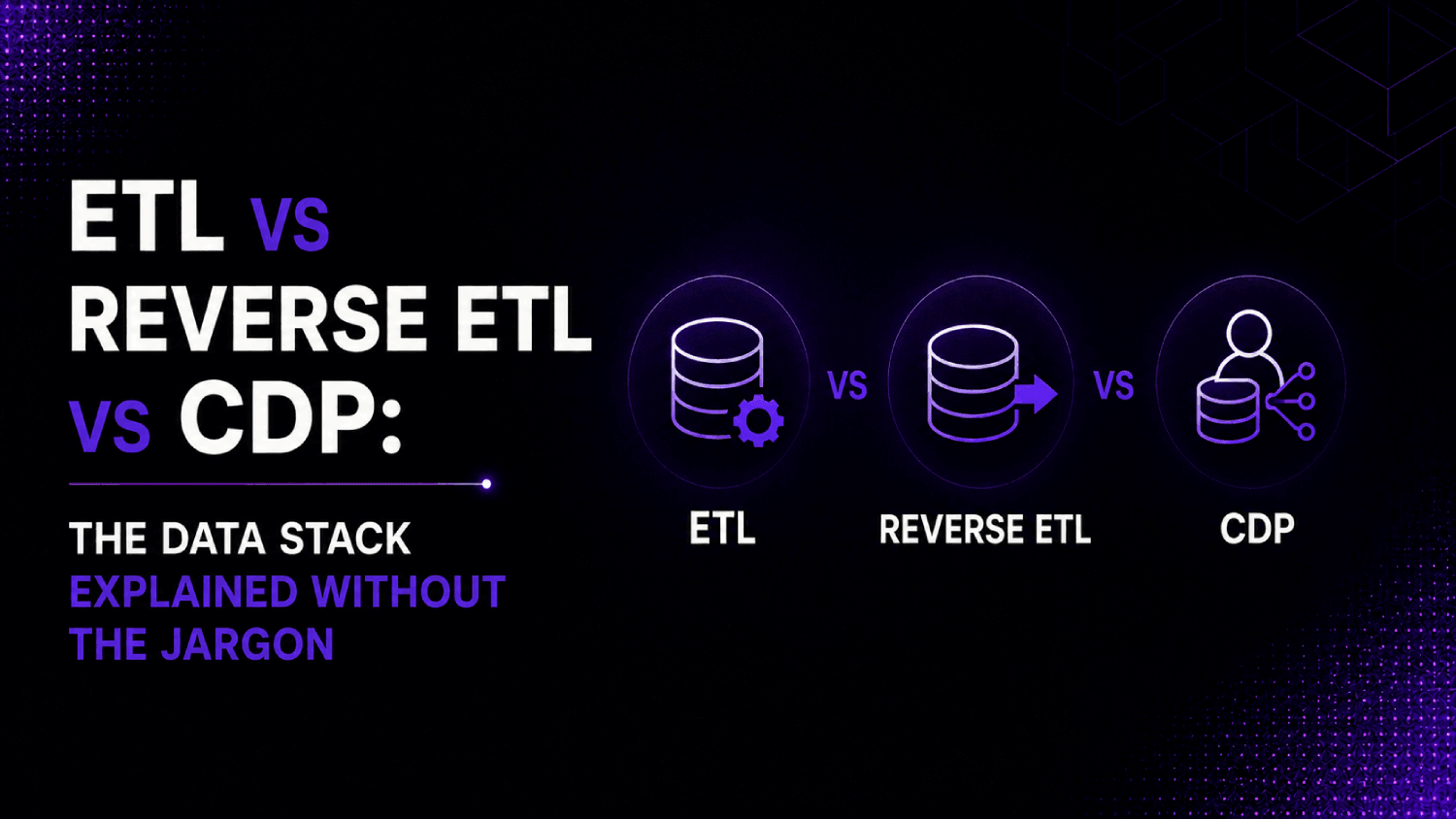

- ETL moves data from source systems into a warehouse for analysis. Reverse ETL moves data from the warehouse back out to operational tools like your CRM, email platform, or ad network. Understanding the difference between reverse ETL vs ETL is the starting point for any stack decision in this space.
- A CDP sits between those two directions, collecting customer events in real time and building unified profiles, but it owns its own storage rather than treating your warehouse as the source of truth.
- Warehouse-native CDPs and reverse ETL tools are converging, but they are not the same thing yet. The distinction matters when you are choosing where identity resolution and audience building actually live.
- Most teams do not need all three. The right starting point depends on where your customer data already lives and which tools need to consume it.
- Understanding these three roles does not require a data engineering degree. It requires knowing what each layer is responsible for and what it cannot do.
ETL, reverse ETL, and a CDP each solve a different problem in your data stack. ETL extracts data from source systems and loads it into a warehouse for analysis. Reverse ETL reads from that warehouse and syncs records to operational tools like Salesforce, HubSpot, or Braze. A CDP collects customer behavioral data in real time, resolves identity across sources, and builds profiles that marketing tools can act on directly. They can coexist, but none of them replaces the others.
Why These Three Terms Keep Getting Conflated
The confusion is understandable. All three deal with moving or transforming customer data. Vendors in each category routinely describe their products using language borrowed from the other two, partly because buyers search for all three terms and partly because the categories genuinely overlap at the edges.
The real distinction is directional and functional. ETL is about getting data into an analytical system. Reverse ETL is about getting processed data back out to systems that run campaigns and workflows. A CDP is about real-time collection, identity stitching, and profile storage. Each solves a different bottleneck, and collapsing them into one mental bucket leads to buying the wrong tool for the actual problem.
What Is ETL, and What Does It Actually Do?
ETL stands for Extract, Transform, Load. It describes a pipeline that pulls raw data from one or more source systems, reshapes it to fit a target schema, and writes it to a destination, usually a data warehouse like BigQuery, Snowflake, or Amazon Redshift.
A typical ETL job might pull closed-won opportunity data from Salesforce, subscription events from Stripe, and support ticket data from Zendesk, then normalize field names and join the records on a customer ID before writing the combined dataset to a warehouse table. That table then powers dashboards, data science models, and attribution reporting.
Modern pipelines often use an ELT variation, where the transformation step happens inside the warehouse after loading rather than before. Tools like Fivetran, Airbyte, and Stitch handle the extract-and-load portion. dbt handles SQL-based transformation inside the warehouse after data has already been loaded, it is a transformation tool, not a data movement or activation layer. For our purposes here, ETL and ELT refer to the same directional flow: data goes from operational systems into the warehouse.
ETL does not make data ready for downstream marketing tools. It makes data queryable. That is an important ceiling to understand.
What Is Reverse ETL, and Who Uses It?
Reverse ETL runs the pipeline in the opposite direction. It reads a SQL query or model from your data warehouse and syncs the resulting records into an operational system, a CRM, an email marketing platform, an ad network, a customer success tool, or anywhere else a downstream team needs enriched data.
Consider a concrete scenario. A B2B SaaS company has product usage data in Snowflake: login frequency, feature adoption scores, pages viewed in the last 30 days. The sales team works in Salesforce. Without reverse ETL, a data analyst exports a CSV once a week, the RevOps team uploads it manually, and the records are stale before anyone acts on them. With a reverse ETL tool like Hightouch or Census, that product usage model syncs to Salesforce contact records on a schedule, or triggered by a threshold, without any CSV handling. Sales sees current health scores. Marketing suppresses low-engagement accounts from expansion campaigns automatically.
The category is relatively young. Hightouch and Census both launched around 2020, and the term “reverse ETL” was not in common use before then. For a detailed comparison of the two leading tools, the Hightouch vs Census head-to-head on AboutMartech breaks down where each wins. For a broader look at the category, the best reverse ETL tools roundup covers nine options with pricing context.
What Is a CDP, and How Is It Different from the Other Two?
A customer data platform is a system that collects customer behavioral and event data in real time, stitches together identity across devices and channels, builds persistent customer profiles, and makes those profiles available to other marketing and analytics tools through APIs or native integrations.
The key architectural difference from ETL and reverse ETL is that a CDP owns its own storage. It is not just a pipeline. It maintains a live database of customer profiles that updates as events arrive. When someone visits your pricing page, that event hits the CDP within seconds, enriches the visitor’s profile, and can immediately trigger a workflow in your marketing automation platform.
Classical CDPs like Segment or mParticle sit between event sources (your website, mobile app, product) and downstream destinations, routing data in both directions. They also handle identity resolution, matching an anonymous website visitor to a known customer record when the visitor later provides an email address.
Reverse ETL tools do not do identity resolution. They sync rows from a table to another system. If your warehouse table has a messy identity graph with duplicate customer IDs, the reverse ETL tool syncs that mess faithfully. The CDP is where identity problems get solved, not the pipeline.
The AboutMartech Stack-Fit Test: Three Questions Before You Buy
Before buying any of these tools, three diagnostic questions clarify which layer you actually need to fill first.
- Where does your customer data already live? If it is scattered across SaaS tools with no central store, you need ETL first. If it already lands in a warehouse and your problem is getting it back to operational tools, reverse ETL is the gap. If you have no real-time event collection and your customer profiles are stitched together from batch exports, a CDP fills that role.
- Who needs the data and in what latency? Analysts running weekly reports tolerate hour-old warehouse data. A sales rep following up on a product signal needs near-real-time sync. Email personalization triggered by in-session behavior requires sub-minute latency. Each tolerance matches a different tool category.
- Does identity resolution need to happen before the data is useful? If downstream tools consume raw customer IDs that are inconsistent across sources, a CDP should sit upstream. If your warehouse already has a clean, resolved customer model, reverse ETL can do the job without a full CDP layer.
Teams that run through these three checks before evaluating vendors avoid the most common mistake in this space: buying a CDP when the real problem is a missing data pipeline, or implementing reverse ETL when the upstream data is not clean enough to sync anywhere useful.
How Do ETL, Reverse ETL, and a CDP Work Together in a Real Stack?
These three layers are complementary, not competing. A mature data stack often uses all three, with each handling a distinct part of the data flow.
| Layer | Direction | Primary job | Where it lives | Example tools |
|---|---|---|---|---|
| ETL / ELT | Source systems → Warehouse | Centralize raw data for analysis | Data pipeline layer | Fivetran, Airbyte, Stitch, dbt |
| CDP | Event sources → Profile store → Destinations | Real-time event collection, identity resolution, profile building | Customer data layer | Segment, mParticle, RudderStack, Amplitude CDP |
| Reverse ETL | Warehouse → Operational tools | Sync warehouse models to CRM, email, ads | Activation layer | Hightouch, Census, Polytomic |
A concrete example: a mid-market SaaS company uses Fivetran to pull billing data from Stripe and support data from Intercom into BigQuery. Segment collects product events in real time and routes behavioral data to both BigQuery and their email platform. A dbt model in BigQuery joins billing, support, and product data into a customer health score. Hightouch syncs that health score to Salesforce daily, so account executives see a live signal without touching a spreadsheet.
In that stack, ETL, CDP, and reverse ETL each do exactly one job. None of them could do the other’s job without significant workarounds.
Where Warehouse-Native CDPs Change the Equation
The newer category of warehouse-native CDPs complicates the neat separation above. Tools like Hightouch’s CDP product, Census Audience Hub, and other dedicated warehouse-native platforms build the profile and audience layer directly on top of your existing warehouse, rather than maintaining a separate data store. These tools use the warehouse as the profile store and add a query and activation layer on top, a different architectural model from classical CDPs like Segment, which maintain their own storage. Note that dbt, while commonly referenced alongside these tools, is a SQL transformation layer that runs inside the warehouse; it is not itself a CDP or an activation platform.
The case for a warehouse-native CDP is governance and single source of truth. If you already have clean, transformed data in Snowflake or BigQuery, adding a classical CDP means replicating that data into a third system and resolving conflicts when the two disagree. A warehouse-native CDP avoids that duplication by treating the warehouse as the profile store and adding a query and activation layer on top.
The case against is latency and real-time capability. Most warehouse-native CDPs still rely on scheduled queries rather than true streaming event capture. If your use cases require sub-second personalization or in-session triggered messaging, a classical CDP with a dedicated event pipeline typically handles it better today. For a detailed look at the options, the best warehouse-native CDPs comparison on AboutMartech covers five leading platforms with honest trade-off analysis.
Does a CDP Replace Reverse ETL?
Not exactly, though this question comes up constantly. Classical CDPs have destination connectors that sync audience segments and events to downstream tools. That sounds like reverse ETL. The difference is the source: a CDP syncs from its own profile store, while reverse ETL syncs from your warehouse.
If the authoritative version of your customer data lives in the CDP, its native syncs may be sufficient. If the authoritative version lives in the warehouse, because it includes data the CDP never sees, like billing history, offline transactions, custom-scored dbt models, or records from systems outside the CDP’s ingestion scope, reverse ETL is necessary regardless of whether you also run a CDP.
There are also scenarios where both run simultaneously and serve distinct purposes. A team might use Segment to collect real-time behavioral events and trigger time-sensitive email workflows, while also using Hightouch to sync a weekly health score model from BigQuery into Salesforce. The CDP handles sub-minute activation from its own profile store; the reverse ETL handles batch activation of warehouse-computed models the CDP never touches. Neither is redundant in that configuration. For teams evaluating the broader CDP category, the best CDPs for B2B teams roundup covers eleven platforms with stack-specific context.
Frequently Asked Questions
What is the difference between ETL and reverse ETL?
ETL moves data from operational source systems (CRMs, payment processors, product databases) into a centralized data warehouse where it can be analyzed. Reverse ETL moves data in the opposite direction: it reads processed, transformed data from the warehouse and pushes it into operational tools like Salesforce, HubSpot, Braze, or ad platforms. ETL feeds the warehouse. Reverse ETL activates what the warehouse produces. The reverse ETL vs ETL distinction is fundamentally about direction, inbound to the warehouse versus outbound from it.
What is reverse ETL in plain terms?
Reverse ETL is a pipeline that reads a SQL query result from your data warehouse and writes those records into a downstream business tool on a schedule or in response to a trigger. Instead of analysts exporting CSVs and uploading them manually to a CRM, reverse ETL automates that sync. It makes the warehouse’s computed models, such as health scores, propensity scores, or lifetime value tiers, visible to sales, marketing, and support teams inside the tools they already use.
Can a CDP replace ETL?
A CDP handles real-time event collection from web, mobile, and product sources, but it does not replace ETL for moving data from offline systems, legacy databases, or SaaS applications that do not emit events. If you need billing data from Stripe, support tickets from Zendesk, or ERP records in the warehouse alongside behavioral data, you still need ETL pipelines running alongside the CDP. The two systems collect different data through different mechanisms.
Can a CDP replace reverse ETL?
A CDP with native destination connectors can sync audience segments to ad platforms and email tools, which overlaps with what reverse ETL does. But if your warehouse contains data the CDP never collected, like computed models from dbt or data from systems outside the CDP’s ingestion scope, reverse ETL handles the activation of that warehouse data. CDPs sync from their own profile store. Reverse ETL syncs from the warehouse. The right tool depends on where the authoritative data lives.
What is the difference between ETL vs reverse ETL vs CDP?
ETL centralizes data in a warehouse for analysis. Reverse ETL activates warehouse data by syncing it to operational tools. A CDP collects real-time customer events, resolves identity across sources, and maintains live customer profiles that both marketing automation tools and the warehouse can consume. ETL is input to the warehouse. Reverse ETL is output from the warehouse. A CDP is a real-time layer that operates in parallel with both, feeding data to the warehouse while also powering time-sensitive activation.
Do I need all three, or can I start with just one?
Most teams start with one depending on their immediate bottleneck. If you have no centralized data store, ETL comes first. If you have a warehouse but your sales and marketing tools are running on stale or manual data, reverse ETL is the faster win. If you have no real-time event collection and cannot personalize at the session level, a CDP fills the gap. Many mature stacks eventually use all three, but buying all three on day one before the data problems are clear is a common and expensive mistake.
How does reverse ETL relate to marketing attribution?
Reverse ETL often feeds attribution signals back into the tools where campaigns run. For example, an offline conversion or closed-won opportunity in your warehouse can sync back to Google Ads or Meta via reverse ETL, improving the quality of signals those ad platforms use for bidding and optimization. That feedback loop is increasingly important as third-party cookie deprecation limits what ad platforms see directly. For teams building out attribution infrastructure, the best marketing attribution tools on AboutMartech covers how these signals connect in practice.
What This Means for Your Stack Decision
The most useful mental model: think of the warehouse as the center of gravity. ETL pulls data toward it. Reverse ETL pushes computed outputs away from it. A CDP orbits it, feeding real-time behavioral data both into it and directly to downstream tools. None of these tools is redundant if your data problems require all three directions of flow.
The practical implication is sequencing. Teams that try to solve everything at once often end up with three partially configured systems, none of them authoritative. Start with the layer that addresses the highest-value use case your team cannot currently execute. For most growing B2B SaaS companies, that is getting clean warehouse data into the CRM via reverse ETL, because the sales team is already waiting for it. The CDP and deeper ETL infrastructure follow once the core activation loop is running.
The warehouse-native CDP category is worth watching closely if you already have a mature warehouse. It may compress the CDP and reverse ETL layers into one system over the next few years, but today there are real trade-offs on latency and real-time event handling that matter for high-velocity use cases. Choose based on what your stack needs now, not what vendors claim the category will be.