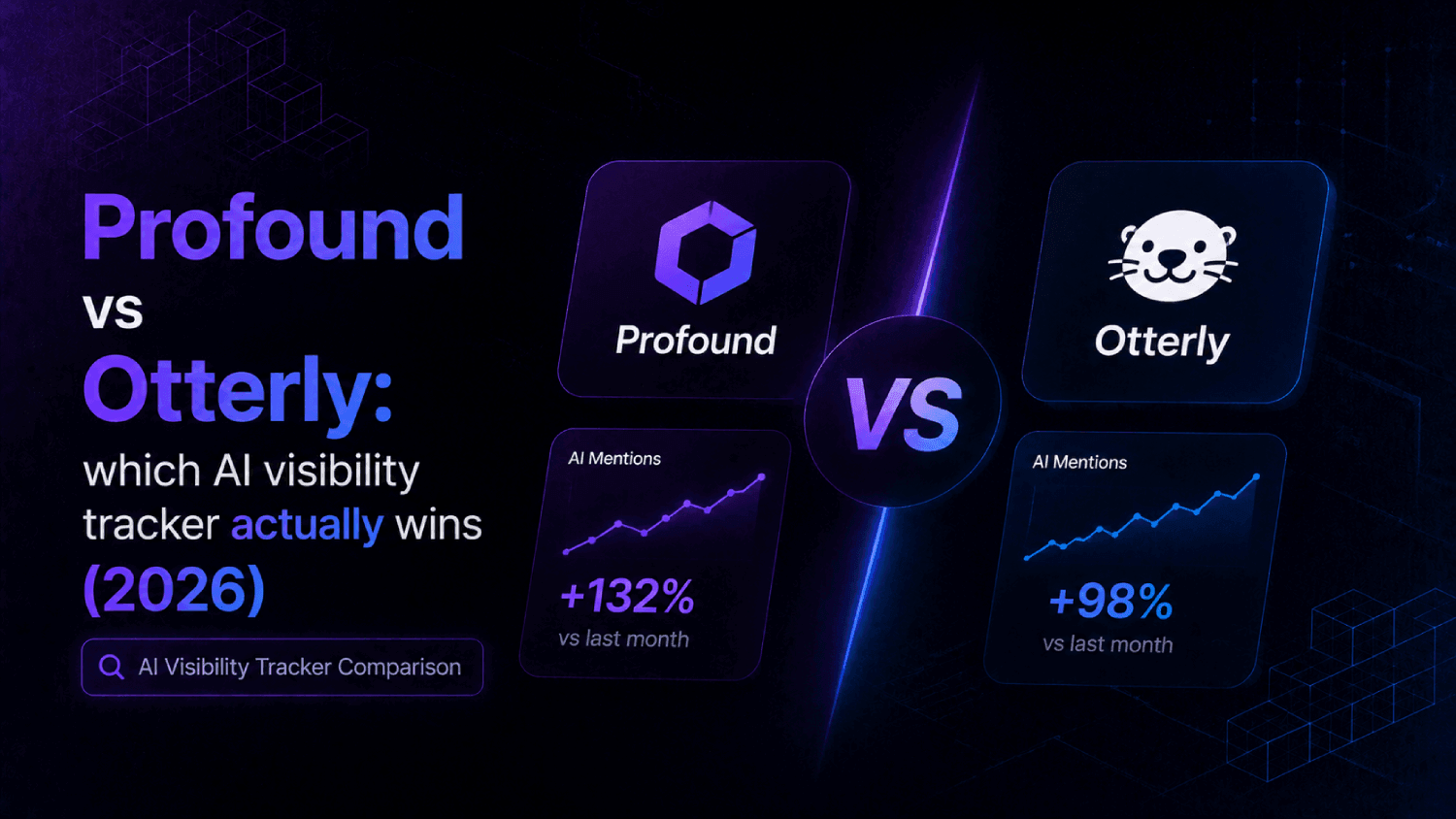
- Profound and Otterly are not interchangeable: they differ meaningfully on which AI engines they monitor, how deep their query libraries go, and what reporting they surface to different team types.
- Profound is built for enterprise and mid-market brands that need broad LLM coverage, share-of-voice tracking across multiple AI engines, and structured reporting for stakeholders.
- Otterly positions itself as a leaner, faster tool aimed at SEO practitioners and agency teams who need quick brand-mention audits without the overhead of a full platform onboarding.
- Price alone should not drive this decision: the gap in query coverage and AI engine breadth matters more than any monthly fee difference for teams whose pipeline increasingly depends on AI-referred traffic.
- If your brand is being evaluated by buyers inside ChatGPT, Perplexity, or Google AI Overviews, the tracker you pick determines whether you see that signal at all.
Profound is the stronger pick for most B2B marketing teams that need multi-engine AI visibility tracking with structured reporting. Otterly fits smaller teams or agency practitioners who want a lightweight brand-mention audit across a handful of prompts without committing to a full platform. The decision hinges on query depth, LLM coverage breadth, and whether your team needs sharable dashboards or just raw data exports.
Why comparing Profound and Otterly is harder than it looks
Most people who land on a Profound-vs-Otterly comparison already know they need some form of AI visibility tracking. What they have not figured out is that these two tools are solving slightly different problems, and pricing them against each other misses the point.
Both tools monitor how AI systems mention or recommend brands in response to prompts. Both surface brand presence data across large language model outputs. Past that common ground, their architectures, target users, and data models diverge enough that the “right” answer depends almost entirely on what you are trying to measure and who needs to act on it.
For context on the broader category, our roundup of the best AI visibility tools for tracking your brand in ChatGPT and Perplexity covers the competitive field in more depth. This article goes narrower: a direct feature-by-feature read on Profound and Otterly for teams at the buying decision.
What does Profound actually do?
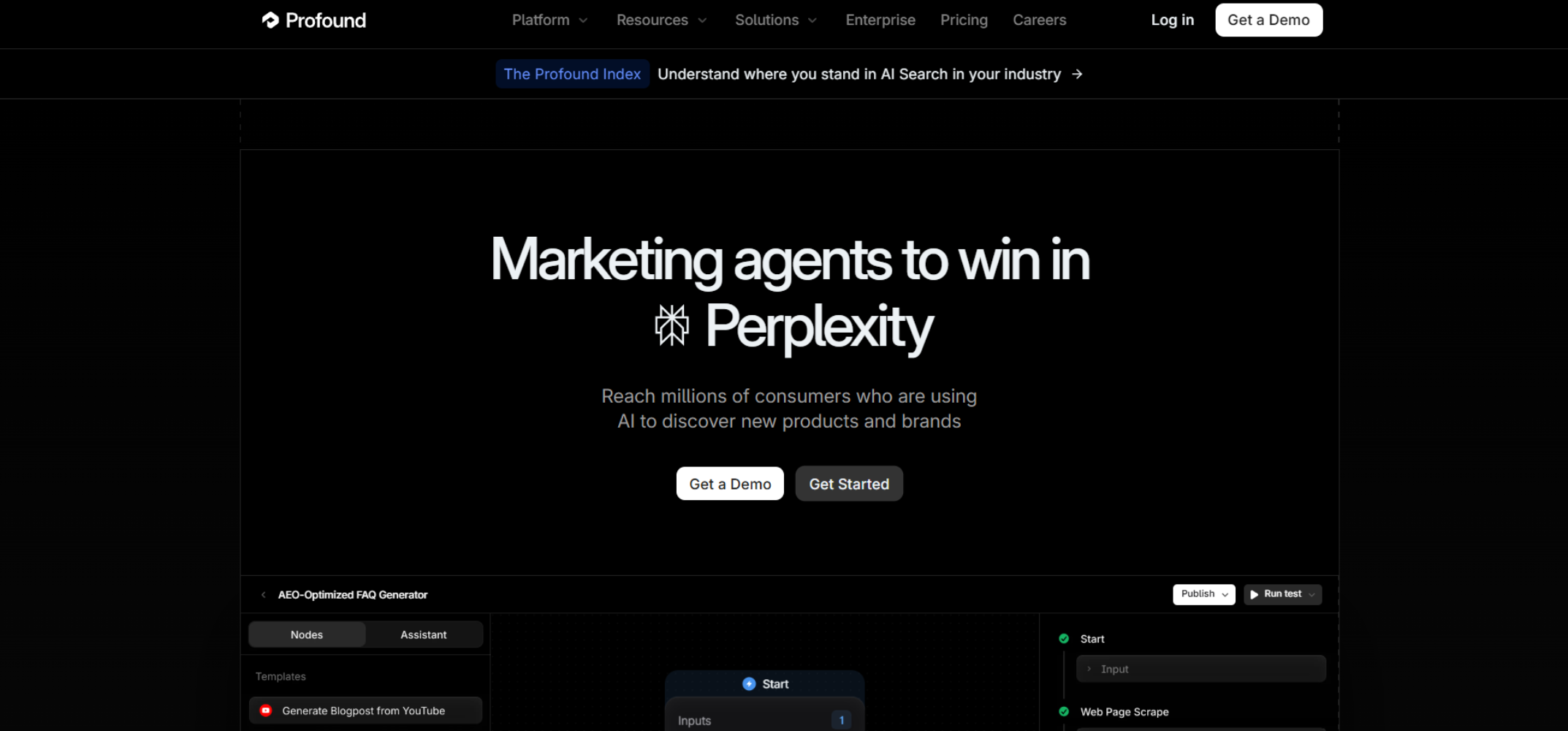
Profound (sponsored link) monitors brand mentions, citations, and recommendations across multiple AI engines including ChatGPT, Perplexity, Google AI Overviews, and others. It tracks a library of queries relevant to your category, records where your brand appears in AI-generated responses, and reports share-of-voice relative to named competitors.
The platform is built around the concept of prompt-level analytics. Rather than just flagging whether your brand name appeared in an AI response, Profound maps which prompts triggered the mention, at what position in the response, and whether the mention was a recommendation, a citation, or an incidental reference. That distinction matters: an AI recommending your brand in response to “what CRM should a 50-person sales team use” is fundamentally different from your brand appearing in a list of ten also-rans.
Profound also tracks competitor visibility across the same query set, which means you can see not just your own share of AI-generated mentions but how that share shifts relative to HubSpot, Salesforce, or whoever else competes for your category’s real estate inside these engines. The reporting layer is designed to be exported and presented to stakeholders who are not living inside the tool daily.
Profound pricing
Profound does not publish flat-rate pricing on its public site. Pricing is quote-based and varies by the number of queries monitored, the number of AI engines tracked, and team size. Teams evaluating Profound should request a demo to get a custom quote. Based on public positioning, Profound targets mid-market and enterprise buyers rather than solo practitioners.
What does Otterly actually do?
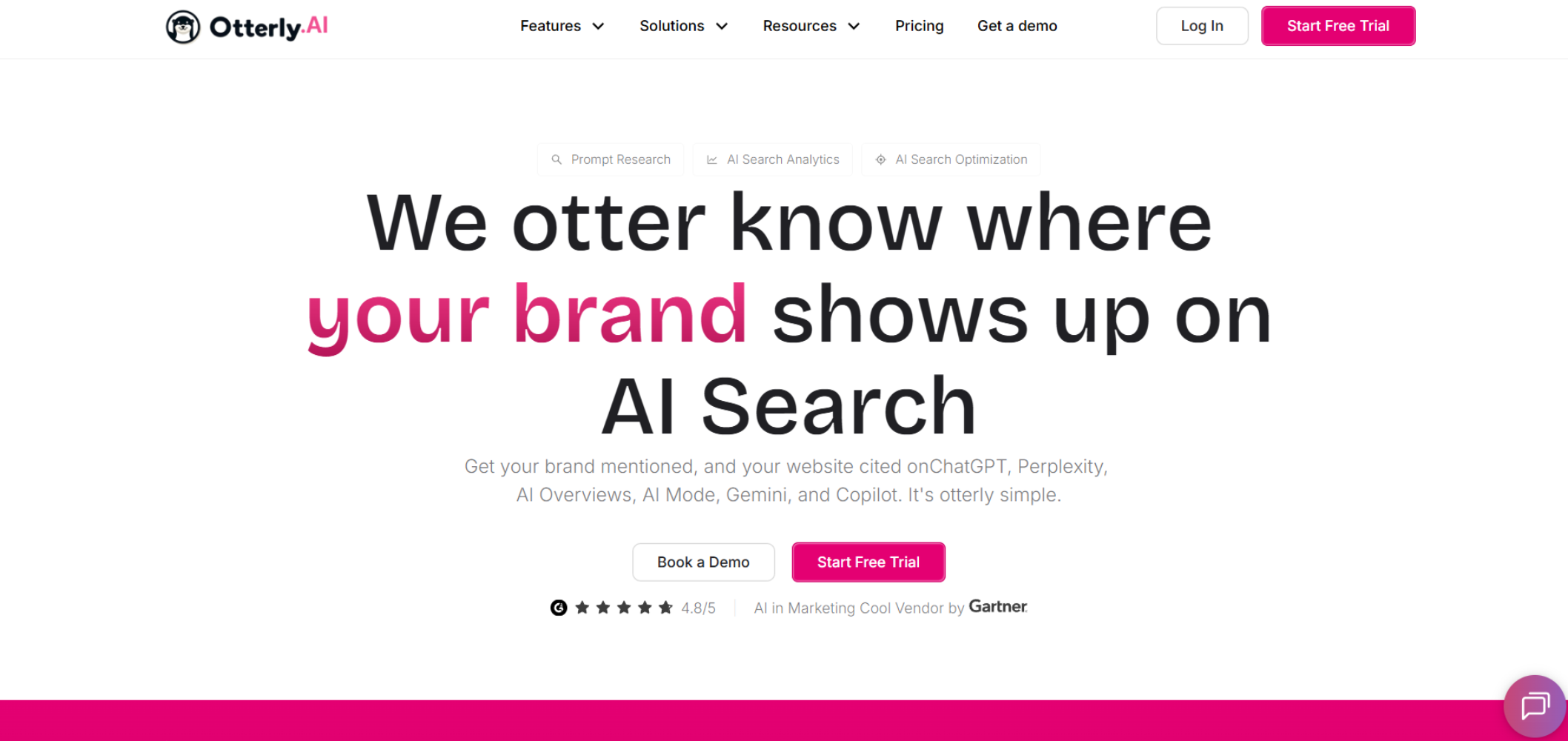
Otterly (sponsored link) approaches AI visibility from a more practitioner-focused angle. The tool lets users define a set of prompts, run those prompts across AI engines, and review where their brand or a competitor’s brand appears in the output. The workflow is closer to a manual audit tool with scheduling and automation layered on top than it is to a full analytics platform.
Otterly’s strength is speed to insight. A user can configure prompts and start seeing brand mention data quickly without a lengthy onboarding or professional services engagement. For SEO practitioners and agency teams running brand audits for clients, that low-friction entry point is genuinely useful.
The tradeoff is depth. Otterly’s reporting tends toward raw visibility data rather than structured share-of-voice analysis or cross-engine aggregation at the sophistication level Profound targets. It covers major AI engines, but the query library management and competitive benchmarking features are lighter.
Otterly pricing
Otterly publishes pricing on its public site. As of their public pricing page, Otterly offers tiered plans starting at lower monthly price points than enterprise-positioned competitors, with limits on the number of tracked prompts and monitored brands per tier. The entry-level tier suits individual practitioners; higher tiers add prompt volume, competitor tracking slots, and reporting features. Teams should verify current pricing directly on Otterly’s site, as this category is evolving quickly.
How do Profound and Otterly compare across the dimensions that actually matter?
| Dimension | Profound | Otterly |
|---|---|---|
| AI engines monitored | ChatGPT, Perplexity, Google AI Overviews, and others (multi-engine) | Major AI engines; coverage varies by plan |
| Query / prompt library | Managed library with category-level prompt sets | User-defined prompts; smaller default library |
| Share-of-voice reporting | Yes, with competitor benchmarking | Limited; primarily brand-mention visibility |
| Mention type classification | Recommendation, citation, incidental | Presence / absence; less granular classification |
| Stakeholder reporting | Structured dashboards, exportable | Data exports; lighter dashboard layer |
| Onboarding complexity | Higher; enterprise-grade setup | Low; self-serve within minutes |
| Target user | B2B marketing teams, demand gen, brand | SEO practitioners, agency teams |
| Pricing model | Quote-based | Published tiered pricing |
| API access | Available on enterprise tiers (verify with vendor) | Available on higher tiers (verify with vendor) |
What does the gap in query depth actually cost you in practice?
Consider a B2B SaaS company with a 30-person marketing team, a 60-day sales cycle, and a product that competes in a crowded category like marketing automation or project management. Buyers in that category are increasingly asking AI engines for recommendations before they ever visit a vendor website. The prompts they use are not always obvious: “what tool should a 50-person ops team use to manage cross-functional projects” surfaces different results than “best project management software,” and neither maps neatly to branded search terms.
A tool that only monitors prompts you manually define, with no managed category library, puts the entire discovery burden on your team. If you miss the prompt variants that are actually driving AI-generated recommendations in your category, your visibility data is incomplete in a way you cannot see. That is the gap Profound’s managed prompt library is designed to close. Otterly relies on you to know which prompts matter, which is fine if your team has the SEO expertise and bandwidth to build and maintain that list.
This is what we call the Prompt Coverage Gap: the difference between the prompts a brand tracks and the prompts real buyers are actually using to find category solutions inside AI engines. Tools differ significantly in how they help teams close this gap, and it is the single most important technical dimension separating serious AI visibility platforms from lighter audit tools.
Which team types should pick Profound?
Profound makes the most sense for in-house B2B marketing teams that need to report AI visibility metrics to leadership alongside traditional SEO and demand-gen data. If your CMO or VP of Marketing is asking about brand presence in AI-generated responses, you need structured share-of-voice data, not a CSV of prompt outputs. Profound’s reporting layer is built for that stakeholder use case.
It also fits teams competing in high-consideration categories where the list of prompts driving buyer research is large and varied. Categories like CRM, HR software, cybersecurity, and financial tools tend to have rich buyer-question libraries inside AI engines. Managing that prompt set manually is a full-time job; a managed library approach pays for itself quickly.
Teams already investing in broader AI answer engine optimization will find Profound integrates more naturally with the strategic work. If you are reading about AEO and GEO tools for getting cited by AI, you are the kind of team that needs the depth Profound provides on the tracking side.
Which team types should pick Otterly?
Otterly fits two profiles well. The first is the agency SEO practitioner running brand audits across a portfolio of clients who needs a fast, repeatable workflow without enterprise pricing. Otterly’s self-serve onboarding and published pricing make it easy to fold into a client deliverable without a contract negotiation.
The second is a smaller in-house team, typically under 15 people in marketing, that wants to establish a baseline of AI visibility before committing to a more sophisticated platform. Otterly lets you answer the question “does our brand appear in AI responses to relevant prompts” without a large investment. That is a legitimate starting point, even if it is not the destination for a mature program.
For teams at that early stage of building out their martech stack, the lighter commitment also mirrors how they should be thinking about other parts of their infrastructure. The same logic that applies to choosing a marketing attribution tool that matches your actual data maturity applies here: do not buy enterprise-grade infrastructure before you have the team and processes to use it.
The AboutMartech AI Tracker Fit Test
Before choosing between Profound and Otterly, run these four checks. They cut through feature-list noise and force clarity on what your team actually needs from an AI visibility tracker.
- Prompt ownership: Can your team build and maintain a comprehensive library of buyer-intent prompts for your category, or do you need the vendor to manage that? If the answer is “we cannot maintain it reliably,” Profound’s managed approach is worth the premium.
- Reporting audience: Is your primary consumer of this data a practitioner running their own analysis, or a VP or CMO who needs a clean dashboard? Practitioner-first use cases fit Otterly. Stakeholder reporting pushes toward Profound.
- Competitor benchmarking need: Do you need to track how competitor brands are performing in AI responses alongside your own, with structured share-of-voice metrics? If yes, Profound. If no, Otterly is sufficient.
- Budget cycle: Are you in a formal martech budget with headroom for a quote-based platform, or are you self-funding a test with a credit card? Otterly’s published pricing is the only option if you need a purchase order in the next two weeks without a sales process.
Is there a meaningful difference in which AI engines each tool covers?
Both tools cover the major AI engines that matter for brand visibility: ChatGPT, Perplexity, and Google AI Overviews are the primary surfaces where B2B buyer research is shifting. Profound publicly emphasizes multi-engine coverage as a core differentiator, with structured tracking across these engines and the ability to compare performance across them in a single view.
Otterly covers major engines as well, but the depth of per-engine analytics and the ability to break out share-of-voice by engine varies by plan. For most teams, the engine coverage is less of a differentiator than the query depth and reporting layer. An AI visibility tool that monitors 12 AI engines against 20 poorly chosen prompts delivers worse intelligence than one that monitors 4 engines against 500 carefully selected buyer-intent queries.
Engine breadth is a marketing message. Prompt coverage is the actual product. Evaluate both tools on the latter before the former.
What about integration with the rest of your martech stack?
Neither Profound nor Otterly sits at the center of a typical martech stack the way a CRM or marketing automation platform does. Both are monitoring and reporting tools, which means their integration story is primarily about data export and dashboard connectivity rather than bidirectional data flow.
Profound’s enterprise positioning suggests deeper integration potential, including API access on higher tiers, which would let a MOps or RevOps team pull AI visibility data into a central analytics layer alongside attribution and pipeline data. If your team is already thinking about how all your marketing signals feed into a single source of truth, that API access matters. Otterly offers integrations on higher tiers as well, but the integration surface is narrower by design.
For teams building a stack where AI visibility is one signal among many, not a standalone dashboard that gets checked weekly, Profound’s extensibility is the right direction. Teams who want to understand how their broader data infrastructure connects should look at how modern B2B customer data platforms are increasingly designed to absorb exactly these kinds of behavioral and presence signals.
Verdict: which AI visibility tracker wins for your use case?
Pick Profound if your team needs multi-engine share-of-voice tracking, a managed prompt library for your category, stakeholder-grade dashboards, and competitive benchmarking built into the reporting. The quote-based pricing is a friction point, but for a B2B marketing team where AI-generated recommendations are increasingly influencing pipeline, that investment is defensible. The absence of structured AI visibility data is not free; it just shows up as lost deals you cannot attribute.
Pick Otterly if you are an SEO practitioner, agency team, or early-stage in-house team that needs a fast, affordable way to audit brand presence in AI responses without a full platform commitment. Otterly answers the basic question well. The limitation is that it asks you to already know which questions to ask.
The reader who came to this comparison believing price is the only differentiator should leave with a different frame. Prompt coverage depth and reporting structure are the actual decision variables. A tool that costs less but misses the prompts your buyers are using is not cheaper. It is blind.
Frequently asked questions about Profound vs Otterly
Is Profound worth the price compared to Otterly?
Profound is worth the price difference for teams that need structured share-of-voice data, competitive benchmarking across AI engines, and stakeholder-ready reporting. If your use case is a periodic brand audit run by a single SEO practitioner, Otterly’s lower price point is justified. The value gap widens as your team size, reporting requirements, and competitive monitoring needs grow. Quote-based pricing means you need a demo to know the actual number, which is itself a signal about the target customer.
Can Otterly replace Profound for enterprise teams?
Not reliably. Enterprise marketing teams need prompt library management at scale, cross-engine competitive benchmarking, and reporting that holds up in a leadership review. Otterly is designed for faster, lighter use cases. An enterprise team could use Otterly for quick-turnaround audits, but it would not replace the systematic AI visibility monitoring a platform like Profound provides. The two tools are closer to complements than direct substitutes at the enterprise level.
How do Profound and Otterly differ beyond engine coverage?
Engine coverage is where both tools share the most common ground, ChatGPT, Perplexity, and Google AI Overviews are primary targets for each. The more consequential differences sit elsewhere: Profound offers a managed prompt library, structured mention-type classification (recommendation vs. citation vs. incidental), and stakeholder-grade share-of-voice dashboards. Otterly is user-defined and practitioner-oriented, with lighter competitive benchmarking and a self-serve reporting layer. Teams should verify current engine coverage directly with each vendor, as both platforms are adding support as the AI search market develops.
Do I need an AI visibility tracker if I already do traditional SEO monitoring?
Yes, and the gap is growing. Traditional SEO tools track performance in Google’s blue-link results. AI visibility trackers capture something different: whether and how your brand appears in AI-generated responses that increasingly intercept buyer research before a user ever clicks an organic result. A buyer asking Perplexity “what marketing attribution platform should we use” will get a generated answer that may not include your brand, regardless of how well you rank in traditional search. Our coverage of AEO and GEO tools covers the optimization side of this problem.
How quickly can each tool return live data?
Otterly is designed for rapid self-serve onboarding. A practitioner can configure prompts and start seeing brand mention data within an hour. Profound involves a sales-led process with demo and scoping before access, which typically means days to weeks before you have live data. For teams under time pressure or without budget approval for a quote-based platform, Otterly’s immediacy is a real advantage. For teams that need the data to be defensible in front of a CMO, Profound’s structured setup is worth the slower start.
Is AI visibility tracking the same as brand monitoring?
Not exactly. Traditional brand monitoring tracks mentions across news sites, social media, and forums. AI visibility tracking measures how large language models represent your brand in response to buyer-intent queries. The distinction matters because an AI engine does not crawl and surface recent content the way a news aggregator does; it draws on training data and real-time retrieval in ways that make brand presence in AI responses a separate, parallel signal from earned media coverage. You need different tools for each.
What should B2B marketing teams track beyond just brand mentions in AI?
Beyond basic brand mention counts, teams should track mention type (recommendation vs. citation vs. incidental reference), position within AI responses, which competitor brands co-appear in the same responses, and how visibility shifts across different prompt categories. Share-of-voice across a defined query set, measured consistently over time, is more useful than raw mention volume. Teams who are serious about this should also track which of their content assets are being cited in AI responses, a signal that connects AI visibility work to content strategy and broader marketing attribution.