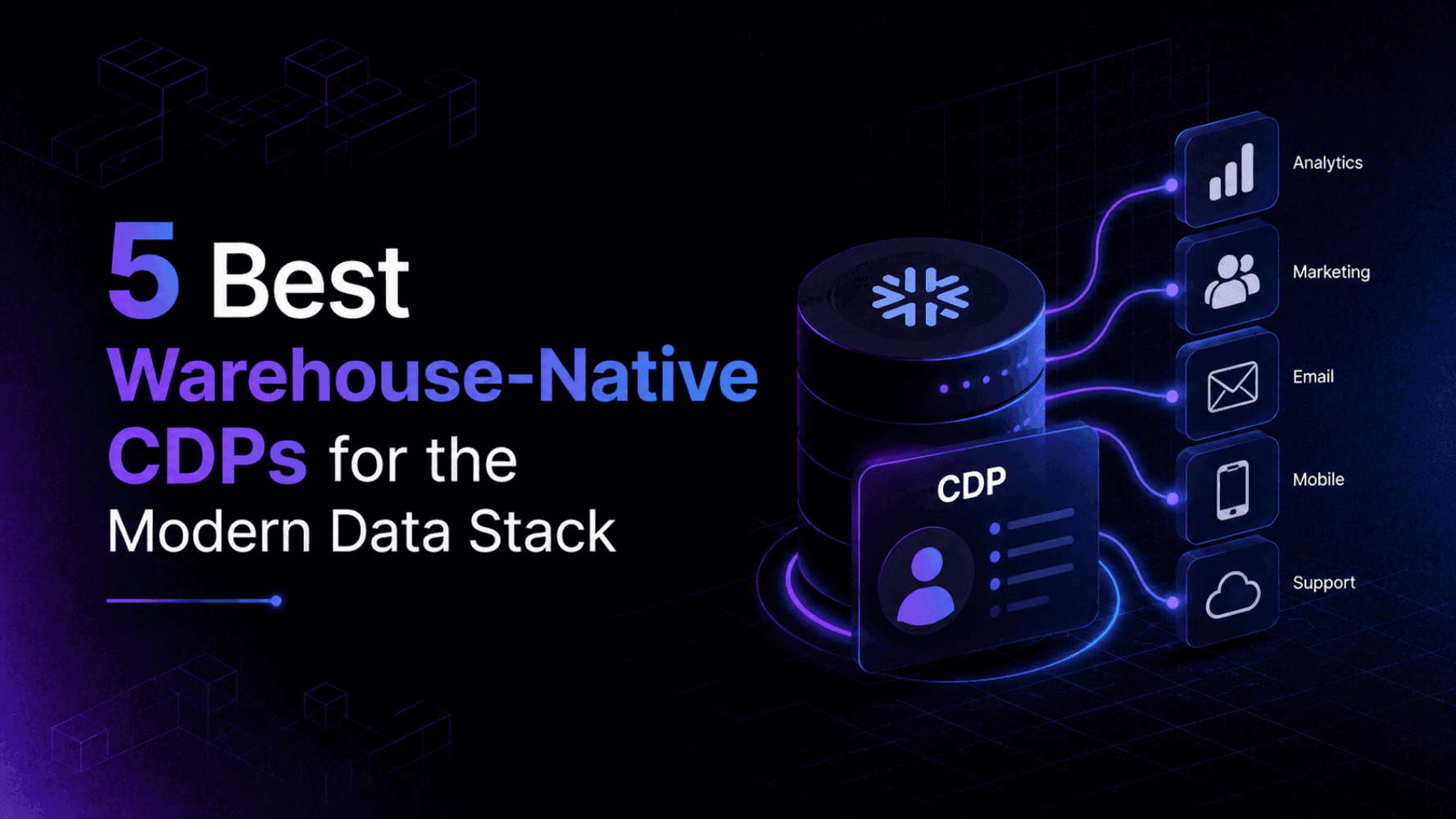
- Warehouse-native CDPs do not copy your data to a proprietary store. They query and activate it directly from Snowflake, BigQuery, Databricks, or Redshift, which means one source of truth and no sync lag.
- The five picks here cover distinct buyer profiles: Hightouch for teams that want maximum activation flexibility, Census for ops-heavy workflows, Segment Unify for teams already on Twilio Segment, RudderStack for open-source-first engineering orgs, and GrowthLoop for enterprise media and loyalty use cases.
- Pricing transparency varies sharply. Hightouch and Census publish tiered plans. RudderStack has an open-source tier. Segment and GrowthLoop are quote-based at scale.
- The biggest hidden cost is not licensing. It is compute. Running complex audience queries directly against your warehouse at high frequency will show up in your Snowflake or BigQuery bill before it shows up in your CDP invoice.
- Teams comparing these tools against traditional CDPs like Salesforce Data Cloud or mParticle should read the full CDP category guide covering B2B team requirements first.
The five strongest warehouse-native CDPs are Hightouch, Census, Segment Unify, RudderStack, and GrowthLoop. Each queries or syncs audience data directly from a cloud data warehouse rather than maintaining a separate data store. Hightouch leads on activation breadth and AI-powered segmentation. Census leads on reverse ETL workflow depth. RudderStack is the only fully open-source option with a free self-hosted tier. Segment Unify suits teams already invested in the Twilio Segment event pipeline. GrowthLoop targets enterprise teams with complex campaign orchestration needs.
Why do warehouse-native CDPs work differently than traditional CDPs?
A traditional CDP ingests data from your sources, copies it into its own proprietary store, builds profiles there, and pushes segments to destinations. You end up with three versions of your customer data: your warehouse, your CDP, and whatever the destination system holds. Reconciling them is a recurring headache.
A warehouse-native CDP inverts this. Your warehouse remains the system of record. The CDP layer sits on top, reading from tables you already own and writing activation payloads back out to Salesforce, Braze, Google Ads, or wherever the campaign runs. There is no proprietary copy of your data. Identity resolution, trait computation, and audience logic all run against the same tables your data team uses for reporting.
The practical difference matters for B2B and mid-market teams in particular. When a sales rep changes an account status in the CRM, a warehouse-native CDP picks that change up in the next warehouse sync, not after a 24-hour batch export to a third-party store. That tighter feedback loop is why demand-gen and RevOps teams at companies with mature data stacks increasingly prefer warehouse-first architecture.
What is the AboutMartech Warehouse-Fit Test for evaluating these tools?
Before comparing vendors, apply this four-part evaluation to your own stack. We call it the AboutMartech Warehouse-Fit Test, and it filters out the noise faster than any feature checklist.
- Warehouse compatibility. Does the CDP support your specific warehouse dialect natively? Snowflake, BigQuery, Databricks, and Redshift each have performance and syntax quirks. A tool that routes queries through a generic JDBC layer will be slower and less reliable than one with a native connector.
- Identity resolution model. Does the tool do deterministic matching, probabilistic matching, or both? Deterministic resolution joins known identifiers (email, user ID) across tables. Probabilistic resolution infers links from behavioral signals. Most B2B teams need deterministic matching across account and contact records. Probabilistic matching matters more for anonymous-to-known consumer paths.
- Activation surface. Count the destinations the CDP can sync to natively versus through a generic webhook. A CDP with 200 native connectors but none for your specific ad platform or MAP is still a blocker. Check the connector catalog against your actual destination list before shortlisting.
- Compute cost model. Understand whether the CDP bills on rows synced, destinations used, MAUs, or a flat platform fee, then model what your bill looks like at 2x current volume. Some warehouse-native tools trigger warehouse compute on every audience refresh, which can double your Snowflake spend if you have dozens of live audiences refreshing hourly.
Run all four checks before requesting a vendor evaluation. Vendors will not volunteer the compute cost problem unless you ask directly.
Which five warehouse-native CDPs are worth evaluating?
| Tool | Best for | Warehouse support | Identity resolution | Pricing model | Open source |
|---|---|---|---|---|---|
| Hightouch | Broad activation + AI audiences | Snowflake, BigQuery, Databricks, Redshift, 10+ others | Deterministic + probabilistic | Free tier; paid plans from $350/mo (public pricing page) | No |
| Census | Ops-heavy reverse ETL workflows | Snowflake, BigQuery, Databricks, Redshift, Postgres | Deterministic | Free tier; paid plans from $500/mo (public pricing page) | No |
| Segment Unify | Teams already on Twilio Segment | BigQuery, Snowflake, Redshift (via Segment warehouses) | Deterministic (ID graph) | Quote-based at Unify tier | No |
| RudderStack | Engineering-first, open-source orgs | Snowflake, BigQuery, Databricks, Redshift, ClickHouse | Deterministic | Free self-hosted; cloud plans from $750/mo (public pricing page) | Yes (core pipeline) |
| GrowthLoop | Enterprise campaign orchestration | BigQuery, Snowflake, Databricks | Deterministic | Quote-based | No |
Hightouch
Hightouch started as a reverse ETL tool and has since built a full composable CDP layer on top. Its core strength is activation breadth: the platform advertises over 200 native destination connectors covering ad networks, CRMs, MAPs, customer success platforms, and data warehouses. For teams that need to sync warehouse-defined audiences to Google Ads Customer Match, Meta Custom Audiences, Salesforce, and Braze in the same workflow, Hightouch covers all four natively.
The AI Audiences feature, added in 2023, lets marketers describe a target audience in plain language and have the system translate that into SQL against the warehouse schema. This is genuinely useful for marketing teams that do not have a data analyst available for every segment build. The underlying model requires you to map your schema once during setup, after which it can generate reasonably accurate queries for standard use cases.
Hightouch’s free tier covers one destination and basic syncs, making it a low-risk starting point for teams still building the business case. Paid plans start at $350 per month according to their public pricing page, though production use cases with multiple destinations and high-frequency syncs will land on higher tiers. The compute cost caveat applies here: Hightouch triggers warehouse queries on your infrastructure, so model your Snowflake or BigQuery costs separately.
Teams looking for a broader picture of how reverse ETL fits this architecture should also review the comparison of reverse ETL tools for warehouse data activation, which covers several of these vendors in more depth on the pipeline side.
Census
Census is the other major reverse ETL vendor that has expanded into composable CDP territory. Its differentiation relative to Hightouch sits in workflow depth rather than AI features. Census has invested heavily in data observability within the sync layer, including row-level sync status, automatic error detection on failed records, and alerting when sync rates deviate from baseline. For RevOps and marketing-ops teams that care about whether the right 12,000 records actually landed in Salesforce, not just whether the sync job reported success, that observability layer matters.
Census also introduced Audience Hub, a no-code audience builder that sits on top of your warehouse data. It is less flexible than writing SQL directly but significantly faster for recurring use cases like churned-user win-back lists or product-qualified lead scoring segments. The tradeoff is that Audience Hub is only as powerful as the data model underneath it. Teams with clean dbt models will get full value. Teams with inconsistent naming conventions will spend time cleaning before they can build.
Paid plans start at $500 per month per Census’s public pricing page. Census does not publish a full pricing grid for enterprise tiers; those are quote-based. The free tier allows up to one source and one destination with limited sync frequency, which is enough to validate a use case but not for production traffic.
Segment Unify (Twilio Segment)
Twilio Segment has been the dominant event collection and routing layer in the modern data stack for years. Segment Unify is the identity graph and profile layer built on top of that pipeline, and it is designed specifically for teams that want a warehouse-native profile store without abandoning their existing Segment event data.
The identity graph in Unify is deterministic, stitching profiles across known identifiers as users move between anonymous sessions and logged-in states. For B2B teams tracking both individual contacts and account-level behavior, this matters: a contact who downloads a whitepaper anonymously and then completes a known-identity action can be linked in the profile without manual data engineering work.
The honest caveat is that Unify’s value is proportional to your existing Segment investment. Teams already paying for Segment’s data pipelines get a meaningful upgrade by adding Unify. Teams evaluating from scratch will find Hightouch or Census easier to deploy on an existing warehouse without committing to the broader Segment stack. Unify pricing is not publicly listed at the enterprise tier; Twilio quotes it based on monthly tracked users and destinations.
It is also worth noting where Segment Unify sits relative to the traditional CDP alternatives covered in the full B2B CDP guide. Unify is warehouse-native in that it can sync profiles to and from a warehouse, but its event pipeline and profile store still run through Twilio’s infrastructure. That distinguishes it from purely warehouse-native tools like Hightouch or Census, where your warehouse is the only data store. For teams comparing Unify against Salesforce Data Cloud, the relevant difference is that Data Cloud handles data modeling and identity resolution inside Salesforce’s own infrastructure, beneficial if the team lacks data engineering resources, but at the cost of a proprietary data layer your warehouse does not control.
RudderStack
RudderStack is the only fully open-source option in this list. The core event pipeline and warehouse sync functionality are available as a self-hosted deployment on GitHub, with a managed cloud version for teams that do not want to run infrastructure. This matters for two specific buyer types: companies in regulated industries (healthcare, fintech) where sending customer data through a vendor’s infrastructure requires legal review, and engineering teams that want full control over the data pipeline without a SaaS dependency.
The warehouse-native CDP feature set in RudderStack, called Profiles, builds identity graphs and computes user traits directly in the warehouse. It uses a SQL-based trait computation model, meaning your data team writes the logic and RudderStack executes it against your warehouse on a schedule. This is more work than Hightouch’s AI Audiences or Census’s Audience Hub, but the output is more auditable and easier to version-control in a dbt project.
Cloud plans start at $750 per month per RudderStack’s public pricing page. Self-hosted is free but requires infrastructure management. For teams evaluating a full customer data platform suite including event collection, not just activation, RudderStack competes more directly with Segment than with Hightouch or Census.
GrowthLoop
GrowthLoop occupies a different part of the market. Built originally for enterprise media and loyalty teams running on Google BigQuery, it has expanded to support Snowflake and Databricks. The platform positions itself as an audience management and campaign orchestration layer rather than a pure reverse ETL or CDP infrastructure play.
Where GrowthLoop stands out is in its closed-loop measurement model. After an audience segment is exported to a paid media channel, GrowthLoop can ingest the campaign performance data back into the warehouse and show lift against a holdout group. For enterprise marketing teams that need to prove incremental return on media spend directly from warehouse data, this feedback loop is a differentiator the other vendors in this list do not match natively.
The tradeoff is fit. GrowthLoop is not the right call for a 50-person SaaS company trying to sync Salesforce and Braze from their warehouse. Its complexity and quote-based pricing reflect an enterprise buyer profile: large marketing teams at companies with existing BigQuery investments, typically in retail, financial services, or media. Teams outside that profile will find Hightouch or Census easier to implement and cheaper to run.
How does a warehouse-native CDP compare to a traditional CDP on total cost?
The licensing cost of a warehouse-native CDP is often lower than a traditional enterprise CDP because you are not paying for data storage or proprietary profiling infrastructure. But the total cost calculation includes warehouse compute, data engineering time to build and maintain the underlying data models, and connector maintenance as destination APIs change.
As a hypothetical illustration: a mid-market B2B SaaS company running 500,000 customer records in Snowflake, syncing six audiences daily to Salesforce, Marketo, and Google Ads, with a data team of three. In this scenario, warehouse-native CDP licensing might run $1,500 to $3,000 per month. The incremental Snowflake compute for daily audience refreshes on 500K rows is relatively low. But if that team does not already have clean dbt models for contact, account, and product-usage data, the engineering work to build them before the CDP can run properly could take four to eight weeks of a data engineer’s time. That setup cost is invisible in the CDP invoice but very visible in the engineering roadmap.
Traditional CDPs like Salesforce Data Cloud or mParticle handle more of that modeling work inside their own platform, which is why large enterprises without strong internal data teams still choose them despite higher licensing costs. Warehouse-native CDPs are a better fit when the data team capacity exists to own the underlying models.
What should marketing ops teams check before buying a composable CDP?
Beyond the Warehouse-Fit Test above, three pre-purchase checks catch the problems that demos do not surface.
- Schema access. Confirm the CDP can read from your specific warehouse schemas without requiring data to be moved to a staging schema it controls. Some vendors require write permissions to a specific schema, which creates a data governance conversation your IT or security team will need to sign off on.
- Connector freshness. Ask the vendor what happens when Google Ads or Meta changes its API. Who is responsible for updating the connector, and what is the typical lag between an API change and a working fix? Native connectors maintained by the vendor are more reliable than community-maintained ones, but verify this in the contract SLA, not just the sales call.
- Audience refresh limits. Some plans cap how many audiences you can run simultaneously or how frequently they refresh. A plan that looks affordable for five audiences refreshing daily becomes a bottleneck when your growth team wants 40 audiences refreshing hourly. Get the refresh rate and audience count limits in writing before signing.
Marketing operations teams evaluating the broader customer data infrastructure picture should also look at how these tools integrate with downstream customer success tooling, particularly for post-sale expansion campaigns. The breakdown of customer success platforms for B2B SaaS teams covers the destination side of several of these activation workflows.
Frequently asked questions about warehouse-native CDPs
What is a warehouse-native CDP?
A warehouse-native CDP is a customer data platform that treats a cloud data warehouse (Snowflake, BigQuery, Databricks, or Redshift) as the primary data store rather than copying data into a proprietary CDP database. It reads customer profile data, computes audience segments, and activates them to marketing and sales destinations directly from the warehouse. This architecture eliminates data duplication and gives marketing teams access to the same data their analytics and engineering teams use.
What is the difference between a composable CDP and a warehouse-native CDP?
The terms are used interchangeably in most vendor marketing, but they have a nuanced difference. A composable CDP refers to a modular architecture where you assemble CDP capabilities (identity resolution, audience building, activation) from separate best-of-breed tools rather than buying an all-in-one platform. A warehouse-native CDP specifically means the data layer lives in your warehouse. Most composable CDPs are warehouse-native, but not every warehouse-native tool is fully composable. Hightouch and Census are both composable and warehouse-native. Segment Unify is warehouse-native but ties activation more tightly to the Segment stack.
Do I need a reverse ETL tool if I have a warehouse-native CDP?
Not necessarily as a separate purchase. Most warehouse-native CDPs include reverse ETL functionality as part of their activation layer. Hightouch and Census both started as reverse ETL tools before adding CDP features. If you already have a dedicated reverse ETL tool, a warehouse-native CDP adds the audience-building and identity resolution layer on top. For teams starting from scratch, the warehouse-native CDP typically handles both. The guide to reverse ETL tools for warehouse data activation covers the distinction in more detail.
Which warehouse-native CDP is best for a small team without a dedicated data engineer?
Hightouch is the most accessible for teams without deep SQL expertise, primarily because its AI Audiences feature lets marketers describe segments in plain language. Census’s Audience Hub is similarly approachable for standard use cases. RudderStack requires the most technical setup and is better suited for engineering-led teams. GrowthLoop and Segment Unify both assume some level of internal data infrastructure investment before deployment. If you have no existing warehouse data models, factor in setup time regardless of which tool you choose.
Can a warehouse-native CDP replace Salesforce Data Cloud or mParticle?
For teams with strong internal data engineering capacity, yes. Salesforce Data Cloud and mParticle handle more of the data modeling and identity resolution work internally, which is why large enterprises with limited data teams choose them. A warehouse-native CDP requires you to own those underlying models in your warehouse. Teams that already run dbt or have clean, well-documented warehouse schemas will find a warehouse-native CDP delivers comparable output at lower cost. Teams without that foundation will experience a longer time-to-value regardless of which composable tool they pick.
How do I avoid unexpected warehouse compute costs with a warehouse-native CDP?
Ask every vendor exactly when they trigger warehouse queries: on audience save, on a fixed schedule, or on-demand. Then calculate how many audiences you expect to run, at what refresh frequency, against how many rows. Request a query execution sample from the vendor and run it against your warehouse in an explain plan to estimate compute cost before you commit. Build a 2x headroom buffer into that estimate for growth. Some vendors, including Hightouch, offer incremental sync options that only process changed rows, which reduces compute significantly for large tables.
Is RudderStack truly open source?
RudderStack’s core data pipeline, including event collection, transformation, and routing, is open source and available under an open-source license on GitHub. The Profiles CDP feature and some enterprise connectors are available only in the managed cloud version. Self-hosting the open-source core is free but requires you to provision and maintain infrastructure. For regulated industries where vendor data access is a compliance concern, the self-hosted deployment eliminates the vendor from the data flow entirely, which is its primary advantage over the other tools in this list.
Which warehouse-native CDP should you actually buy?
Buy Hightouch if your primary need is activating warehouse audiences across a large number of destinations and you want marketing teams to build segments without writing SQL. Buy Census if your RevOps team is running complex sync workflows and needs row-level observability on what actually landed in Salesforce or Marketo. Buy RudderStack if you are in a regulated industry, have engineering resources to own the infrastructure, and need open-source auditability. Add Segment Unify if you are already paying for Twilio Segment’s event pipeline and want identity resolution built on top of the data you are already collecting. Consider GrowthLoop only if you are an enterprise team with a BigQuery-heavy stack and a specific need for closed-loop media measurement.
The category is still maturing. Hightouch and Census have both expanded their feature sets significantly over the past two years, and the line between a warehouse-native CDP and a sophisticated reverse ETL tool is genuinely blurry. Teams that feel they need to understand the full CDP category before committing to a warehouse-native architecture can use the B2B CDP comparison covering both traditional and composable options as a reference point.
The decision ultimately comes down to one question the Warehouse-Fit Test is designed to answer: does your team own clean, documented data models in your warehouse today? If yes, a warehouse-native CDP will work. If not, no vendor in this list will paper over that gap, and the right first investment is in the data foundation, not the activation layer on top of it.