- Client-side A/B testing tools inject JavaScript after the page loads, creating a flicker window that corrupts results on fast sites. Server-side testing eliminates that entirely but requires engineering access.
- Most teams conflate statistical significance with correctness. The testing method (frequentist vs Bayesian vs sequential) determines whether a “winner” is real or a false positive.
- Feature flag platforms and A/B testing platforms overlap more than vendors admit. The right choice depends on whether decisions live in marketing or engineering.
- Optimizely, VWO, and Kameleoon dominate sponsored comparison content. This list deliberately excludes all three to surface the tools that actually compete on merit.
- The cheapest setup for low-traffic sites is not a dedicated platform at all. Google Optimize’s death left a gap that Statsig and GrowthBook now fill at near-zero cost.
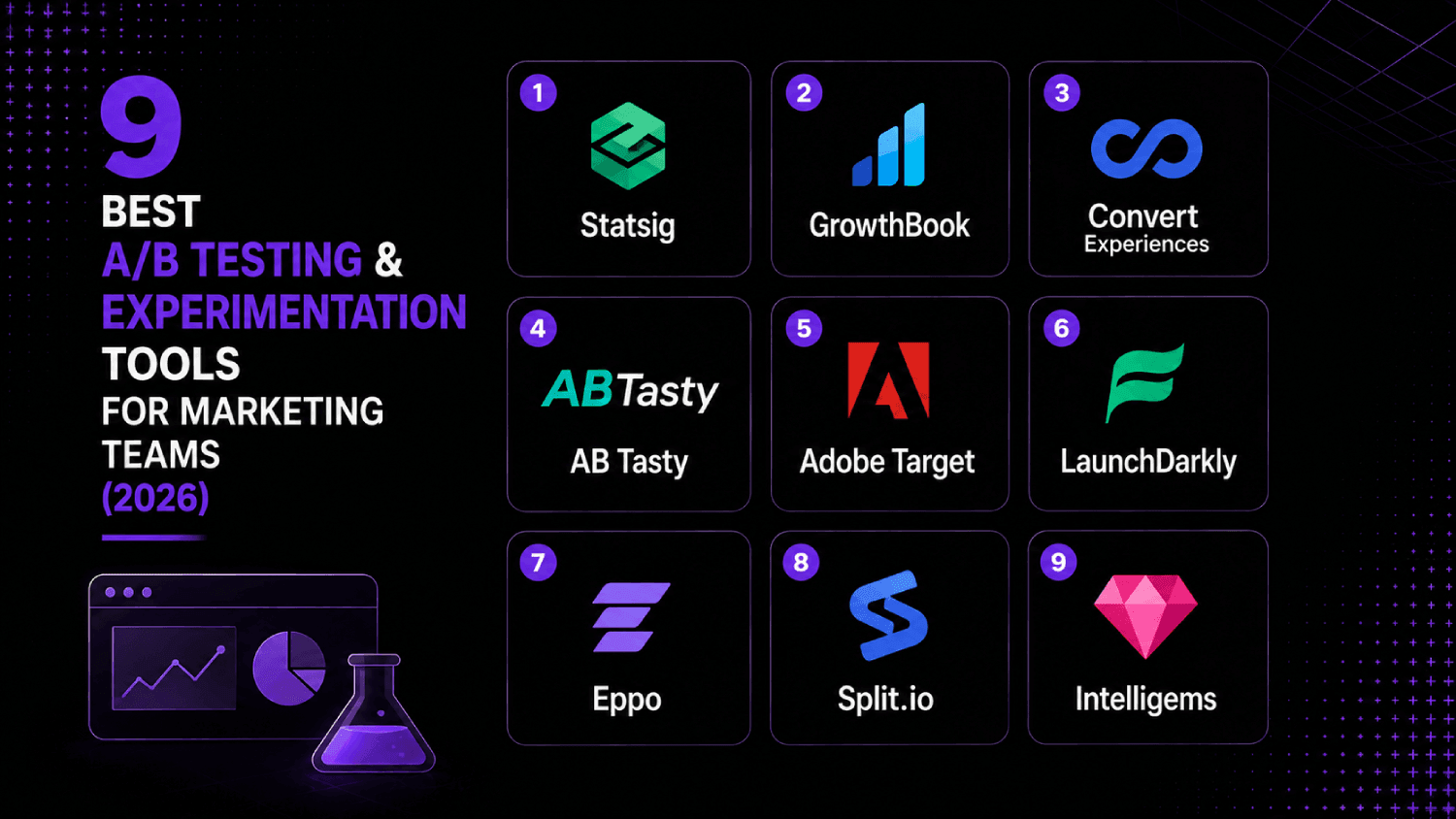
The best A/B testing tools for marketing teams in 2026 are Statsig, GrowthBook, Convert Experiences, AB Tasty, Adobe Target, LaunchDarkly, Eppo, Split.io, and Intelligems. Each differs on statistical method, delivery model, and who in the organization controls the experiment. Statsig and GrowthBook are the strongest options for teams with engineering support and limited budgets. Convert and AB Tasty are the most capable for marketers running visual experiments without developer involvement. Adobe Target belongs in enterprise stacks already committed to the Adobe suite.
Why Most Marketers Are Running A/B Tests Wrong
The default mental model for A/B testing goes like this: install a JavaScript snippet, drag elements around in a visual editor, wait for green, declare a winner. That model produces a lot of confident decisions based on unreliable data.
Three things go wrong. First, client-side tools load after the browser renders the page, so the original version flashes before the variant appears. That flicker changes user behavior, particularly on fast sites or for users with ad blockers. Second, most teams peek at results before reaching the planned sample size and stop the test the moment significance hits 95%, a practice called “peeking” that inflates false positive rates dramatically. Third, the phrase “statistically significant” tells you almost nothing without knowing the statistical method, the minimum detectable effect the test was powered for, or whether the platform uses frequentist p-values, Bayesian credible intervals, or sequential testing.
The statistical method is not a footnote. It changes which results you can trust. Frequentist methods require you to pre-commit to a sample size and not peek. Bayesian methods let you stop early with interpretable probability statements. Sequential testing (the method used by platforms like Statsig and Eppo) is designed specifically for continuous monitoring without inflating error rates. If your platform does not tell you which method it uses, that is a red flag, not a minor omission.
Understanding how experiments connect to your broader analytics picture matters too. The relationship between testing tools and marketing analytics infrastructure is where most teams have gaps: they run tests in isolation and never connect experiment results to revenue attribution.
How to Choose the Right A/B Testing Tool: The AboutMartech Delivery-Method-First Test
Most buyers evaluate testing tools by feature checklist: visual editor, multivariate support, integrations. A more useful starting filter is delivery method, because it determines what you can test, who can run the test, and how trustworthy your results will be.
The AboutMartech Delivery-Method-First Test runs four sequential checks before any feature comparison:
- Where does the variation render? Client-side tools modify the DOM after page load. Server-side tools serve the correct variation from the origin, before anything reaches the browser. Server-side testing is more reliable but requires code deployment access.
- Who owns experiment creation? If the answer is a marketer using a visual editor, you need a client-side tool with a solid WYSIWYG layer. If the answer is an engineer or data scientist, a feature flag or server-side platform is faster and less fragile.
- What statistical method does the platform use by default? Frequentist with fixed-horizon requires pre-planned sample sizes. Bayesian or sequential testing supports continuous monitoring. Neither is universally better, but you need to know which one you are running.
- Where do results need to go? If experiment data needs to flow into your data warehouse for analysis alongside revenue, look for platforms with native warehouse export (Statsig, Eppo, GrowthBook) rather than walled-garden dashboards.
Run those four checks before opening any pricing page. The filter alone eliminates half the shortlist for most teams.
The 9 Best A/B Testing and Experimentation Tools Compared
| Tool | Delivery | Stats Method | Visual Editor | Feature Flags | Pricing Model | Best For |
|---|---|---|---|---|---|---|
| Statsig | Server-side / client SDK | Sequential (CUPED) | No | Yes | Free tier; usage-based paid | Product and growth teams with eng support |
| GrowthBook | Server-side / client SDK | Bayesian or frequentist | Basic (visual layer in progress) | Yes | Free open-source; cloud from $0 | Data-stack-native teams on tight budgets |
| Convert Experiences | Client-side | Frequentist + Bayesian | Yes | No | Starts ~$699/mo (public pricing) | Marketer-run CRO on existing sites |
| AB Tasty | Client-side + server-side | Frequentist + Bayesian | Yes | Yes (Flagship IO) | Quote-based | Mid-market teams needing both visual CRO and feature flags |
| Adobe Target | Client-side + server-side | Frequentist (Bayesian option) | Yes | Yes | Quote-based (Adobe DX suite) | Enterprise teams in Adobe Experience Cloud |
| LaunchDarkly | Server-side / client SDK | Frequentist (Experimentation add-on) | No | Yes (primary product) | Usage-based; experimentation add-on priced separately | Engineering-led feature release and rollout |
| Eppo | Server-side / warehouse-native | Sequential (CUPED) | No | Yes | Quote-based | Data teams running warehouse-native experimentation |
| Split.io | Server-side / client SDK | Frequentist | No | Yes | Quote-based; free tier available | Engineering-led teams needing feature flags with basic experiment tracking |
| Intelligems | Client-side (Shopify-native) | Frequentist + Bayesian | Yes (price testing focused) | No | Usage-based; starts ~$100/mo | Shopify DTC brands testing price and shipping |
Statsig: The Strongest Free Starting Point for Teams With Engineering Access
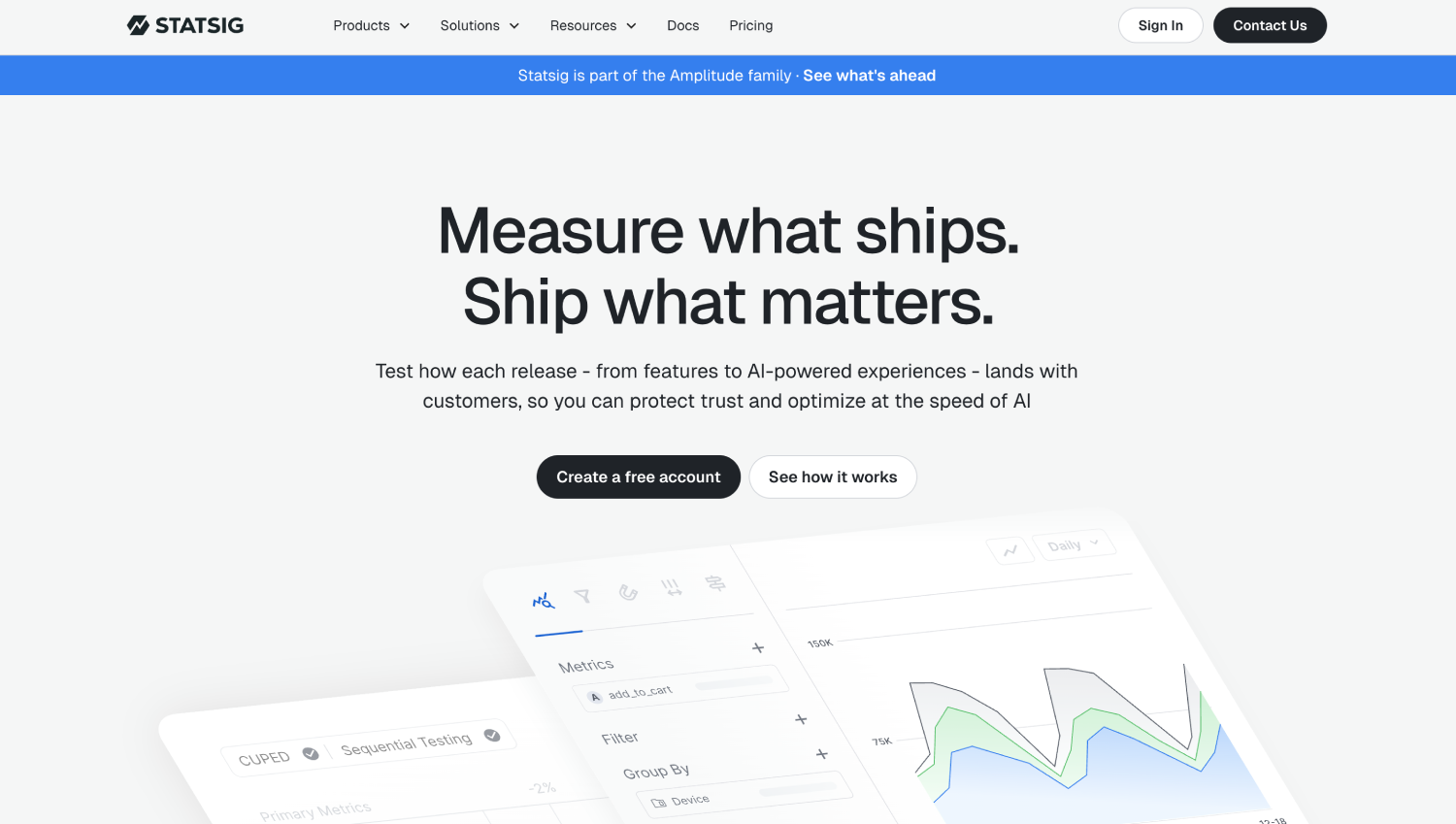
Statsig was built by former Facebook engineers and it shows in the statistical rigor. The platform uses sequential testing with CUPED (Controlled-experiment Using Pre-Experiment Data) variance reduction by default, which means tests reach significance faster with smaller sample sizes. That matters enormously for teams that do not have Amazon-scale traffic.
The free tier is genuinely usable, not crippled. According to Statsig’s public pricing page, the free plan supports up to 1 million metered exposures per month, unlimited feature flags, and access to the core experiment dashboard. The paid plans scale on usage. This makes Statsig the most compelling answer to the “cheapest A/B testing platform for a small site” query, as long as the team has an engineer available to instrument the SDK.
There is no visual editor. Statsig is built for code-instrumented experiments, and marketers who need to run tests without a developer will find it frustrating. The platform shines when product and growth teams want to run hundreds of experiments simultaneously, understand interaction effects, and pipe results directly into a data warehouse for analysis alongside business metrics.
GrowthBook: The Open-Source Alternative That Connects to Your Warehouse
GrowthBook is open-source, warehouse-native, and free to self-host. The cloud version starts at no cost for small teams. That combination made it the natural successor when Google Optimize shut down in 2023 and left thousands of teams without a platform.
What distinguishes GrowthBook from every other tool on this list is its data model. Rather than storing event data in a proprietary database, GrowthBook connects directly to your data warehouse (BigQuery, Snowflake, Redshift, Databricks, and others) and runs analysis queries against your existing tables. This means experiment results sit alongside your revenue data, customer lifetime value calculations, and attribution models from day one, without any export pipeline.
Teams that have already invested in a warehouse-native data stack will find GrowthBook fits naturally. Teams that have no data warehouse yet will find the setup friction higher than a plug-and-play client-side tool. GrowthBook supports both Bayesian and frequentist methods, and the documentation is unusually good about explaining the statistical implications of each choice.
Convert Experiences: The Best Marketer-Operated Client-Side Tool
Convert Experiences is the strongest option for marketing teams that need to run visual A/B tests without engineering involvement. The visual editor handles multi-page experiments, URL targeting, and audience segmentation without requiring code changes, and the platform has a clean interface that non-technical users can operate in a day.
Convert’s public pricing starts at approximately $699 per month for the Kickstart plan, which covers up to 50,000 tested visitors. That is not cheap for an SMB, but it is transparent: Convert publishes its pricing tiers directly, which is not common in this category. The platform supports both frequentist and Bayesian statistical methods, lets users set minimum detectable effects before launching a test, and includes a built-in significance calculator that surfaces sample size requirements upfront.
Convert also takes a firm position on data privacy. The platform processes no personal data by default and is designed for GDPR-compliant deployments, which matters for teams running experiments on European traffic. For a marketer who does not want to involve a developer for every test and does not have enterprise budget, Convert is the most complete client-side option.
AB Tasty: When You Need Visual CRO and Feature Flags Under One Roof
AB Tasty occupies a specific position: it is one of the few platforms that handles both marketer-operated visual A/B testing and developer-operated feature flag management without requiring two separate contracts. The feature flag product is called Flagship IO and runs as a distinct module within the same platform.
Pricing is quote-based and varies significantly by traffic volume and features enabled. AB Tasty does not publish rates publicly, which is frustrating for teams trying to build a budget without a sales call. The platform targets mid-market and enterprise buyers, and the minimum contract is typically in the range that makes it uncompetitive for early-stage companies.
The platform supports server-side testing, client-side testing, and mobile app experiments through the same interface, which reduces the coordination overhead for teams running experiments across multiple surfaces. The AI-generated copy suggestion feature inside the editor is a minor convenience, not a meaningful differentiator. The core value is consolidation across channels without needing a separate LaunchDarkly or Split contract.
Adobe Target: Enterprise Personalization Inside the Adobe Stack
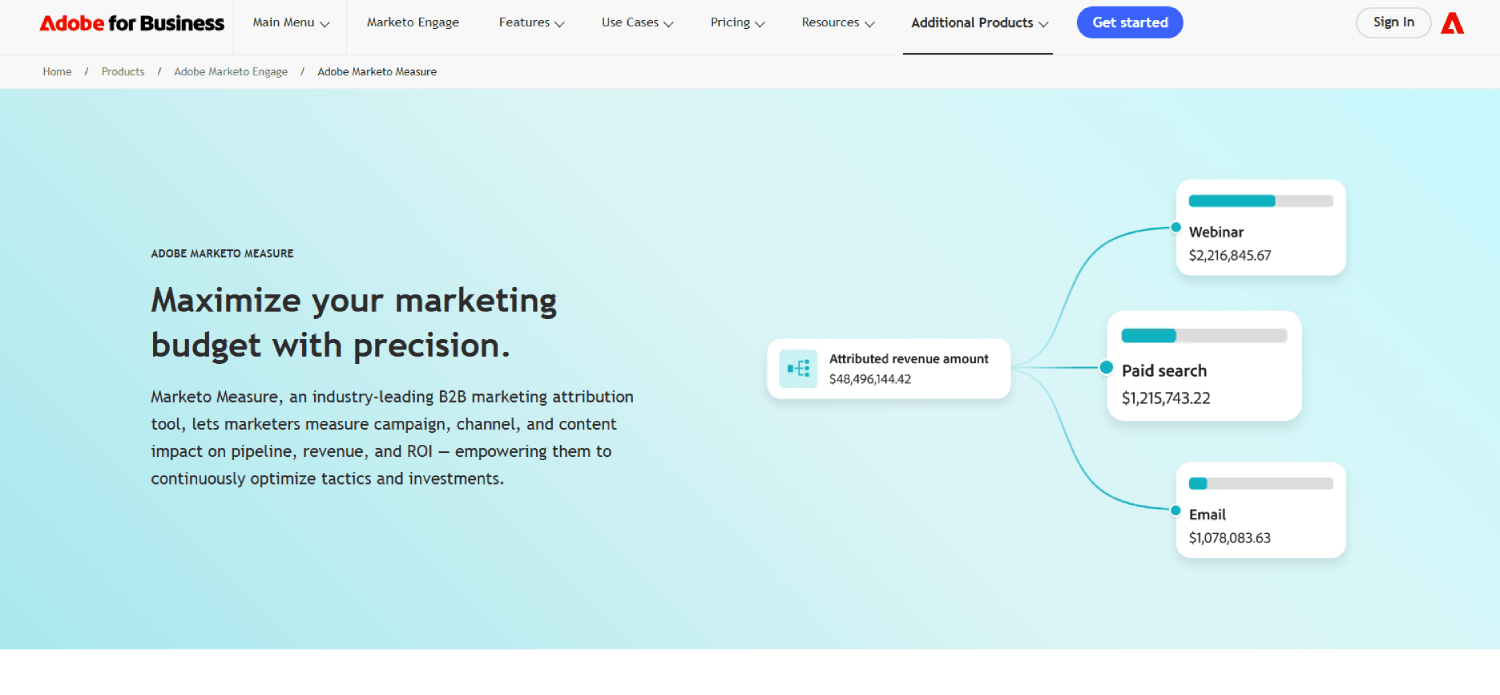
Adobe Target is not a standalone A/B testing tool. It is a personalization and experimentation module inside Adobe Experience Cloud, and it only makes financial sense for teams already committed to that suite. Adobe does not publish Target pricing publicly; contracts are negotiated as part of broader Adobe DX agreements.
The platform supports client-side and server-side testing, multivariate testing, automated personalization (using Adobe Sensei’s machine learning), and auto-allocate features that shift traffic to winning variants during a test. For teams already using Adobe Analytics, the integration is tight: experiment segments and analytics audiences share the same definitions, which eliminates the reconciliation problem that plagues teams stitching together separate analytics and testing tools.
For teams not in the Adobe suite, Target is expensive, difficult to implement, and architecturally over-specified for most experimentation programs. For teams that are in the suite, it is often already included in their license and worth activating before evaluating a separate experimentation platform.
LaunchDarkly: Feature Flags First, Experimentation Second
LaunchDarkly is primarily a feature management platform. Experimentation is an add-on, and it is priced separately from the core feature flag product. That ordering matters: if your primary need is controlled A/B testing on marketing copy or landing pages, LaunchDarkly is not the right starting point. If your primary need is safe, progressive feature rollouts with the ability to attach experiment measurement to those rollouts, it is one of the best options available.
The platform’s flag targeting is extremely granular. You can target by user attribute, segment, percentage rollout, or custom rules, and you can schedule flag changes without a deployment. The experiment layer uses frequentist statistics and requires the team to pre-specify metrics and sample sizes before running, which is actually good practice even if it feels restrictive.
LaunchDarkly’s pricing is usage-based and scales on seats and monthly active users exposed to flags. The vendor does not publish a clear public rate card for enterprise plans; expect a sales conversation for teams above the starter tier. For engineering-led organizations where the goal is shipping features safely and measuring their impact, LaunchDarkly has the deepest feature management capabilities on this list.
Eppo: Warehouse-Native Sequential Testing for Data Teams
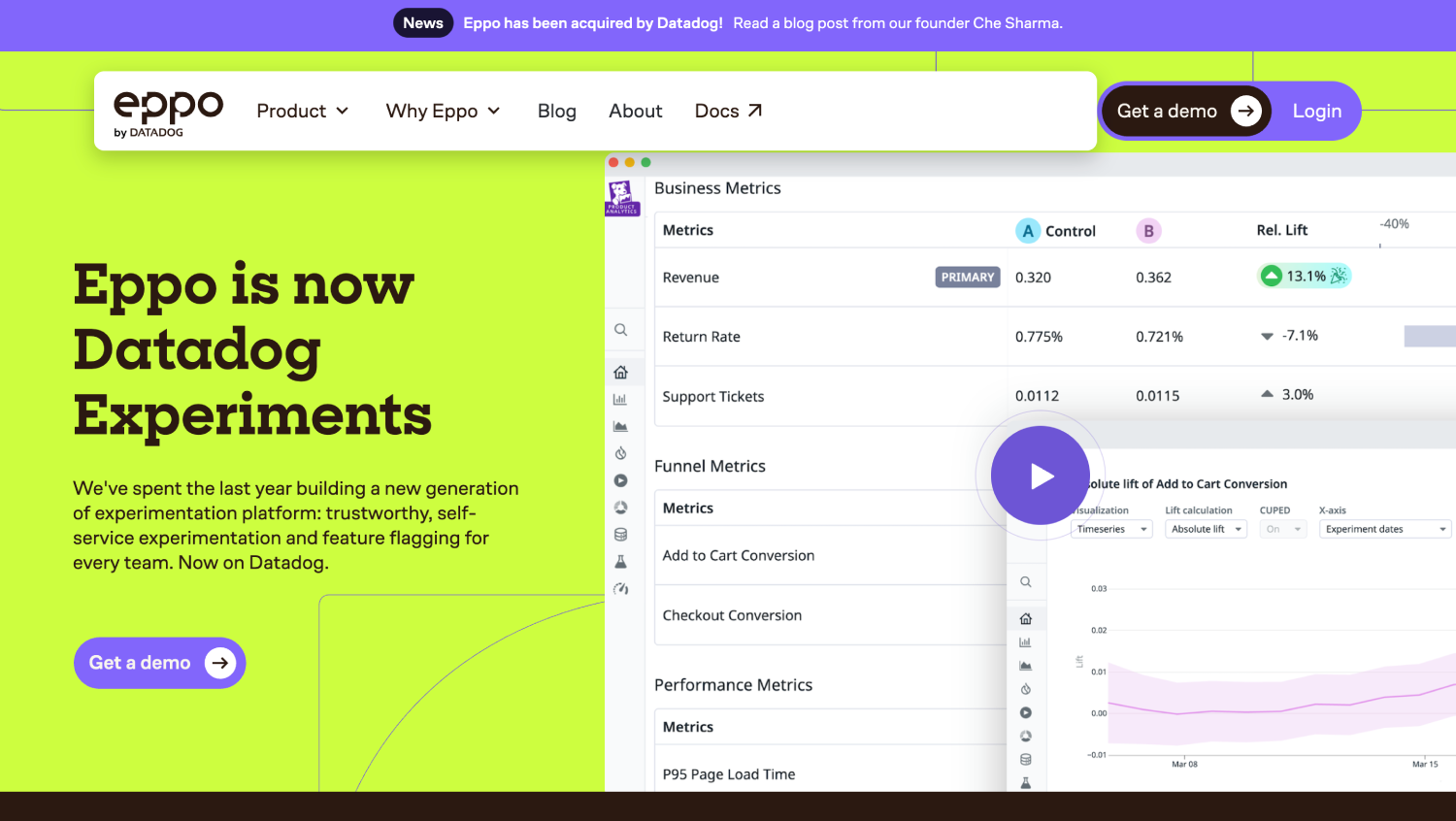
Eppo is the most statistically sophisticated platform on this list and also the most narrowly targeted. It is designed for organizations with a data warehouse, a dedicated data or analytics engineering team, and an active experimentation culture. It is not a tool for running your first A/B test.
Eppo uses sequential testing with CUPED variance reduction, which means it is safe to monitor experiment results continuously without inflating false positive rates. The platform also supports metric definitions that live directly in your warehouse’s dbt models, so the metrics used to evaluate an experiment are the same definitions used everywhere else in the business. That metric consistency is harder to achieve than it sounds. Teams with separate analytics and experimentation tools frequently discover that “conversion” means something slightly different in each system.
Pricing is quote-based. Eppo targets growth-stage and enterprise companies with dedicated data teams. For RevOps and marketing analytics leaders trying to build a rigorous experimentation program that connects directly to revenue metrics, Eppo is worth evaluating seriously. For a marketing team that wants to drag and drop a button color change, it is complete overkill.
The broader context of building that kind of measurement infrastructure is covered in the modern marketing data stack guide for RevOps teams, which covers where experimentation fits alongside attribution and analytics tooling.
Split.io: Engineering-Led Experimentation With a Generous Free Tier
Split.io (now part of Harness) is a feature flag and experimentation platform aimed at engineering teams. The free tier includes unlimited feature flags and basic experiment tracking, which makes it a reasonable starting point for small engineering teams that want feature management without an immediate budget commitment.
The experimentation layer uses frequentist statistics and is less sophisticated than Statsig or Eppo in terms of variance reduction and sequential testing support. Split’s core advantage is the depth of its flag targeting rules and the strength of its SDK library, which covers most major languages and frameworks. The integration with Harness’s CI/CD pipeline adds deployment context that pure experimentation platforms cannot match.
For marketing teams, Split is most useful when experiments need to be embedded in engineering workflows rather than operated independently. If the marketing team wants to own experiment creation end-to-end without a developer, Split is the wrong tool. If the marketing team works closely with engineering and needs experiments tied to feature releases, Split’s release management workflow is genuinely useful.
Intelligems: The Only Tool Built Specifically for Shopify Price Testing
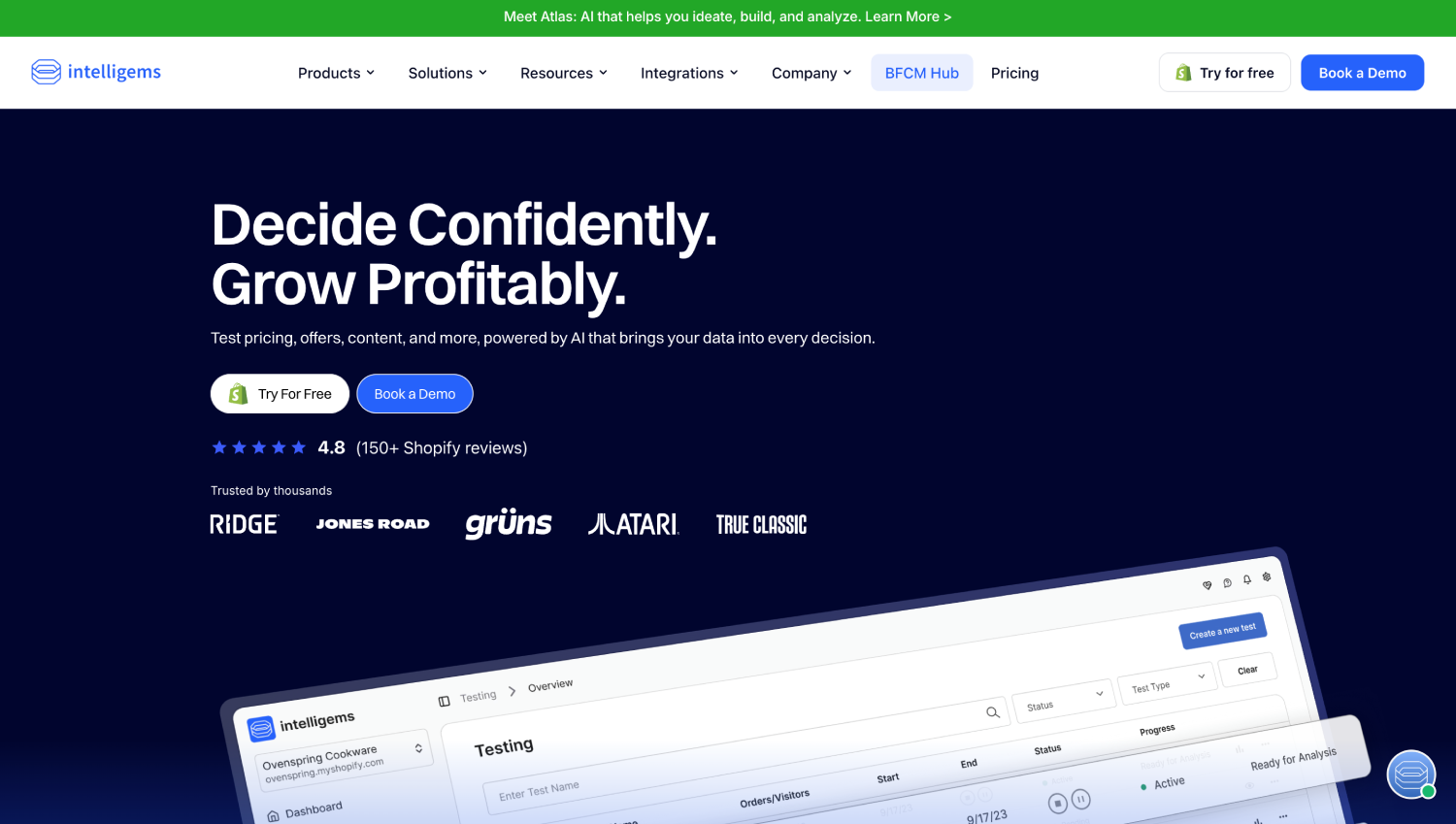
Intelligems solves a problem that general-purpose A/B testing tools handle badly: testing prices, shipping rates, and subscription offers on Shopify stores. Running price tests on a generic tool requires workarounds that often break discount logic, confuse Shopify’s native reporting, or create inconsistent experiences across checkout. Intelligems is built specifically to avoid those problems.
The platform integrates natively with Shopify and surfaces results in terms that DTC operators care about: revenue per visitor, average order value, conversion rate by price point, and margin impact. Pricing starts at approximately $100 per month for lower-traffic stores, scaling with order volume. According to the public pricing page, plans are structured around monthly orders rather than sessions, which aligns incentives better for DTC brands.
Intelligems is narrow by design. It does not test landing page copy, email subject lines, or anything outside the Shopify checkout and product experience. For a Shopify brand that primarily wants to find the right price for a product or shipping threshold, it is the most purpose-built tool available. For a brand that needs broader website experimentation, pair it with a separate client-side tool or use it only for the pricing layer.
DTC brands evaluating the full experimentation and messaging stack alongside SMS channels may also find the SMS marketing apps for Shopify stores comparison useful for understanding how testing tools fit the broader Shopify technology stack.
Do You Need a Feature Flag Tool or an A/B Testing Tool?
The boundary between feature flags and A/B testing platforms has blurred significantly. Statsig, GrowthBook, AB Tasty, LaunchDarkly, Eppo, and Split all offer both. But the origin of each product still shapes its strengths.
Feature flag platforms (LaunchDarkly, Split) are built around safe deployment: you want to ship code to production without exposing it to all users, with the ability to turn it off instantly if something breaks. Experimentation is layered on top of that deployment control. The workflow starts with engineers and flows to analysts.
A/B testing platforms (Convert, AB Tasty, Intelligems) are built around conversion rate optimization: you want to test hypotheses about user behavior without touching the codebase. The workflow starts with marketers and flows to developers only when implementation requires it.
Warehouse-native experimentation platforms (GrowthBook, Eppo) sit in a third category. They care primarily about statistical rigor and metric consistency, and they assume you have both engineering and data infrastructure available. The workflow starts with the experiment design and flows simultaneously to engineers (for instrumentation) and analysts (for metric definition).
Most teams with fewer than 50 employees need one of these categories clearly, not all three. Teams above 200 employees frequently end up with two: a feature flag tool for engineering and a client-side tool for marketing, with growing pressure to consolidate them.
Server-Side vs Client-Side A/B Testing: Which Is Actually Better?
Server-side testing is more reliable. That is not a debatable point. When the server decides which variation to serve before sending any HTML to the browser, there is no flicker, no race condition between the page render and the JavaScript injection, and no exposure to ad blockers that prevent client-side scripts from loading. The experiment is cleaner by construction.
The trade-off is implementation cost. Server-side testing requires a code change, a deployment, and ongoing SDK maintenance. A marketer cannot spin up a server-side test without engineering involvement. For teams running dozens of tests per quarter on landing pages and email click destinations, that dependency creates a backlog that kills experimentation velocity.
Client-side testing is faster to deploy but carries real risks on high-performance sites. The flicker effect, technically called FOOC (Flash of Original Content), can reduce measured conversion rates on variants even when the variant is genuinely better. Some client-side tools mitigate this with anti-flicker scripts, but those scripts introduce their own latency. On a site where page load speed directly affects conversion, the anti-flicker medicine can be as harmful as the flicker disease.
The practical answer for most marketing teams: use client-side testing for above-the-fold landing page changes where flicker risk is manageable and iteration speed matters, and push for server-side testing on anything that touches checkout, personalization, or pricing. That split maps naturally to the tool split that emerges at many mid-market companies: a visual editor tool for marketing and a feature flag or server-side tool for engineering.
Which Experimentation Tool Has Proper Statistics?
The tools that use sequential testing by default are Statsig and Eppo. Sequential testing is the most practically correct method for teams that want to monitor results continuously without pre-committing to a fixed sample size. Both also apply CUPED variance reduction, which uses pre-experiment data to reduce the noise in measurements and shortens the time to reach valid conclusions.
GrowthBook gives users a choice between Bayesian and frequentist methods, with clear documentation on what each implies for how you interpret results. Bayesian methods produce probability statements (“there is an 87% chance the variant is better”) that are more intuitive for non-statisticians but require different decisions about when to stop a test.
Convert Experiences and AB Tasty both support frequentist and Bayesian methods, though the frequentist implementation in most client-side tools does not prevent peeking at the dashboard level. You can still see results update in real time and be tempted to stop early. The statistical method is only as good as the discipline used to apply it.
Adobe Target includes an “Auto-Allocate” feature that uses multi-armed bandit algorithms to shift traffic toward winning variants during the test. This is distinct from pure A/B testing: it optimizes for near-term conversions rather than measuring a clean causal effect. That trade-off is worth understanding before treating auto-allocate results as equivalent to a properly powered experiment.
Statistics and Setup Quick Reference
| Tool | Default Stats Method | Supports Sequential Testing | Variance Reduction (CUPED) | Can Prevent Peeking | Min Setup Time (with eng support) |
|---|---|---|---|---|---|
| Statsig | Sequential | Yes | Yes | Yes | 1-2 days |
| GrowthBook | Bayesian (configurable) | Partial | No (native) | Configurable | 1-3 days (self-hosted) |
| Convert Experiences | Frequentist + Bayesian | No | No | No | Under 1 hour (snippet install) |
| AB Tasty | Frequentist + Bayesian | No | No | No | Under 1 hour (snippet install) |
| Adobe Target | Frequentist (Bayesian option) | No | No | No | 1-2 weeks (Adobe impl.) |
| LaunchDarkly | Frequentist | No | No | Configurable | 1-3 days |
| Eppo | Sequential | Yes | Yes | Yes | 1-2 weeks (warehouse setup) |
| Split.io | Frequentist | No | No | No | 1-2 days |
| Intelligems | Frequentist + Bayesian | No | No | No | Under 1 hour (Shopify install) |
What Does Proper Multivariate Testing Actually Require?
Multivariate testing (MVT) tests multiple elements simultaneously to identify the best combination. It sounds appealing but has a traffic requirement that kills most implementations. To test three headlines and three images in a full factorial design (nine combinations total), you need roughly nine times the traffic of a standard A/B test to achieve the same statistical power. For most sites, that means a full factorial MVT is statistically impractical.
The platforms that support genuine MVT, not just sequential A/B tests labeled as multivariate, are Convert Experiences, AB Tasty, and Adobe Target. All three use fractional factorial designs to reduce the traffic requirement, but fractional factorial means not all combinations are tested, and interaction effects between elements can be missed.
For the majority of marketing teams, running a series of sequential A/B tests is more statistically valid than a single MVT, produces clearer causal stories, and requires far less traffic. Save multivariate testing for pages with very high traffic where you need to test layout changes across multiple elements at once, like a major homepage or a high-volume paid landing page.
Frequently Asked Questions
What is the cheapest A/B testing platform for a small or low-traffic site?
GrowthBook’s self-hosted version is free with no traffic caps, making it the lowest-cost option for teams willing to manage their own infrastructure. Statsig’s free tier covers up to 1 million metered exposures per month at no cost. Both require engineering time to instrument. For a marketer who needs a visual editor with zero engineering, Convert Experiences at approximately $699 per month is the lowest-cost fully featured option. Running meaningful tests on very low-traffic sites (fewer than 5,000 visitors per month) is statistically difficult regardless of platform.
What is the difference between server-side and client-side A/B testing?
Client-side testing injects JavaScript into the page after it loads in the browser, modifying the DOM to show a variant. This creates a brief flash of the original content (FOOC) before the variant appears, which can skew results. Server-side testing decides which variation to serve before any HTML is sent to the browser, eliminating flicker entirely. Server-side testing is more reliable but requires code changes and developer involvement for every experiment. Client-side testing can be set up by marketers without engineering help but is less trustworthy on performance-sensitive sites.
Do I need a feature flag tool or an A/B testing tool?
If your experiments are driven by marketing and involve copy, layout, or visual changes on public pages, you need an A/B testing tool with a visual editor: Convert Experiences, AB Tasty, or Intelligems for Shopify. If your experiments are tied to feature releases in code and driven by engineering, you need a feature flag platform: LaunchDarkly or Split. If you need both and want them in one product, Statsig, GrowthBook, and AB Tasty all handle both. Most mid-market teams eventually run two tools: one for each function.
Which A/B testing platforms use sequential testing, and why does it matter?
Statsig and Eppo use sequential testing by default. Sequential testing uses statistical methods that remain valid even when you check results continuously during a test, eliminating the false positive inflation that occurs when teams “peek” at frequentist p-values before reaching a planned sample size. In a standard frequentist framework, checking results at multiple points during a test significantly increases the probability of declaring a false winner. Sequential testing is designed to fix that problem while still allowing continuous monitoring.
Can I run A/B tests on pricing without a specialized tool?
Technically yes, but practically it is difficult. General-purpose A/B testing tools do not integrate with Shopify’s pricing engine natively, which means price tests often require custom code to change displayed prices, can break discount logic, and produce results that do not reconcile with Shopify’s native revenue reporting. Intelligems is the only platform on this list built specifically for Shopify price testing. For non-Shopify sites, server-side tools like Statsig or Eppo can handle price tests when instrumented by engineering, with revenue metrics pulled directly from the data warehouse.
How do I know if my A/B test result is statistically valid?
Four conditions need to be met: you defined the metric and minimum detectable effect before launching (not after); you did not stop the test early because it looked promising; the sample size matched your pre-specified plan; and there was no external factor (seasonality, a traffic spike from an unrelated campaign) that contaminated the experiment window. Platforms like Statsig and Eppo help with conditions two and three through sequential testing. Conditions one and four require human discipline regardless of platform.
Which tools connect experiment results directly to a data warehouse?
GrowthBook’s entire architecture is built around querying your existing data warehouse rather than storing events in a proprietary database. Eppo is similarly warehouse-native. Statsig supports data warehouse export to Snowflake, BigQuery, and Redshift on paid plans. For teams that have already built a unified customer data infrastructure, warehouse-native experimentation is worth prioritizing: it eliminates the metric reconciliation problem and ensures that experiment results are analyzed using the same revenue definitions used everywhere else in the business.