

- Your MMP’s fraud filter blocks the obvious stuff: known bad IPs, duplicate clicks, installs with impossible device fingerprints. It does not catch sophisticated click flooding, SDK spoofing, or the affiliate-driven install fraud that inflates your CPI reports by 20-40% on some networks.
- Dedicated ad fraud prevention platforms sit between your ad networks and your MMP, analyzing traffic patterns in real time before a fraudulent event is ever attributed.
- Channel coverage is the single most important buying criterion: a platform that excels at click fraud on Google Ads but misses in-app event fraud on mobile is the wrong tool for an app-growth team.
- TrafficGuard, CHEQ, Scalarr, Fraudlogix, Anura, and 24metrics are the six platforms with the most substantive mobile and performance coverage for app marketers.
- Pre-bid filtering and post-attribution analysis are not the same thing. Most teams need both layers, and almost no MMP delivers both.
The nine best ad fraud prevention platforms for app and performance marketers are TrafficGuard, CHEQ, Scalarr, Fraudlogix, Anura, 24metrics, DoubleVerify, Protected Media, and Lunio. Each covers a different combination of channels and fraud types. For mobile app teams specifically, Scalarr and TrafficGuard lead on install and in-app event fraud, while Anura and Fraudlogix are stronger on web traffic quality. The right choice depends on where your budget flows: paid social, programmatic display, or UA campaigns on mobile ad networks.
Why Your MMP’s Fraud Filter Is Not Enough
Mobile measurement partners like Adjust, AppsFlyer, and Kochava all ship fraud filtering as a bundled feature. It catches a meaningful slice of invalid traffic: click spam from known bad actors, installs from blacklisted device farms, and basic bot signatures. What it does not catch is the sophisticated middle layer, the fraud that looks like real user behavior long enough to pass attribution rules.
SDK spoofing, for example, generates fake install signals at the SDK level, never touching a real device. A standard MMP filter checks whether an install is plausible given the click timestamp and device ID. SDK spoofing creates plausible-looking data from scratch. Catching it requires behavioral modeling across thousands of concurrent install signals, which is computationally expensive and not what MMPs were built to do.
Click flooding is subtler still. A bad actor fires tens of thousands of clicks from real-looking devices against your campaign. A small percentage of real users happen to install your app in the attribution window. The MMP credits those installs to the fraudulent source because the click-to-install path looks legitimate. Your CPI looks fine. Your ROAS looks fine. Your retention cohorts, however, crater, because most of those “users” never existed. By the time you notice the retention signal, you have already renewed the placement.
Dedicated fraud platforms catch these patterns by analyzing traffic at a level of statistical depth that sits outside an MMP’s core product roadmap. They are looking for distributions, not individual events. That is a fundamentally different technical approach, and it explains why teams with meaningful UA budgets run both.
Channel Coverage Table: Which Platform Covers What
Before evaluating individual platforms, map your channel mix. A fraud tool that covers Google UAC but not ironSource or Meta Advantage+ campaigns is only solving part of your problem. The table below reflects publicly documented coverage from each vendor’s product pages and documentation.
| Platform | Mobile UA / In-App | Paid Search (PPC) | Programmatic / Display | Affiliate / Partner | Paid Social | Pre-Bid Blocking |
|---|---|---|---|---|---|---|
| TrafficGuard | Yes | Yes | Yes | Yes | Yes | Yes |
| CHEQ | Partial | Yes | Yes | Yes | Yes | Yes |
| Scalarr | Yes | No | Partial | Yes | No | No |
| Fraudlogix | Yes | Yes | Yes | Yes | Partial | Yes |
| Anura | Partial | Yes | Yes | Yes | Yes | Yes |
| 24metrics | Yes | No | No | Yes | No | Partial |
| DoubleVerify | Yes | No | Yes | No | Yes | Yes |
| Protected Media | Yes | No | Yes | No | Partial | Yes |
| Lunio | No | Yes | Yes | Yes | Yes | Yes |
Coverage assessed from public product documentation and vendor feature pages. “Partial” means the vendor covers a subset of placements or ad formats within that channel. Verify current coverage directly with each vendor before purchasing.
The AboutMartech Fraud-Layer Test: Four Checks Before You Buy
Most fraud platform evaluations collapse into a demo-and-pricing conversation too quickly. The vendor shows you a dashboard full of blocked traffic and a percentage savings estimate. That estimate is almost always generated by the vendor’s own traffic analyzer, which has an obvious interest in finding fraud. The Fraud-Layer Test below is a structured evaluation sequence designed to cut through that dynamic. It is a house framework, not a vendor-supplied checklist.
Check 1: Attribution integration depth. Ask the vendor to show you a working integration with your specific MMP, not a generic API connection. The critical question is whether the platform can pass rejection decisions back to your MMP in real time, before the install is counted, or only flag events post-attribution. Post-attribution flagging is valuable for auditing but does not stop inflated install counts from reaching your dashboards and bid algorithms.
Check 2: Machine learning transparency. Some platforms block traffic using static IP blacklists and device-ID blocklists. Others use ML models that classify traffic in real time. Ask specifically: what signals feed the model, how often is it retrained, and can you see the feature weights that triggered a block? Vendors who cannot answer the third question are running a black box, which creates disputes with your networks that you cannot win.
Check 3: False positive rate on known-clean traffic. Request a 14-day shadow-mode test against a campaign you know converts well. The platform should flag a negligible percentage of your verified organic traffic. A fraud tool that blocks 8-15% of legitimate clicks is destroying revenue faster than the fraud was.
Check 4: Contract structure and dispute resolution. Ad fraud platforms typically charge either on ad spend percentage, on events analyzed, or on a flat monthly fee. The spend-percentage model creates a perverse incentive: the vendor earns more when your budgets grow, regardless of whether fraud rates change. Ask how disputes with ad networks are handled when your fraud tool rejects traffic that the network claims was valid. Who owns that conversation?
The 9 Best Ad Fraud Prevention Platforms for App and Performance Marketers
1. TrafficGuard

TrafficGuard is built specifically for performance marketers running multi-channel budgets, and it has the broadest channel matrix of any dedicated fraud platform reviewed here. It covers Google Ads, Meta, programmatic, mobile UA networks, and affiliate traffic under a single dashboard, with pre-bid blocking available across most integrations.
What separates TrafficGuard technically is its incremental lift methodology. Rather than simply flagging suspicious events, it measures the actual revenue impact of invalid traffic by comparing attributed conversions against verified downstream behavior. This gives marketing ops teams a defensible number for budget reallocation conversations, not just a list of blocked clicks. Pricing is not publicly listed; the vendor operates on a quote basis depending on monthly ad spend volume.
Best for: Growth teams running UA campaigns across three or more networks who need a single fraud layer that talks to their MMP without managing separate integrations per channel.
2. CHEQ
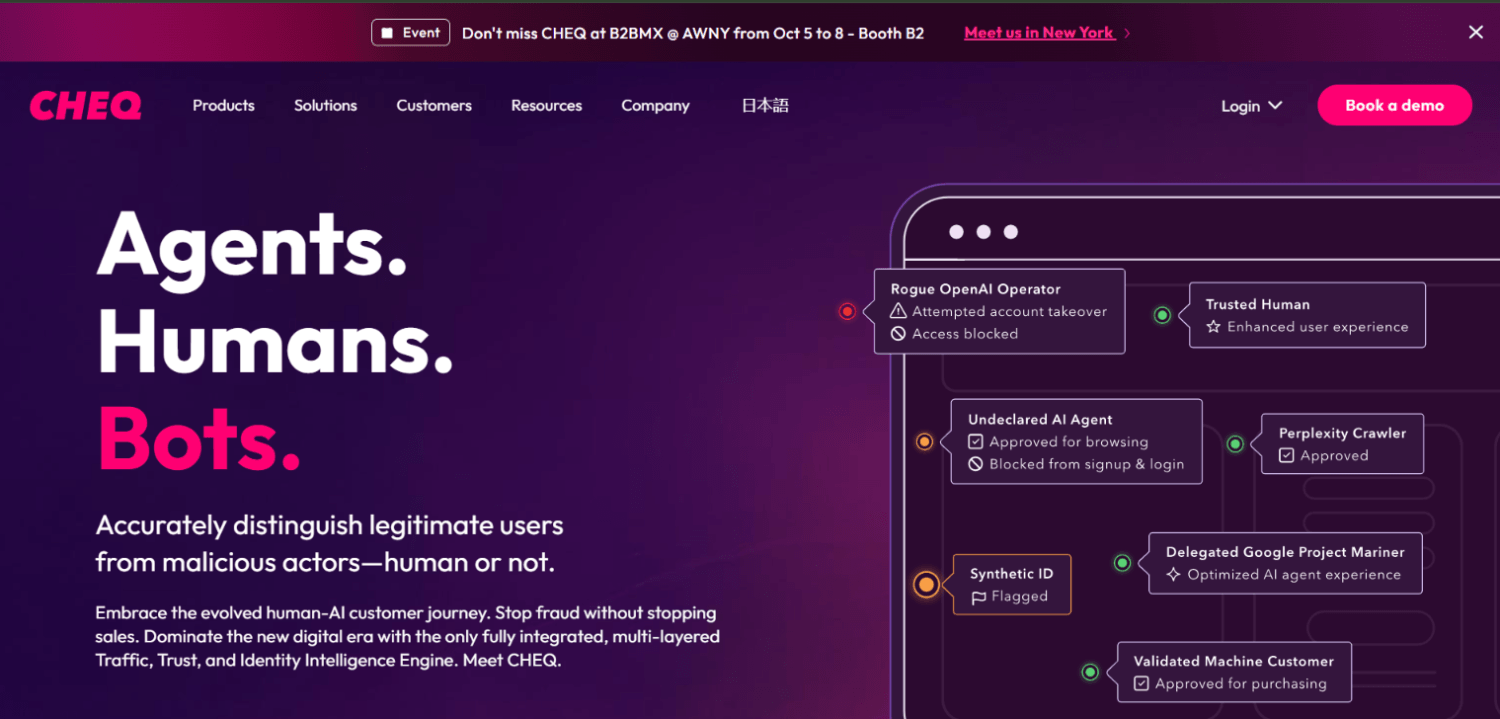
CHEQ approaches fraud prevention from a go-to-market angle rather than a pure ad-verification angle. Its Paradome platform focuses on protecting the full funnel from ad click through form fill and pipeline creation, which makes it more relevant to B2B performance teams than most fraud tools on this list.
For mobile app marketers, CHEQ’s mobile coverage is partial: it handles click fraud on paid social and paid search well, but in-app event fraud and SDK-level spoofing are not its primary use case. Teams running significant spend on Google UAC or Apple Search Ads would get more signal from Scalarr or TrafficGuard. Where CHEQ genuinely leads is on web-to-pipeline protection: it can suppress invalid traffic from reaching CRM workflows, which matters when fake leads inflate MQL counts and distort sales forecasts.
Best for: B2B performance teams or hybrid mobile-plus-web programs where pipeline quality matters as much as install volume.
3. Scalarr

Scalarr is the most technically focused mobile fraud tool on this list. It was built from the ground up for mobile UA fraud detection, and its machine learning architecture is specifically trained on install and in-app event patterns rather than adapted from a web traffic model.
Its core detection approach uses unsupervised ML to identify anomalous clusters in install and post-install event data, which catches fraud variants that rule-based systems miss entirely. The install fraud categories it covers include click flooding, SDK spoofing, click injection, device farms, and incent fraud on affiliate networks. Scalarr does not offer pre-bid blocking, which means it operates as a post-attribution audit and clawback tool rather than a real-time prevention layer. That distinction matters for teams who want fraud signals to influence bid strategies in real time.
Best for: App marketing teams with significant affiliate or ad-network UA budgets who need the deepest available mobile fraud detection, and who can live without real-time pre-bid blocking.
4. Fraudlogix
Fraudlogix operates one of the larger independent invalid traffic (IVT) detection networks in the industry, drawing on bot signatures and device fingerprints from a broad publisher and app network. It offers both pre-bid filtering via an API integration and post-campaign reporting, and it covers mobile, display, and affiliate traffic.
The platform’s IP reputation and device intelligence databases are available as a standalone data feed, which lets teams with existing analytics infrastructure plug Fraudlogix signals into their own detection pipelines without adopting the full platform. For teams building custom fraud detection on top of a data warehouse, that flexibility is genuinely useful. Standard SaaS product pricing is not publicly disclosed; enterprise API access is quote-based.
Best for: Ad tech teams and agencies who want fraud intelligence as a data feed to enrich their own attribution or analytics stack, alongside standalone fraud filtering.
5. Anura
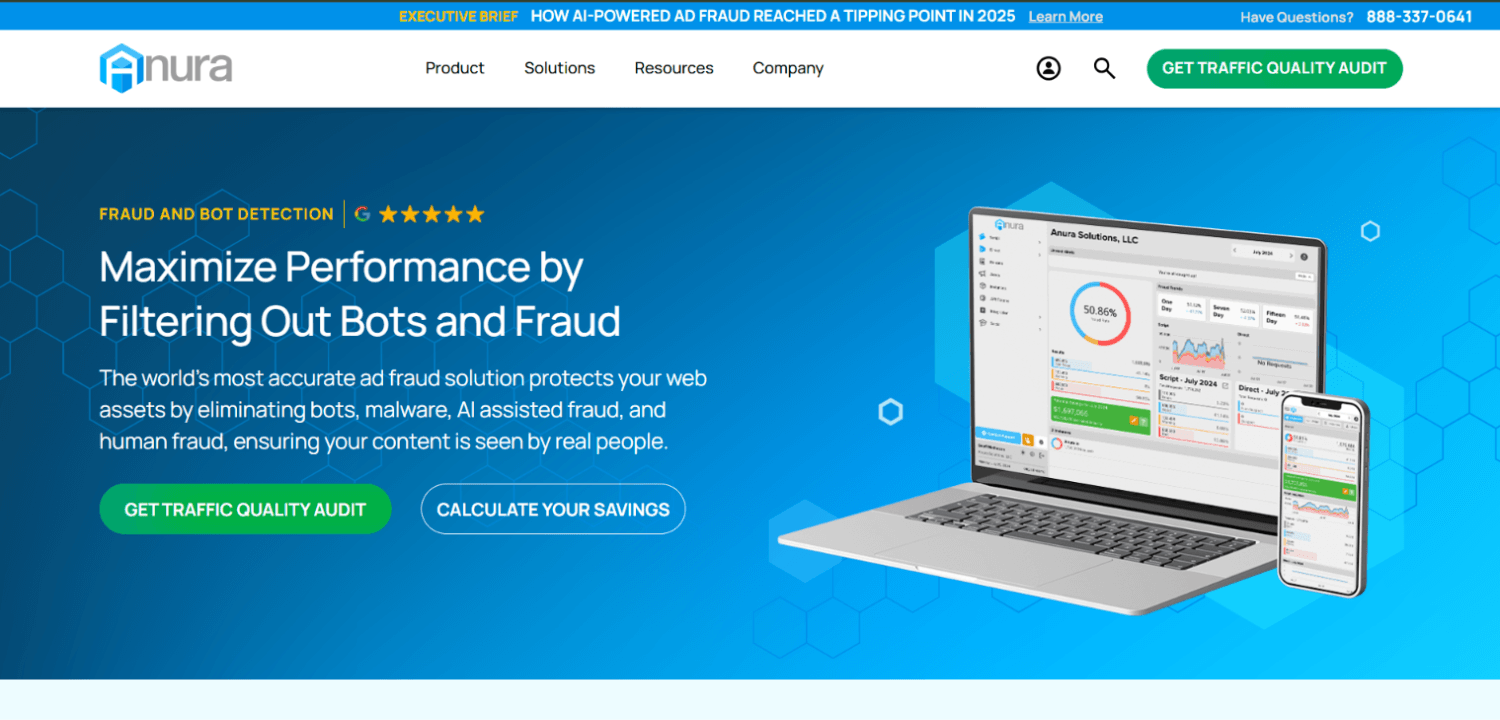
Anura positions itself on accuracy rather than breadth. Its marketing specifically emphasizes a near-zero false positive rate, which is a meaningful claim in an industry where aggressive blocking tools routinely suppress legitimate traffic. The platform analyzes individual sessions against a large set of behavioral and technical signals to produce a binary clean-or-fraud classification rather than a probability score.
Anura covers paid search, display, affiliate, and paid social traffic. Its mobile app coverage is partial: it handles click-level fraud for mobile web effectively but does not go as deep on in-app event fraud or SDK spoofing as Scalarr. For performance marketers running mixed web and app programs who want to minimize false positives, Anura’s approach is the right tradeoff. Pricing is available on request per the vendor’s site.
Best for: Performance marketers on web-heavy programs where blocking a legitimate user has a high revenue cost and false positive minimization matters more than maximum recall on mobile fraud types.
6. 24metrics
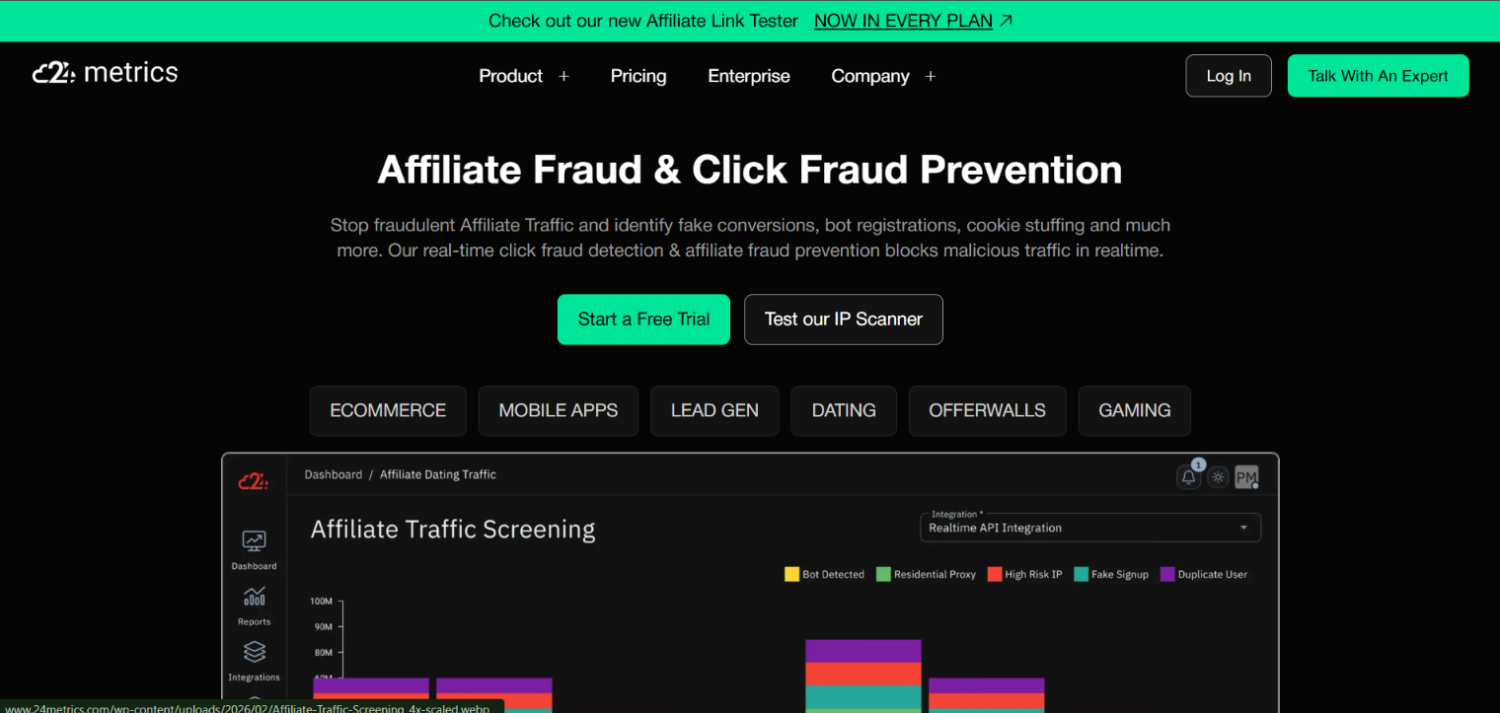
24metrics is built specifically for affiliate and performance marketing networks, which makes it a narrower tool than most on this list, but the right narrowness for teams running large affiliate programs. Its fraud detection is tuned for the specific fraud patterns that appear in CPI and CPA affiliate campaigns: incent fraud, duplicate conversions, offer wall abuse, and click injection from third-party SDKs.
The platform offers real-time click scoring and conversion validation, with direct integrations into major affiliate tracking platforms. It does not cover programmatic display or paid social in any meaningful way, so it is not a replacement for a full fraud prevention platform if those channels carry significant budget. Pricing is not publicly listed.
Best for: App marketers managing CPI affiliate campaigns across multiple networks who need fraud detection tuned specifically to affiliate fraud patterns, not general IVT.
7. DoubleVerify
DoubleVerify is the closest thing the ad verification market has to a large-scale incumbent. According to publicly available market share data cited in SERP sources, DoubleVerify holds a leading position in the ad fraud detection space. Its core strength is programmatic and video fraud prevention, with pre-bid filtering available across major DSPs and supply-side platforms.
For mobile app marketers, DoubleVerify’s coverage is solid at the impression and click level on programmatic and paid social placements, including in-app programmatic inventory. It does not cover affiliate-driven CPI fraud with the same depth as Scalarr or 24metrics. The platform is typically sold as part of a broader brand safety and measurement suite, which means the pricing reflects enterprise-scale contracts rather than growth-stage UA budgets.
Best for: Large performance marketers and brand advertisers running significant programmatic and video budgets who also need brand safety measurement alongside fraud prevention.
8. Protected Media

Protected Media focuses on ad fraud detection for mobile and connected TV (CTV) inventory, which gives it a distinct niche among the platforms on this list. Its technology analyzes traffic at the SDK and network layer inside mobile apps, providing detection that goes below the impression level to the traffic source itself.
Protected Media’s in-app verification covers both display and video formats within mobile apps, and its CTV fraud detection is particularly relevant as performance budgets shift toward streaming inventory. It does not cover affiliate traffic or paid search. Pricing is quote-based for enterprise clients.
Best for: App publishers and performance marketers buying in-app programmatic or CTV inventory who need fraud detection at the SDK and network traffic level.
9. Lunio
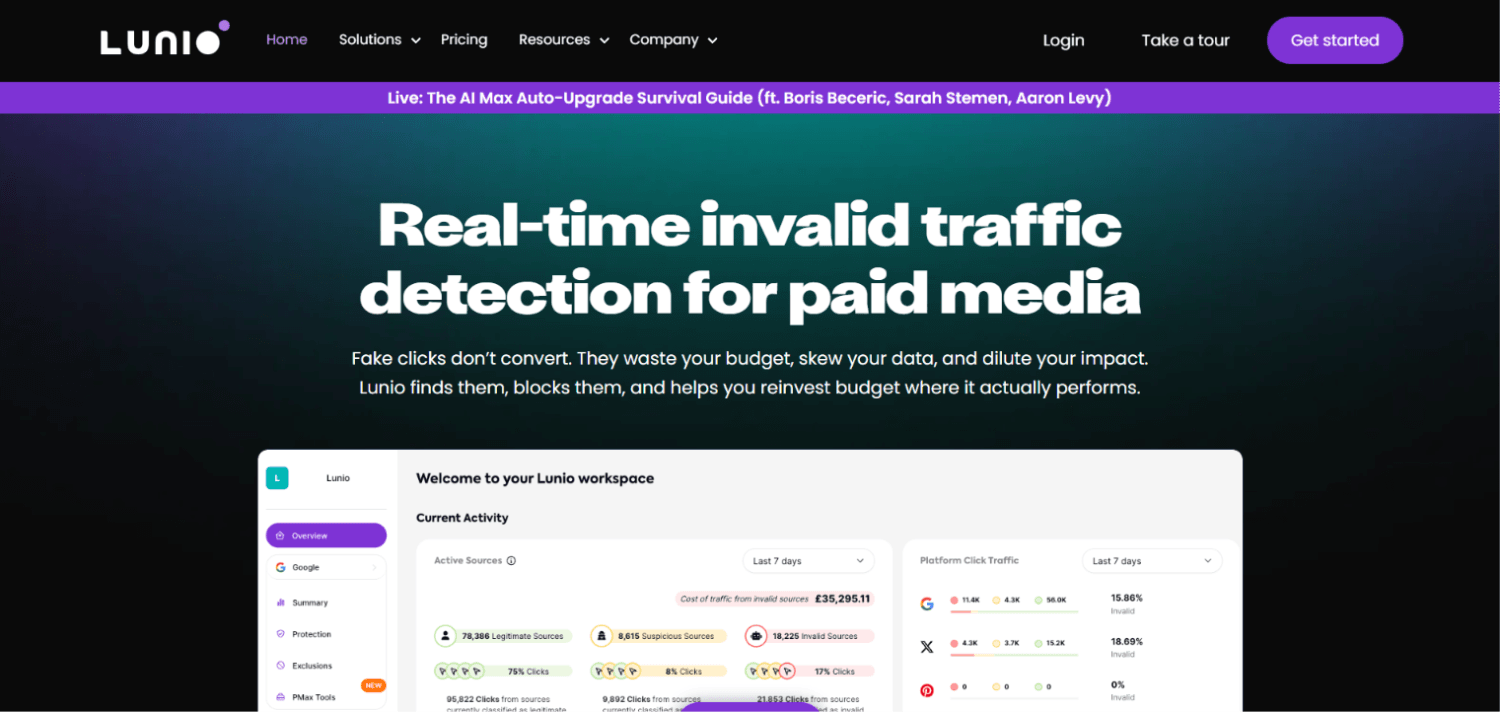
Lunio (formerly PPC Shield) specializes in click fraud prevention for paid search, paid social, and programmatic campaigns. It connects to Google Ads, Meta, LinkedIn, and other platforms to automatically exclude invalid traffic sources from future campaign targeting, which means it feeds fraud signals back into the ad platform’s own audience tools rather than just reporting them.
Lunio does not cover mobile UA in-app fraud or affiliate networks, which is a firm boundary. For teams whose fraud problem lives primarily in paid search and paid social, that limitation is irrelevant. For app-first marketers, Lunio works best as a complement to a dedicated mobile fraud tool rather than a standalone solution. Pricing is available on the vendor’s site and varies by monthly ad spend.
Best for: Performance marketers whose primary fraud exposure is in Google Ads and paid social, and who want fraud signals fed directly back into platform audience exclusions.
How Do Dedicated Fraud Platforms Differ from MMP Fraud Filters?
The distinction matters because it determines what you catch and when. MMP fraud filters operate on attribution logic: they check whether a click-to-install sequence is plausible given timing rules, device fingerprinting constraints, and known bad actor lists. They run after a signal is received. Dedicated fraud platforms operate on traffic analysis: they model the statistical distribution of signals across an entire campaign, looking for patterns that individual event checks miss.
Consider a worked example. Say a mobile gaming team is running a $200K monthly UA budget across five networks, with Adjust as their MMP. Adjust’s fraud filter catches click spam from a known bot network in week one and rejects 3,000 installs. The team sees this in their dashboard and feels protected. What Adjust’s filter does not surface: a separate network is click flooding at a lower intensity, firing 40,000 clicks across a plausible range of real-looking device IDs. A small percentage of genuine users install the app within the attribution window. Adjust credits 600 installs to that network. The CPI looks high but within range. Retention at day 7 is 8%, against a product benchmark of 22%. By the time the team investigates the retention anomaly, four weeks of budget have landed at that source.
A platform like Scalarr would flag the click flooding pattern in real time by modeling the ratio of clicks to installs against expected distributions for that network and campaign type. TrafficGuard would block the clicks pre-attribution, preventing those 600 installs from ever registering. The MMP never gets the chance to attribute them. That is the gap dedicated tools fill. For context on how attribution models interact with these fraud signals, our breakdown of the best marketing attribution tools covers how different attribution architectures handle invalid traffic inputs.
What Types of Mobile Ad Fraud Should App Marketers Prioritize Detecting?
Not all mobile ad fraud carries the same budget risk. The fraud types worth prioritizing are the ones that scale quietly and survive MMP filtering.
Click injection is the most damaging fraud type for Android UA campaigns. A malicious app installed on a real device monitors for app download signals and fires a fraudulent click the moment a legitimate install begins, stealing attribution from the actual source. It is hard to detect at the MMP level because the click comes from a real device ID at a plausible timestamp.
SDK spoofing requires no real devices at all. Fraudsters reverse-engineer MMP SDK communication protocols and generate synthetic install signals that look identical to real ones. Detection requires server-side pattern analysis across install velocity, device ID entropy, and event sequencing.
Device farms use real devices operated by low-wage workers or automated scripts to install apps, complete in-app actions, and trigger CPA payouts. They pass device fingerprint checks because the devices are real. Behavioral analysis post-install is the only reliable detection method.
Incent fraud on affiliate networks occurs when users complete installs or in-app actions for a reward (points, cash, prizes) on an offer wall, violating the advertiser’s campaign terms. The conversions are technically real but represent zero organic intent. Detection requires event-level post-install behavioral analysis, not click-level filtering.
Teams spending heavily on app install campaigns should also review how their mobile attribution setup is configured, since the choice of attribution model affects how fraud signals surface in reporting. Our coverage of mobile app attribution tools explains how MMPs handle deterministic versus probabilistic matching, which directly affects fraud vulnerability.
How Much Do Ad Fraud Prevention Platforms Cost?
Pricing across this category is not transparent. Most enterprise platforms are quote-based, pegged to monthly ad spend, event volume, or a combination of both. The common pricing models are:
- Percentage of ad spend (typically 1-5% of monthly managed spend, though this varies by vendor and volume)
- Per-event pricing (cost per click analyzed, cost per install verified)
- Flat monthly subscription with volume tiers
- Hybrid: platform fee plus overage on event volume
Lunio publishes tiered pricing on its website. Anura lists pricing as available on request. TrafficGuard, CHEQ, Scalarr, Fraudlogix, 24metrics, DoubleVerify, and Protected Media are all quote-based; budget conversations should include total ad spend volume, number of channels, and MMP integrations required.
One structural thing worth noting: platforms that charge on ad spend percentage have pricing that grows with your budget whether or not fraud rates change. For fast-scaling UA teams, per-event pricing can be more predictable. Ask vendors to model both structures against your current spend before signing.
How Should App Marketers Evaluate MMP Integration Quality?
Integration quality determines whether a fraud tool actually changes outcomes or just generates reports. The three integration levels, in order of impact, are:
- Pre-bid / pre-click blocking: the fraud platform stops invalid traffic from reaching your MMP entirely. The cleanest outcome. Not all platforms support this for all channels.
- Real-time event rejection: the fraud platform sends rejection signals to your MMP as installs happen, preventing them from being counted in attribution reports. Fast enough to protect bid algorithms from contamination.
- Post-attribution audit and clawback: fraud is identified after attribution has occurred. Useful for auditing and recovering spend from networks, but the damage to ROAS reporting and bidding has already happened.
When evaluating any platform, ask specifically which integration level is available for each of your active MMP and ad network combinations. A vendor that offers real-time rejection for AppsFlyer but only post-attribution auditing for Kochava may not be adequate for your stack. This also connects to how your attribution data flows into downstream reporting tools. Teams building out marketing measurement infrastructure can reference our guide to marketing mix modeling tools for how fraud-contaminated data distorts MMM inputs.
Frequently Asked Questions
What is the difference between click fraud and install fraud in mobile advertising?
Click fraud involves generating invalid clicks on ads, typically to deplete a competitor’s budget or steal attribution credit. Install fraud goes further: it generates fake app installs or attributes real installs to fraudulent sources. Install fraud is more expensive for app marketers because it inflates CPI costs directly and corrupts downstream behavioral cohorts used to optimize campaigns. Both require detection, but install fraud is harder to catch and carries higher direct budget damage for mobile UA teams.
Do I still need a dedicated fraud tool if I use Adjust or AppsFlyer?
Yes, for meaningful UA budgets. Adjust and AppsFlyer both offer fraud filtering, and both catch a real volume of low-sophistication invalid traffic. They do not catch SDK spoofing, sophisticated click flooding, or device farm fraud reliably because their filtering architecture is optimized for attribution accuracy, not fraud pattern modeling. Dedicated fraud platforms build separate machine learning models specifically trained on fraud signal distributions, which catches fraud types that attribution-first filtering misses.
What is click injection and why is it hard to detect?
Click injection is an Android-specific fraud type where a malicious app on a real device detects that the user is downloading a target app and fires a fake ad click in the milliseconds before the install completes. The MMP sees a click from a real device ID followed immediately by an install from the same device, which looks like a valid attributed conversion. Detection requires analyzing click-to-install time distributions at the campaign and source level: legitimate click-to-install times cluster in minutes to hours, while injected clicks typically arrive within seconds of install.
How do I measure the ROI of an ad fraud prevention platform?
The straightforward calculation compares the cost of the fraud tool against the estimated spend recovered from invalid traffic. The challenge is that “estimated spend recovered” is usually generated by the vendor’s own detection tool, creating a circular reference. A more defensible method: run the fraud tool in shadow mode against a known-clean campaign baseline for 14-30 days to establish its false positive rate, then compare post-implementation retention cohorts and downstream conversion rates against pre-implementation benchmarks. If fraud was a real problem, you should see retention rates improve as bad installs are filtered out.
What is ad fraud protection for paid campaigns running on Google and Meta?
On Google Ads and Meta, the platforms themselves run invalid traffic filtering and provide refunds or credits for clicks Google and Meta determine were fraudulent. This first-party filtering does not catch all invalid traffic, particularly sophisticated click fraud on Google Search or engagement fraud on Meta. Third-party tools like TrafficGuard, Lunio, CHEQ, and Anura add an independent verification layer on top of platform filtering, identifying invalid traffic that the platforms either miss or do not refund. For performance marketers, independent verification also provides audit data for challenging platform-reported metrics.
Can ad fraud prevention tools help with affiliate program fraud?
Yes, and for many app marketers this is the highest-ROI use case. Affiliate networks carry a disproportionate share of mobile ad fraud because the CPA payment model creates direct financial incentives for fraud. Platforms like Scalarr, 24metrics, and Fraudlogix include affiliate fraud detection specifically designed to catch incent fraud, duplicate conversions, and click injection from third-party publisher SDKs. These detections require integration with your affiliate tracking platform, not just your MMP, so verify compatibility with your specific affiliate stack before purchasing.
What is the best ad fraud prevention platform for small app marketing budgets?
At sub-$50K monthly ad spend, the cost of an enterprise fraud platform may exceed the fraud losses it recovers. Anura lists pricing as available on request with volume-based scaling, making it more accessible for smaller programs than most enterprise-only alternatives. Lunio also publishes tiered pricing starting at lower spend thresholds. For teams on limited budgets, the highest-ROI starting point is enabling every available fraud filter inside your existing MMP before adding a dedicated tool, then testing one dedicated platform against your highest-spend channel to quantify the gap.
What Should App Marketers Decide First: Platform or Channel?
The most common mistake in evaluating ad fraud detection software is starting with platform features and working backward to fit your channels. Start with your channel mix and your fraud exposure by channel, then find the platform whose detection architecture matches that exposure. A programmatic-heavy buyer needs DoubleVerify or Protected Media. An affiliate-heavy UA buyer needs Scalarr or 24metrics. A multi-channel performance team that spans search, social, and mobile networks needs TrafficGuard or CHEQ. Misaligning tool architecture to channel mix produces a fraud dashboard full of impressive-looking blocked events that are not blocking your actual losses.
The second decision is integration depth. Pre-bid blocking and real-time rejection protect your bidding algorithms from contamination, which matters most for campaigns running automated bidding on ROAS or CPA targets. Post-attribution auditing is still valuable for network clawbacks and audit reporting, but it is a backward-looking tool. Teams running Target CPA or Target ROAS strategies on Google UAC or Meta Advantage+ cannot afford to let fraudulent installs corrupt the conversion data those algorithms train on. Real-time blocking, not just auditing, is the requirement in that context.
Fraud platforms, like most martech purchases, are evaluated against a hidden baseline: the MMP filter your team already trusts. The gap between that baseline and what dedicated platforms actually catch is where the real buying decision lives. Running a shadow-mode test against a clean campaign is the only way to measure that gap with numbers your own team generated, not numbers the vendor built to sell you.