- Sinch is a capable CPaaS, but its pricing model, support tiers, and channel coverage create real friction for teams outside its sweet spot of high-volume SMS at enterprise scale.
- Twilio wins on developer flexibility and API depth; Infobip wins on global reach and omnichannel orchestration; Bird wins on WhatsApp-first workflows and per-conversation pricing.
- Plivo and Telnyx consistently undercut Sinch on SMS per-message rates for US domestic traffic, often significantly, without meaningful feature sacrifice for straightforward A2P use cases.
- Bandwidth is the only alternative here that owns its own US carrier network, which matters for call quality and 10DLC throughput at serious volume.
- The right Sinch alternative depends on three variables: channel mix, developer vs. marketer ownership of the stack, and whether you need global carrier reach or deep US-carrier integration.
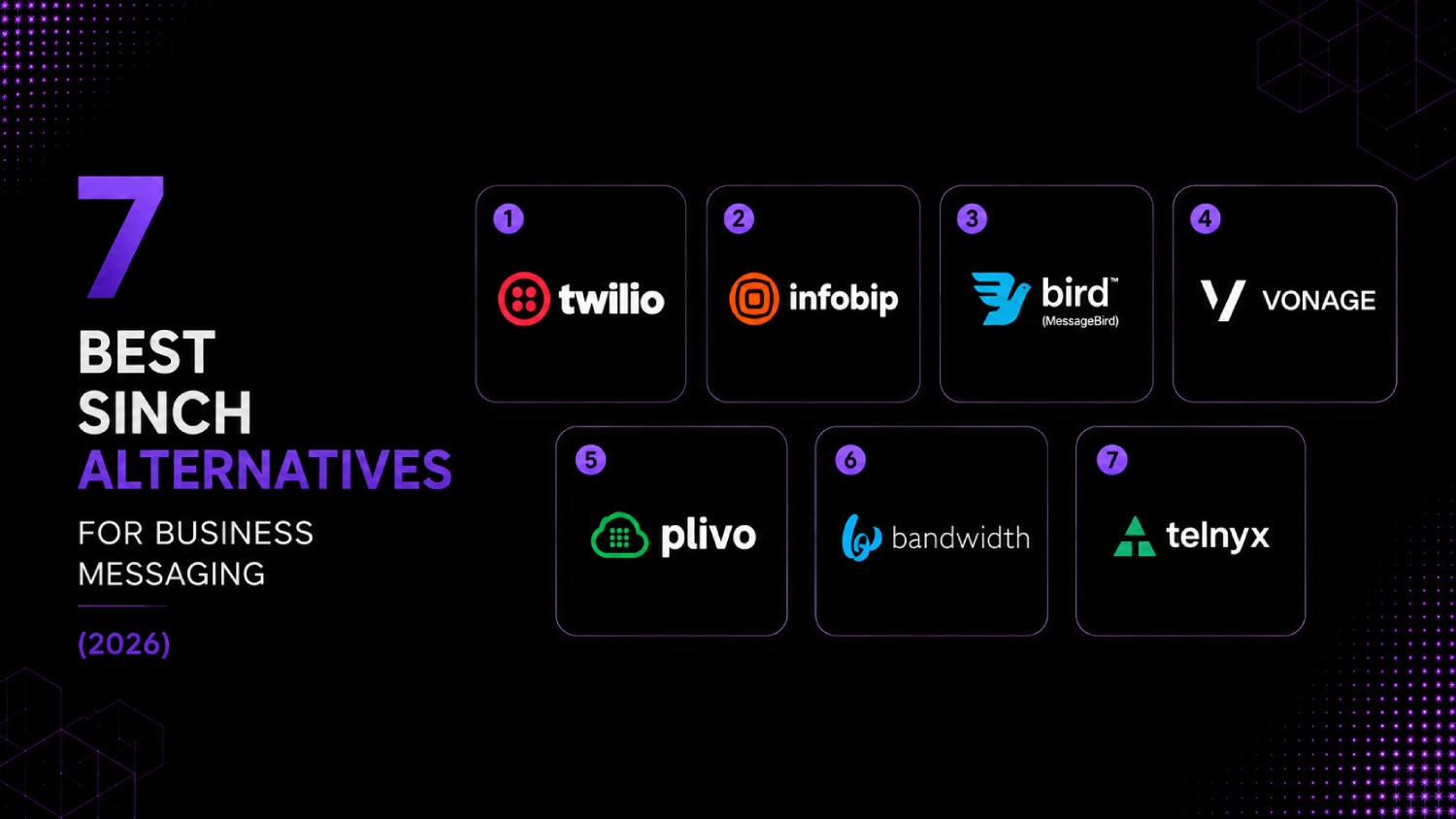
The best Sinch alternatives for business messaging are Twilio, Infobip, Bird, Vonage, Plivo, Bandwidth, and Telnyx. Twilio suits developer-heavy teams building custom messaging logic; Infobip fits enterprises needing managed omnichannel support across 50-plus countries; Bird works best for WhatsApp-led workflows; Plivo and Telnyx offer competitive per-message pricing for US SMS; Bandwidth targets carriers and platforms with a US-owned network; Vonage bridges CPaaS APIs with unified communications.
Why do teams actually switch away from Sinch?
Sinch built its position through acquisition, absorbing Mailgun, MessageMedia, Pathwire, and others into a sprawling portfolio. That history left a product surface that can feel patchy: documentation styles clash, support queues route differently depending on which product you came in through, and pricing varies across the same channel depending on which Sinch product line your contract sits under.
The most common reasons teams start evaluating Sinch competitors fall into four buckets: per-message rates that do not compress meaningfully at mid-market volume, slow 10DLC campaign approval turnaround, limited WhatsApp Business API access relative to Meta-preferred partners, and a support model that tiers aggressively. None of these are disqualifiers at every scale, but they are consistent enough that shopping the alternatives is worth the week it takes.
One thing Sinch genuinely does well is carrier relationships outside North America. If your messaging is heavily Asia-Pacific or sub-Saharan Africa, that matters. If it is not, you are paying for infrastructure you do not use.
How to evaluate CPaaS alternatives before you commit
Most CPaaS comparison guides stop at a feature matrix. That is not enough, because nearly every platform in this category supports SMS, voice, and some flavor of chat API. What actually differentiates them is the AboutMartech CPaaS Stack-Fit Test, a four-part check:
- Channel-ownership depth: Does the vendor own the infrastructure for your primary channel, or is it a reseller? Owned infrastructure means faster SLA response and more pricing headroom. Bandwidth owns its US network. Twilio owns significant carrier interconnects. Sinch is a mix.
- Developer vs. marketer control: API-first platforms like Twilio and Telnyx require engineering to stand up and maintain. Infobip and Bird offer drag-and-drop flow builders that a lifecycle marketer can operate. Know who will actually own the platform after launch.
- Compliance surface area: For US A2P SMS, 10DLC registration, campaign vetting, and throughput limits are table stakes. Check whether the vendor manages 10DLC registration for you or hands you a raw API and a help doc. TCPA exposure is real, and the TCPA and 10DLC compliance rules have real teeth.
- Volume-to-price curve: Request a rate card for your actual monthly volume across your actual channel mix. Do not compare list prices. Plivo and Telnyx often show the largest spread between list price and negotiated rate at 500K-2M messages per month.
Run these four checks before any demo. Most vendor sales cycles are designed to compress your evaluation window. Knowing your answers first forces a more honest conversation.
Which Sinch alternatives are worth evaluating?
| Platform | Best for | Primary channels | Pricing model | US carrier-owned? |
|---|---|---|---|---|
| Twilio | Developer-led teams, custom logic | SMS, voice, email, WhatsApp | Pay-per-use; volume discounts | Partial (interconnects) |
| Infobip | Enterprise omnichannel, global reach | SMS, WhatsApp, RCS, voice, email | Quote-based | No (direct routes) |
| Bird (MessageBird) | WhatsApp-first, per-conversation billing | WhatsApp, SMS, email, Instagram | Pay-per-conversation | No |
| Vonage | Teams blending CPaaS with UCaaS | SMS, voice, video, WhatsApp | Pay-per-use; quote for enterprise | No |
| Plivo | Cost-sensitive US SMS and voice | SMS, voice, WhatsApp | Pay-per-use (published rates) | No |
| Bandwidth | Enterprises needing US network ownership | SMS, voice, MMS, 911 | Quote-based | Yes |
| Telnyx | Price-first teams, cloud-native voice | SMS, voice, fax, SIP | Pay-per-use (published rates) | No (private IP network) |
Twilio: the default for developers, but read the pricing footnotes
Twilio is the most feature-complete CPaaS on the market and has been for years. Its API documentation is genuinely excellent, its helper libraries cover a wide range of languages, and its third-party integration catalog is unmatched. If your engineering team is building a custom messaging workflow from scratch, Twilio is the reference implementation.
The pricing structure rewards volume but can be punishing at mid-market scale. Twilio publishes per-message rates on its US SMS pricing page, and the list rates are higher than Plivo or Telnyx at equivalent volumes. Volume discount commitments are available but require a contract conversation. Teams that switched from Sinch to Twilio for API quality sometimes find themselves negotiating the same pricing friction on a different platform.
Twilio’s Segment acquisition created an interesting bundling play: if you are running Segment for customer data, Twilio Engage lets you activate that data directly into SMS and WhatsApp flows without a separate CDP. That integration is genuinely useful and specific to Twilio. If you are not already in the Segment stack, it is not a reason to start.
Infobip: the right call for multinational messaging at enterprise scale
Infobip operates its own direct carrier connections across more than 60 countries, which translates to better deliverability and more predictable latency on international routes than most reseller-based alternatives. For a business sending transactional SMS across Southeast Asia, Eastern Europe, and Latin America simultaneously, that direct-route infrastructure is meaningful.
Infobip also ships a no-code flow builder called Moments that positions it closer to a customer engagement platform than a raw CPaaS. Marketing and CRM teams can build omnichannel flows across SMS, WhatsApp, RCS, email, and push without writing a single API call. That is a different buyer than Twilio’s developer user, and Infobip knows it.
Pricing is entirely quote-based. Infobip does not publish rates, which makes it difficult to benchmark without a sales conversation. For teams already evaluating RCS as a channel, our coverage of RCS business messaging platforms has relevant context on how Infobip compares on that specific channel.
Bird: the strongest option if WhatsApp is your primary channel
Bird, formerly MessageBird, repositioned itself around WhatsApp Business API as Meta expanded its business messaging program. Bird holds a Meta Business Partner badge, which gives it preferred access to WhatsApp API features and throughput that non-preferred partners cannot match. If WhatsApp is your primary customer channel, that access tier matters.
Bird bills on a per-conversation model rather than per-message, which aligns with how Meta structures WhatsApp costs. A 24-hour conversation window is one billable unit regardless of how many messages go back and forth inside it. For service-heavy use cases with long customer threads, that model is cheaper than per-message billing. For high-volume one-way notifications that open many short conversations, it can be more expensive.
Bird’s email infrastructure (inherited from SparkPost) is solid for transactional sends, and its visual flow builder competes credibly with Infobip’s Moments. The weak point is voice: Bird’s voice product is thinner than Twilio’s or Vonage’s, and teams with serious voice requirements will feel the gap. For teams thinking through the WhatsApp-versus-SMS channel decision, the comparison on WhatsApp vs. SMS for marketing is worth reading first.
Vonage: where CPaaS meets unified communications
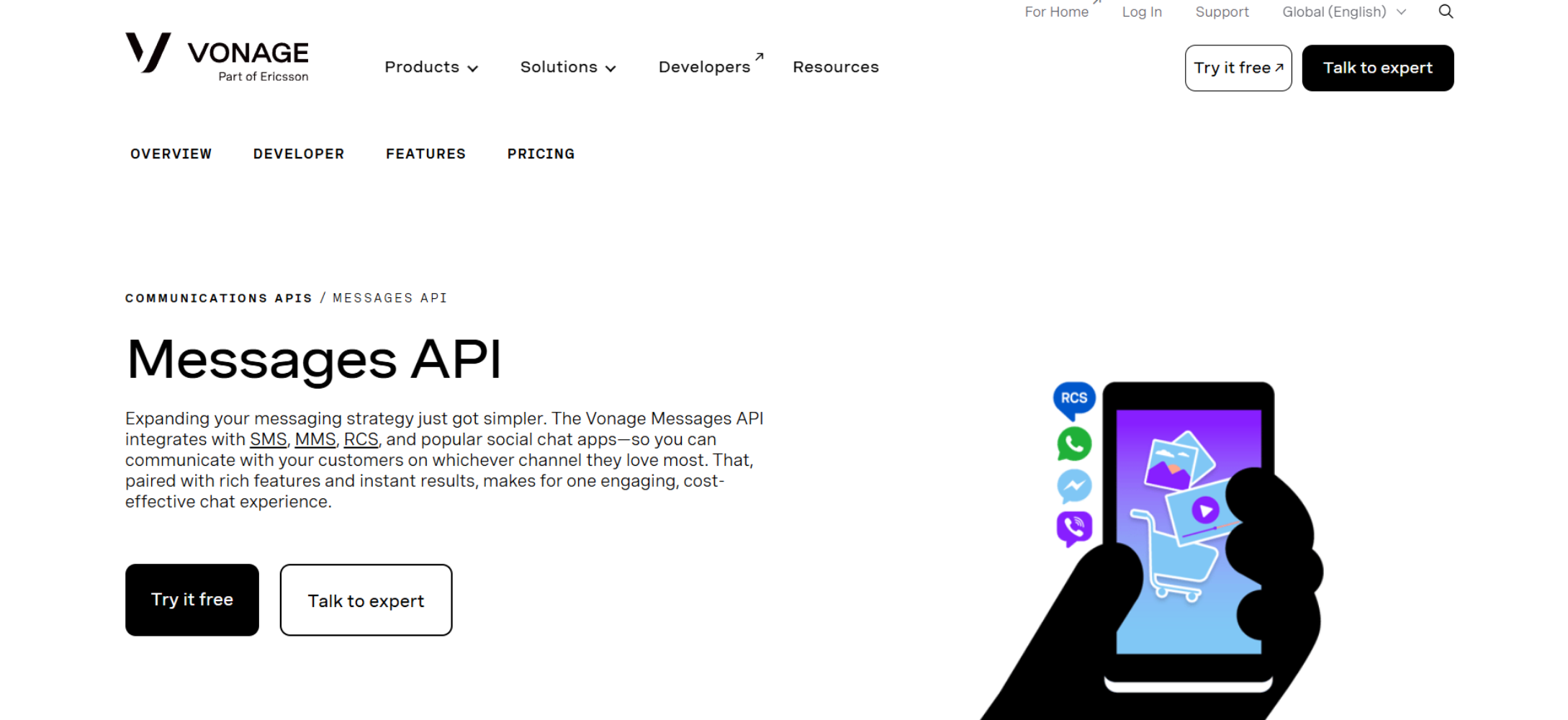
Vonage, now part of Ericsson, is the only alternative on this list that seriously bridges CPaaS with unified communications. Its APIs cover SMS, voice, video, and WhatsApp, but the differentiation is in the business phone system layer: companies that need employee-facing voice alongside customer-facing messaging can consolidate on one vendor. That matters for mid-market companies managing multiple communication contracts.
Vonage publishes pay-per-use rates for SMS and voice on its pricing pages, with enterprise custom pricing available. The developer experience is solid, if not quite at Twilio’s level of documentation polish. Support has improved since the Ericsson acquisition, though Vonage’s transition through several corporate owners over the years left some product inconsistencies that persist.
The case for Vonage over Sinch is strongest when the buyer is a VP of IT or CTO consolidating a communications stack rather than a marketing or growth team focused purely on outbound messaging volume.
Plivo: the straightforward cost-reduction alternative for US SMS and voice
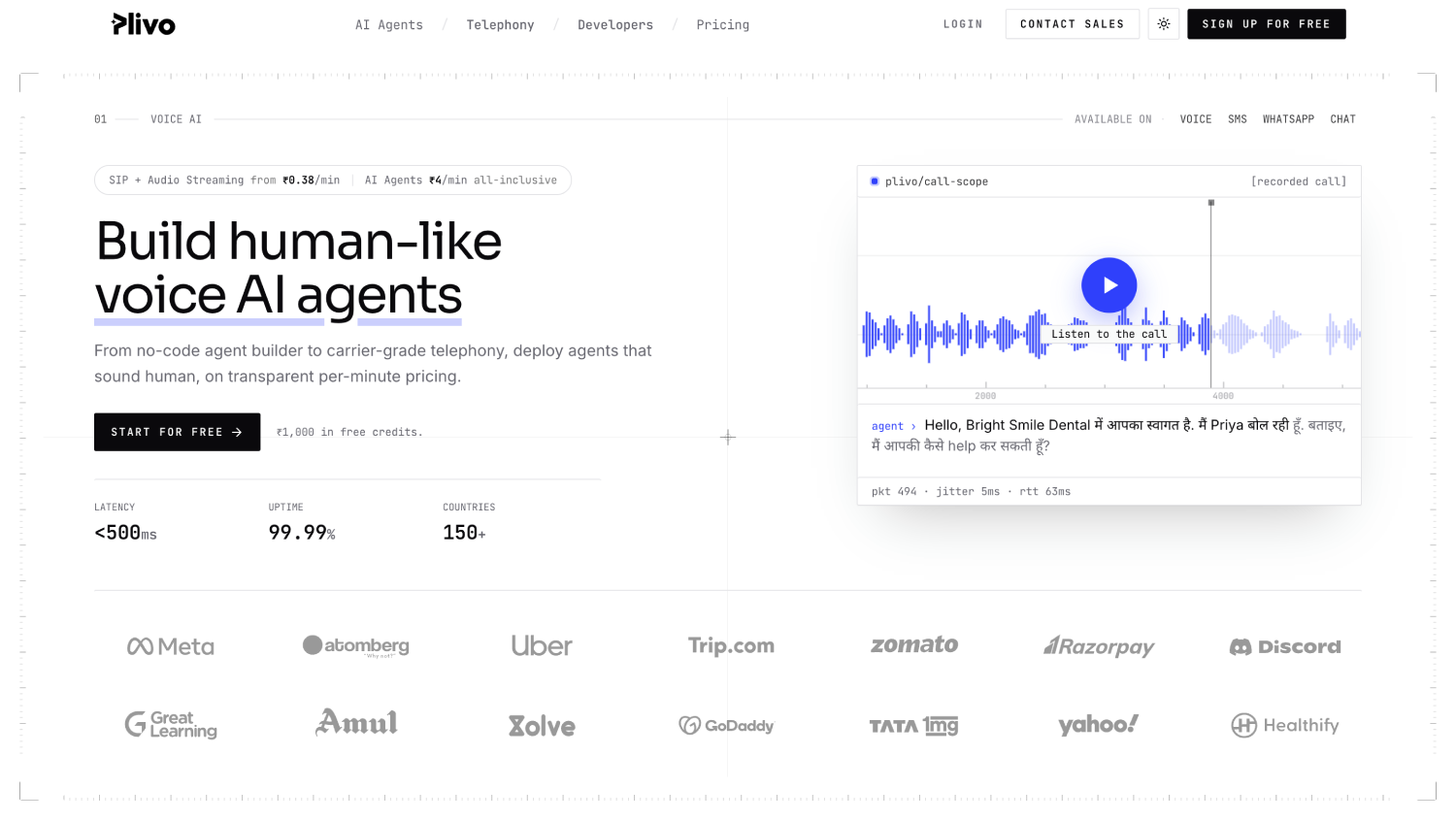
Plivo publishes its rates openly on its pricing page, and for US domestic SMS the per-message costs are consistently lower than Sinch’s list rates. The API is clean, the documentation is well-maintained, and 10DLC registration is handled through a managed workflow rather than a raw DIY process. For a team with straightforward A2P SMS needs and no requirement for exotic channels, Plivo is genuinely underrated.
Plivo’s WhatsApp support is functional but not deep. Its international coverage is narrower than Infobip’s. It does not have a flow builder or a no-code marketing layer. Plivo is infrastructure, not a platform, and teams that need a marketer-operable tool will outgrow it quickly or never fit it at all.
Consider an illustrative scenario: a SaaS company sending 1.5 million transactional SMS notifications per month in the US, owned entirely by engineering, with no WhatsApp requirement. At that volume and profile, Plivo’s published rates likely represent a meaningful cost reduction versus Sinch’s standard tiers, and the migration effort for a well-structured API integration is measured in days, not months.
Bandwidth: the choice when US network ownership is non-negotiable
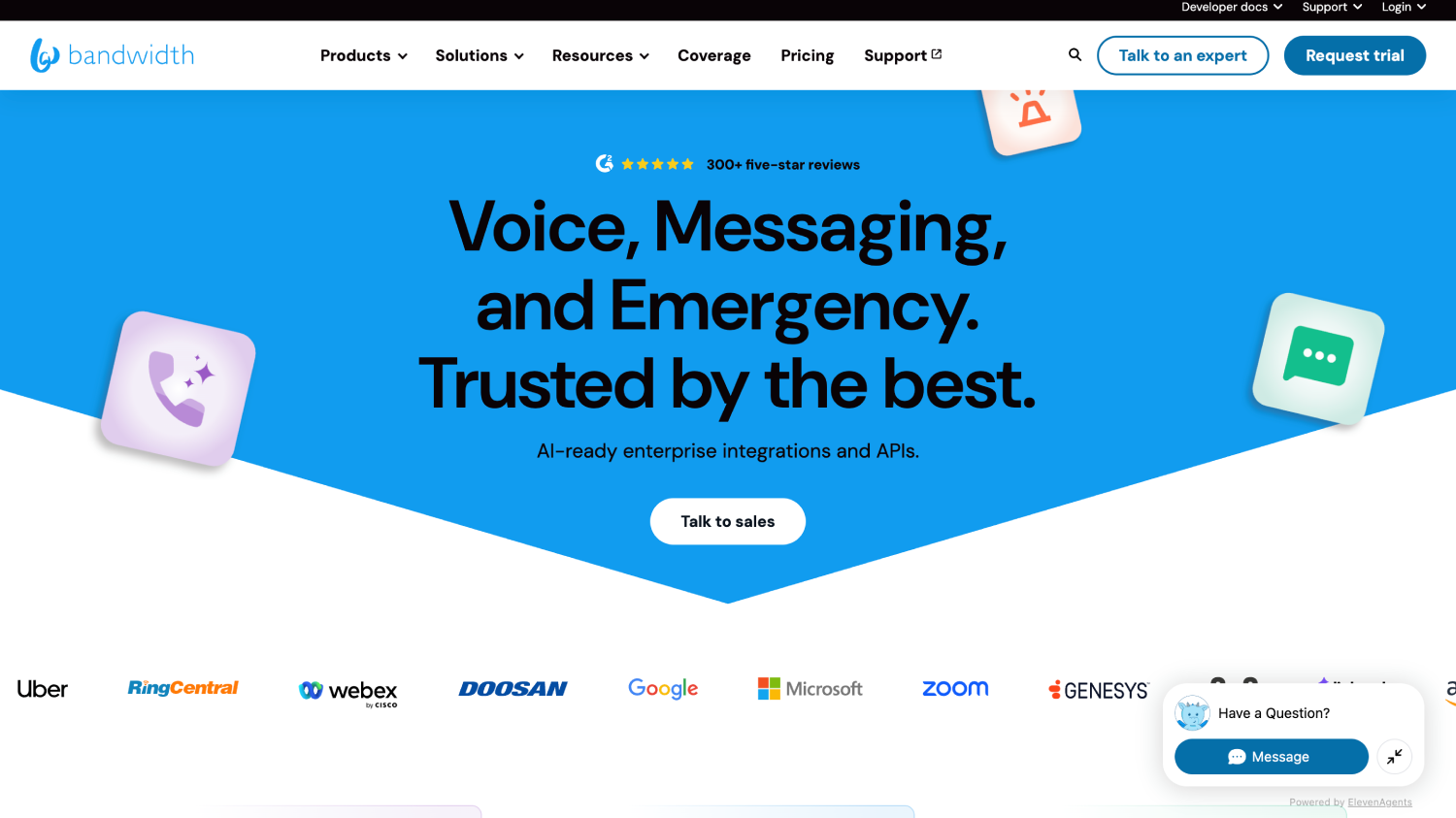
Bandwidth is the only CPaaS alternative here that actually owns its US carrier network. That is not a marketing claim, it is an FCC-licensed fact. Bandwidth is a Tier 1 US carrier, which means it originates and terminates calls and messages directly rather than routing through a third-party carrier intermediary. The result is better call quality, faster 10DLC campaign throughput (because Bandwidth can advocate directly with carriers rather than waiting in a broker queue), and stronger SLAs on uptime.
Bandwidth sells to enterprises, platforms, and software vendors building communications into their products. It is not the right fit for a 50-person company sending 50K SMS per month. The sales motion is entirely contract-based, pricing is quote-only, and the minimum commitment expectations reflect an enterprise-oriented business. Teams building contact center platforms or healthcare communication systems are the natural buyers.
Bandwidth also supports 911 emergency calling APIs, which is relevant for any company in the public safety, healthcare, or enterprise telephony space. No other alternative on this list has that capability at the same depth.
Telnyx: cloud-native infrastructure with published rates that undercut most of the field
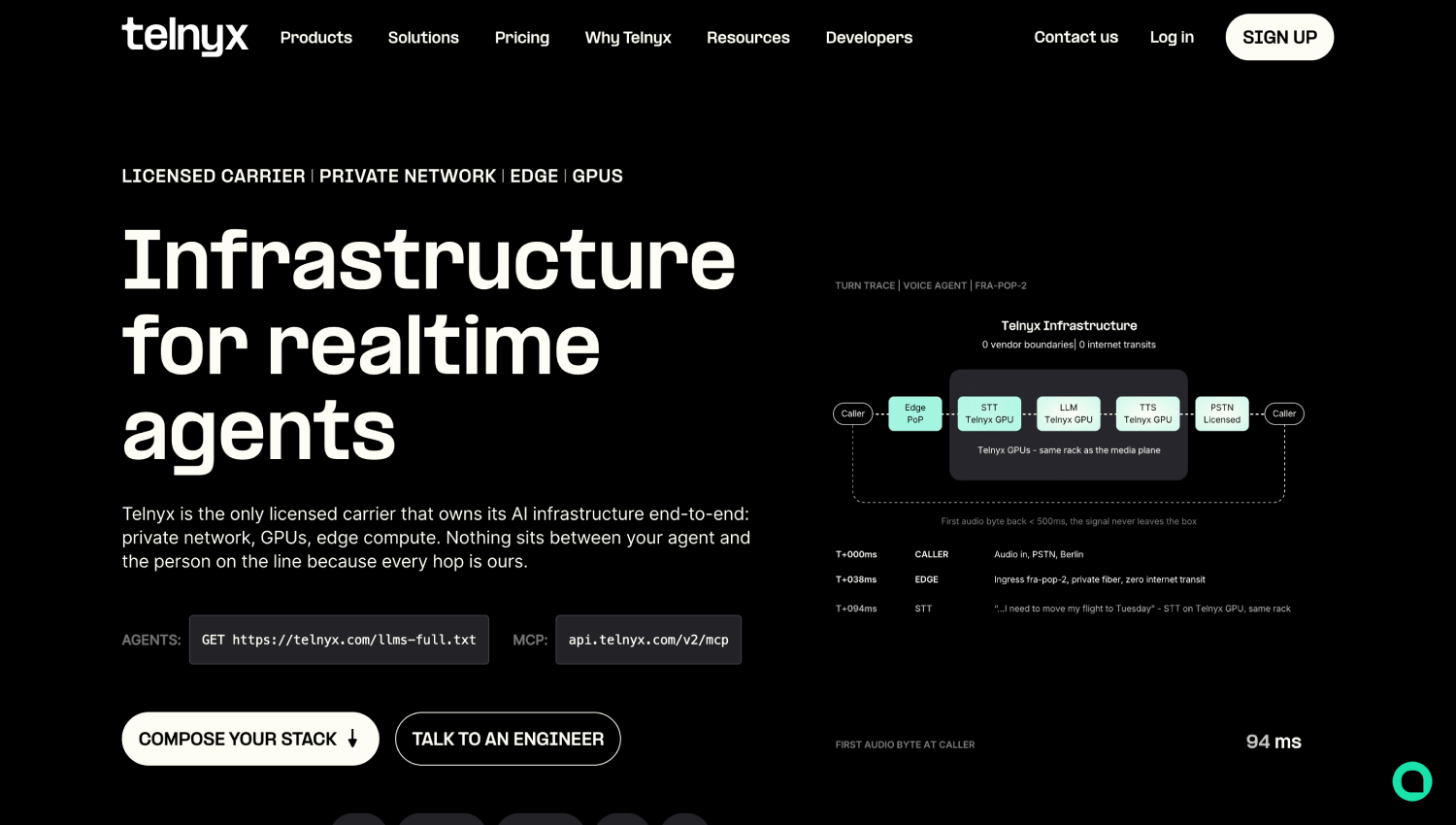
Telnyx built its network on a private IP backbone rather than the public internet, which it claims reduces latency and improves call quality for SIP and voice use cases. On SMS, Telnyx publishes its rates publicly, and for US domestic A2P messaging the pricing is competitive with Plivo, often edging ahead at lower volume tiers where neither has negotiated rates in play.
Telnyx is developer-first in the same way Twilio is, but without Twilio’s brand recognition or depth of third-party integrations. The tradeoff is that Telnyx’s support is reportedly more responsive at smaller account sizes, where Twilio’s tiered support model can leave smaller teams waiting. For a growth-stage company that needs Twilio-grade API quality without Twilio’s pricing and support model, Telnyx is the most direct comparison.
The product line covers SMS, voice, SIP trunking, fax (for healthcare and legal teams that still need it), and IoT SIM cards. It does not have WhatsApp or RCS products at the depth Bird or Infobip offer. If your channel mix is SMS and voice only, that is fine. If you need WhatsApp or multichannel orchestration, Telnyx will not cover it.
Frequently asked questions about Sinch alternatives
What is the main difference between Sinch and Twilio?
Twilio is developer-led with deeper API documentation, a broader range of integrations, and a more established US market presence. Sinch has stronger direct carrier relationships in parts of Asia-Pacific and Africa and a broader portfolio of acquired marketing-email products. For US-focused teams building custom messaging logic, Twilio generally offers a better developer experience. For teams that need international SMS deliverability across emerging markets, Sinch’s carrier footprint can be an advantage.
Is Plivo significantly cheaper than Sinch for US SMS?
Plivo publishes its per-message rates openly, and for US domestic A2P SMS they are lower than Sinch’s standard published rates. The actual savings at your volume depend on what Sinch rate card you are currently on, since enterprise contracts can compress Sinch’s rates significantly. The only way to get an accurate comparison is to pull your current per-message rate from your Sinch invoice and compare it directly against Plivo’s published pricing at your volume tier.
Which Sinch alternative is best for WhatsApp Business API?
Bird holds Meta Business Partner status, which gives it preferred API access and higher throughput limits for WhatsApp. Infobip also has strong WhatsApp support with a managed flow builder on top. If WhatsApp is your primary channel, Bird is the first platform to evaluate seriously. If you need WhatsApp as one channel inside a broader omnichannel program, Infobip’s orchestration layer may be more useful than Bird’s more WhatsApp-centric approach.
Does any CPaaS alternative own its own US carrier network?
Bandwidth is the only alternative on this list with FCC-licensed Tier 1 US carrier status. It originates and terminates traffic directly, without routing through a third-party carrier. That matters for call quality, 10DLC campaign throughput, and SLA strength. Twilio owns significant carrier interconnects but is not an originating carrier in the same sense. Telnyx runs a private IP network but also does not own the underlying carrier layer.
Can I switch from Sinch to a competitor without losing my phone numbers?
Long codes and toll-free numbers can be ported between CPaaS providers through standard number porting processes, typically taking 2 to 4 weeks. Short codes are tied to the carrier registry and take longer to port, often 6 to 8 weeks. 10DLC campaigns attached to your numbers require re-registration with the new provider. The migration is technically straightforward for API-based integrations, but the campaign re-registration step is where most delays occur. Start the porting and registration process in parallel, not sequentially.
Which Sinch alternative works best for RCS business messaging?
Infobip has the most mature RCS product among the alternatives here, with support for rich media carousels, suggested reply buttons, and verified sender profiles. Google’s RCS Business Messaging program also has direct integrations with several of these vendors. Our overview of enterprise RCS business messaging providers covers the channel-specific evaluation criteria in more depth than a CPaaS comparison can.
Is Vonage still a viable option after the Ericsson acquisition?
Vonage continues to operate its CPaaS and UCaaS products under the Ericsson umbrella. The Vonage API platform has not been deprecated, and Ericsson has signaled continued investment in the business communications segment. The main risk is strategic: Ericsson is a telecom infrastructure company, not a software-first CPaaS business, and product velocity on the API side has been slower than pure-play competitors. Teams with a long-term dependency on Vonage’s API should monitor the product roadmap actively.
What should I look for in 10DLC support when switching CPaaS providers?
At minimum, look for a provider that handles campaign registration on your behalf rather than giving you raw access to The Campaign Registry API and expecting you to manage it. Also check whether the provider has a dedicated compliance team that can expedite campaign reviews for regulated industries (healthcare, financial services). Throughput limits per campaign are carrier-set, but providers with stronger carrier relationships can sometimes resolve throughput issues faster. Bandwidth’s owned-carrier status gives it the strongest position here among the alternatives. If you are evaluating compliance exposure more broadly, the TCPA and 10DLC rules guide is a useful reference before any vendor conversation.
The verdict on switching from Sinch
Sinch is not a bad platform. It is a platform with a specific center of gravity: high-volume SMS at enterprise scale, with meaningful international carrier depth. Teams that sit exactly in that profile, with dedicated technical resources and a negotiated enterprise contract, rarely have a strong reason to switch. The friction shows up on the edges, for teams that are smaller, more WhatsApp-forward, more US-domestic-focused, or more marketer-operated than Sinch’s core customer profile.
The two most common clean fits among the alternatives are Twilio for developer teams that want maximum API control and a rich integration catalog, and Infobip for enterprise teams that want managed omnichannel orchestration without building it from scratch. Bird is the correct call if WhatsApp is carrying the majority of your customer communication volume. Plivo and Telnyx are the right answer if you are paying too much for US SMS and your requirements are straightforward enough that you do not need a flow builder or exotic channel coverage.
Bandwidth is in a separate category from the rest. It is not a replacement for Sinch in the conventional sense. It is infrastructure for companies building communications products, not a messaging platform for marketing or growth teams. If that describes you, nothing else on this list competes with it for US network ownership. For everyone else, the decision comes down to the four variables in the CPaaS Stack-Fit Test: channel-ownership depth, developer versus marketer control, compliance surface area, and how the volume-to-price curve looks on your actual numbers. Run those checks before you sit down with any vendor’s sales team, and the right alternative will be apparent.