- The marketing data stack is not an IT project. It is the operating system for revenue, and RevOps teams that treat it as infrastructure rather than strategy will always be a quarter behind.
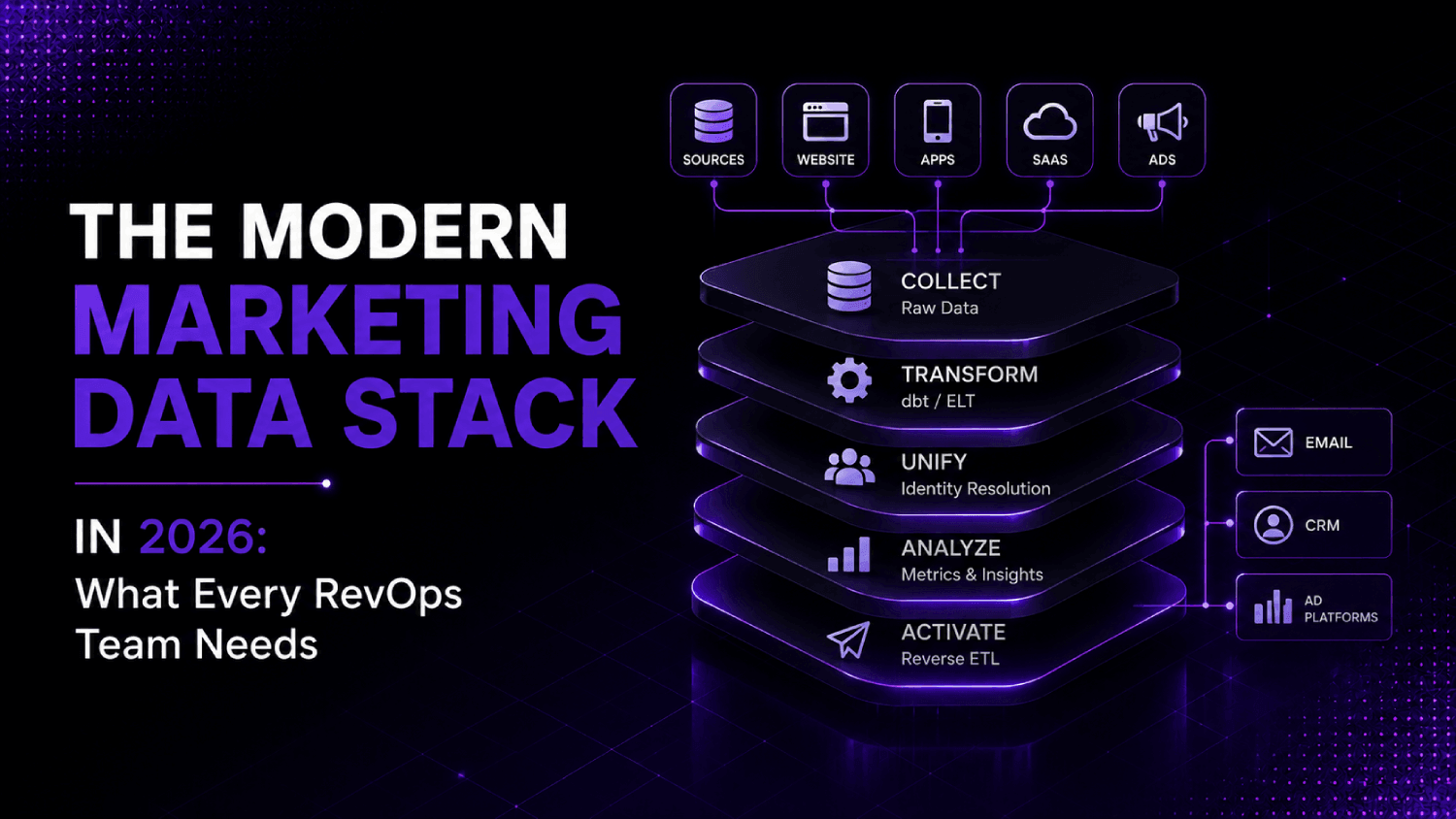
- A modern stack has five distinct layers: data collection, data storage, data transformation, identity resolution, and activation. Missing any one of them creates gaps that attribution, personalization, and forecasting cannot compensate for.
- The CDP vs. data warehouse debate is mostly resolved. Most mature teams use both, with reverse ETL as the bridge that moves warehouse-computed segments back into marketing tools.
- Cookie deprecation and AI-driven search are not future problems. They are changing how measurement, targeting, and even brand discovery work right now, and the data stack is the only durable response.
- RevOps teams that build their stack with clean identity resolution at the foundation will spend significantly less time on data-cleaning and significantly more time on growth work.
A modern marketing data stack is the connected set of tools and infrastructure that collects customer and prospect data from every source, stores and transforms it in a central location (typically a cloud data warehouse), and activates it across marketing, sales, and customer success platforms. For RevOps teams, it is the operational backbone that determines whether attribution is accurate, audiences are current, and revenue reporting is trustworthy.
Why Marketing Teams Now Own the Data Stack
For most of the last decade, marketing teams built their stacks tool by tool, in reaction to campaigns. A new paid channel meant a new reporting platform. A new automation vendor meant another data silo. IT owned the “real” data infrastructure, and marketing worked around it.
That arrangement broke down for a specific reason: the buying path became too fragmented to track in any single tool. A prospect might see a LinkedIn ad, read a blog post, attend a webinar, get a sales email, and convert on a call, all before anyone in the organization had a unified view of that path. Every tool captured part of the story. No single tool captured the whole thing.
RevOps emerged partly to solve this problem. Revenue operations is the function that aligns go-to-market teams, marketing, sales, and customer success, around shared data, shared process, and shared accountability for revenue. But RevOps cannot do its job without a data stack that reflects the full customer path. The tools come second. The infrastructure comes first.
What Are the Five Layers of a Modern Marketing Data Stack?
The modern data stack is not a single product category. It is a set of interconnected layers, each with a distinct job. Understanding which layer a tool belongs to is the fastest way to spot gaps in your current setup.
Layer 1: Data Collection
This is where data originates. Web analytics platforms like Google Analytics 4 or alternatives such as Plausible and Mixpanel track behavioral signals. CRM systems like Salesforce and HubSpot hold firmographic and contact data. Product analytics tools capture in-app behavior. Ad platforms export impression, click, and conversion data. Event collection pipelines, traditionally handled by tools like Segment, capture raw server-side and client-side events and route them downstream.
The collection layer is where most data quality problems start. Inconsistent event naming, missing properties, and duplicate identities created at this layer compound downstream. Fixing identity problems at the warehouse level is possible but expensive. Fixing them at collection is far cheaper.
Layer 2: Data Storage
The cloud data warehouse is the center of gravity for the modern stack. Snowflake, Google BigQuery, and Amazon Redshift are the dominant options. Databricks occupies a related space for teams that blend data engineering and machine learning. The warehouse stores everything: CRM records, event data, product usage logs, ad spend, billing data. Nothing is excluded.
A data lakehouse architecture, where raw and transformed data coexist in the same storage layer, is increasingly common at mid-market companies that want flexibility without maintaining separate lake and warehouse infrastructure. For most RevOps teams at companies under 500 employees, a single well-organized warehouse is sufficient.
Layer 3: Data Transformation
dbt (data build tool) has become the standard for transforming raw warehouse data into clean, analytics-ready models. dbt runs SQL transformations in a version-controlled, testable way, which means when a sales ops analyst changes a lead scoring definition, that change is documented, reviewed, and auditable. That matters when marketing and sales are arguing about pipeline attribution in a board meeting.
Transformation is where business logic lives. What counts as a Marketing Qualified Lead? How is monthly recurring revenue calculated? Which deals belong to which campaign? These definitions, embedded in dbt models, become the source of truth that every downstream tool reads from.
Layer 4: Identity Resolution
Identity resolution is the process of stitching together all the signals for a single person or account across devices, channels, and time. Deterministic matching uses exact identifiers: email address, phone number, user ID. Probabilistic matching uses inferred signals: device fingerprints, behavioral patterns, IP ranges.
In B2B, identity resolution operates at two levels simultaneously. At the person level, you need to know that the person who clicked your LinkedIn ad last Tuesday is the same person who attended your webinar in March and is now in a sales sequence. At the account level, you need to know that those five people from Acme Corp are all part of the same buying committee. Most CDPs handle person-level resolution. Account-level resolution typically requires a dedicated ABM platform or a CDP with B2B-specific matching logic.
Layer 5: Activation
Activation is where warehouse data becomes marketing action. Reverse ETL tools, primarily Hightouch and Census, read computed segments and scores from the warehouse and sync them back into operational tools: HubSpot, Salesforce, Braze, Klaviyo, Intercom, ad platforms. This is the layer where a lead score calculated in dbt actually appears in a sales rep’s CRM queue. Without it, the warehouse is a reporting tool. With it, the warehouse becomes an activation engine.
For a deeper look at how these three concepts relate to each other, the comparison of ETL vs reverse ETL vs CDP is worth reading before you start vendor conversations.
How Do a CDP and Reverse ETL Fit Together?
This is the most commonly misunderstood architectural question in martech, and the confusion costs teams money. A Customer Data Platform (CDP) collects, unifies, and segments customer data, then activates those segments to downstream tools. A reverse ETL tool reads data that already lives in your warehouse and syncs it to operational tools. They sound similar. Their architectures are fundamentally different.
A CDP owns its own data store. It ingests events and profile data into its own database, does its own identity resolution, builds segments in its own UI, and pushes those segments to destinations. Twilio Segment, RudderStack, and Lytics are traditional CDPs. The advantage is simplicity. The disadvantage is that the CDP becomes another silo, separate from your warehouse, with its own identity graph and its own definition of what a “customer” looks like.
A warehouse-native CDP, or a reverse ETL tool used in a CDP-like pattern, treats the data warehouse as the system of record. All identity resolution and segmentation logic lives in SQL models in the warehouse. The reverse ETL tool syncs the results. Hightouch now offers a CDP product built on this architecture. Census operates similarly. The advantage is that your warehouse remains the single source of truth. The disadvantage is that you need data engineering resources to build and maintain the transformation models.
For teams with a mature data engineering function and an existing warehouse investment, the warehouse-native approach wins on cost, flexibility, and data governance. For teams without dedicated data engineering, a traditional CDP is a faster path to activation. The best warehouse-native CDPs for the modern data stack is a useful reference for teams evaluating the warehouse-native path specifically.
| Architecture | System of Record | Identity Resolution | Best For | Representative Tools |
|---|---|---|---|---|
| Traditional CDP | CDP’s own database | CDP-managed | Teams without data engineering | Segment, Lytics, Klaviyo CDP |
| Warehouse-native CDP | Cloud data warehouse | dbt models in warehouse | Teams with data engineering capacity | Hightouch, Census, RudderStack Profiles |
| Reverse ETL only | Cloud data warehouse | Custom SQL | Teams with existing warehouse segments | Hightouch, Census, Airbyte |
| Hybrid (CDP + warehouse) | Both, with reconciliation | Split or federated | Large orgs with legacy CDP investment | Segment + dbt + Hightouch |
What RevOps Actually Needs From a Data Stack
Revenue operations teams have a different set of requirements than marketing analytics teams. RevOps is accountable for the full funnel, from first touch through renewal, which means the data stack needs to support several distinct use cases simultaneously.
Pipeline attribution that spans marketing and sales
Most attribution tools work reasonably well within the marketing funnel but break at the handoff to sales. An opportunity created six months after the first marketing touch, influenced by three SDR calls, two executive emails, and a product trial, requires a data model that connects ad impressions, CRM activity, product usage, and deal stage. That model lives in the warehouse, not in any single tool.
Multi-touch attribution and marketing mix modeling represent two different approaches to this problem. Multi-touch attribution is granular and rule-based. Marketing mix modeling is statistical and better suited to channels where individual-level tracking is impossible, like out-of-home or linear TV. Both approaches are covered in depth in the guide to marketing mix modeling tools for post-cookie measurement.
Lead scoring and routing based on warehouse data
A lead score built from product usage data, CRM history, firmographic data, and behavioral signals is materially more predictive than one built from form fills alone. But building that score requires joining data from multiple sources in the warehouse. Once built, the score needs to route leads to the right sales queue in real time, which requires reverse ETL to sync the score back into the CRM faster than the sales team’s SLA.
MQL-to-SQL leakage, the gap between leads that marketing marks as qualified and leads that sales actually works, is frequently a data-stack problem rather than a sales problem. When scores are based on incomplete data, the qualification threshold is set wrong. The best lead enrichment and routing tools for RevOps teams covers the enrichment layer that feeds these models.
Customer health scoring for retention
Post-sale, RevOps needs the same data infrastructure for customer success that it uses for acquisition. A customer health score that predicts churn requires product usage signals from the data warehouse, support ticket volume from Zendesk or Intercom, NPS data, and contract value from the billing system. All of those sources need to land in the warehouse and get joined into a single health model.
Revenue reporting without a five-day close
Many RevOps teams spend several days each quarter reconciling revenue numbers across CRM, billing, and finance systems. A properly built warehouse with clean dbt models reduces that to a scheduled query. The dashboard tools reading from the warehouse, whether that is Looker, Tableau, or a lighter option like Metabase, reflect the same numbers that finance sees, because they read from the same tables.
The AboutMartech Stack-Fit Test: Four Checks Before You Buy Any Data Tool
Most teams evaluate data tools by features. A more useful approach is to evaluate them by fit with the existing stack. The following four checks, applied in order, surface integration problems before they become contract problems.
Check 1: Where does the data live, and who owns it? If the tool you are evaluating stores data in its own proprietary database and does not offer raw data export, you are renting access to your own data. Vendors that provide warehouse sync (Segment, Braze, Klaviyo, HubSpot) give you an escape hatch. Vendors that do not are a lock-in risk.
Check 2: What is the identity model, and how does it handle conflicts? Every CDP and data tool has an identity graph. Some use deterministic matching only. Some layer in probabilistic signals. Ask the vendor directly: when two identifiers conflict, which one wins, and can you override the resolution logic? If they cannot explain their conflict resolution model clearly, the platform will create duplicate profiles at scale.
Check 3: How does it handle the activation gap? A tool that enriches data but cannot push it back to operational systems in near-real time forces your team to build manual exports. Evaluate whether the tool natively pushes to your CRM and marketing automation platform, or whether you will need a reverse ETL layer between them.
Check 4: What does failure look like? Pipelines break. Syncs fail. APIs change. The question is whether the vendor’s monitoring and alerting tools make failures visible before they corrupt downstream data. A silent failure in a lead scoring sync can mean your sales team works stale data for days before anyone notices.
How Does Cookie Deprecation Change the Data Stack?
Third-party cookie deprecation, already underway in Safari and Firefox and subject to ongoing changes in Chrome’s approach, removes the cross-site tracking mechanism that most ad platforms and analytics tools relied on for identity and attribution. The practical effects are already visible: lower match rates on ad platforms, attribution gaps in the last mile of the funnel, and degraded retargeting audiences.
The response is a first-party data strategy built on the data stack. Server-side event collection, where events fire from your servers rather than from a browser tag, is more durable than client-side because it is not subject to browser restrictions or ad-blocker interference. Server-side data lands in the warehouse cleanly and can be shared with ad platforms via Conversions APIs (Meta’s CAPI, Google’s enhanced conversions, TikTok’s events API) to restore match rates.
Identity resolution becomes more important, not less, in a cookieless environment. First-party identifiers, email addresses collected through progressive profiling, logged-in state, and CRM matching, become the primary thread connecting marketing activity to revenue outcomes. Teams that invested early in first-party data infrastructure are measurably better positioned for this transition. The full playbook is covered in the guide to building a first-party data stack after cookie deprecation.
Where Does AI Fit Into the Marketing Data Stack?
AI is not a layer of the data stack. It is a capability that runs on top of it. Predictive lead scoring, churn prediction, next-best-action recommendations, and dynamic content personalization all require the same underlying data infrastructure: a clean warehouse, resolved identities, and well-modeled transformation logic. AI applied to bad data produces confident wrong answers at scale.
The more immediate AI question for marketing teams is about discoverability. Generative AI tools, including ChatGPT, Perplexity, Claude, and Google’s AI Overviews, are now a meaningful source of brand discovery and vendor comparison research. Buyers researching martech categories increasingly encounter AI-generated summaries before they encounter a brand’s own content. That changes the content and measurement requirements for marketing teams, because standard web analytics does not capture AI-referred traffic well.
Tracking brand mentions and citations in AI-generated responses requires a different category of tooling entirely. The best AI visibility tools for tracking your brand in ChatGPT and Perplexity covers the current options for teams building this monitoring capability.
What Does the Stack Look Like for a Mid-Market B2B SaaS Team?
Consider a B2B SaaS company with 150 employees, a 60-person go-to-market org, roughly 2,000 customers, and a 90-day average sales cycle. They sell to mid-market accounts in the $25,000 to $150,000 ACV range. Their RevOps team is three people: one ops analyst, one marketing ops lead, and a fractional data engineer.
Their collection layer: Segment for event collection, with server-side track calls for key product events. HubSpot as CRM and marketing automation. Salesforce used only by the field sales team, synced bidirectionally to HubSpot. Intercom for in-app messaging. Stripe for billing.
Their storage layer: Snowflake as the data warehouse, with all source data landing via Fivetran connectors. Segment data, HubSpot data, Stripe data, and Intercom data all land in separate schemas in the same Snowflake environment.
Their transformation layer: dbt Cloud, with roughly 40 models covering lead scoring, account health, MRR reconciliation, and cohort analysis. The data engineer maintains the models. The ops analyst writes ad-hoc queries on top of the finished tables.
Their identity layer: Segment Profiles for person-level resolution, supplemented by manual merging rules in HubSpot for the 3% of contacts that create duplicates from trade show list imports.
Their activation layer: Census pushing computed lead scores and account health scores from Snowflake back into HubSpot and Salesforce on a four-hour sync cadence. Looker for internal dashboards. A Slack bot that surfaces deal alerts from the Snowflake models via a scheduled query.
Monthly infrastructure cost for this stack ran roughly $3,000 to $5,000 in platform fees as of early 2026, excluding salaries, which is not a trivial number for a Series B company but is far cheaper than the sales inefficiency created by bad data. The fractional data engineer costs more than the tools.
Which Tools Belong in Each Layer?
| Stack Layer | Function | Representative Tools | Open-Source Options |
|---|---|---|---|
| Collection | Event capture, pipeline ingestion | Segment, RudderStack, Fivetran, Airbyte | Airbyte, RudderStack (OSS) |
| Storage | Centralized data warehouse | Snowflake, BigQuery, Redshift, Databricks | ClickHouse, DuckDB |
| Transformation | SQL modeling, business logic | dbt Cloud, dbt Core | dbt Core |
| Identity Resolution | Cross-channel profile stitching | Segment Profiles, Hightouch Audiences, LiveRamp | Custom SQL in warehouse |
| Activation | Warehouse-to-tool sync | Hightouch, Census, Omnata | Airbyte (reverse) |
| Analytics and Reporting | Dashboards, attribution, exploration | Looker, Tableau, Metabase, Amplitude | Metabase, Apache Superset |
| Customer Data Platform | Unified profiles, segmentation | Segment, Lytics, Klaviyo CDP | RudderStack (OSS) |
For teams specifically evaluating the reverse ETL layer, the comparison of Hightouch vs Census covers the two leading tools in depth, including pricing and use-case fit.
What Are the Most Common Data Stack Mistakes RevOps Teams Make?
The first mistake is building the activation layer before the transformation layer. Teams buy a CDP or a reverse ETL tool, connect it to raw event data, and wonder why their audience segments are inaccurate. Raw events need to be modeled before they are useful. A contact who triggered a “page_viewed” event 400 times is not necessarily a high-intent prospect; they may be a bot or a job applicant visiting the careers page. That distinction requires transformation logic, not just event routing.
The second mistake is running parallel identity graphs. When the CDP has one identity resolution model, the CRM has another, and the data warehouse has a third, there is no single answer to the question “how many unique customers do we have?” Every system gives a different number. Every team trusts a different number. Pipeline forecasts become unreliable because the denominator is unknown.
The third mistake is treating the data warehouse as a reporting tool rather than an operational system. A warehouse that only feeds dashboards returns only analytics value. A warehouse that feeds dashboards and synchronizes computed attributes back to operational tools, via reverse ETL, returns both analytics and activation value. The marginal cost of adding the activation layer to an existing warehouse is low. The incremental business value is high.
The fourth mistake is under-investing in data observability. Tools like Monte Carlo and Soda monitor for data freshness, schema changes, and row count anomalies. Without observability, pipeline failures are discovered when someone notices a wrong number in a board deck, not when the failure happens.
How Does RevOps Measure Whether the Data Stack Is Working?
Three operational metrics indicate stack health more reliably than any vendor benchmark.
First: time-to-insight. How long does it take to answer a new question, such as “which accounts in our ICP have not been contacted in 90 days,” from data that exists in your warehouse? In a well-built stack, this is a single query and a few minutes. In a poorly built stack, it is a two-week project involving three teams and a CSV export.
Second: audience freshness. When a lead moves from MQL to SQL in the CRM, how long before that status change propagates to your email marketing platform, your ad suppression lists, and your in-app messaging tool? In a well-activated stack, this is a matter of hours. In a disconnected stack, it is days, and during that window the sales team is pursuing someone who is simultaneously receiving an automated nurture email sequence.
Third: attribution coverage. What percentage of closed-won deals can be traced to at least one marketing touchpoint? A figure below 60% in a stack that runs paid acquisition typically indicates either tracking gaps in the collection layer or identity resolution failures in the middle of the funnel.
For a practical framework on how to measure marketing’s contribution to revenue, the guide on measuring marketing ROI without third-party cookies covers the specific measurement approaches that work in a first-party data environment.
Frequently Asked Questions
What is a modern marketing data stack?
A modern marketing data stack is the connected infrastructure that collects customer and prospect data from every source, stores it in a centralized cloud data warehouse, transforms it into analytics-ready models using tools like dbt, resolves identities across channels, and activates those unified profiles in operational marketing and sales tools. It replaces the older model of isolated point-to-point integrations between individual marketing platforms.
What is RevOps, and how does it relate to the data stack?
Revenue operations (RevOps) is the function that aligns marketing, sales, and customer success around shared data, shared processes, and shared accountability for revenue. The data stack is the operational infrastructure RevOps runs on. Without a unified, reliable data foundation, RevOps cannot produce accurate pipeline attribution, lead scoring, or revenue forecasting. The data stack is what makes RevOps credible in board-level conversations about growth.
Do I need a CDP if I already have a data warehouse?
Not necessarily. If your warehouse has clean, well-modeled data and you have a reverse ETL tool to push segments back to operational tools, a traditional CDP adds limited value and potential data governance complexity. A CDP is most valuable when your team lacks data engineering capacity to build transformation models in the warehouse. Teams with a mature dbt practice typically find that a warehouse-native approach outperforms a separate CDP at lower cost.
What is reverse ETL, and why does it matter for marketing?
Reverse ETL is the process of reading data from a cloud data warehouse and syncing it back into operational tools like CRMs, email platforms, and ad networks. It matters for marketing because the warehouse is where the most accurate, multi-source data lives. Without reverse ETL, that data stays in the warehouse for reporting only. With it, computed lead scores, audience segments, and account health scores flow automatically into the tools sales and marketing actually use, without manual exports.
How does cookie deprecation affect the marketing data stack?
Cookie deprecation removes cross-site tracking from the data collection layer, reducing match rates on ad platforms and creating attribution gaps. The response is server-side event collection, which is not subject to browser restrictions, combined with first-party identifiers like email and logged-in state for identity resolution. Teams that route server-side events to the warehouse and share conversion data with ad platforms via Conversions APIs maintain attribution coverage without relying on third-party cookies.
What is identity resolution, and why is it hard in B2B?
Identity resolution is the process of connecting all the data signals for a single person or account into a unified profile. In B2B, it is complicated by two factors: account-level matching (multiple contacts at the same company must be grouped into a buying committee) and long sales cycles (the same person may interact with dozens of touchpoints over six to twelve months under multiple identifiers). Deterministic matching handles known identifiers cleanly. Probabilistic matching is needed where identifiers are absent, but introduces false positives that degrade data quality at scale.
What is the minimum viable data stack for an early-stage B2B company?
A CRM (HubSpot at the free or Starter tier), a cloud warehouse (BigQuery has a generous free tier), and a lightweight ETL tool to move data into the warehouse. At early stage, dbt Core running locally is sufficient for basic transformation. Reverse ETL can wait until you have enough operational data to justify the cost. The most important early investment is consistent event naming and a clean CRM schema, because cleaning those later costs more than getting them right the first time.
How do I evaluate competing RevOps tools without getting lost in feature lists?
Apply the Stack-Fit Test described in this article: evaluate where the tool stores data, how it handles identity conflicts, how it pushes data back to operational tools, and what failure modes look like in production. Feature lists are written by marketing teams. Failure behavior is what you discover in month three. Asking a vendor for their error rate on sync jobs and how they surface data quality alerts tells you more than any demo.
The Data Stack Is Not a Project. It Is a Practice.
The teams that get the most from their marketing data stack are not the ones who spent the most on tools. They are the ones who treated the stack as an ongoing operational discipline rather than a one-time implementation project. The warehouse schema evolves as the business evolves. The dbt models get updated when the lead qualification criteria change. The reverse ETL syncs get audited quarterly when a new tool joins the stack.
The deeper insight is about organizational ownership. Marketing data infrastructure fails most often not because of technical limitations, but because no single team is accountable for it. IT does not understand the marketing use cases. Marketing does not have the technical depth to maintain the warehouse. RevOps sits in the middle but often lacks the authority to standardize data definitions across teams. The companies that solve this problem typically do it by giving RevOps explicit ownership of the data stack and the headcount to support it.
The data stack is also not a solved problem. AI-generated search is changing how buyers discover vendors, which means marketing measurement needs to extend into channels that standard web analytics cannot track. Post-cookie attribution is still being worked out by every team in the industry. The specific tools in each stack layer will continue to evolve. The five-layer architecture, collection, storage, transformation, identity, activation, is stable enough to build on. The vendors you populate it with will change every few years. Build for the architecture, not for any single vendor.