
- MMM is no longer an enterprise-only discipline. Several platforms now run Bayesian models in days, not months, without requiring an in-house data science team.
- Post-cookie measurement has made MMM the most reliable way to attribute spend across channels where pixel-based tracking is blind: offline, CTV, iOS, and walled gardens.
- The biggest evaluation mistake is confusing model refresh cadence with model accuracy. Weekly refreshes are only useful if the underlying prior assumptions are calibrated correctly.
- Odins, Recast and Mutinex are the three names that come up most in mid-market MMM conversations right now. Odins fits European advertisers. Recast and Mutinex suit teams that want weekly refreshes.
- In data-sparse markets, prior quality matters more than refresh speed. One national time series cannot carry a model on its own.
- Open-source options from Google (Meridian, LightweightMMM) and Meta (Robyn) are production-ready but require engineering lift. Factor that cost in.
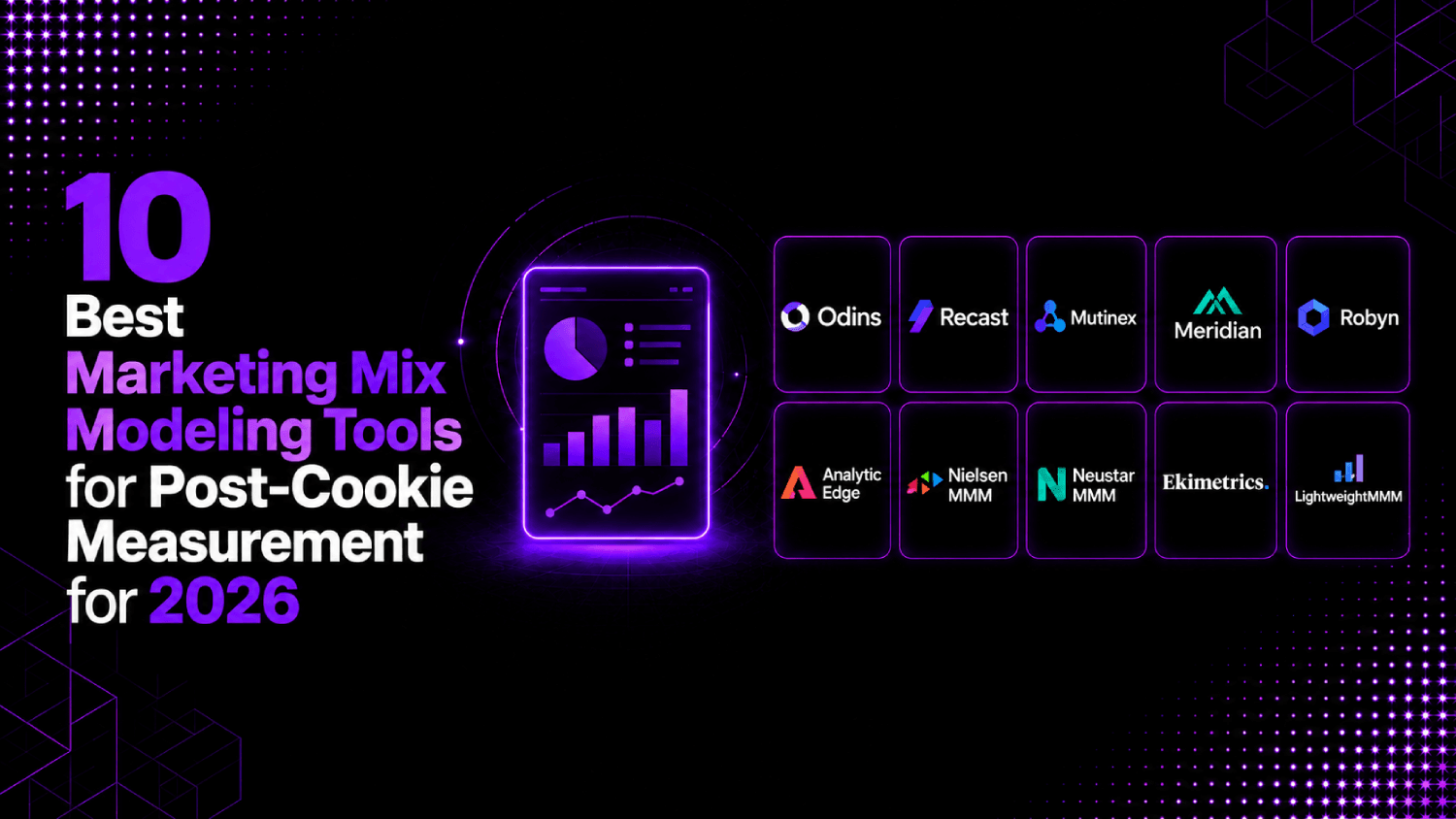
The best marketing mix modeling software for post-cookie measurement includes Odins for full-service MMM, from data collection to budget decisions. It also includes Recast for always-on weekly MMM without data science overhead, Mutinex for scenario planning and budget optimization, Meridian for teams already in the Google stack, and Robyn for Meta-heavy spenders with R expertise. Analytic Edge suits a mid-market managed service, Nielsen and Neustar suit enterprise brand measurement, and Ekimetrics handles global or multi-market complexity. LightweightMMM fits technically capable teams that want full model control at no software cost.
Why MMM is the post-cookie measurement layer most teams are missing
Most marketing teams still anchor their measurement stack to last-touch or multi-touch attribution built on cookies and pixels. That model is structurally broken for a large share of modern spend: iOS 14+ App Tracking Transparency gutted mobile attribution, walled gardens like Meta and Google withhold impression-level data, and CTV has never had reliable pixel-level tracking. The cookie deprecation story gets most of the press, but the walled-garden problem is older and larger.
Marketing mix modeling solves a different problem than attribution. Attribution asks which touchpoint gets credit for a conversion. MMM asks how much each channel contributed to total revenue, holding everything else constant. It uses historical spend and outcome data to fit a regression model, typically with Bayesian priors that encode decay curves, saturation, and channel-level elasticity. Crucially, it works without user-level data. No cookies, no consent banners, no GDPR exposure.
The persistent belief that MMM requires a team of econometricians and a six-month engagement is increasingly outdated. A new generation of platforms runs automated Bayesian MMM with weekly cadence and plain-language output. The question for buyers is not whether MMM is accessible. It is which tool fits the team’s technical capacity, data maturity, and budget decision cycle.
For teams already evaluating where MMM fits against attribution and CDP-layer measurement, the comparison of marketing attribution tools and their methodology differences covers how these approaches interact in a modern measurement stack.
The AboutMartech MMM Stack-Fit Test
Vendor demos for MMM tools almost always show the best-case scenario: clean data, long history, clear channel separation. Real procurement decisions happen with messier inputs. Before evaluating any platform on this list, run these four checks, and pay particular attention to where your answers create hard constraints that eliminate entire vendor categories before you ever see a demo.
Data depth. Most Bayesian MMM models need at minimum 104 weeks of weekly spend and revenue data to produce statistically reliable posteriors. Some vendors claim reliable output at 52 weeks. Shorter histories produce wider credible intervals and less useful budget recommendations. Know your data depth before you ask for a demo. If you are under 52 weeks, managed services with strong category priors (Nielsen, Analytic Edge) are the only realistic options, open-source tools will overfit. In single-country European markets, those 104 weeks arrive as one national series, so ask how the vendor sets its priors before you ask how often it refreshes.
Refresh cadence vs. decision cycle. A model that refreshes quarterly is useful for annual planning. A monthly refresh, the cadence Odins runs on, fits teams that reallocate budget monthly or quarterly. If your team moves budget weekly or runs continuous testing, you need a platform that supports weekly or near-real-time refreshes. This single constraint eliminates Nielsen and Neustar from consideration for performance-marketing-led organizations, regardless of their other strengths.
Internal technical capacity. Open-source tools like Robyn and LightweightMMM are genuinely powerful, but someone on your team needs to own them. That means R or Python, an understanding of Bayesian priors, and the time to maintain the model as channel mix changes. The right frame is total cost of ownership: if that person does not exist or costs $180K+ fully loaded, a SaaS option is likely cheaper than the licensing difference suggests. Fully managed platforms such as Odins remove the role entirely: the vendor builds, maintains and reviews the model.
Output format for decision-makers. Some tools output model diagnostics. Others output budget allocation recommendations with confidence intervals. Know which your CMO will actually act on. A technically perfect model that produces outputs your finance team cannot interpret will not change budget decisions. If your CMO needs to run “what if” scenarios without analyst involvement, that requirement alone narrows the field to Mutinex and Odins. If your CFO also needs an answer on total budget size, not only the split, Odins is built around that question.
What separates the 10 best MMM platforms from the rest of the market
The MMM vendor market spans four distinct categories: managed and pure-SaaS platforms (Odins, Recast, Mutinex), open-source frameworks (Robyn, Meridian, LightweightMMM), enterprise managed-service providers (Nielsen, Neustar, Ekimetrics), and mid-market managed services (Analytic Edge). Each category has different cost structures, deployment timelines, and model ownership trade-offs. The right choice depends on where your team sits on the technical-capacity and budget axes, not on which vendor has the slickest demo.
| Tool | Category | Best for | Model type | Refresh cadence | Pricing model |
|---|---|---|---|---|---|
| Odins | Managed SaaS | Full-service MMM, data collection included | Bayesian | Monthly | Quote-based |
| Recast | SaaS | Mid-market, always-on MMM | Bayesian | Weekly | Quote-based |
| Mutinex | SaaS | Scenario planning, budget sim | Bayesian | Weekly | Quote-based |
| Meridian | Open source | Google stack, Python teams | Bayesian (JAX) | Custom | Free |
| Robyn | Open source | Meta-heavy spend, R teams | Ridge regression + Nevergrad | Custom | Free |
| Analytic Edge | Managed service | Mid-market, no internal data science | Varies | Quarterly/custom | Quote-based |
| Nielsen MMM | Enterprise managed | Large brand measurement | Econometric | Quarterly | Quote-based |
| Neustar MMM | Enterprise managed | Identity-linked measurement | Econometric | Quarterly | Quote-based |
| Ekimetrics | Consultancy + SaaS | Global, multi-market brands | Bayesian | Custom | Quote-based |
| LightweightMMM | Open source | Full model control, Python teams | Bayesian (NumPyro) | Custom | Free |
Odins
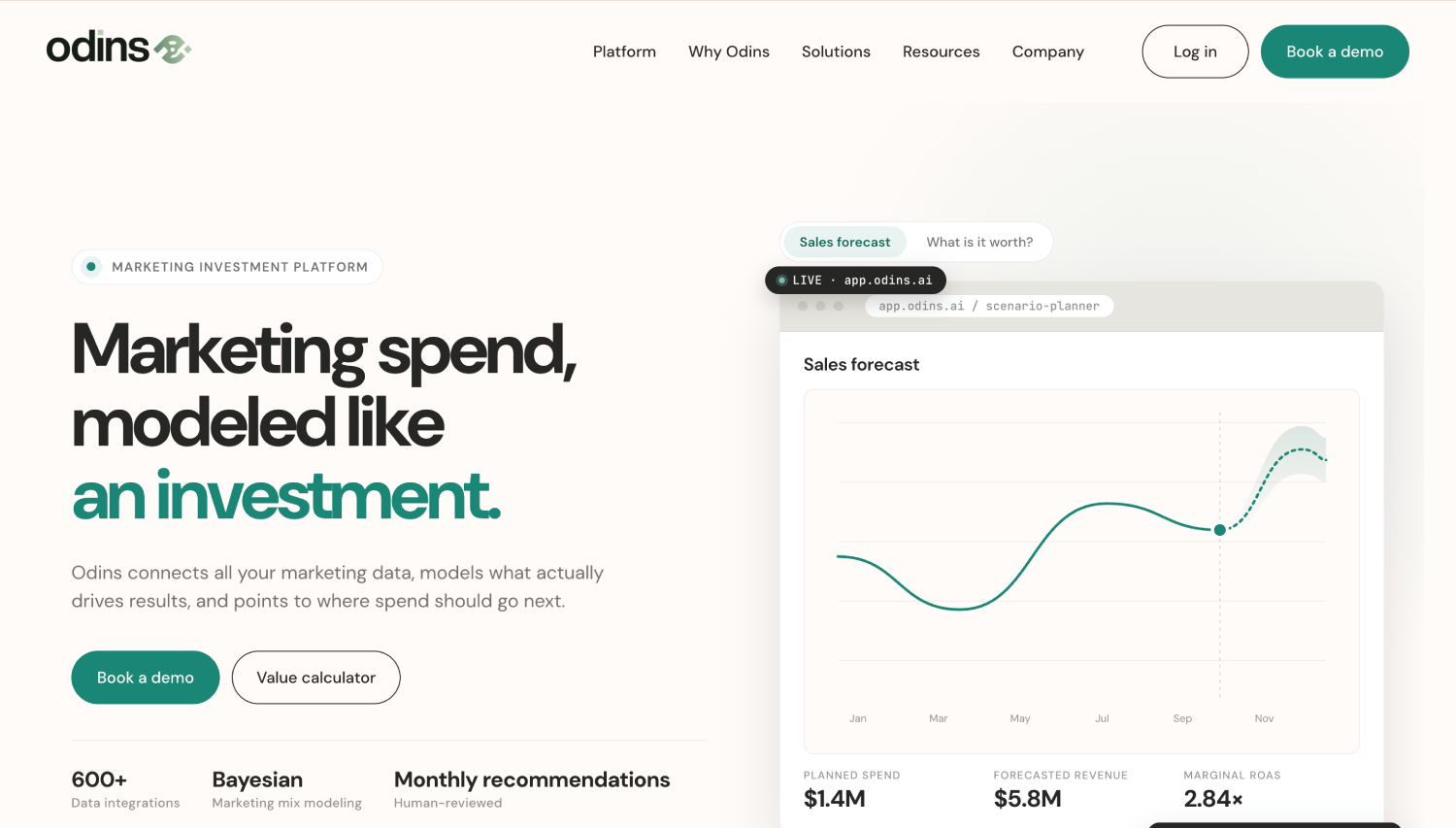
Odins is a fully managed Bayesian MMM platform from Oslo. It is built for mid-market advertisers that run several channels and have no econometrics team. Most platforms on this list hand the customer a login. Odins hands over a working model. Its team connects the data sources, builds and maintains one model per market, and reviews every recommendation before it reaches the customer. A monthly review and a quarterly strategy session are part of the service, and the structured data can be delivered back into the customer’s own warehouse.
The integration layer is where Odins solves the problem this article opened with. It covers 600+ connectors on the digital side. TV, radio and out-of-home are included even when that data arrives as invoices and spot reports rather than an API feed. Those offline channels are exactly the ones pixel-based tracking cannot see. In most MMM projects, they are also where data preparation quietly eats the first two months. Odins reports a first model four to six weeks from kickoff.
The modeling choices are built for thin data. A US brand can lean on variation across fifty states. Most European markets offer one national time series, which gives the model far less to learn from. Odins puts most of its effort into the priors. It sets them from the customer’s own historical budgets, signals in the ad platforms, and structured interviews with the marketing team. It then updates them against two or more years of spend and revenue history. This is the calibration problem flagged at the top of this article, handled as the core of the product rather than a setup step.
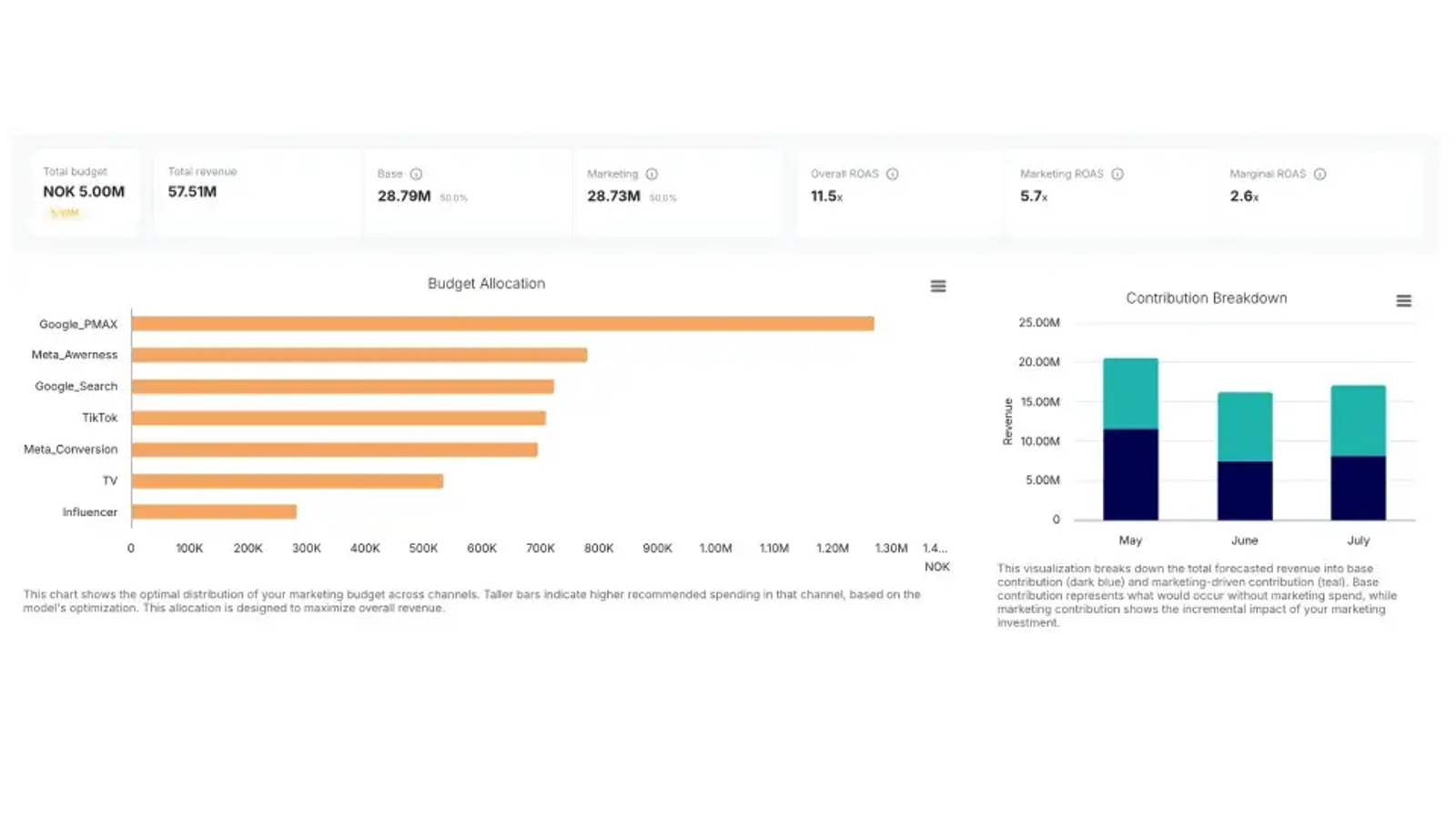
The output is built for the budget conversation. Odins treats total budget size as the first question, before the channel split. That gives the CFO an answer on how much to spend and gives the CMO an answer on where to put it. Each month brings a ranked list of recommendations with confidence ranges. A scenario planner covers budget levels and channel mixes, and cross-channel reporting shows spend and revenue across every channel in one view. A test plan targets channels where the model is still uncertain. Odins also stores each forecast before the actuals arrive, so accuracy can be checked after the fact. Few vendors in this category expose that kind of accountability. The model can also be queried from Claude, ChatGPT or Copilot through an MCP server.
The customer base is Nordic. Brands including CDON, Nettbil, Hyre and Megaflis run their marketing budgets on it. Odins has also published a case study with Aprila Bank reporting 37% more applications on the same budget.
The trade-off is control and cadence. Because this is a managed service, teams that want to change the model architecture or run code in their own environment will be better served by Meridian or Robyn. Models refresh monthly, which suits monthly and quarterly budget decisions but is too slow for weekly bid changes. Teams on that cycle should look at Recast. The sweet spot is an advertiser spending more than EUR 1 million a year across several channels, offline included, that wants the modeling run for them. Pricing is quote-based, and a demo environment with sample data is available on request.
Recast
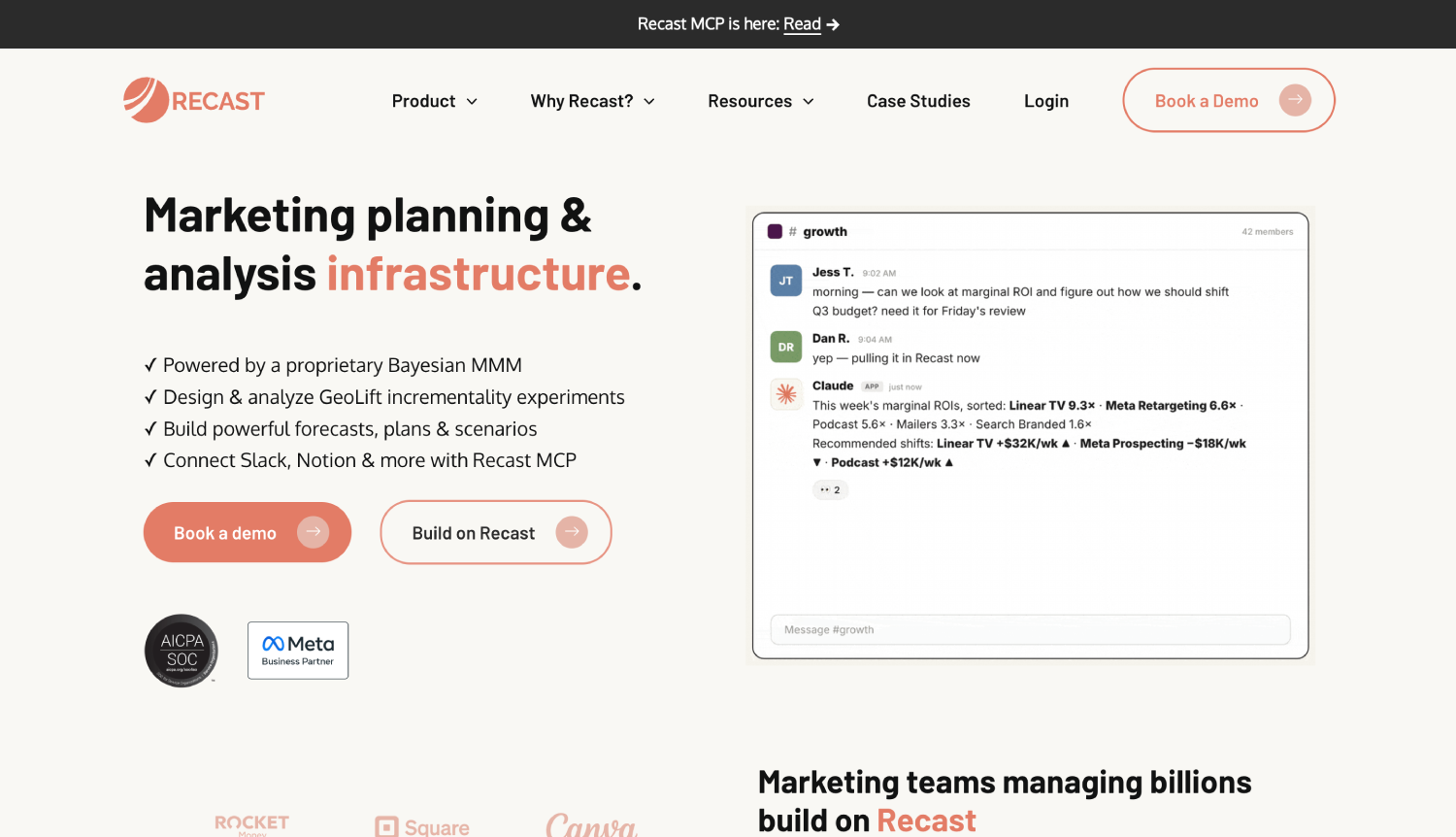
Recast is the closest alternative to Odins for teams that want weekly refreshes: a fully managed Bayesian MMM platform built specifically for marketing teams that cannot staff an econometrics function. The core product takes weekly spend data across channels, revenue or conversion outcomes, and external variables like promotions and seasonality, then fits a hierarchical Bayesian model that refreshes weekly. The output is a budget allocation recommendation with credible intervals, not just point estimates.
What sets Recast apart technically is its treatment of adstock and saturation. Rather than requiring the user to specify decay parameters as fixed inputs, Recast estimates them from the data using Bayesian priors calibrated to channel type. A team new to MMM that does not know the right adstock half-life for paid social versus TV will not have to guess. The model infers it.
The platform is transparent about uncertainty in a way that most tools are not. Budget recommendations come with probability distributions, so a CMO can see not just “spend more on paid search” but “there is an 80% probability that increasing paid search by X% produces positive incremental return at your current saturation level.” That framing tends to land better in budget conversations than a single point estimate.
The main limitation is that you are working inside Recast’s model structure. Teams that need to export raw posteriors, modify prior distributions, or integrate MMM outputs into a custom data warehouse workflow will hit walls. That is a meaningful constraint for a data-mature team with existing measurement infrastructure, and a non-issue for the target buyer who does not have one. Pricing is quote-based; Recast does not publish tiers publicly.
Mutinex
Mutinex is an Australian MMM platform that has expanded significantly into North American and European markets. Its differentiation from Recast is primarily in the front-end experience: the GrowthOS product is built around an interactive budget simulation layer that lets marketers run “what if I shift $500K from display to connected TV” scenarios in real time, with the underlying Bayesian model updating the projected revenue outcome.
For teams where the CMO is the primary MMM consumer rather than an analyst, this matters. Most MMM outputs require someone to interpret model coefficients and translate them into budget decisions. Mutinex compresses that translation step into a UI that finance and marketing leadership can use directly.
The trade-off is model transparency. Teams that want to inspect priors, modify the model architecture, or export raw posteriors for further analysis will find the platform constraining. Mutinex is a decision-support tool first and a modeling environment second, that distinction should drive whether it belongs in your shortlist.
Mutinex publishes customer case studies from large Australian retailers and consumer brands, but verifiable pricing is not public. The platform targets mid-enterprise spend. For teams evaluating the broader attribution picture, the comparison of customer data platforms for B2B teams is relevant context for how upstream data quality affects MMM model accuracy.
Meridian: Google’s open-source Bayesian MMM framework

Meridian is Google’s production-grade open-source MMM library, released in 2024 as the successor to its earlier LightweightMMM project. It is built in Python using JAX and NumPyro, and it supports geo-level modeling out of the box, which is rare in open-source tools. Geo-level MMM is particularly useful for brands that run regional budget experiments because it can identify causal effects from geographic variation rather than relying solely on time-series data.
Meridian also ships with built-in support for Google Ads data ingestion and a calibration framework that lets users incorporate results from incrementality tests as informative priors. If your team runs geo holdout experiments via Google’s Conversion Lift product, Meridian is the natural modeling home for those results. The library is free, but a Python-fluent analyst who understands Bayesian inference is a prerequisite. Google provides documentation and colab notebooks, not a customer success team.
Robyn: Meta’s open-source MMM for R-based teams

Robyn, maintained by Meta’s marketing science team, uses a gradient-free optimization algorithm called Nevergrad to explore the model parameter space more aggressively than standard Bayesian samplers. This makes it faster at producing Pareto-optimal model solutions across thousands of hyperparameter combinations, which is useful when a team is first building its MMM and exploring which model structure fits the data best.
Robyn’s main limitation is that it is R-based. For teams whose data stack runs on Python, integrating Robyn into existing pipelines adds friction. Meta has kept the library actively maintained, and the documentation is solid, but the R requirement is a real constraint in 2026 where most analytics infrastructure has shifted toward Python. Teams running heavy Meta spend will find Robyn’s default channel priors well-calibrated for Meta’s ad products, which is a meaningful advantage in early model runs.
Analytic Edge: best mid-market managed MMM service

Analytic Edge sits between DIY open source and full enterprise managed service. The company delivers MMM as a service, handling data ingestion, model specification, and output presentation, but at price points designed for mid-market advertisers rather than Fortune 500 budgets. Teams that want expert-built models without internal data science capacity and cannot justify enterprise managed-service pricing are the core audience.
The trade-off with any managed MMM service is model transparency. When the vendor controls the model, understanding what assumptions drive the output requires active dialogue. Teams should ask explicitly for prior documentation, validation diagnostics, and the ability to rerun models with different assumptions before signing a contract.
Nielsen and Neustar: enterprise MMM with decades of benchmark data

Nielsen’s MMM practice and Neustar’s marketing mix modeling (now under TransUnion) are the legacy leaders in the space. Both charge enterprise-level fees, deliver quarterly cadence models, and bring decades of cross-category benchmark data that pure-SaaS competitors cannot match. If your CMO is presenting MMM results to a board that will ask “how does our paid media efficiency compare to category norms,” Nielsen and Neustar have the benchmarks.
The weakness of both is speed. Quarterly cadence made sense when MMM ran on mainframes. Modern Bayesian tools on cloud compute can refresh weekly. For brands running always-on digital spend where channel mix shifts month to month, a quarterly model is a rearview mirror. Nielsen and Neustar are best suited to large CPG, pharma, or financial services brands where the budget cycle is annual, the spend is heavily offline, and benchmark comparison to category peers is genuinely valuable. Pricing for both is quote-only and typically anchors in the six-figure annual range.
Ekimetrics: best for multi-market and global MMM complexity

Ekimetrics is a data science consultancy with a proprietary MMM platform, and it is the right choice for brands running campaigns across multiple countries with different media markets, currency effects, and regulatory environments. Building a single MMM that correctly handles German TV versus UK digital versus US paid social requires model architecture choices that generic SaaS tools do not support out of the box. Ekimetrics builds models with enough flexibility to handle that complexity while providing a shared platform layer for output visualization.
Cost and timeline are the constraints. Ekimetrics engagements are priced as consulting retainers, not software subscriptions. For a single-market brand, that structure is expensive relative to Recast or Mutinex. For a brand with material spend across five or more markets, the alternative of running separate country-level models and trying to reconcile budget recommendations across them is worse.
LightweightMMM: Google’s original open-source Bayesian framework
LightweightMMM is Google’s earlier open-source MMM library, built in Python using NumPyro. Google has since released Meridian as its next-generation offering, but LightweightMMM remains actively used by teams that built on it before Meridian’s launch and have no reason to migrate. It handles adstock transformations, saturation curves, and Bayesian inference well, with a clean API and good documentation.
For new projects starting from scratch, Meridian is the better choice given its geo-level capabilities and tighter integration with Google’s incrementality products. LightweightMMM makes sense if you have existing model code and trained analysts familiar with its structure. Both are free, so the comparison is about future maintenance cost and capability ceiling rather than price.
How does marketing mix modeling compare to multi-touch attribution?
MMM and multi-touch attribution (MTA) measure different things and should not be treated as substitutes. MTA allocates conversion credit across touchpoints at the user level, requiring cookies or identity resolution. MMM estimates the aggregate revenue contribution of each channel using historical spend data, with no user-level tracking. MMM works where MTA cannot: offline media, CTV, cookieless environments, and walled gardens that withhold impression logs.
The most measurement-sophisticated teams run both and use them to triangulate. MTA gives granular short-term channel feedback. MMM provides the macro read on long-run channel contribution and diminishing returns. When the two disagree, that disagreement is itself informative. It usually points to either an attribution gap in MTA (a channel that converts but gets no credit because it operates outside the pixel) or an overfitted MMM. Teams evaluating the full measurement picture should also look at the warehouse-native CDP options that can centralize the spend and conversion data that feeds both models.
What does good MMM output actually look like?
Consider a hypothetical direct-to-consumer brand spending $2M per month across paid search, paid social, email, connected TV, and podcast. A well-specified MMM would produce, for each channel, a response curve showing marginal revenue per additional dollar spent at the current investment level. Paid search at $400K/month might show steep diminishing returns at that saturation point, while podcast at $150K/month might show the curve still in its linear phase. The model’s budget recommendation would be to shift dollars from search to podcast until the marginal returns equalize.
That specific output format, marginal return curves and confidence intervals rather than coefficient tables, is what distinguishes the commercial platforms (Odins, Recast, Mutinex) from raw open-source output. Odins goes a step further by storing each forecast before the actuals arrive, so the model’s accuracy can be audited after the fact. An analyst can build those curves from Robyn or LightweightMMM output, but it takes additional work. For teams where the analyst spends more time building charts than asking questions, the SaaS markup is justified.
For data pipeline context, since clean weekly spend and revenue data is a prerequisite for any MMM, the best reverse ETL tools for activating warehouse data covers the infrastructure layer that often feeds MMM inputs from a centralized data warehouse.
Frequently asked questions about marketing mix modeling software
How much historical data does MMM require to produce reliable results?
Most practitioners recommend a minimum of two years of weekly data, meaning 104 data points per channel, to produce posterior distributions with credible intervals narrow enough to inform budget decisions. Some Bayesian platforms claim usable output at one year, but shorter histories produce wider uncertainty ranges and increase the risk that the model is fitting noise rather than signal. Brands with shorter histories should use informative priors based on industry benchmarks to compensate.
Can MMM work for B2B companies with longer sales cycles?
Yes, but it requires extra care with the outcome variable. A B2B company with a 90-day sales cycle cannot use weekly closed-won revenue as the dependent variable because the signal arrives too late to reflect the channel activity that drove it. Most B2B MMM implementations use pipeline created or marketing-qualified opportunities as the outcome, or they model a lagged revenue variable that accounts for the average conversion timeline. The model structure is valid; the outcome selection is the variable that requires judgment.
What is the difference between Bayesian MMM and traditional econometric MMM?
Traditional econometric MMM uses frequentist regression, producing point estimates for each channel’s contribution. Bayesian MMM treats model parameters as probability distributions, allowing the modeler to encode prior knowledge about channel behavior, such as expected adstock decay rates, and producing posterior distributions that quantify uncertainty explicitly. Bayesian models are more interpretable in the “what is the probability this channel is producing positive ROI” framing and tend to be more reliable with shorter data histories, which is why most modern platforms have migrated to Bayesian architectures.
Do I need a clean data warehouse before starting MMM?
Not necessarily, but data quality is the primary determinant of model quality. You need weekly aggregated spend by channel and a weekly outcome metric, both going back at least two years. Many teams start with a spreadsheet-based data pull and migrate to a warehouse-connected pipeline later. Where warehouse investment pays off most is in automating the weekly data refresh that keeps an always-on MMM current. Manual data pulls introduce errors and delay, which degrade a model that is otherwise accurate.
How does MMM handle digital channels versus offline media?
MMM treats digital and offline channels symmetrically, which is one of its core advantages over pixel-based attribution. TV, radio, out-of-home, and print all enter the model as weekly spend inputs alongside paid social and search. The model estimates each channel’s contribution from the correlation between spend changes and revenue changes over time, controlling for seasonality and external factors. The caveat is that channels with highly stable spend over time, such as a TV flight that never changes, provide less statistical variation for the model to learn from and produce wider confidence intervals. Offline data also rarely arrives clean. Platforms such as Odins ingest TV, radio and out-of-home from invoices and spot reports, which removes the most manual part of the setup.
Is open-source MMM production-ready for a team without data scientists?
No. Robyn, Meridian, and LightweightMMM are production-grade tools for teams with Python or R expertise and a working understanding of Bayesian inference. Setting up the model, validating priors, interpreting output, and maintaining the pipeline as your channel mix evolves all require technical ownership. Teams without that capacity will spend more on analyst time than the cost difference between open source and a commercial platform. The right frame is total cost of ownership, not licensing cost. Those teams are better served by a fully managed platform such as Odins or a managed service such as Analytic Edge.
How often should an MMM model be refreshed?
It depends on how frequently your budget decisions change. For annual planning cycles, a quarterly refresh is adequate. For teams that set budgets monthly, a monthly refresh such as Odins’ is the practical middle ground. For teams moving budgets weekly, such as performance marketing teams with fast feedback loops, a weekly refresh is the right target. Most commercial SaaS platforms support weekly refresh as their standard cadence. Managed service providers like Nielsen and Neustar typically operate on quarterly cadence by default, which limits their utility for tactical budget decisions.
What is adstock, and why does it matter for MMM accuracy?
Adstock is the carryover effect of advertising: the idea that a TV impression or podcast ad does not produce its full revenue contribution in the same week it airs. Some impact persists in subsequent weeks as audiences recall the message and eventually convert. MMM models adstock using a decay parameter that controls how quickly that carryover effect diminishes. Getting adstock parameters wrong, either too fast or too slow, systematically misattributes revenue between the period the ad ran and subsequent periods, distorting channel contribution estimates. Bayesian models estimate adstock from the data rather than requiring the user to specify it, which is one reason they have largely replaced traditional econometric approaches.
What to prioritize when choosing your MMM platform
The most common mistake buyers make is optimizing for model sophistication when they should be optimizing for decision speed. A technically superior model that requires a PhD to interpret and updates quarterly will move fewer budget dollars than a good-enough model with a clean UI that updates weekly and surfaces a clear recommendation every Monday morning. The gap between “best model” and “most useful model for your organization” is real, and it is not always the same tool.
For teams starting from zero, Odins is the most hands-off route to MMM: the vendor builds, maintains and reviews the model, and offline media is part of the setup. Recast is the most direct path to always-on weekly MMM without internal data science capacity. Mutinex is the better choice if the CMO will be the primary platform user and needs to run budget scenarios without an analyst intermediary. If your team has Python engineers and wants model transparency plus zero licensing cost, Meridian is the current open-source standard. Nielsen and Neustar belong in the conversation only when enterprise benchmark data or offline-heavy measurement is a board-level requirement.
Post-cookie measurement is not a single tool problem. MMM covers the aggregate read on channel contribution. Attribution tools cover the user-level funnel. Incrementality experiments provide causal validation. Teams that treat MMM as the only measurement layer they need will draw confident conclusions from a partial picture. The most measurement-mature teams use MMM to set the macro budget allocation, run incrementality tests to validate the model’s key assumptions, and use whatever attribution data remains to optimize within channels. That three-layer architecture is more work than buying one platform and calling it done. It is also the only approach that holds up as identifiers disappear.