TLDR
- Clay’s credit model prices enrichment attempts, not enrichment successes, so a waterfall pass across five providers burns credits whether the email resolves or not.
- Apollo, FullEnrich, Persana, Freckle, and Cargo each offer waterfall enrichment with different pricing structures, data coverage trade-offs, and workflow depth.
- Small teams under 20 seats typically overpay for Clay’s workflow builder; pure enrichment APIs or lighter orchestration tools recover that budget immediately.
- The right alternative depends on whether your bottleneck is data coverage, workflow automation, or CRM writeback, not on which tool has the longest vendor list.
- This article uses the AboutMartech Coverage-Cost-Control framework to evaluate each option so you can match the tool to your actual constraint, not the tool’s marketing page.
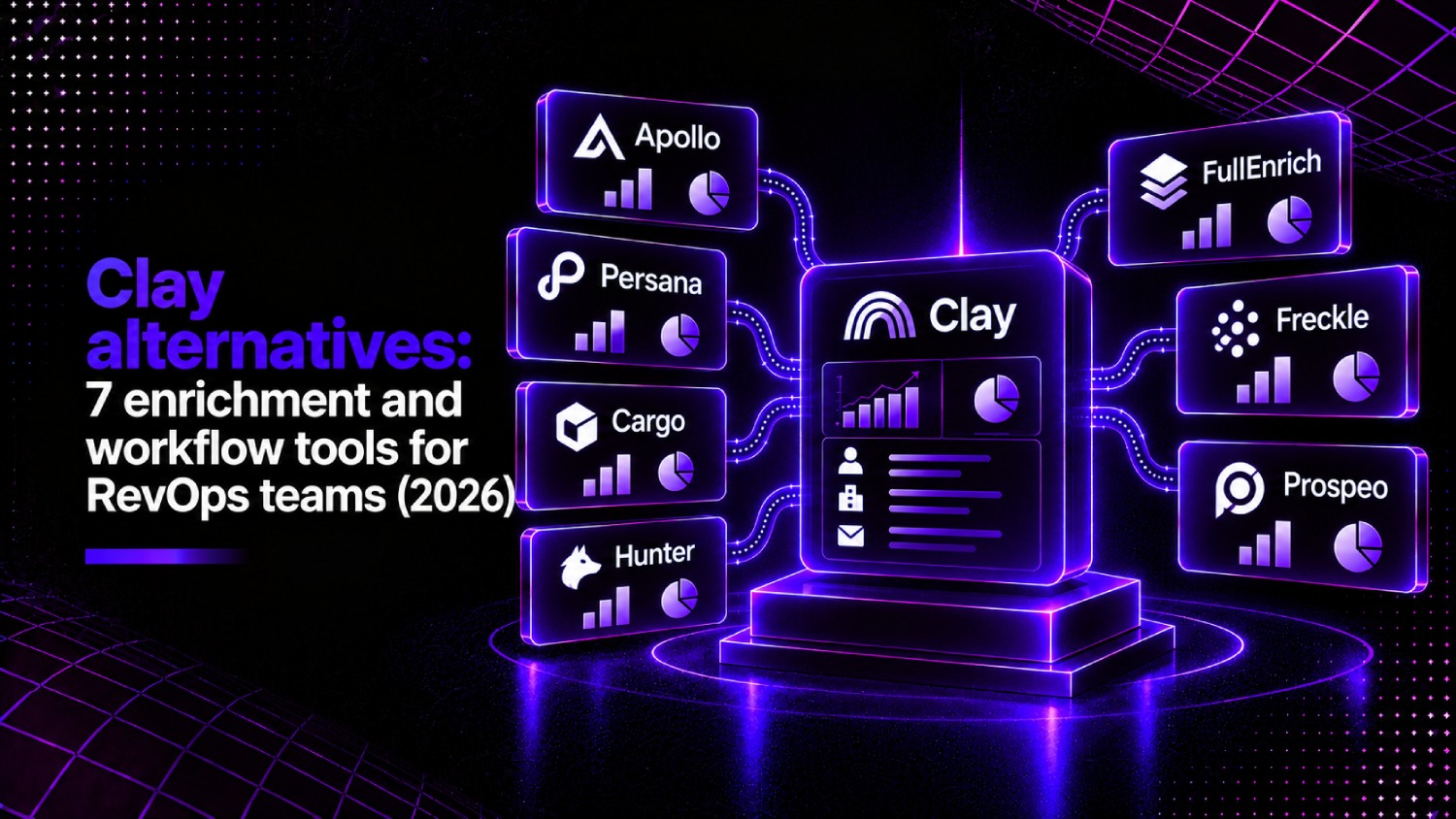
The best Clay alternatives for RevOps teams are Apollo, FullEnrich, Persana, Freckle, Cargo, Prospeo, and Hunter. Each covers waterfall enrichment across multiple data providers, but they differ significantly on pricing structure, workflow depth, and how they handle credit consumption. If your main objection to Clay is unpredictable credit costs, Apollo and FullEnrich are the fastest replacements. If you need orchestration depth closer to Clay’s table-building model, Persana and Cargo are the better comparisons.
Why RevOps teams are re-evaluating Clay right now
Clay’s value proposition is legitimate: you build a waterfall enrichment flow, pull from 75-plus data providers in sequence, and only pay one vendor. The problem is the credit model. According to Clay’s public pricing page, credits are consumed per row per action, and waterfall enrichment by design runs multiple actions per row before it resolves a result. A team enriching 10,000 contacts per month through a five-provider waterfall can burn three to five times more credits than a naive reading of the plan limits would suggest.
That math produces bill shock. Several Reddit threads on the topic note that teams hit their plan ceiling within the first two weeks of a month after building aggressive waterfalls. Clay’s pricing calculator helps model this, but it requires you to already understand the flow you want to build, which is a chicken-and-egg problem for teams new to the tool.
The other friction point is complexity. Clay is genuinely powerful, but it is a workflow builder first and an enrichment tool second. Teams that need enrichment without orchestration, or enrichment baked directly into a CRM like Salesforce or HubSpot, are buying tooling they will not use.
The AboutMartech Coverage-Cost-Control framework for evaluating enrichment tools
Before comparing individual tools, it helps to have a consistent evaluation lens. Generic feature comparisons obscure the actual trade-off, which is always between three variables.
Coverage is how many records a tool can resolve across your target segment. A tool with deep coverage in US SaaS companies may have shallow coverage in EMEA manufacturing. Coverage is always segment-specific, never absolute.
Cost structure is how the tool charges for enrichment attempts versus enrichment successes. Some tools charge per successful match. Others charge per API call regardless of outcome. That difference is the core reason teams switch away from Clay.
Control is how much the tool lets you configure fallback logic, data source priority, and field-level overwrite rules. Low-control tools are faster to set up but produce data quality problems at scale. High-control tools require investment to configure but protect CRM hygiene downstream.
Run every tool on this list through these three lenses against your specific ICP before buying. The winner changes depending on which variable is your actual constraint.
1. Apollo: the most direct clay alternative for teams that want one vendor
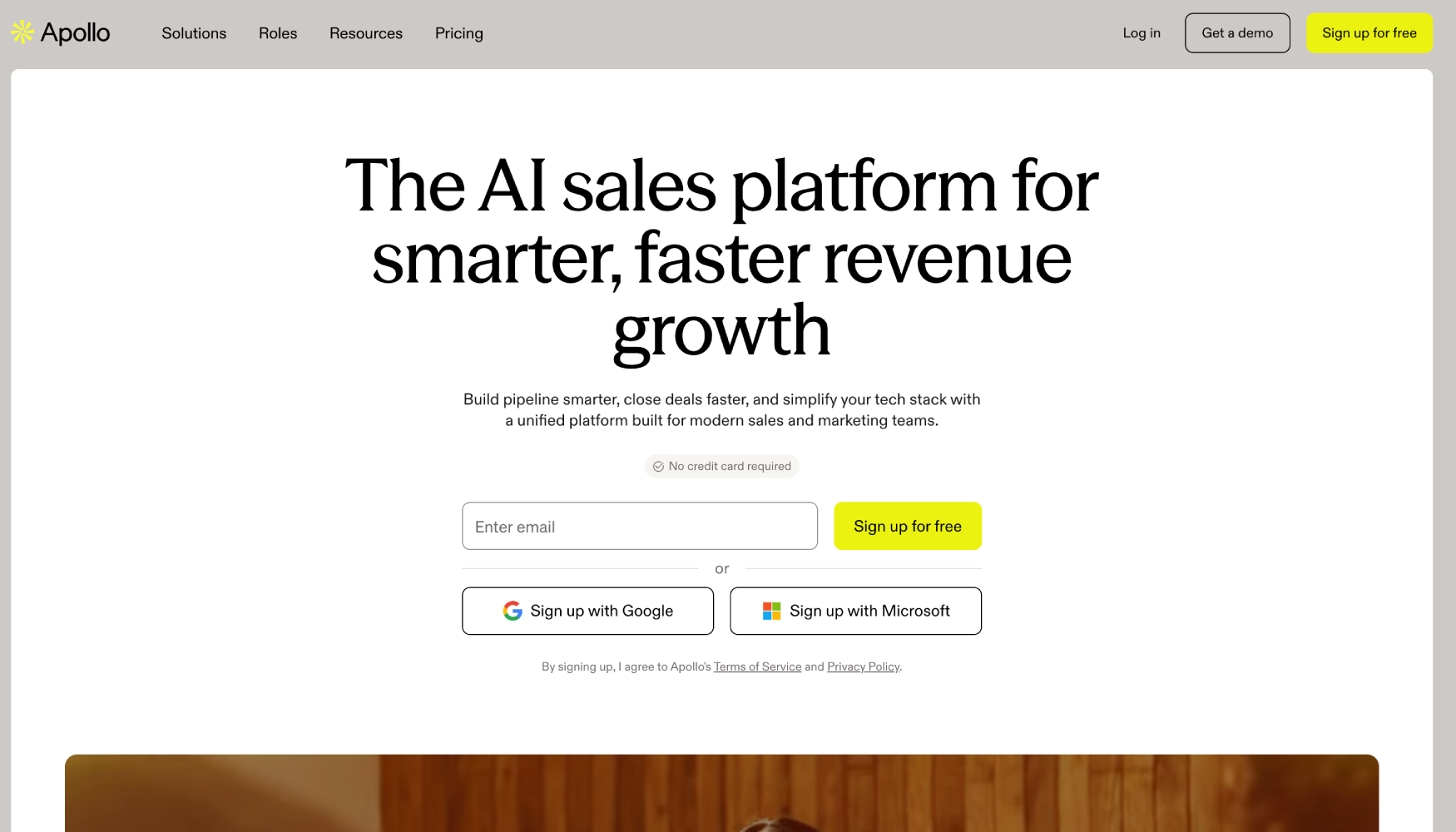
Apollo is the tool most teams reach for first when leaving Clay, and for straightforward reasons. It combines a contact database, email sequencing, and enrichment in a single platform, so the integration surface area is smaller. Apollo’s database covers over 275 million contacts according to their public product page, and enrichment runs against that database plus third-party sources.
Apollo’s pricing model differs meaningfully from Clay’s. Rather than credits per enrichment action, Apollo charges per plan tier with credit allotments for exports and enrichment calls. The Basic plan starts at $49 per user per month as of Apollo’s public pricing page, and credits reset monthly. Teams running high-volume prospecting sequences find this more predictable than Clay’s consumption model.
The trade-off is workflow flexibility. Apollo’s enrichment is tied to Apollo’s database and its own sequencing engine. You cannot orchestrate external providers the way Clay does. If you need to pull from Clearbit, Bombora, or a niche technographics provider in sequence, Apollo will not replace that capability. But if your enrichment need is finding verified emails and mobile numbers for accounts your sales team already identified, Apollo covers it without the waterfall complexity.
Apollo vs Clay is also a question of sequencing. If your SDRs run outreach inside the enrichment tool, Apollo wins on consolidation. If enrichment is a data pipeline step that feeds a separate engagement tool, Clay’s architecture fits better. Our lead enrichment and routing tools guide covers how to think about that infrastructure split in more depth.
2. FullEnrich: the cheapest alternative to Clay for email and phone waterfall
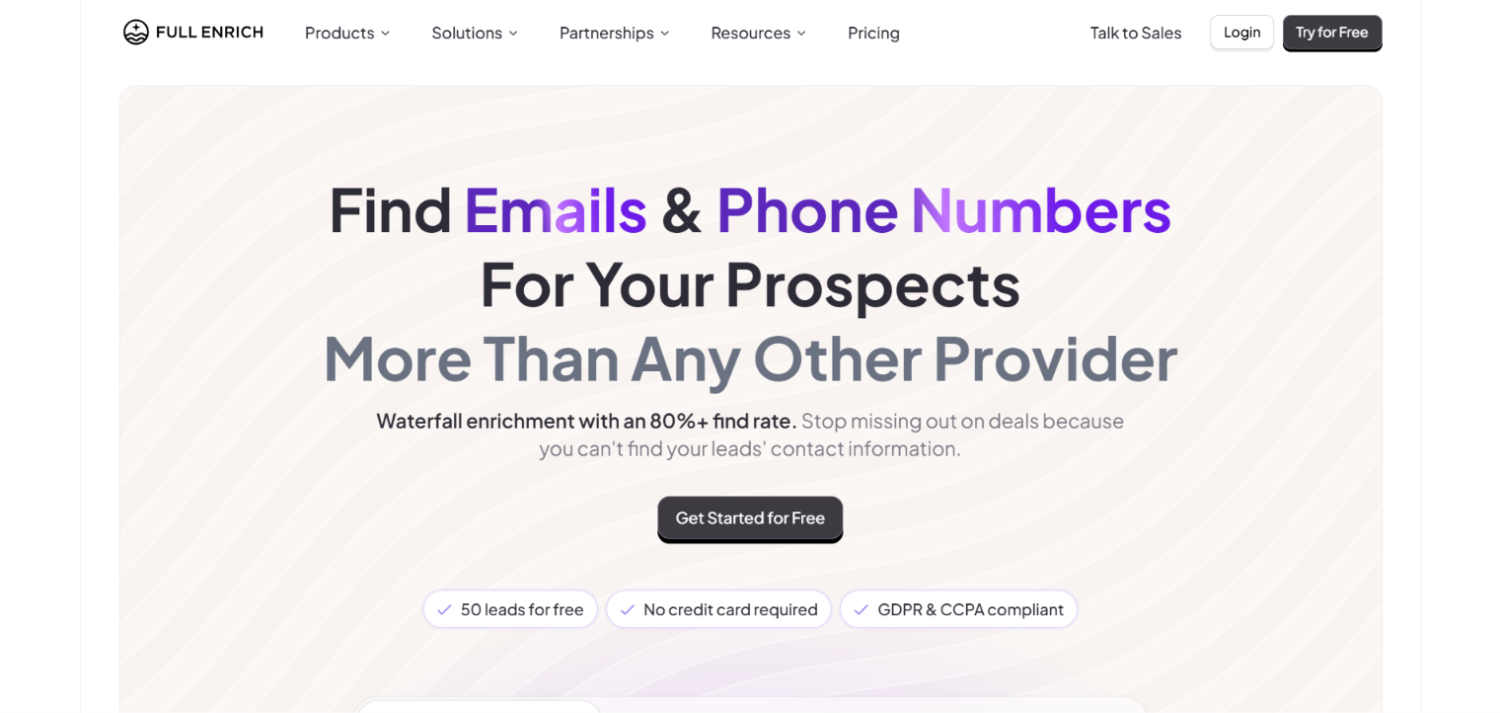
FullEnrich is purpose-built for one thing: finding verified emails and mobile numbers at the lowest cost per successful match. It runs a waterfall across multiple providers, including Hunter, Dropcontact, Snov, and others, and charges only for successful matches. That pricing inversion is the main reason teams testing it report lower effective cost-per-enriched-record compared to Clay’s credit-per-action model.
FullEnrich’s public pricing page shows plans starting at $29 per month for 250 credits, where one credit equals one successful match. There are no charges for failed lookups. For teams enriching relatively clean lists of known accounts, that structure is highly efficient. For teams running speculative enrichment against cold lists with low match rates, the difference narrows.
What FullEnrich does not do is workflow orchestration. There are no conditional branches, no AI research steps, no web scraping. It is an enrichment API and a CSV enrichment interface. Teams that want the full Clay workflow model will find it too narrow. Teams that extracted only the waterfall enrichment piece from Clay and paid heavily for it will find FullEnrich a materially cheaper replacement.
3. Persana: the clay alternative that adds AI research to the waterfall
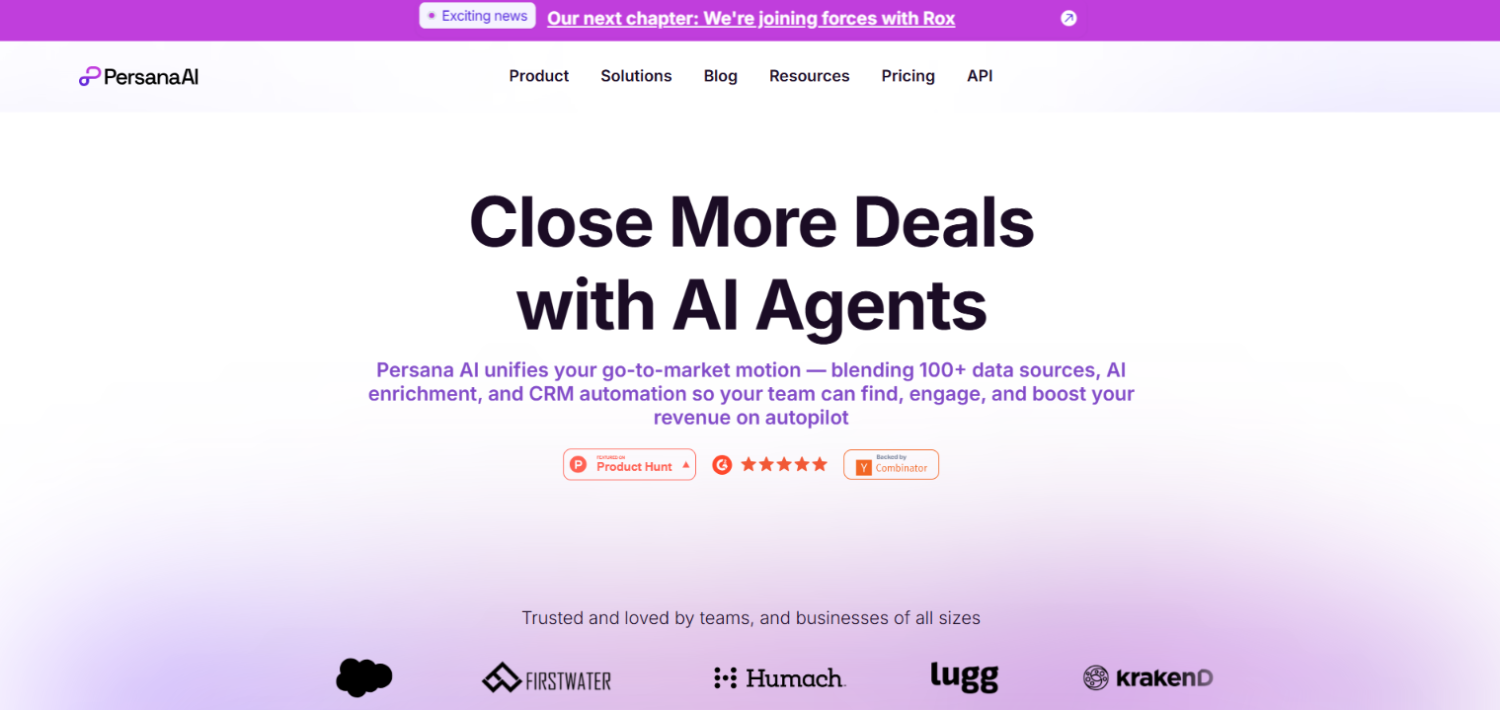
Persana occupies the middle ground between pure enrichment tools and Clay’s full workflow depth. It runs waterfall enrichment across providers and layers in AI-powered research steps that can pull from LinkedIn, company websites, and news sources to generate personalized context for outreach. That combination makes it closer to Clay’s table-building model without requiring the same setup investment.
Persana’s pricing is not fully public; the website shows plans starting at $85 per month but directs larger teams to sales for enterprise pricing. The platform integrates with Salesforce, HubSpot, and Outreach, and it supports CRM writeback with field-level control. For RevOps teams that want AI-generated talking points alongside contact data, rather than assembling that from separate tools, Persana combines both in one workflow.
The weakness is data coverage depth. Persana’s underlying provider network is smaller than Clay’s 75-plus integrations. Teams with niche enrichment requirements, specific technographics signals, or specialized firmographic sources may hit coverage gaps. It is a strong fit for outbound-focused teams running standard B2B ICP enrichment who want AI personalization baked in without stitching together three separate platforms.
4. Freckle: the easiest waterfall enrichment tool for small teams
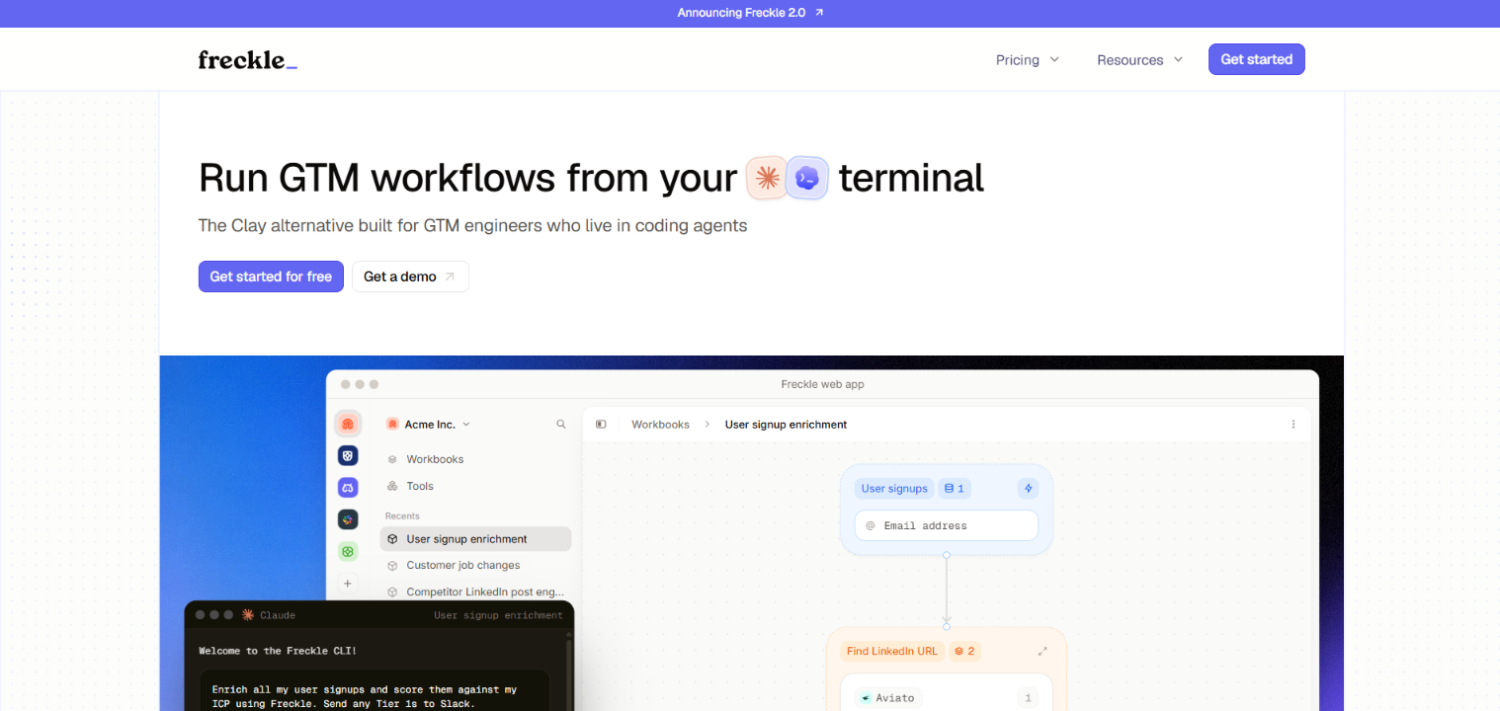
Freckle appears consistently in practitioner reviews as the lowest-friction Clay alternative for teams that found Clay’s table interface overwhelming. It runs waterfall enrichment with a simpler setup flow, charges on a per-match basis rather than per attempt, and is designed for teams under 15 seats that do not have a dedicated RevOps engineer to configure a Clay workspace.
Freckle’s public pricing is not fully disclosed on the site, with users directed to contact sales, but community discussions report pricing in the range of entry-level enrichment tools. The platform covers email, mobile, and basic firmographic enrichment. It does not support the kind of multi-step AI research or conditional logic that Clay or Persana offer.
For a small sales team that needs verified emails and phone numbers for a list of target accounts, Freckle is genuinely the fastest path from spreadsheet to enriched data. For a RevOps team building a data pipeline that feeds a CDP or warehouse, it is too thin. The product’s positioning is explicitly ease-of-use, and it delivers on that without pretending to be a workflow platform.
5. Cargo: the clay alternative for warehouse-native revenue teams
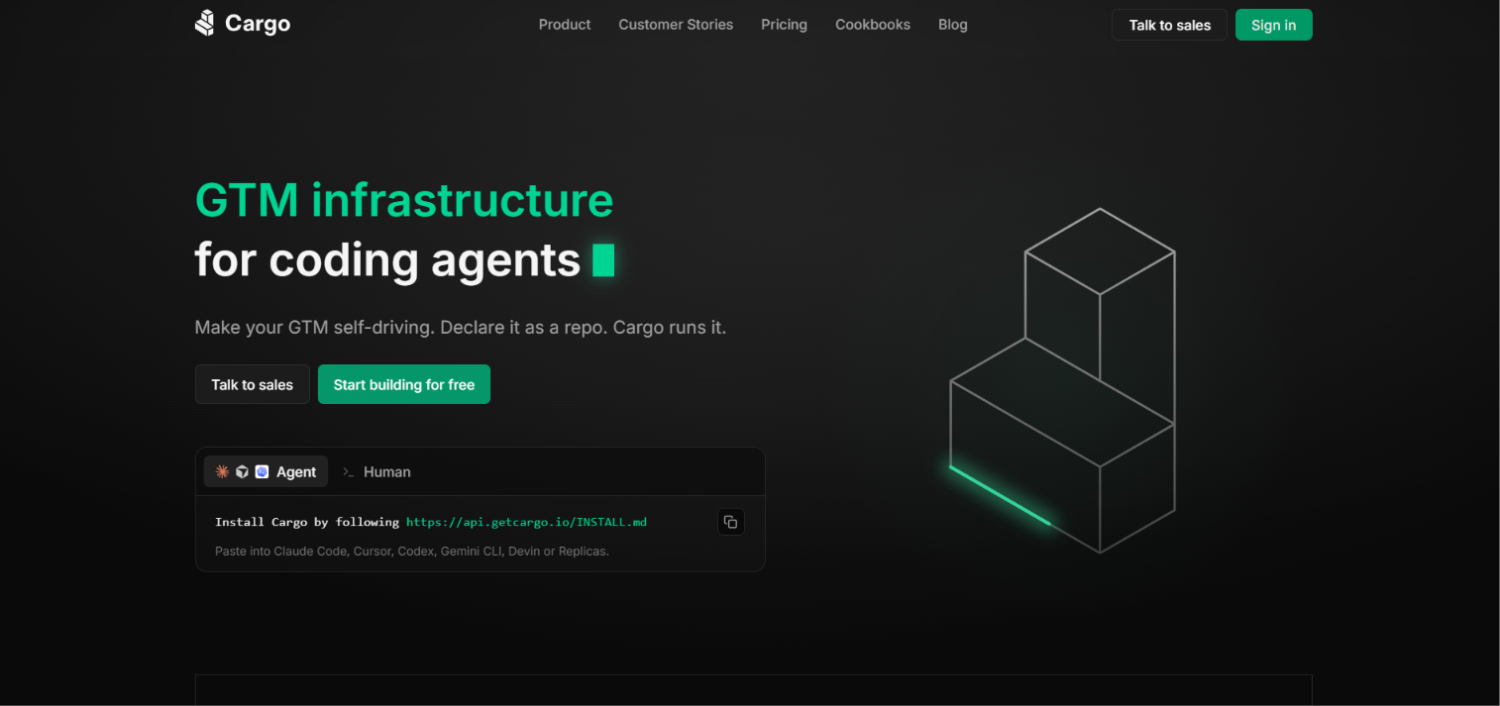
Cargo is the most architecturally distinct tool on this list. Rather than operating as a standalone enrichment workspace, Cargo connects to your data warehouse or CRM and runs enrichment and segmentation workflows directly against your existing data. If your team has already invested in a Snowflake or BigQuery warehouse and wants enrichment to feed into that stack rather than exist as a separate silo, Cargo fits that model in ways Clay does not.
Cargo supports waterfall enrichment, CRM writeback, and audience segmentation with a visual workflow builder. Pricing is not public and requires a demo. The platform is a better fit for teams with a RevOps or data engineering function than for small teams without that infrastructure. Our coverage of RevOps tools across the revenue operations stack gives broader context on where enrichment fits in that architecture.
The trade-off with Cargo is onboarding time. Connecting a warehouse-native enrichment tool requires that your warehouse is clean, your schema is documented, and someone on your team can configure the workflow. Teams without that foundation will find Cargo harder to start than Clay, not easier. Teams with that foundation will find Cargo produces cleaner downstream data because enrichment happens in context of their actual data model rather than exporting and re-importing between systems.
6. Prospeo: the clay alternative for finding emails at scale without paying per attempt
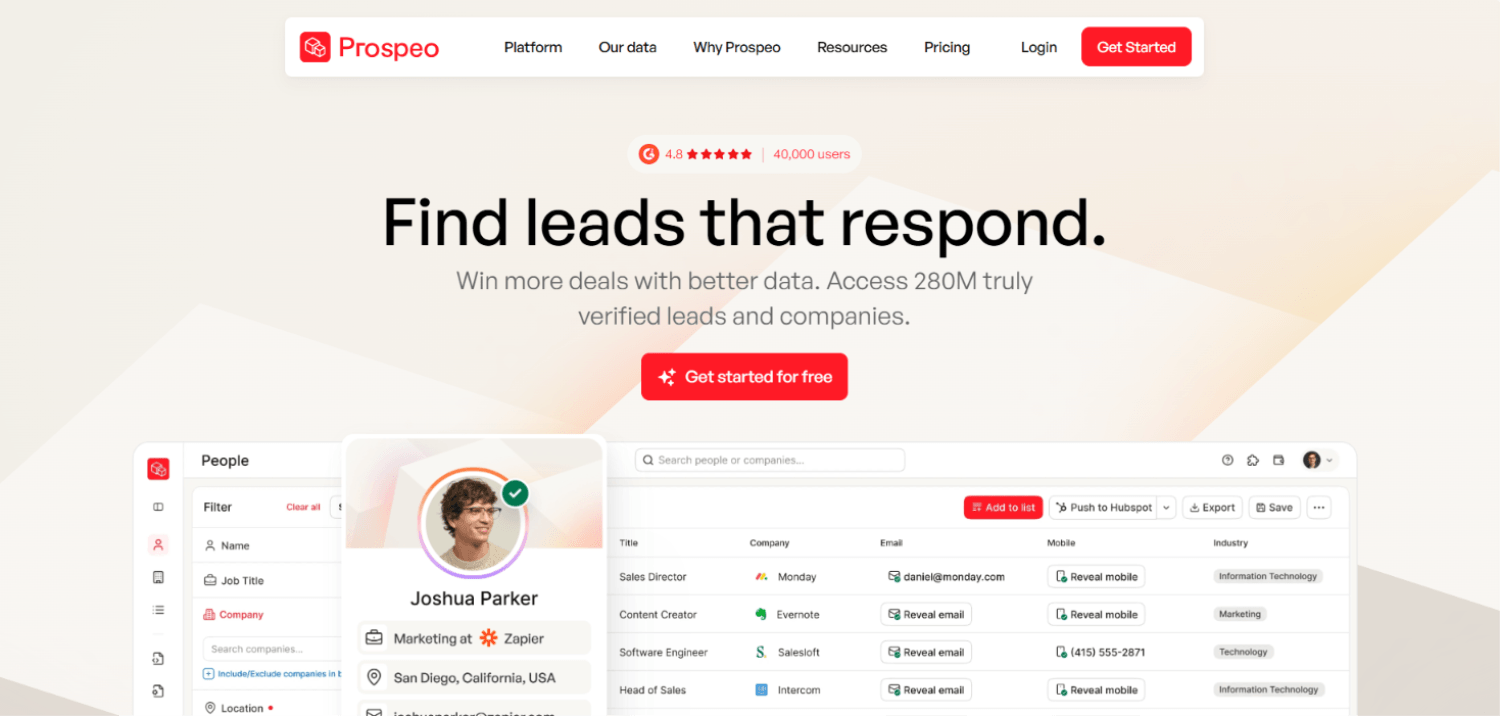
Prospeo is a focused email finder that runs verification through multiple sources and charges per valid result. It is not a workflow tool, but it solves the most common single enrichment task at a predictable cost. According to Prospeo’s public pricing page, plans start at $39 per month for 1,000 credits, where credits apply to found and verified emails only.
Prospeo’s LinkedIn Email Finder extension and bulk enrichment via CSV make it practical for SDR teams that import lead lists from LinkedIn Sales Navigator. The platform does not support phone enrichment, firmographic data, or AI research steps. It is the narrowest tool on this list by design, which is also what makes it the cheapest option for teams whose only gap is verified business email addresses at volume.
Teams running a mixed enrichment stack, where phone data comes from Apollo and emails come from Prospeo, can undercut Clay’s total credit cost on those two fields alone if their lists have high match rates. That fragmented approach requires more integration work, but for cost-sensitive teams with straightforward enrichment needs, it is a legitimate alternative to paying for Clay’s full workflow capacity.
7. Hunter: the clay alternative with the longest track record for email enrichment
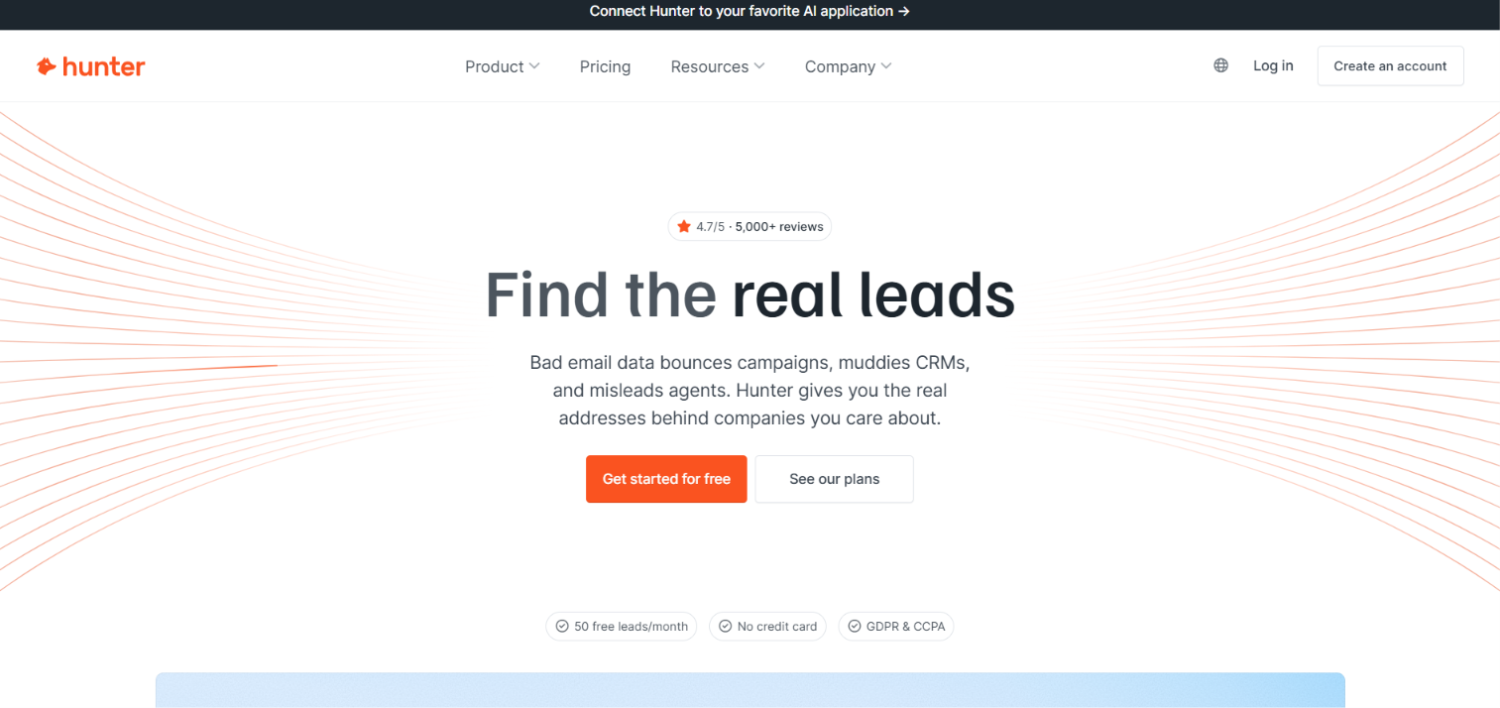
Hunter is the oldest standalone email enrichment tool in widespread use among B2B sales teams. It finds and verifies professional email addresses by domain, crawls publicly available sources, and provides a confidence score for each result. Hunter’s public pricing page shows a free tier for 25 searches per month, with paid plans starting at $34 per month for 500 searches.
Hunter does not do waterfall enrichment across multiple providers. It runs its own database and crawler. For teams that need email enrichment only, and specifically domain-based pattern matching (finding the right email format for a company), Hunter remains the most reliable and cost-transparent option available. The tool has been in production long enough that its data quality on established US and European companies is well-documented.
Where Hunter falls short is mobile numbers, firmographics, technographics, and anything beyond email. Teams that need full contact enrichment will need to combine Hunter with a second tool, or accept incomplete records. Hunter is a component in an enrichment stack, not a replacement for Clay’s full feature set. That context matters when evaluating cost savings: the savings are real, but only if email enrichment is your primary gap.
Clay alternatives compared: pricing, coverage, and control
| Tool | Pricing model | Waterfall enrichment | AI research steps | Phone numbers | Workflow depth | Best for |
|---|---|---|---|---|---|---|
| Clay | Credits per action (attempt-based) | Yes (75+ providers) | Yes | Yes | High | GTM teams needing full orchestration |
| Apollo | Per user per month, credit allotments | Partial (Apollo DB + select providers) | Limited | Yes | Medium | Teams consolidating enrichment and sequencing |
| FullEnrich | Per successful match | Yes (multi-provider) | No | Yes | Low | Cost-focused teams needing email and phone only |
| Persana | Starts at $85/month, enterprise pricing on request | Yes | Yes | Yes | Medium-high | Outbound teams wanting AI personalization built in |
| Freckle | Contact sales | Yes | No | Yes | Low | Small teams without a RevOps engineer |
| Cargo | Quote-based | Yes | Limited | Yes | High | Warehouse-native RevOps teams |
| Prospeo | Starts at $39/month, per valid email | Partial (email only) | No | No | Low | SDR teams enriching LinkedIn exports |
| Hunter | Starts at $34/month, per search | No (own crawler only) | No | No | Low | Domain-based email pattern matching |
How to pick the right clay replacement without over-buying again
The most common mistake teams make after leaving Clay is buying the next tool based on feature breadth rather than their actual bottleneck. Apply the Coverage-Cost-Control framework to your last 90 days of enrichment activity before evaluating vendors.
Start with Coverage: pull your CRM enrichment success rate by field (email resolved, phone resolved, company data resolved). If your email match rate is above 70% but phone is below 30%, your coverage problem is provider-specific, not tool-specific. A tool with a stronger mobile number network fixes that. A workflow builder does not.
Then examine Cost: calculate your actual cost-per-enriched-record from your current Clay spend, including failed attempts. If that number is above $0.15 per record for standard contact fields, you are likely overpaying for workflow capability you are not using. FullEnrich, Prospeo, and Hunter all operate materially below that threshold for their coverage scope.
Finally, assess Control: if your RevOps team is spending more than four hours per week managing CRM data quality downstream of enrichment, that is a signal that your current tool has low control over field-level overwrite rules. Cargo and Persana both offer more granular writeback configuration than most lightweight alternatives. For teams building toward a data warehouse architecture, our analysis of warehouse-native CDPs for the modern data stack is worth reading alongside this comparison, since enrichment writeback and CDP activation often overlap in practice.
A worked scenario: what switching from Clay actually saves a 30-person team
Consider a B2B SaaS company with 30 people in sales and marketing, a 60-day sales cycle, and a monthly target of enriching 5,000 net-new contacts per month. They are running Clay on a plan that provides 50,000 credits per month. Their waterfall hits four providers per record (LinkedIn, Clearbit, Hunter, and a mobile provider), consuming roughly four credits per successful resolve and eight credits per failed attempt. With a 60% match rate, that burns approximately 28,000 credits on successful matches and 16,000 on failed attempts, totaling approximately 44,000 credits. They are near their ceiling every month, and failed lookups are costing them roughly 36% of their total credit spend.
If that team switches enrichment to FullEnrich for email and phone, paying only for successful matches, and uses Apollo for sequencing (where they already pay per seat), their effective enrichment cost drops to the price of 3,000 successful matches per month under FullEnrich’s pricing, plus zero for failures. That is not a negligible difference across a quarter. The trade-off is losing Clay’s workflow builder, which matters only if the team was actively using conditional logic, AI research steps, or external data provider orchestration beyond the four providers in the scenario above.
This scenario is illustrative. The credit math follows how Clay’s billing documentation describes consumption; teams should build their own version of this model against their actual match rates before signing a renewal or switching contracts.
Does your RevOps stack need enrichment at all, or something adjacent?
Not every team that evaluates Clay alternatives has an enrichment problem. Some have a data activation problem: they have enriched data sitting in a CRM that is not flowing to the right places at the right time. Others have a lead routing problem: records are enriched but assignment logic is broken. Both problems present as “our data is bad” but neither is fixed by switching enrichment vendors.
If your team is debugging why enriched records are not converting into pipeline, look at your B2B lead scoring setup before assuming enrichment quality is the cause. Lead scoring that fires on incomplete field sets will produce erratic results even with perfect enrichment. Similarly, if you are trying to activate enriched data across marketing and sales in a coordinated way, that is a reverse ETL or CDP question as much as an enrichment question. Our breakdown of reverse ETL tools for warehouse data activation covers that adjacent infrastructure in detail.
Frequently asked questions about clay alternatives
Is Clay better than Apollo for B2B enrichment?
Clay and Apollo solve adjacent but different problems. Clay is a workflow orchestration platform that pulls from 75-plus data providers in sequence. Apollo is a database and sequencing platform with built-in enrichment against its own data. Clay wins on coverage breadth and waterfall configurability. Apollo wins on simplicity, sequencing integration, and per-user cost predictability. If your team runs outbound sequences inside the same platform it uses for enrichment, Apollo is the more practical choice. If you need to orchestrate multiple external data providers with conditional logic, Clay’s architecture is purpose-built for that.
How does Clay pricing actually work?
Clay charges credits per action, not per successful result. When you run a waterfall enrichment flow, each provider lookup consumes credits whether or not it returns a match. A four-provider waterfall on a record that fails the first three providers consumes credits on all three failed attempts before succeeding on the fourth. Clay’s public pricing calculator lets you model expected consumption, but you need to know your expected match rates per provider to get an accurate estimate. Teams with low match rates on early waterfall providers pay significantly more per resolved record than the base credit price implies.
What is the cheapest alternative to Clay for email enrichment?
Hunter and Prospeo are the lowest-cost options for email-only enrichment, with Hunter starting at $34 per month and Prospeo at $39 per month on public pricing pages. FullEnrich is the cheapest option that also covers phone numbers, because it charges only for successful matches rather than enrichment attempts. The cheapest tool for your specific list depends on your match rate: high match rate lists will favor per-match pricing, while low match rate lists may favor unlimited or high-credit-allotment plans.
Can small teams use Clay, or is it overkill?
Clay’s free tier and Starter plan exist specifically for small teams, but the platform’s value compounds with workflow complexity. A team running simple email enrichment on a CSV upload is paying for a workflow builder it is not using. Small teams under 10 seats with straightforward enrichment needs will get better cost efficiency from Freckle, FullEnrich, or Prospeo. Clay becomes the right choice when the team needs to orchestrate multiple data providers, layer in AI research steps, or connect enrichment flows to webhooks, CRMs, and external APIs in a no-code environment.
What is waterfall enrichment and why does it matter?
Waterfall enrichment is a sequential lookup strategy where a tool queries multiple data providers in order until one returns a verified result. Instead of relying on a single provider and accepting gaps in coverage, waterfall enrichment maximizes match rates by cascading through fallbacks. The order of providers matters: placing the highest-coverage provider first reduces the number of fallback queries, which directly affects cost in tools that charge per attempt. Most Clay alternatives on this list support some form of waterfall enrichment, but differ in how many providers they support and whether they charge for failed lookups in the sequence.
Does Persana replace Clay for AI-personalized outreach?
Persana covers most of what Clay’s AI research steps do for outbound personalization: pulling recent news, LinkedIn activity, and company context to generate messaging hooks. It does not match Clay’s full provider breadth (75-plus versus Persana’s smaller network), so teams enriching niche segments may hit coverage gaps. For standard B2B outbound against US or European SaaS and tech companies, Persana’s AI personalization layer is comparable to Clay’s at a setup cost that is lower for teams without an existing Clay workspace. Teams with complex multi-provider waterfall requirements will find Clay’s architecture more complete.
How do I evaluate enrichment tool coverage for my specific ICP?
Request a sample enrichment run from any vendor before signing. Provide 200 to 500 records from your actual target accounts, anonymized if needed, and ask the vendor to run them through their system. Compare match rates for each field you need: email, mobile, title, firmographics, technographics. Run the same sample through two or three vendors simultaneously. Match rate variance across vendors for the same list is often 15 to 30 percentage points, which translates directly into cost and coverage differences. A vendor’s aggregate match rate claim means nothing for your specific ICP without a sample test against your actual data.
The real question is not which tool has the most providers
Clay’s dominance in the enrichment conversation comes partly from marketing a number: 75-plus data providers in a single waterfall. That number is compelling until you realize that most RevOps teams actively use three to five providers for 90% of their enrichment volume. The remaining integrations exist for edge cases. Paying for infrastructure you use 10% of the time is a budget allocation problem, not a data quality problem.
The tools on this list that charge per successful match, FullEnrich and Prospeo most clearly, are not cutting corners on enrichment methodology. They are removing the cost structure that makes waterfall enrichment expensive when match rates are imperfect. That is a meaningful architectural difference, not just a marketing positioning choice.
Teams that have genuinely complex enrichment workflows, conditional logic, AI research steps, webhook integrations, and multi-provider orchestration across 10-plus sources, will find Clay’s pricing justified by the capability. But that describes a fraction of the teams currently paying for Clay. The rest are candidates for a cheaper, narrower tool that does the one or two enrichment jobs they actually run, without the credit overhead of an orchestration platform built for use cases they have not reached yet. For broader context on how enrichment fits into the full revenue operations stack, our guide to B2B intent data providers covers the adjacent data layer that often feeds enrichment workflows in the first place.