- Statsig and GrowthBook are not interchangeable. Their statistical engines, data architectures, and pricing models diverge in ways that matter more than feature lists.
- GrowthBook is the only major experimentation platform with a true open-source codebase and a warehouse-native mode that reads directly from BigQuery, Snowflake, Redshift, or ClickHouse without moving data anywhere.
- Statsig’s statistical engine is more opinionated out of the box, offering sequential testing, CUPED variance reduction, and Bayesian readouts with minimal configuration required.
- Price alone does not decide this comparison. A team that already pays for a data warehouse often finds GrowthBook’s total cost lower, while a team that wants a fully managed stats layer finds Statsig worth the premium.
- The right choice comes down to one question: does your team own its data pipeline, or does it want the experimentation platform to own it?
Statsig is the better pick for teams that want a fully managed, stats-forward experimentation platform with feature flags, product analytics, and sequential testing bundled together. GrowthBook is the better pick for teams that store their event data in a warehouse and want the statistical engine to query that data directly, or for engineering teams that need to self-host for data residency reasons. Cost, control, and statistical philosophy each point to a different winner depending on your stack.
Why Most Teams Get This Choice Wrong
Most evaluation guides treat experimentation platforms as variations on the same theme: flags plus a stats layer plus a dashboard. That framing misses the actual architectural split between Statsig and GrowthBook.
Statsig ingests your event data into its own cloud. GrowthBook, in warehouse-native mode, never touches your raw events. It issues SQL queries directly against tables you already own in your data warehouse. That distinction cascades into pricing, data governance, GDPR compliance posture, and statistical methodology in ways that a feature checklist will not show you.
Teams shopping on price alone sometimes dismiss Statsig as expensive and move to GrowthBook’s free tier, then discover they need an engineer to maintain the warehouse connection and write experiment metric definitions in YAML. Teams that buy Statsig without reading the docs sometimes build experiments without activating CUPED, leaving variance reduction on the table and running tests longer than necessary. Neither outcome is inherent to the tool. Both are avoidable with a clearer picture of what each platform actually does.
How Do Statsig and GrowthBook Handle Statistical Methods?
Statistical methodology is where these two platforms diverge most sharply, and where the “experimentation platforms are all the same” belief does the most damage.
Statsig’s statistical engine
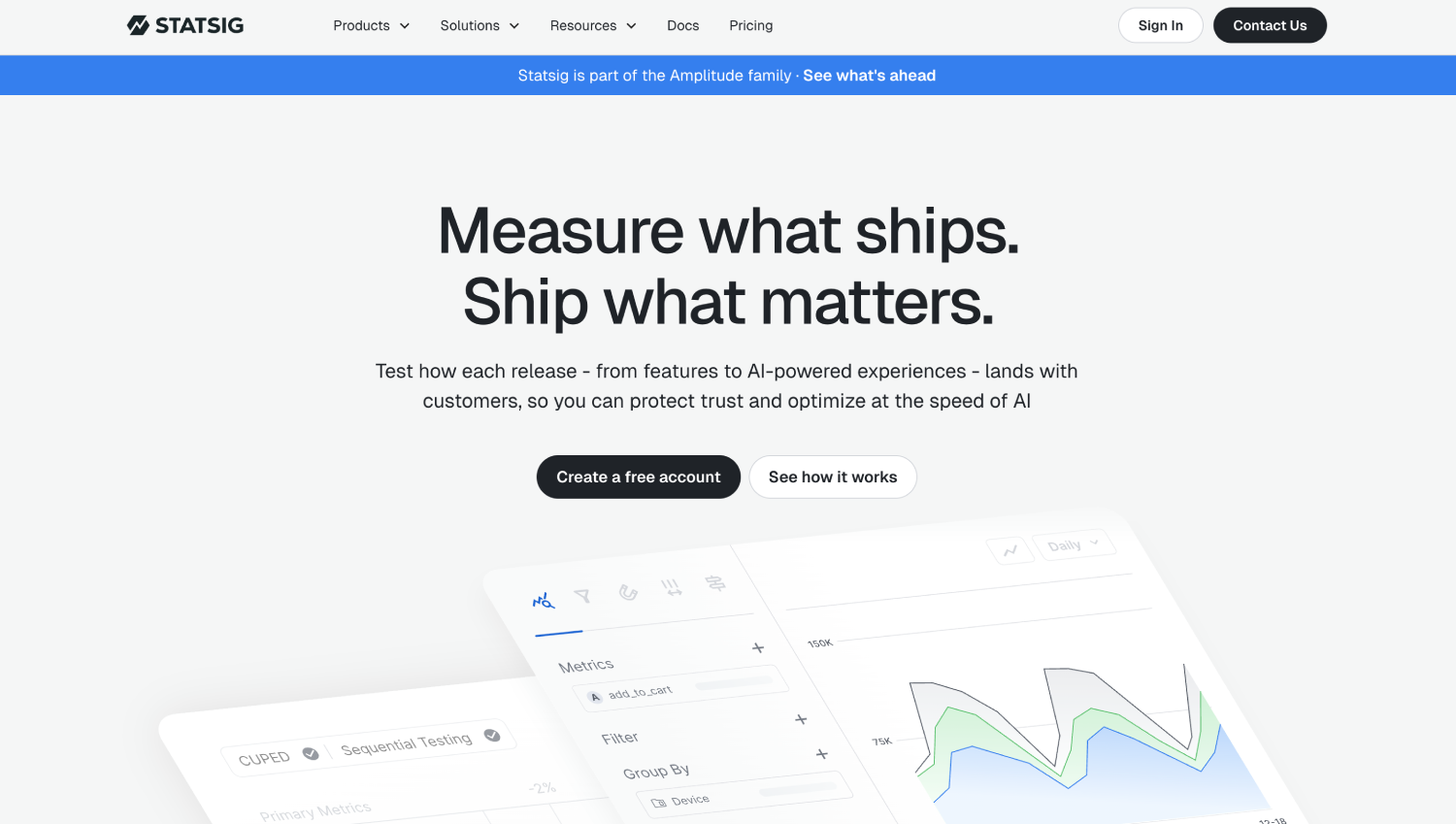
Statsig ships with sequential testing enabled by default, which means you can check results at any point during a test without inflating your false-positive rate. This matters in practice because most growth and product teams peek at results daily even when they know they shouldn’t. Sequential testing makes peeking statistically valid instead of just psychologically comforting.
Statsig also implements CUPED (Controlled-experiment Using Pre-Experiment Data) for variance reduction. CUPED uses pre-experiment behavior as a covariate to reduce the noise in your outcome metric, which effectively shrinks the sample size required to reach significance. Statsig applies this automatically when it has sufficient pre-experiment data, without requiring the experimenter to configure it. The platform also offers Bayesian analysis alongside frequentist readouts, so teams with different statistical philosophies can coexist.
GrowthBook’s statistical engine
GrowthBook’s default statistical approach is frequentist with Bayesian readouts available. As of its public documentation, GrowthBook supports CUPED and sequential testing, but the implementation requires more deliberate configuration than Statsig’s. Teams comfortable writing SQL metric definitions and configuring fact tables in YAML get full access to these methods. Teams less comfortable with that setup may end up running standard t-tests by default and missing the variance-reduction gains.
GrowthBook’s advantage is transparency. Because it is open source, the statistical code is readable and auditable. For regulated industries or teams with a staff statistician who wants to inspect the engine, that openness is not cosmetic. It is a genuine trust signal.
What Does Warehouse-Native Experimentation Actually Mean?
Warehouse-native is a term that gets applied loosely across the data stack. In GrowthBook’s case, it has a specific meaning: the platform can connect directly to your existing data warehouse and run experiment analysis by querying your event tables via SQL, without copying or ingesting that data into GrowthBook’s cloud.
You define metrics as SQL snippets or fact tables pointing to your warehouse schema. GrowthBook runs the statistical analysis on query results. Your raw event data never leaves your warehouse environment. For teams already running warehouse-native CDPs or reverse ETL pipelines, this fits naturally into an architecture where the warehouse is the system of record for all behavioral data.
Statsig’s architecture is different. Events flow into Statsig’s infrastructure via SDK instrumentation or through a data connector. Statsig does offer a “metrics warehouse” integration that can pull computed metrics from your warehouse, but the core experiment assignment and event logging still runs through Statsig’s cloud. For teams with strict data residency requirements, this distinction is not trivial. For teams without those requirements, Statsig’s managed ingestion reduces setup friction significantly.
The warehouse-native model also changes the cost equation. If you are already paying for BigQuery or Snowflake compute, running experiment queries there costs compute credits rather than per-event ingestion fees. For high-volume teams, that shift in cost structure can be meaningful. For teams with low event volume, the managed approach Statsig offers may be cheaper in total cost of ownership once engineering time is factored in.
Can You Self-Host GrowthBook in Production?
Yes. GrowthBook publishes its full source code under an open-source license on GitHub, and the self-hosted deployment is production-ready rather than a stripped-down demo version. Teams deploy it via Docker, and GrowthBook provides documentation for running it on AWS, GCP, or any infrastructure that supports containers.
The self-hosted version includes feature flags, A/B testing, warehouse data source connections, and the statistical analysis engine. The primary features reserved for GrowthBook’s paid cloud tier are enterprise-specific controls: SSO, advanced user permissions, audit logs, and priority support. The core experimentation functionality is not gated.
Self-hosting has real costs. An engineer needs to manage deployments, updates, backups, and the MongoDB instance GrowthBook relies on for metadata storage. For a team with a dedicated platform engineer or a strong DevOps function, this is manageable. For a two-person growth team without engineering support, it is a meaningful ongoing commitment.
Statsig does not offer a self-hosted option. It is a fully managed cloud service. Teams with hard data residency requirements or air-gapped environments will find that disqualifying. Teams without those constraints will find the managed model saves operational overhead.
Statsig vs GrowthBook Pricing: What Do They Actually Cost?
Pricing is where the “just pick the cheaper one” logic breaks down most visibly.
GrowthBook pricing
According to GrowthBook’s public pricing page, the open-source self-hosted version is free with no usage limits. The cloud-hosted free tier supports unlimited feature flags and experiments with up to 3 users. Pro plans are available at a per-seat price for teams that want the cloud-hosted version with more users and collaboration features. Enterprise pricing is quote-based and adds SSO, priority support, and advanced permissions.
The effective cost of GrowthBook’s free or low-cost tier also includes whatever warehouse compute you burn on analysis queries, plus engineering time for setup and maintenance. For a self-hosted deployment, add server costs and operational overhead. For a warehouse-native deployment on a large event dataset, add Snowflake or BigQuery query costs.
Statsig pricing
According to Statsig’s public pricing page, Statsig offers a free tier with a meaningful limit on monthly events, which covers early-stage products. Growth and Enterprise tiers are priced based on event volume. Enterprise pricing is quote-based. Statsig’s event-based model means costs scale with usage, which can become significant for high-traffic consumer applications.
Statsig’s pricing includes the full statistical engine, feature flag management, product analytics, and session replay depending on the plan. Teams that would otherwise pay separately for a feature flag tool, a stats layer, and a lightweight analytics product may find Statsig’s bundle competitive against the sum of parts.
| Dimension | Statsig | GrowthBook |
|---|---|---|
| Open source | No | Yes (MIT-licensed) |
| Self-hosted option | No | Yes, production-ready |
| Warehouse-native analysis | Partial (metrics pull) | Yes, native SQL queries |
| Sequential testing | Yes, default | Yes, requires configuration |
| CUPED variance reduction | Yes, automatic | Yes, configurable |
| Bayesian analysis | Yes | Yes |
| Feature flags | Yes, full feature | Yes, full feature |
| Free tier | Yes, event-limited | Yes, 3-user cloud or unlimited self-hosted |
| Enterprise pricing | Quote-based | Quote-based |
| Data residency control | Limited (cloud only) | Full (self-host or warehouse-native) |
| Built-in product analytics | Yes | No |
| Setup complexity | Low | Medium to high |
Which Platform Has Better Feature Flag Capabilities?
Both platforms offer full-featured flag management: targeting rules, percentage rollouts, multi-variate flags, environments, and SDKs for major languages and frameworks. The implementation quality is comparable. The meaningful differences are in how flags connect to experimentation and analytics.
Statsig integrates flags directly with its experiment and analytics layer. A flag rollout automatically becomes an experiment you can analyze. Exposure events flow into Statsig’s analytics, and you can query metric impact from the same interface where you manage the flag. The entire workflow stays in one product.
GrowthBook connects flags to experiments, but the metric analysis lives in your warehouse. A developer flipping a GrowthBook flag triggers assignment events that get logged and later queried via SQL. The integration is coherent, but requires the warehouse connection to be configured and maintained. Teams that want flag-to-insight in a single managed UI will find Statsig’s approach more immediate.
For teams with a modern data stack where the warehouse already centralizes behavioral data, GrowthBook’s architecture reinforces what they already built rather than creating a parallel data silo. For teams evaluating their marketing analytics infrastructure and choosing tools that work with a single source of truth, that alignment matters.
A Worked Scenario: Where Each Platform Wins
Consider two hypothetical teams to make this concrete. These profiles are constructed from the architectural patterns described throughout this piece, they are illustrations, not case studies.
Team A is a B2B SaaS company with 50 engineers, a data warehouse in Snowflake, a dedicated data engineering team, and a compliance requirement to keep user behavioral data within their own cloud account. They run roughly 200 concurrent feature flags and want to analyze experiment results using the same event tables that power their BI dashboards. This profile, warehouse-centric, compliance-constrained, data-engineering-staffed, is common among mid-market SaaS companies that have already invested in a modern marketing data stack. GrowthBook self-hosted, connected to their Snowflake environment, fits this architecture without requiring a new data silo. Their data team writes metric definitions in SQL. Their engineers self-host on ECS. Total incremental software cost above what they already pay for Snowflake: near zero, with some engineering hours for setup and ongoing maintenance.
Team B is a consumer mobile app with 3 million monthly active users, a two-person growth team, no dedicated data engineer, and a product manager who checks experiment results every morning. They need sequential testing to avoid inflating false-positive rates from daily peeking. They want CUPED to kick in automatically on noisy retention metrics. They do not want to maintain infrastructure. This profile, high traffic volume, lean team, no warehouse-centric architecture, maps to the pattern where managed tooling consistently wins on total cost of ownership. Statsig’s managed cloud, with automatic CUPED and sequential testing on by default, fits this profile. The event volume cost scales with their growth, but the operational overhead is near zero.
The platform that wins for Team A will frustrate Team B, and vice versa.
How Do They Handle Multi-Metric Experiments and Guardrail Metrics?
Running an experiment that optimizes one metric while monitoring several others for regression is standard practice in mature experimentation programs. Both platforms support this, with different levels of built-in guidance.
Statsig provides explicit guardrail metric support, where you designate certain metrics as ones that must not degrade for an experiment to ship. The platform surfaces guardrail metric status prominently in experiment results and can flag regressions automatically. The Statsig Pulse results view shows primary metrics, secondary metrics, and guardrails in a single organized readout.
GrowthBook supports multiple metrics per experiment and displays them together in results, but guardrail designation and alerting is less automated. Teams define metrics in SQL, assign them to experiments, and review the output, but the system requires more human interpretation rather than surfacing automatic guardrail warnings. For teams running high experiment velocity with less statistical oversight per test, Statsig’s more automated guardrail system reduces the risk of shipping regressions undetected.
Which Tool Fits If You Are Already Running Reverse ETL or a Modern Data Stack?
Teams that have already invested in a warehouse-centric data stack, with reverse ETL tools pushing warehouse data into downstream systems and event data flowing back from products into the warehouse, will find GrowthBook a more natural fit architecturally. The warehouse is already the analytical source of truth. Adding a GrowthBook connection to an existing Snowflake or BigQuery environment is an extension of that philosophy rather than a departure from it.
If your team has built a first-party data stack where warehouse centrality is a design principle, GrowthBook’s warehouse-native mode fits without forcing a new data residency decision. Statsig’s architecture, by contrast, introduces a separate event store that sits outside your warehouse, which can create reconciliation overhead when experiment results need to be joined with warehouse data for broader analysis.
That said, Statsig does offer data export and warehouse sync options, so the gap is not absolute. Teams that want experiment data in their warehouse can get it there with Statsig. The question is whether you want the warehouse to be upstream or downstream of your experimentation platform.
The Stack-Fit Test for Experimentation Platforms
Rather than comparing feature checkboxes, this framework surfaces the four architectural constraints that actually determine which platform fits your team. Answer each check honestly, the platform that clears more of the checks relevant to your situation is the right starting point.
- Data residency check. Do you have compliance or contractual requirements that prohibit sending raw behavioral events to a third-party cloud? If yes, GrowthBook self-hosted is the short list. Statsig is off the table.
- Stats sophistication check. Does your team have someone who can configure CUPED, sequential testing boundaries, and metric fact tables? If yes, GrowthBook gives you the control. If no, Statsig’s automated implementation of these methods is the safer bet.
- Warehouse centrality check. Is your data warehouse already the analytical source of truth for product and marketing metrics? If yes, GrowthBook’s warehouse-native mode extends that architecture. If no, Statsig’s managed ingestion is faster to production.
- Operational overhead check. Does your team have engineering cycles to maintain self-hosted infrastructure, write SQL metric definitions, and manage container deployments? If yes, GrowthBook’s flexibility pays off. If no, Statsig’s managed service trades some control for meaningful time savings.
No single platform passes all four checks for every team. The one that passes three of the four checks most relevant to your situation is the right starting point.
Frequently Asked Questions
Is GrowthBook a good free alternative to Statsig?
GrowthBook’s self-hosted open-source version is genuinely free with no usage caps on experiments or feature flags, making it a credible alternative for teams with engineering resources to run it. The catch is operational overhead: someone needs to deploy, update, and maintain it. Teams without a dedicated platform engineer will find the ongoing maintenance cost in engineering time comparable to what Statsig’s free tier offers with no infrastructure to manage. Free in software cost is not the same as free in total cost.
Does Statsig support warehouse-native experimentation?
Statsig is primarily a managed-cloud platform that ingests events into its own infrastructure. It offers a metrics warehouse integration that can pull pre-computed metrics from your data warehouse for use in experiment analysis, but experiment assignment events and raw data still flow through Statsig’s cloud. Teams that need raw event data to remain in their own warehouse environment will find this architecture insufficient. GrowthBook’s warehouse-native mode, which issues SQL queries directly against warehouse tables, is more aligned with strict data residency requirements.
What is CUPED and does it matter for my experiments?
CUPED stands for Controlled-experiment Using Pre-Experiment Data. It uses a user’s behavior before an experiment starts as a statistical covariate to reduce variance in the outcome metric. In practice, it lets you reach statistical significance with fewer users or in less time, which matters when your test traffic is limited or your metrics are noisy. Both Statsig and GrowthBook implement CUPED. Statsig applies it automatically when sufficient pre-experiment data is available. GrowthBook requires configuration. For teams running frequent small experiments on engagement metrics, CUPED is not optional.
Can I use GrowthBook with Snowflake or BigQuery?
Yes. GrowthBook’s warehouse-native mode supports Snowflake, BigQuery, Redshift, ClickHouse, MySQL, Postgres, and Databricks as data sources. You connect GrowthBook to your warehouse by providing credentials and then define experiment metrics as SQL queries or fact table references pointing to your event tables. GrowthBook executes analysis queries against your warehouse directly. Data does not transfer to GrowthBook’s servers in warehouse-native mode, which is the primary data governance advantage.
What is sequential testing and why does it matter?
Sequential testing is a statistical methodology that controls the false-positive rate even when you look at results before an experiment reaches its planned sample size. Standard frequentist tests (t-tests, z-tests) inflate the false-positive rate when you peek at results and stop early based on what you see. Sequential testing uses boundaries calculated in advance so that any look at any point in the experiment maintains the stated alpha level. Statsig enables this by default. GrowthBook supports it with configuration. For any team where stakeholders check results daily, sequential testing is not a nice-to-have.
How does Statsig pricing scale with high event volume?
Statsig’s pricing is event-based, meaning costs grow as your product instrumentation and user base grow. The free tier covers a limited monthly event count suitable for early-stage products. Growth and Enterprise tiers increase the event ceiling at higher price points. For consumer applications with millions of daily active users, event costs can become significant. High-volume teams should model their expected monthly events against Statsig’s current pricing tier thresholds before committing. GrowthBook’s warehouse-native model shifts that cost to warehouse compute, which for teams already paying for Snowflake or BigQuery may be cheaper at scale.
Which platform is better for a lean growth team without a data engineer?
Statsig. A growth team without data engineering support needs a platform that handles experiment assignment, event ingestion, metric computation, and statistical analysis with minimal configuration. Statsig’s managed infrastructure and automatic application of CUPED and sequential testing removes the need for SQL metric definitions, warehouse connections, and infrastructure maintenance. GrowthBook’s warehouse-native mode and self-hosted option are genuinely powerful, but both require technical investment that a lean team without engineering support will struggle to sustain.
Do both platforms support multi-armed bandit or adaptive experiments?
Statsig offers multi-armed bandit experiments (also called adaptive assignments) in addition to standard A/B and multivariate tests. GrowthBook’s public documentation focuses primarily on A/B and multivariate experiment types. Teams that want to automatically shift traffic toward winning variants during an experiment rather than waiting for a fixed-horizon test to conclude will find Statsig’s bandit support more developed. This matters most for teams optimizing high-frequency decisions like recommendation systems or ad creative selection where the cost of running a losing variant is high.
The Choice That the Feature List Hides
The surface-level feature comparison between Statsig and GrowthBook is closer than the pricing gap suggests. Both support feature flags, multivariate experiments, CUPED, sequential testing, and Bayesian readouts. The real choice is an architectural one: do you want experimentation to live inside your existing data infrastructure, or do you want to hand that infrastructure problem to a managed service?
Teams that have already made the warehouse their analytical center of gravity, as covered in the discussion of the modern marketing data stack, will find GrowthBook’s warehouse-native mode a logical extension of decisions already made. Teams that have not yet centralized their data stack, or that lack the engineering capacity to maintain one, will find Statsig’s managed approach lets them run statistically rigorous experiments without building the plumbing first.
One pattern to watch: teams often start with GrowthBook’s free cloud tier, discover the warehouse connection requires more SQL expertise than expected, and either invest in that expertise or migrate to Statsig’s managed layer. Teams that start with Statsig sometimes hit event-volume pricing thresholds and re-evaluate whether the warehouse-native model would have been cheaper at their scale. Both migration paths are real. Starting with an honest assessment of where your engineering capacity actually sits, not where you hope it will be in six months, is what the Stack-Fit Test is designed to surface.