- Rocketlane is purpose-built for implementation teams running multi-phase, multi-stakeholder projects where internal task management and client visibility must live in the same tool.
- GuideCX is built around guided, structured client handoff: it excels when the goal is walking a customer through a repeatable onboarding sequence with clear milestone signaling.
- The gap between the two shows up in professional services automation (PSA) depth: Rocketlane includes time tracking, resource management, and project financials; GuideCX does not.
- If your onboarding is owned by a CS team doing high-volume, lower-complexity implementations, GuideCX wins on simplicity. If a dedicated services team runs complex deployments with billing tied to project scope, Rocketlane is the stronger fit.
- Neither tool replaces a CRM or a customer success platform, but both integrate with Salesforce and HubSpot to close that gap.
Rocketlane is the better choice for implementation teams running complex, multi-phase deployments where internal project management and client-facing visibility must coexist in one tool, especially when time tracking and project financials matter. GuideCX is better for customer success teams running high-volume, structured onboarding sequences where the priority is guiding clients through defined steps quickly and cleanly, without the overhead of PSA features.
Why Most Onboarding Platform Comparisons Miss the Point
Most teams shopping in this category start with the wrong frame. They treat Rocketlane and GuideCX as interchangeable project trackers with a client login bolted on, and then wonder why the demo felt off.
The real distinction is architectural. Rocketlane was designed from the outside in, starting with the internal project management needs of implementation engineers and professional services managers, then adding a client portal on top. GuideCX was designed from the client experience forward, starting with the question of how to guide a customer through a defined onboarding sequence, then adding internal coordination tools to support that. That origin shapes everything from the feature set to the pricing model to who in your organization should own the tool.
If your onboarding is complex enough to require a dedicated implementation team, scoped project plans, billable hours, and resource allocation across multiple accounts simultaneously, you are buying a different category of tool than a CS team that needs to run a clean, repeatable 30-day activation sequence. Rocketlane serves the first team. GuideCX serves the second. Picking the wrong one means you will spend six months fighting the tool instead of the problem.
What Is Rocketlane, and Who Is It Actually Built For?
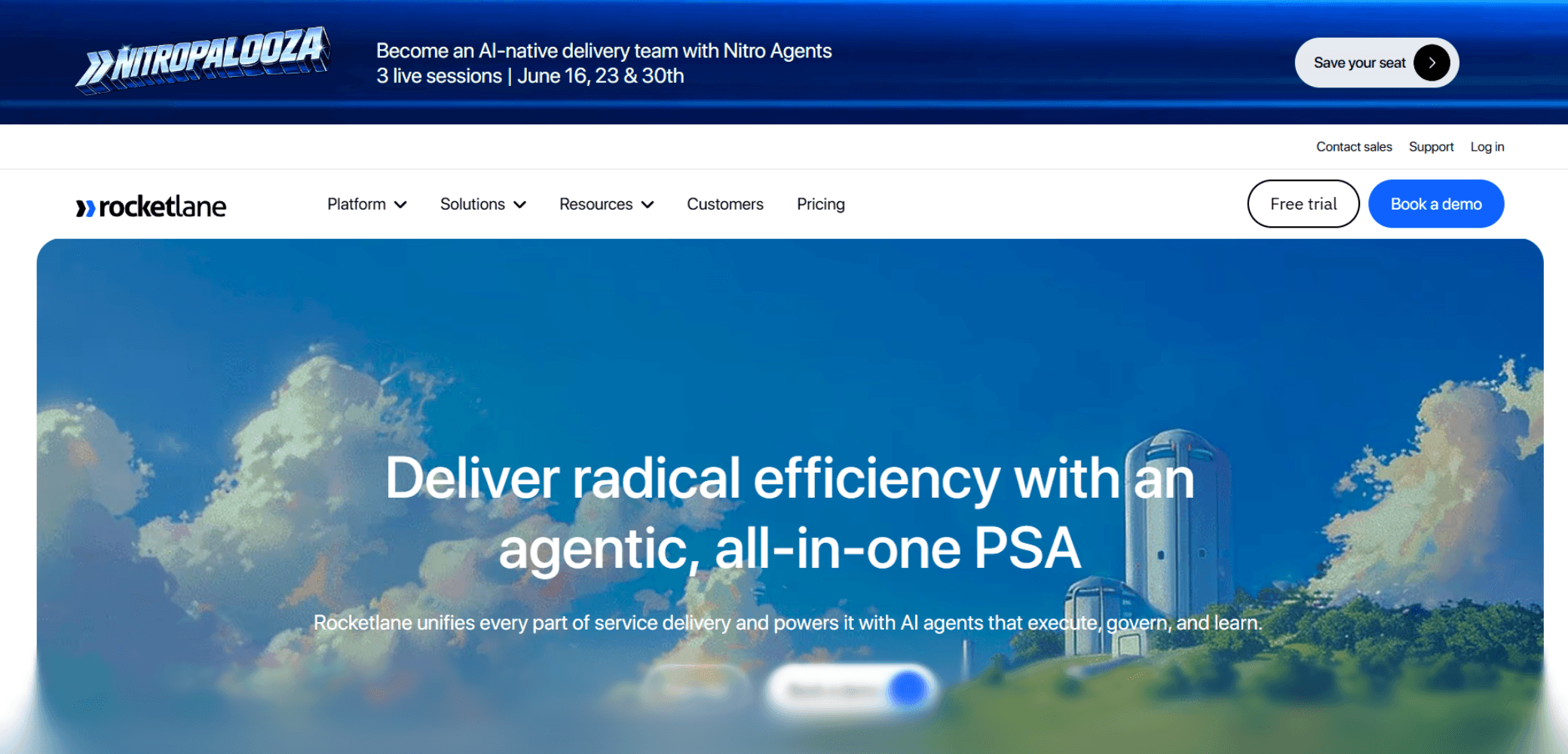
Rocketlane positions itself as a professional services automation platform with a built-in customer portal. That PSA framing is not marketing copy; it describes real functionality. The platform includes a project workspace where implementation tasks, dependencies, and timelines are managed internally, a client-facing portal where customers see only what they need to see, and a layer of resource and financial management that most pure onboarding tools skip entirely.
Where Rocketlane’s feature depth shows up
Time tracking is native in Rocketlane, not an integration. Implementation managers can log hours against specific project phases, which feeds into budget tracking and, for teams running professional services at scale, into invoicing workflows. This matters if your services team operates as a profit center or needs to tie resource spend to contract value.
The project templates in Rocketlane are genuinely sophisticated. You can define phase gates, conditional task dependencies, and milestone-based status updates that trigger automatically when a predecessor task closes. For SaaS companies running enterprise implementations where a go-live date is contractually committed, that dependency logic prevents the kind of scheduling drift that costs teams credibility with customers.
The client portal gives customers a real-time view of project progress without exposing internal notes, resource assignments, or financial data. Customers can complete assigned tasks, upload documents, and respond to requests directly in the portal, which keeps communication out of email threads. That portal is co-branded and white-labeled, a detail that matters more than it sounds when the implementation itself is part of the perceived product quality.
What Rocketlane is not great at
Rocketlane is not a lightweight tool. The setup time to build your first template library, configure your portal, and connect it to your CRM is real. Teams that need something running in a week will find the ramp-up friction significant. And because it is designed for implementation teams, the reporting is oriented toward project health and resource utilization, not toward the customer health scoring and renewal risk signals that customer success managers typically need. For that broader CS layer, you would need a separate platform, as covered in our overview of how customer success software works to stop churn before it starts.
What Is GuideCX, and Who Is It Actually Built For?
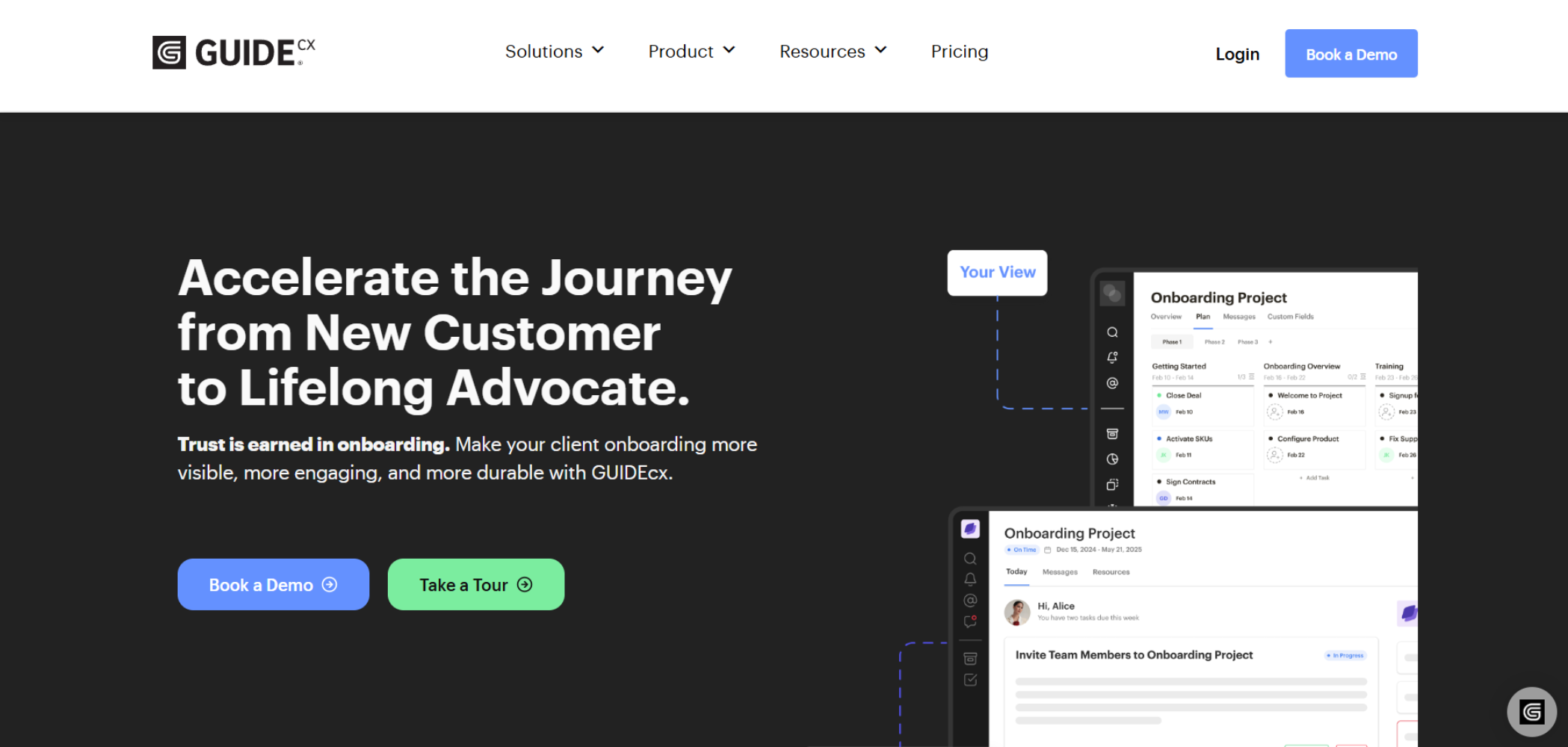
GuideCX approaches the same general problem from a different angle. Its core design premise is that the primary friction in customer onboarding is not internal project management but getting customers to complete their side of the work. The platform is built around customer-facing task sequences, automated nudges, and milestone visibility that keeps customers engaged and accountable without requiring them to log into a complex tool.
Where GuideCX’s design philosophy pays off
GuideCX’s customer notification system is one of its most cited strengths. Automated task reminders, progress emails, and milestone alerts go out to customer stakeholders without requiring your CS team to manually chase anyone. For onboarding programs that fail because customers deprioritize their own tasks, this automated accountability layer can measurably reduce time-to-value by keeping the project moving on the customer side.
The onboarding experience for customers is also notably simpler than Rocketlane’s portal. Customers receive a clean view of what they need to do, what is done, and what is coming next, without needing to understand your internal project structure. For SMB customers or less technical buyer contacts, that simplicity is a real advantage.
GuideCX also has strong reporting around time-to-value metrics at the program level. You can see, across all active implementations, which onboarding stages are causing the most delay, which customer segments complete tasks fastest, and where the process itself is the bottleneck. That aggregate view is useful for a CS leader who needs to optimize the onboarding program as a whole, not just manage individual projects.
What GuideCX trades away
GuideCX does not offer PSA-level features. There is no native time tracking, no resource capacity management, no project financial tracking, and no billable hours reporting. For a CS team running onboarding as a cost of acquisition, that is fine. For a professional services organization that needs to manage utilization rates and project margins, GuideCX is simply the wrong tool category.
The internal project management layer in GuideCX is also lighter than Rocketlane’s. Task dependencies are available, but the depth of scheduling logic, phase gates, and Gantt-style timeline management that implementation engineers expect is not at the same level. Teams running 90-day enterprise deployments with dozens of interdependent workstreams will likely find the internal tooling constraining.
How Do Rocketlane and GuideCX Compare on Core Features?
| Feature | Rocketlane | GuideCX |
|---|---|---|
| Client-facing portal | Yes, white-labeled and co-branded | Yes, simplified task-focused view |
| Internal project management | Full Gantt, dependencies, phase gates | Basic task management, lighter dependencies |
| Time tracking | Native, tied to project billing | Not available natively |
| Resource management | Yes, utilization and capacity views | No |
| Project financials | Yes, budget tracking and invoicing | No |
| Automated customer notifications | Available | Core differentiator, highly configurable |
| Onboarding templates | Yes, with conditional logic | Yes, repeatable playbooks |
| Time-to-value reporting | Project-level and portfolio-level | Program-level with stage analysis |
| Salesforce integration | Yes | Yes |
| HubSpot integration | Yes | Yes |
| Slack integration | Yes | Yes |
| White-label / co-branding | Yes | Yes |
| PSA classification | Yes | No |
Is Rocketlane Cheaper Than GuideCX?
Both vendors use quote-based pricing for most tiers, and neither publishes a full pricing table that allows a clean public comparison. Rocketlane does offer a publicly listed Starter tier, though the functionality at that level is limited compared to what most implementation teams need in production. GuideCX also does not publish its pricing publicly, routing prospects to a sales conversation for any real package detail.
What is clear from public information is that Rocketlane’s pricing scales with users and seats, with separate tiers that add PSA features like time tracking and financials. GuideCX pricing is similarly seat-based, with tiers tied to the number of active projects or contacts. Teams serious about either platform should request a quote with their actual user count and expected active project volume to get a realistic number.
The more relevant cost question is total cost of ownership. Rocketlane replaces a project management tool, a client portal, a time tracking tool, and potentially parts of a PSA for teams that need all of those. If you are currently paying for Asana or Monday plus a separate client portal and a time tracking product, the consolidation math can work in Rocketlane’s favor. GuideCX is typically replacing a mix of CS platform tasks and email-based onboarding coordination, so the comparison set is different.
How Do the Integrations Stack Up for SaaS Implementation Teams?
Both platforms connect to Salesforce and HubSpot, which covers the majority of SaaS companies using either CRM. The Salesforce integration in Rocketlane is particularly relevant for professional services teams: it can pull opportunity data into a project automatically when a deal closes, trigger project creation from a workflow, and push project status back into the CRM so account executives and CS managers have visibility without logging into Rocketlane.
GuideCX’s CRM integrations serve a similar triggering function but are more focused on the CS team’s workflow. A closed-won deal in Salesforce can kick off an onboarding template in GuideCX, and milestone completions can be logged back to the contact or opportunity record. For a revenue operations team trying to connect the full customer lifecycle from sale to go-live, that bidirectional data flow matters. It connects directly to the kind of post-sale attribution and lifecycle tracking covered in depth in our guide to the top customer success platforms for B2B SaaS.
Slack is supported natively in both platforms for internal team notifications. Rocketlane also integrates with Jira, which matters for engineering-heavy implementations where development tasks need to be tracked in the same project timeline as onboarding milestones. GuideCX does not have a documented Jira integration, which is a real gap for product implementation teams that bridge CS and engineering work.
The Implementation Fit Test: A Framework for Getting This Right
Before any demo call, run what we call the Onboarding Architecture Check: four questions that force clarity on which tool category you actually need.
1. Who owns onboarding? If a dedicated implementation or professional services team owns delivery, and that team’s utilization, hours, and project margins matter to the business, you need PSA features. That means Rocketlane. If onboarding is owned by CS generalists running a program, GuideCX fits the workflow better.
2. How complex is a typical project? Count the number of distinct workstreams, the number of internal teams involved, and the number of customer stakeholders. More than three internal teams or more than 90 days to go-live points toward Rocketlane’s project management depth. A linear 30-to-60-day activation sequence with one or two customer contacts points toward GuideCX.
3. Does customer task completion drive your biggest delays? If customers not doing their part is the primary bottleneck, GuideCX’s automated accountability layer is directly aimed at that problem. If internal coordination and scheduling complexity is the bottleneck, Rocketlane’s dependency management addresses it more directly.
4. Do you need to report on project economics? Any team that tracks billable hours, project margins, or services revenue as a line item needs time tracking and financial reporting native in the tool. That is Rocketlane, and GuideCX does not compete here.
Which Has Better Client-Facing Portals?
The portal comparison is genuinely close, but the answer depends on what your customers need to do inside it. Rocketlane’s portal gives clients a real-time window into the full project: task status, upcoming milestones, document uploads, and a comments layer that keeps communication contextual. It is rich, and it is designed for enterprise buyers who expect that kind of transparency during a complex deployment.
GuideCX’s client experience is intentionally simpler. The customer sees their tasks, what is complete, what is pending, and what comes next. There is less information density, which is a feature rather than a limitation when your customer contact is a busy operations manager who does not want to interpret a Gantt chart.
White-labeling is available in both platforms at higher tiers, so neither has a structural advantage on branding. The real distinction is experience depth versus experience simplicity, and the right answer maps directly to your customer’s sophistication and your implementation’s complexity.
Do You Need PSA Features in an Onboarding Tool?
Most SaaS companies buying in this category do not think they need PSA features until they have been running implementations for 18 months and realize they cannot answer basic questions: which customers are consuming more services hours than their contract budgeted, which implementation managers are consistently over-allocated, and whether the professional services business is actually profitable. By then, retrofitting time tracking and financial reporting into a tool that was not built for it is painful.
If your company has a named professional services or implementation function, even a small one, PSA features matter. Rocketlane’s inclusion of time tracking, resource management, and project financials in the same platform where the work happens is a compounding advantage: the data is accurate because it is captured in context, not reconstructed from memory in a separate system at the end of the month.
Teams in the CS-led onboarding model, where CSMs handle activation as part of their account management responsibilities, rarely need PSA depth. GuideCX is built for that model. Paying for Rocketlane’s PSA layer when your team will never use it is wasted budget. This overlaps with the broader category question of where an onboarding tool ends and a CS platform begins, a distinction worth understanding before you buy either. Our overview of customer success software and churn prevention covers that boundary in detail.
A Worked Scenario: SaaS Implementation Team at 200 Customers
Consider a B2B SaaS company with 200 active enterprise customers, an average implementation timeline of 60 days, a four-person implementation team, and a services contract attached to each new customer deal. The team runs three to five active projects per implementation manager at any given time.
In this scenario, Rocketlane fits because the team needs to manage resource capacity across 12 to 20 simultaneous projects, track hours against each services contract for billing, and give enterprise customers a professional portal experience that reflects the seriousness of the engagement. The PSA features are not optional; they are how the services function justifies its cost to the CFO.
Now consider a SaaS company at the same customer count, but with a CS team of eight where every CSM owns both onboarding and ongoing retention. Implementations are 30 days, mostly self-guided with CSM check-ins, and customers need to complete tasks like uploading a data file, inviting their team, and scheduling a training call. GuideCX wins here: the automated task nudges reduce CSM follow-up time, the simple client view matches the customer’s expectation, and there is no need for time tracking or resource utilization reporting because the onboarding is not a billable service.
Rocketlane vs GuideCX: How Do They Handle Time-to-Value Tracking?
Time-to-value (TTV) tracking is a selling point for both platforms, but they measure it at different levels. Rocketlane tracks TTV at the individual project level with granular milestone timestamps. You can see exactly when a customer completed each phase gate and where delays occurred, which is useful for a project manager doing a post-mortem on a specific account.
GuideCX aggregates TTV data across the entire onboarding program, giving CS leaders a view of average completion time by stage, by customer segment, or by onboarding template. That program-level analysis is more useful for a head of CS trying to optimize the onboarding process itself, not just diagnose one late project. This connects naturally to the customer health metrics that determine whether an account renews, a connection explored in our guide on building a customer health score that predicts churn.
Neither platform provides TTV benchmarks against industry averages, which remains a gap in this category broadly. Both give you the data to build your own benchmarks over time, but you are starting from scratch on day one.
Frequently Asked Questions
Is Rocketlane better than GuideCX for enterprise SaaS implementations?
For enterprise implementations with complex project structures, multiple internal teams, and professional services billing, Rocketlane is the stronger choice. Its native time tracking, resource management, Gantt-based project planning, and full PSA feature set are built for the complexity that enterprise deployments require. GuideCX is better suited to structured but less complex onboarding sequences where customer task completion and automated nudges are the primary need.
Does GuideCX have project management features?
GuideCX includes task management, templated onboarding playbooks, and basic dependency support, but it is not a full project management tool. It does not offer Gantt chart views, advanced scheduling logic, resource capacity management, or phase gate controls at the depth that Rocketlane provides. Teams running lightweight, linear onboarding sequences will find GuideCX’s project management sufficient. Teams running multi-phase enterprise implementations will likely find it constraining.
Can Rocketlane replace a PSA tool like Certinia or Kantata?
Rocketlane covers the core PSA functions that most growing SaaS services teams need: time tracking, resource management, project financials, and invoicing workflows. For teams with very large professional services organizations that require deep financial consolidation, multi-currency billing, or integration with ERP systems, dedicated PSA platforms like Certinia (formerly FinancialForce) or Kantata (formerly Mavenlink) offer more depth. For SaaS implementation teams at sub-enterprise scale, Rocketlane often replaces a lighter PSA plus a separate project tool, which simplifies the stack.
Which platform is easier to set up and launch quickly?
GuideCX has a faster initial ramp. Its onboarding template builder is intuitive, and customer-facing sequences can be live within days. Rocketlane’s setup takes longer because configuring project templates with conditional logic, setting up the branded client portal, and connecting it to your CRM requires more decision-making upfront. The payoff for Rocketlane’s setup investment is a more powerful system once configured, but teams under time pressure to launch should factor in that ramp difference.
Do both platforms integrate with Salesforce and HubSpot?
Yes. Both Rocketlane and GuideCX integrate with Salesforce and HubSpot, supporting bidirectional data flow for deal-to-project triggers and status updates back to CRM records. Rocketlane additionally integrates with Jira, which is relevant for implementation teams whose projects span engineering and CS work. GuideCX does not have a documented Jira integration, which is a consideration for product implementation teams that need to coordinate development tasks within the same project timeline.
Which tool is better for a customer success team that does not have a separate implementation function?
GuideCX is the cleaner fit for CS-led onboarding where there is no dedicated implementation team. Its automated customer nudges, simplified client portal, and program-level TTV reporting align with how a CS generalist manages activation at scale. Rocketlane’s PSA depth and project management complexity are unnecessary overhead for teams that do not need to track billable hours or manage resource utilization across a services organization.
Can either tool connect to a customer data platform or data warehouse?
Neither Rocketlane nor GuideCX offers native warehouse connectors or CDP integrations as a standard feature. Data activation from a warehouse into these tools typically requires middleware like Zapier or a reverse ETL tool that bridges the warehouse and either onboarding system. For teams evaluating options in that layer, our roundup of the best reverse ETL tools for warehouse data activation covers the main platforms worth considering.
What happens when an onboarding project goes live, does either tool support the post-go-live handoff to a CS platform?
Both platforms are designed to hand off to a separate CS tool once implementation is complete. Neither Rocketlane nor GuideCX replaces a dedicated customer success platform for ongoing retention, health scoring, or QBR management. The typical architecture is: CRM triggers an onboarding project in Rocketlane or GuideCX, that project closes at go-live, and the account then moves into a CS platform for ongoing management. Teams choosing between CS platforms for that post-go-live layer should review the top-rated customer success platforms for B2B SaaS to find the right fit for that next stage.
The Verdict: Which Platform Wins?
Rocketlane wins for implementation teams. If your company has a named professional services or implementation function, if you track hours against projects, if your implementations run longer than 60 days and involve multiple internal teams, and if your enterprise customers expect a branded, substantive project portal, Rocketlane is the correct tool. GuideCX is not a weaker version of the same product; it is a different product entirely, one that does not address the operational needs of a real services organization.
GuideCX wins for CS-led onboarding programs. If your CSMs own activation as part of their account management role, if your onboarding is a defined repeatable sequence rather than a custom project, and if the biggest friction is getting customers to complete their tasks rather than coordinating your internal team, GuideCX’s automated accountability layer and simplified client experience solve the actual problem. Adding Rocketlane’s complexity to that workflow would slow you down, not speed you up.
The category mistake to avoid is buying the more feature-rich tool as a default safety play. Rocketlane’s PSA depth is overhead for a CS team that never needs it. GuideCX’s simplicity is a limitation for an implementation team that does. Know which team you are, run the Onboarding Architecture Check above, and the answer becomes clear before you ever sit through a demo.