- Rocketlane and GuideCX charge per seat or per project, so costs scale with your customer success headcount and active project volume, not your user base.
- Userpilot and Appcues price on monthly active users (MAUs), which means a B2C-adjacent product with 10,000 users can cost more than a B2B team running 50 onboarding projects simultaneously.
- Annual commit discounts are standard across all four vendors, but none publish them openly; industry convention and vendor conversations suggest 10 to 20% off monthly rates when negotiating a 12-month term, though individual results vary.
- Implementation fees exist at the enterprise tier for Rocketlane and GuideCX; Userpilot and Appcues do not typically charge setup fees at their self-serve tiers.
- The cheapest option flips depending on your scenario: MAU-based pricing punishes high-volume product teams, while per-seat pricing punishes small CS teams managing many accounts.
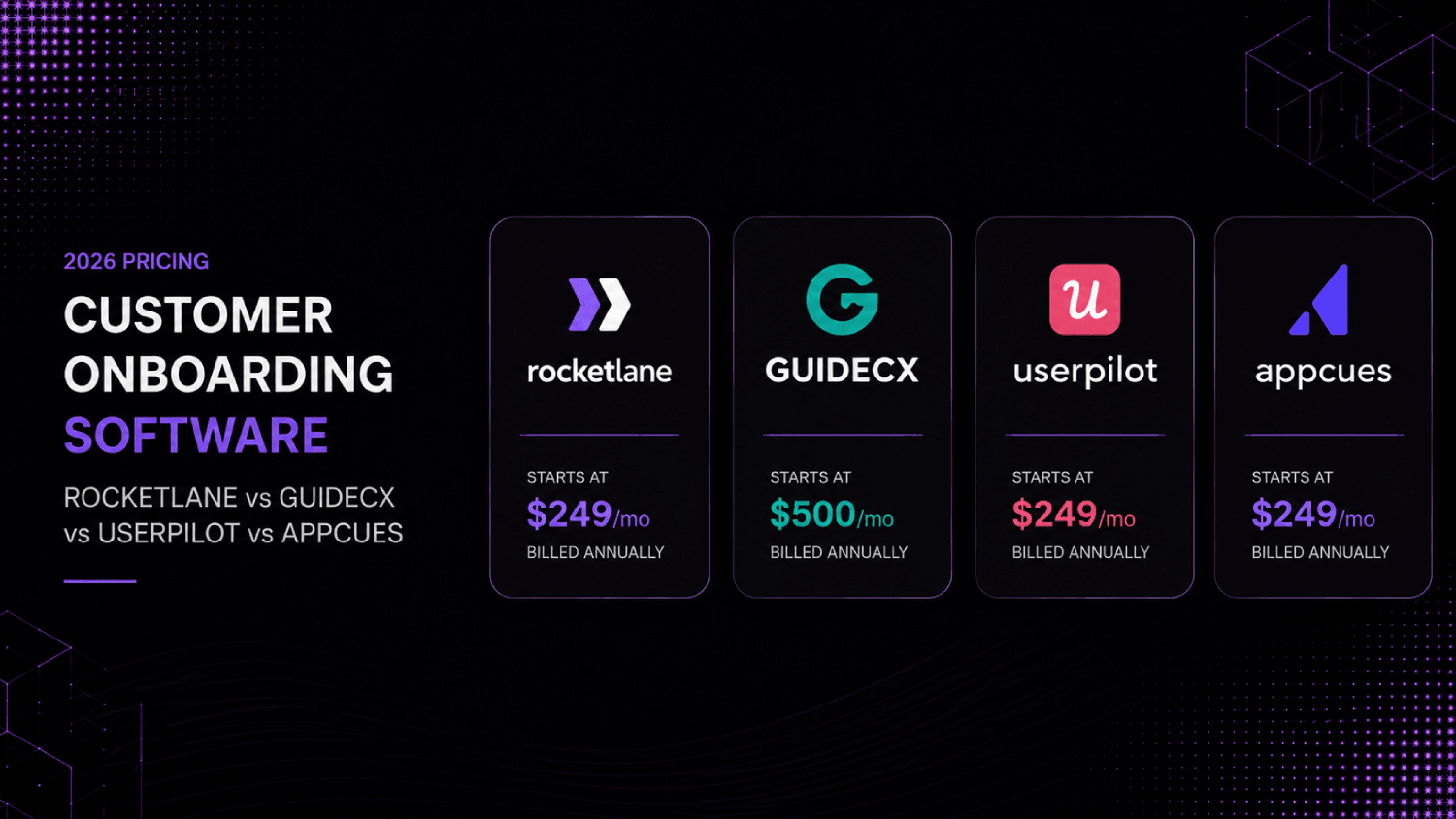
Customer onboarding software pricing splits into two fundamentally different billing models: seat-based or project-based tools built for client-facing CS teams (Rocketlane, GuideCX), and MAU-based tools built for product-led in-app onboarding (Userpilot, Appcues). Rocketlane and GuideCX start around $19 to $29 per seat per month at entry tiers, while Userpilot starts at $249 per month for up to 2,000 MAUs and Appcues starts at $279 per month. The right choice depends entirely on whether your onboarding is external project work or in-product user activation.
Why Most Buyers Compare the Wrong Tools Against Each Other
The term “customer onboarding software” covers two distinct categories that happen to share a name. One category manages the external project of getting a new B2B client live: kickoff calls, mutual action plans, task assignments, status portals, and stakeholder visibility. The other category manages in-product activation: the welcome modals, product tours, checklists, and tooltips that teach users what to do inside your SaaS application.
Rocketlane and GuideCX sit firmly in the first category. Userpilot and Appcues sit firmly in the second. Comparing Rocketlane’s pricing to Userpilot’s is a category error, not a pricing analysis, because they solve different problems and bill on different units. A CS team running 30-day implementation projects for enterprise clients has no use for MAU-based pricing. A PLG team driving self-serve activation has no use for project management workflows.
This article covers pricing mechanics, billing units, hidden costs, and worked cost scenarios for all four. If you want a full feature ranking, our roundup of the best customer onboarding tools for time-to-value covers that ground separately. This article is only about cost.
How Does Rocketlane Price Its Onboarding Platform?
Rocketlane publishes tiered pricing on its public pricing page. As of its current public pricing page, Rocketlane offers three tiers: Essentials, Standard, and Enterprise. The Essentials plan starts at $19 per user per month (billed annually), the Standard plan at $49 per user per month, and Enterprise is quote-based.
The billing unit is per internal seat, meaning every member of your CS or professional services team who accesses the platform counts toward your license. Clients who access the customer portal do not count as seats, which is an important distinction: a 5-person CS team could manage hundreds of client-facing onboarding projects without the client logins adding to the bill.
The Essentials tier covers project templates, task tracking, and a basic customer portal. Standard adds time tracking, resource management, revenue recognition, and deeper integrations with Salesforce and HubSpot. The jump from $19 to $49 per seat is significant if your team is 10 or more people: a 10-person team moves from $190/month to $490/month on annual billing, before any implementation or onboarding fees.
Rocketlane does not publicly disclose implementation fees for its Enterprise tier, but enterprise contracts typically include a paid onboarding engagement. At the self-serve Essentials and Standard tiers, implementation is self-directed.
How Does GuideCX Price Its Client Onboarding Software?
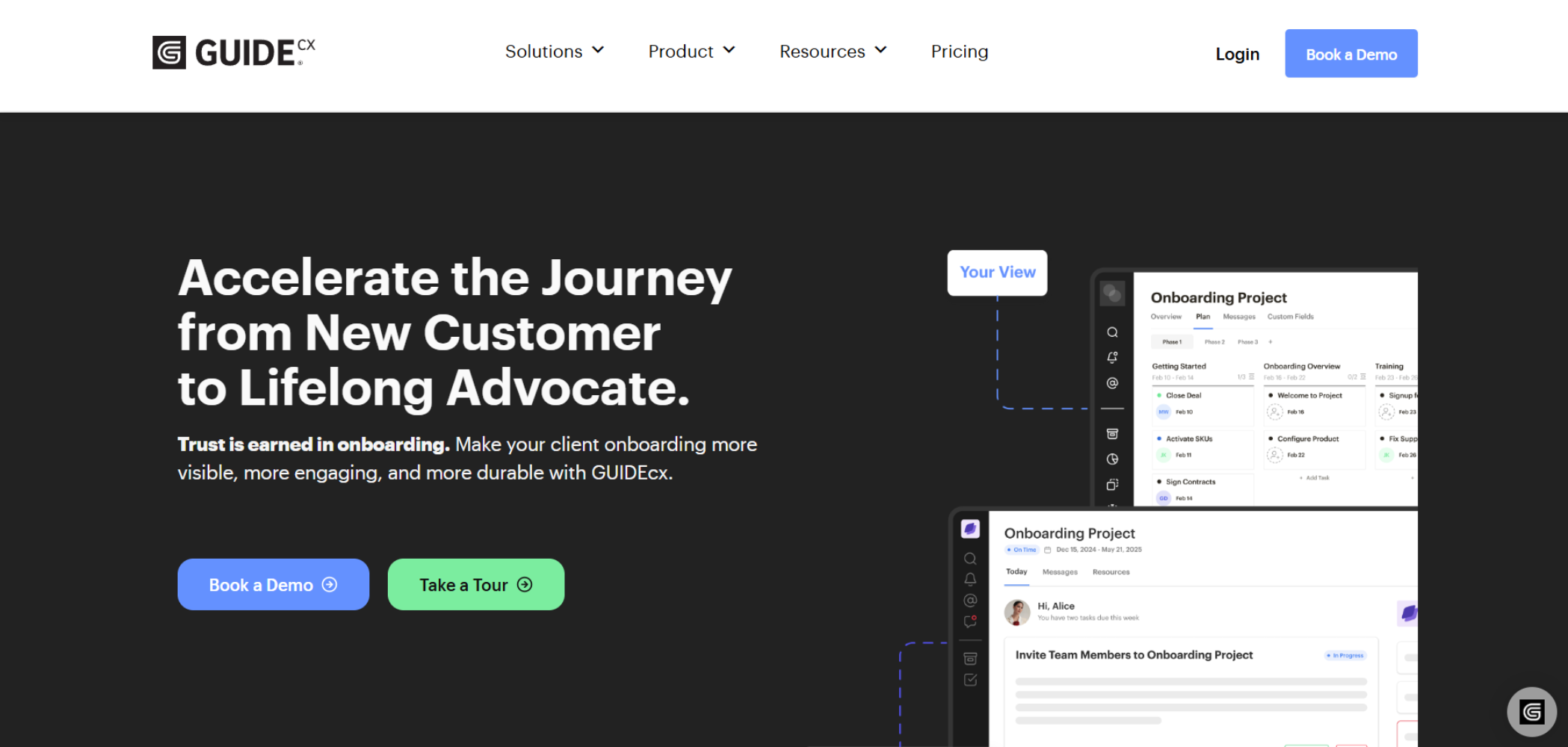
GuideCX takes a different approach: its pricing is not fully self-serve, and the vendor does not publish a complete public price list for all tiers. Reported base pricing for GuideCX starts at roughly $29 per seat per month, with higher tiers priced on a quote basis depending on seat count, integration needs, and project volume.
Like Rocketlane, GuideCX bills on internal seats. External stakeholders (the client contacts who receive updates and complete tasks) are not counted as seats. GuideCX leans heavily on its client-facing engagement layer: automated task nudges, stakeholder status views, and milestone notifications. Teams choosing between Rocketlane and GuideCX are typically comparing project management depth (Rocketlane) against client engagement automation (GuideCX).
GuideCX does not publicly disclose implementation fees, but enterprise buyers report that a paid onboarding package is standard for larger contracts. If you are evaluating both tools, ask each vendor directly what is included in the first 90 days, and whether there is a separate statement of work for platform configuration.
How Does Userpilot Price Its In-App Onboarding Tool?
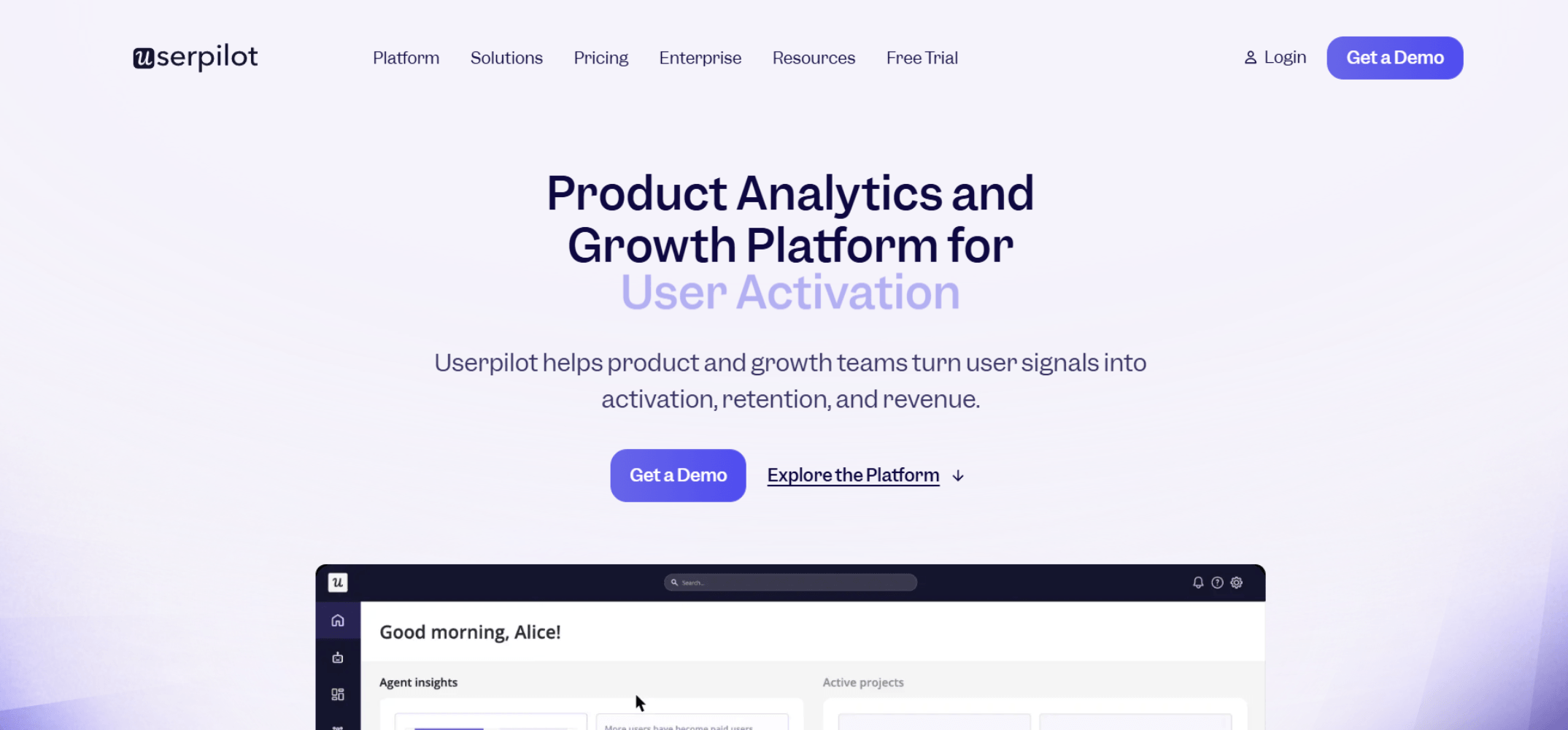
Userpilot prices on monthly active users, not seats. As of its public pricing page, the Starter plan begins at $249 per month (billed annually) for up to 2,000 MAUs. The Growth plan starts at $499 per month and covers higher MAU thresholds with additional analytics and segmentation capabilities. The Enterprise plan is quote-based.
The MAU billing model has a specific implication: your cost is determined by how many unique users trigger at least one event in a given month, not by how many people are on your CS team. A B2B SaaS company with 500 customers, each with 10 users in the product, could be looking at 5,000 MAUs, which pushes well past the Starter tier. Userpilot’s pricing page shows MAU bands, so it is worth mapping your actual active user count before requesting a demo.
Userpilot does not charge a setup fee at the self-serve tiers. The platform includes product tours, checklists, in-app surveys, and NPS. Its analytics layer also functions as a lightweight product analytics tool, which reduces the need for a separate event tracking tool at early stage. For teams already running a full product analytics stack, see how these tools fit into a broader customer success strategy before adding another analytics layer.
How Does Appcues Price Its Onboarding and Adoption Platform?
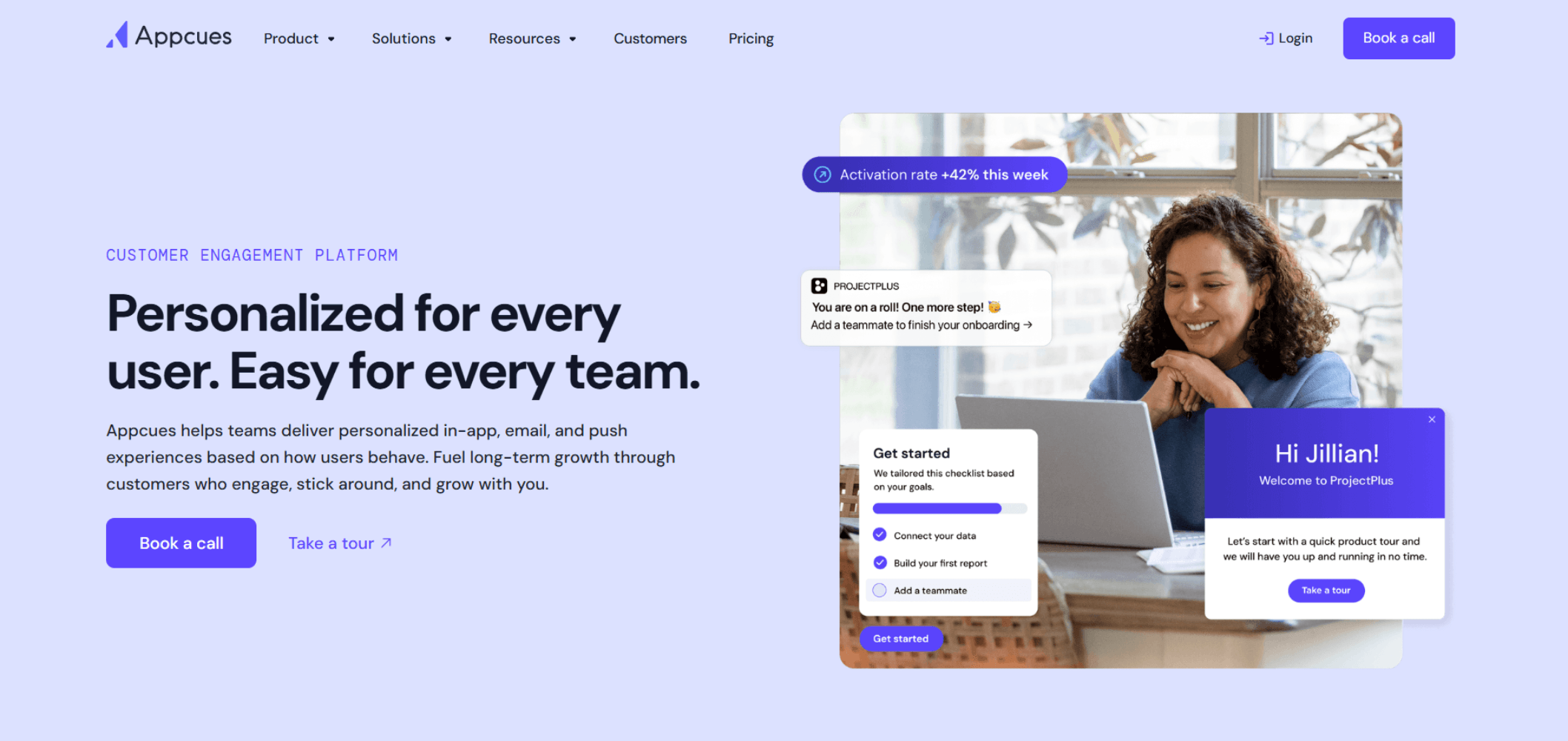
Appcues also prices on MAUs. As of its public pricing page, the Essentials plan starts at $279 per month (billed annually) for up to 2,500 MAUs. The Growth plan runs higher and adds event-based segmentation, A/B testing for flows, and integrations with Salesforce, Heap, and Mixpanel. Enterprise is quote-based and adds SSO, SLA, and a dedicated CSM.
Appcues is roughly comparable in entry price to Userpilot, with a slightly higher MAU ceiling at the base tier ($279 for 2,500 MAUs vs. $249 for 2,000 MAUs). The practical difference is less about the entry price and more about which integrations and analytics depth you need at each tier. Appcues’s Growth tier includes digital adoption capabilities like goal tracking and flow analytics that Userpilot reserves for its Growth tier as well.
Appcues does not charge implementation fees at the self-serve tiers. At the Enterprise level, a paid onboarding engagement is available but not mandatory. The Appcues team is also known for its design quality: flows look polished out of the box without custom CSS, which reduces design overhead for small teams.
What Does Customer Onboarding Software Actually Cost? A Scenario-by-Scenario Table
The cleanest way to compare these four tools is to run them against three real buyer profiles. These are illustrative scenarios based on published entry-tier pricing and reported figures where applicable , not vendor-published benchmarks, and upper-bound estimates where quote-based tiers apply.
| Buyer Profile | Rocketlane (est. annual) | GuideCX (est. annual) | Userpilot (est. annual) | Appcues (est. annual) |
|---|---|---|---|---|
| Scenario A: 5-person CS team, 40 active client projects, 1,000 product MAUs | ~$1,140/yr (Essentials, 5 seats) | ~$1,740/yr (base, 5 seats) | $2,988/yr (Starter, up to 2,000 MAUs) | $3,348/yr (Essentials, up to 2,500 MAUs) |
| Scenario B: 10-person CS team, 80 active projects, 6,000 product MAUs | ~$5,880/yr (Standard, 10 seats) | Quote-based (illustrative upper bound; actual pricing requires vendor conversation) | Quote or Growth tier (~$5,988+/yr, illustrative upper bound) | Growth tier (quote-based; illustrative upper bound) |
| Scenario C: 3-person PLG team, 0 external projects, 12,000 MAUs | Not the right tool | Not the right tool | Growth tier (~$7,000+/yr, illustrative upper bound) | Growth tier (~$7,000+/yr, illustrative upper bound) |
Scenario A reveals the sharpest pricing inversion: a small CS team with modest product usage pays less with Rocketlane or GuideCX than with either MAU-based tool, even though the MAU count is well within the Starter tier. At 1,000 MAUs, paying $249/month for Userpilot means you are paying for headroom you are not using. Scenario C flips the logic entirely: a PLG team with no external project management need would waste money on Rocketlane or GuideCX.
Scenario B is where most mid-market B2B SaaS companies land. At this scale, all four vendors move toward quote-based pricing, and the gap between them narrows or reverses depending on negotiated terms. Annual commits typically carry a discount over monthly rates , 10 to 20% is a common pattern across the category, though individual results depend on deal size and negotiation. Neither discount is published openly; all four vendors require a sales conversation to access them.
The AboutMartech Billing-Unit Test: How to Figure Out Which Pricing Model Costs You Less
Before requesting a demo from any of these vendors, run what we call the Billing-Unit Test. It has three steps and takes under 10 minutes.
- Count your internal operators. How many CS managers, implementation leads, or onboarding specialists will actively use the platform? This is your seat number for Rocketlane and GuideCX.
- Count your monthly active users. Pull your last 90 days of product login data and find the average unique users triggering at least one event per month. This is your MAU number for Userpilot and Appcues.
- Run both against published entry-tier pricing. Multiply seats by per-seat cost. Map your MAU count to the closest pricing tier. Compare the annualized totals.
If your seat count times the per-seat price comes out lower than the MAU-tier price, you belong on a seat-based tool. If your MAU tier price comes out lower than your team headcount times a per-seat rate, you belong on an MAU-based tool. Most B2B SaaS teams with fewer than 15 CS headcount and more than 3,000 MAUs will find this test shows MAU-based tools cost more, not less.
The test does not account for feature gaps, which is a real variable. If Rocketlane gives you project management depth you actually need, the feature value changes the calculus. But for a pure cost comparison, the Billing-Unit Test surfaces the answer faster than any vendor sales deck.
Do Onboarding Platforms Charge Implementation Fees?
At the self-serve tiers, Userpilot and Appcues do not charge implementation fees. You install a JavaScript snippet and start building flows. Configuration complexity scales with how many flows, segments, and integrations you build, but that is your team’s time, not a vendor invoice.
Rocketlane and GuideCX are more variable. At their entry tiers, implementation is also self-directed. At Enterprise, both vendors commonly package a paid onboarding engagement, sometimes billed as a separate professional services line item. When evaluating an enterprise contract with either tool, ask explicitly whether implementation support is included in the license or quoted separately. A $50,000 annual contract with a $10,000 implementation add-on is meaningfully different from a $60,000 all-in number.
For teams considering an outside implementation partner rather than vendor professional services, our breakdown of top customer onboarding implementation partners covers what those engagements typically include and cost.
What Is the Cheapest Client Onboarding Tool for a Small Team?
For a team of three to five CS managers running external client onboarding projects, Rocketlane’s Essentials tier at $19 per seat per month on an annual commit is the lowest published entry price among the four tools covered here. A 4-person team pays roughly $912 per year.
GuideCX’s entry pricing starts higher per seat, and because its full pricing is not self-serve, smaller teams may find the sales friction disproportionate to the deal size. GuideCX is better suited to teams of 10 or more where the client engagement automation layer pays for itself in reduced manual follow-up.
For in-app onboarding, neither Userpilot nor Appcues has a free tier with production-level functionality. Both vendors offer trials, but at $249 to $279 per month as an entry price, small teams with under 1,000 MAUs should weigh whether a simpler, lower-cost tool (like a basic modal library or a feature flag tool with in-app messaging) might meet their needs without the overhead. The product analytics angle of Userpilot can justify the price if it replaces a separate tool; without that consolidation, the Starter tier is hard to defend for very early-stage teams.
Per Seat vs Per Project vs MAU: Which Billing Model Works in Your Favor?
Per-seat pricing rewards teams where the ratio of CS headcount to managed accounts is high. If five people manage 200 accounts, per-seat pricing is extremely efficient. Per-project pricing (which some vendors in the broader category use, though none of the four covered here do at current) rewards teams with a predictable, bounded project backlog. MAU pricing rewards product teams with a small but highly engaged user base, or teams where MAU growth is slow and predictable.
MAU pricing punishes growth. A product team scaling from 5,000 to 15,000 MAUs over 12 months will see their Userpilot or Appcues bill increase materially mid-contract unless they negotiated a MAU ceiling upfront. This is a real budget risk that per-seat tools do not carry in the same way, because CS headcount rarely grows as fast as product user counts.
Teams evaluating onboarding tooling alongside a broader customer success stack should read how these tools fit into a customer success infrastructure for early-stage SaaS before committing to a billing model that conflicts with their growth trajectory.
What Should You Budget for Customer Onboarding Software?
For a seed-stage or Series A B2B SaaS company with a small CS team and under 2,000 MAUs, a realistic budget is $1,000 to $4,000 per year, depending on tool choice and tier. At Series B and beyond, as team size and user counts grow, most companies end up in the $6,000 to $30,000 annual range before they hit enterprise pricing territory.
Enterprise contracts for Rocketlane, GuideCX, Userpilot, and Appcues are all quote-based. Deals above $50,000 annually are common for large organizations, particularly where the onboarding platform integrates deeply with Salesforce, Gainsight, or a proprietary data warehouse. For context on how onboarding tools sit alongside customer health and retention infrastructure, our analysis of the best customer success platforms for B2B SaaS maps the full stack.
Budget conversations also need to include the cost of not having onboarding tooling. A delayed time-to-value on a $30,000 ARR account, caused by manual onboarding chaos, more than pays for a year of Rocketlane. That is not a soft argument; it is the core business case every CS leader should walk into their CFO conversation with.
Frequently Asked Questions
Is Userpilot priced per monthly active user?
Yes. Userpilot’s pricing is based on monthly active users (MAUs), not internal seats. The Starter plan covers up to 2,000 MAUs at $249 per month (billed annually). As your active user count grows beyond each tier threshold, you move to a higher tier or negotiate custom pricing. This means costs scale with your product’s user growth, not with your CS or onboarding team headcount.
Is Rocketlane cheaper than GuideCX?
Based on published pricing, Rocketlane’s Essentials tier at $19 per seat per month is lower than GuideCX’s reported base pricing of approximately $29 per seat per month. For small teams, Rocketlane has a lower entry cost. GuideCX does not publish a full price list publicly, so direct comparisons at higher seat counts require a sales conversation with each vendor. Neither is uniformly cheaper once you factor in features and enterprise-tier negotiation.
Do any of these onboarding tools offer a free plan?
None of the four tools covered here offer a free plan with production-level functionality. All four offer trials or demos, but Userpilot and Appcues start at $249 to $279 per month on paid plans. Rocketlane and GuideCX require a sales conversation for enterprise tiers, though Rocketlane’s self-serve entry tier is available at $19 per seat per month. Teams looking for a free in-app onboarding option typically turn to open-source modal libraries or simpler feature flag tools.
What is an annual commit in onboarding software pricing?
An annual commit means you pay for 12 months of software upfront or commit to 12 monthly payments, rather than paying month-to-month with the option to cancel. All four vendors offer an annual billing option, and all four offer a lower per-unit rate for annual commits compared to monthly billing. A 10 to 20% discount is a commonly reported pattern across the category, though none of the four vendors publish exact figures openly. Month-to-month pricing is available from Userpilot and Appcues at the self-serve tiers but costs more per month.
Do onboarding platforms charge implementation fees?
At self-serve tiers, Userpilot and Appcues do not charge implementation fees. Rocketlane and GuideCX also do not charge implementation fees at their entry tiers, but Enterprise contracts from both vendors commonly include a paid professional services or onboarding engagement as a separate line item. Before signing an enterprise contract with any of these vendors, ask explicitly whether the implementation support is included in the annual license or priced separately.
Can Rocketlane or GuideCX replace Userpilot for in-app onboarding?
No. Rocketlane and GuideCX are project management and client portal tools for external onboarding workflows. They do not build in-app product tours, tooltips, checklists, or welcome modals. Userpilot and Appcues are the tools for in-product user activation. A company running both external client onboarding and in-product activation sometimes runs two tools simultaneously, one from each category.
What should I budget for onboarding software as a Series A startup?
A Series A B2B SaaS company with a 3 to 5 person CS team and under 3,000 MAUs should budget $2,000 to $6,000 per year for onboarding software at standard tiers. If you need both a client project management tool and an in-app onboarding tool, double that estimate. Enterprise tiers, custom integrations, and paid implementation engagements push costs higher. Build in budget room for a MAU tier upgrade if your product is growing faster than 20% quarter over quarter.
The Insight That Changes the Budget Conversation
Most onboarding tool evaluations get stuck on feature lists. The pricing evaluation matters more, and it is simpler than it appears: find your billing unit, count yours, and run the math before you enter a demo. A 10-person CS team with 5,000 MAUs should model both per-seat and per-MAU tools, because the cheaper option is not obvious without the numbers in front of you.
The deeper insight is that the billing model signals the vendor’s intended customer. Rocketlane and GuideCX are built for teams where onboarding is a managed service, a professional project with milestones, deliverables, and stakeholder accountability. Userpilot and Appcues are built for teams where onboarding is a product surface, something designed once and experienced by thousands of users automatically. Buying the wrong category because the price looked right at a quick glance is an expensive mistake that takes a full contract year to correct.
If you are still mapping your broader customer stack alongside this decision, the relationship between onboarding tooling and retention infrastructure is worth understanding before you commit. Where onboarding ends and customer success begins is a tooling boundary that most teams draw in the wrong place.